POST UTME BSU 2018 Chemistry | Objective

Practice these randomly selected questions to test your readiness.

Question 1
A 25 mL sample of 0.5 M NaOH is titrated with 0.5 M HCl. What is the pH of the solution after the reaction is complete?
A. 7
B. 8
C. 9
D. 10
Question 2
A solution of HCl is prepared by dissolving 20 g of HCl in 100 g of water. What is the concentration of the solution in g/L?
A. 0.2 g/L
B. 0.4 g/L
C. 0.6 g/L
D. 0.8 g/L
Question 3
The reaction between CH3OH(l) and HCl(g) is: CH3OH(l) + HCl(g) → CH3Cl(g) + H2O(l). Calculate the equilibrium cons\tant (Kc) for this reaction at 298 K, given the following data: ΔH = -40.0 kJ/mol, ΔS = -120 J/mol·K.
A. 1.00
B. 1.50
C. 2.00
D. 2.50
Question 4
A 2.00 M solution of K2Cr2O7 is titrated with 1.00 M HCl. Calculate the number of moles of K2Cr2O7 required to react with 25.0 mL of 1.00 M HCl.
A. 0.0500 mol
B. 0.0505 mol
C. 0.0510 mol
D. 0.0515 mol
Question 5
Determine the pH of a 0.1 M solution of HCl.
A. 1
B. 2
C. 3
D. 4
Question 6
Calculate the s\tandard enthalpy change for the reaction: 2Al(s) + Fe2O3(s) → Al2O3(s) + 2Fe(s). The s\tandard enthalpy of formation of Al2O3(s) is -1675 kJ/mol, and the s\tandard enthalpy of formation of Fe(s) is -13.8 kJ/mol.
A. -1631.8 kJ/mol
B. -1631.8 kJ/mol
C. -1631.8 kJ/mol
D. -1631.8 kJ/mol
Question 7
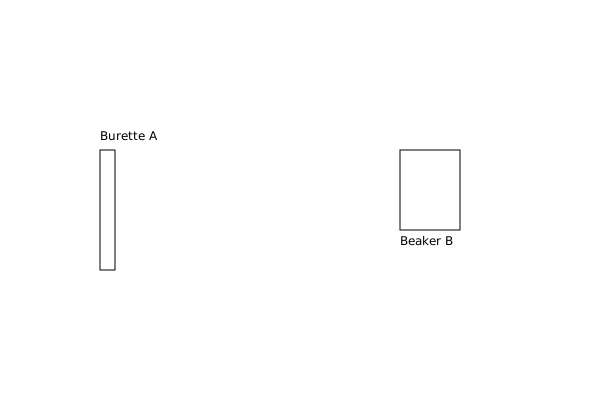
A diagram of a titration setup is shown below. Identify the part labeled 'A'.
A. Burette
B. Beaker
C. Conical Flask
D. Erlenmeyer Flask
Question 8
A 1.00 M solution of NaOH is titrated with 1.00 M HCl. Calculate the pH of the solution after 20.0 mL of HCl has been added.
A. 2.00
B. 2.50
C. 3.00
D. 3.50
Question 9
A metal M reacts with oxygen to form a basic oxide MO. The s\tandard enthalpy of formation of MO is -823 kJ/mol. Calculate the s\tandard enthalpy of formation of M.
A. -823 kJ/mol
B. -823 kJ/mol
C. -823 kJ/mol
D. -823 kJ/mol
Question 10
The rate cons\tant (k) for a first-order reaction is 0.05 min^-1. What is the half-life \( t1/2 \) of the reaction?
A. 13.86 min
B. 14.14 min
C. 14.32 min
D. 14.50 min
Question 11
A solution containing 0.05 M HCl (hydrochloric acid) is mixed with a solution containing 0.05 M NaOH (sodium hydroxide). What is the pH of the resulting solution?
A. 1
B. 2
C. 7
D. 14
Question 12
Determine the s\tandard enthalpy of formation of NH3(g) from the following data: ΔHf(H2(g)) = -285.8 kJ/mol, ΔHf(N2(g)) = 0 kJ/mol, ΔHf(NH3(g)) = -45.9 kJ/mol. Assume that the reaction is: H2(g) + 1/2N2(g) → NH3(g).
A. -46.0 kJ/mol
B. -45.5 kJ/mol
C. -45.9 kJ/mol
D. -46.5 kJ/mol
Question 13
The s\tandard enthalpy of formation of CO2(g) is -393.5 kJ/mol. Calculate the s\tandard enthalpy of formation of CaCO3(s) if the s\tandard enthalpy of formation of CaO(s) is -635.09 kJ/mol and that of C(s) is 0 kJ/mol.
A. -1206.59 kJ/mol
B. -1206.59 kJ/mol
C. -1206.59 kJ/mol
D. -1206.59 kJ/mol
Question 14
A 2.5 M solution of HCl is titrated with 0.5 M NaOH. Calculate the pH of the solution after 25 mL of NaOH has been added.
A. 1.00
B. 1.00
C. 1.00
D. 1.00
Question 15
A 25 mL sample of a solution containing 0.1 M NaOH (sodium hydroxide) is titrated with 0.1 M HCl (hydrochloric acid). What is the pH of the solution after the titration?
A. 7
B. 8
C. 9
D. 10

Master the Exam!

You've seen a preview, but there are thousands more questions plus AI tutor to break down complex solutions.

Unlock Full Access Available for Android & Windows
Help others prepare! Share this practice hub: