POST UTME BELLS UNIVERSITY 2018 Chemistry | Objective

Practice these randomly selected questions to test your readiness.

Question 1
A 10.0 g sample of a compound containing only carbon and hydrogen is analyzed by combustion. If 9.5 g of CO2 and 4.2 g of H2O are produced, what is the empirical formula of the compound?
A. C2H4
B. C3H6
C. C4H8
D. C5H10
Question 2
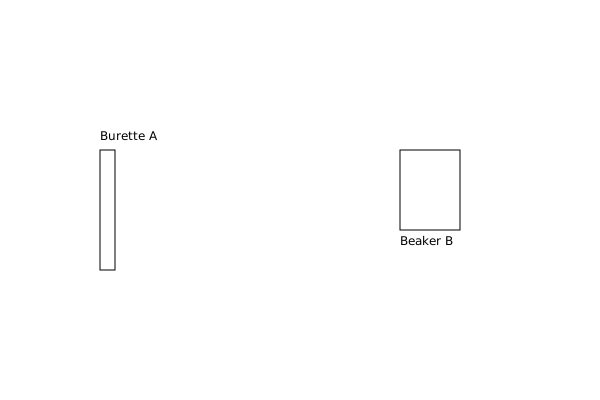
A diagram of a titration setup is shown below. What is the purpose of the burette in this setup?
A. To measure the volume of the titrant.
B. To measure the volume of the analyte.
C. To mix the titrant and analyte.
D. To separate the titrant and analyte.
Question 3
The reaction between sodium hydroxide and hydrochloric acid is represented by the equation: NaOH + HCl → NaCl + H2O. If 25 cm3 of 0.1 M NaOH is added to 25 cm3 of 0.1 M HCl, calculate the number of moles of NaCl produced.
A. 0.005 mol
B. 0.01 mol
C. 0.015 mol
D. 0.02 mol
Question 4
A solution contains 5 g of NaCl per 100 g of water. What is the molarity of the solution?
A. 0.1 M
B. 0.2 M
C. 0.3 M
D. 0.4 M
Question 5
A diagram of a distillation setup is shown below. What is the purpose of the condenser in this setup?
A. To separate the components of the mixture
B. To identify the components of the mixture
C. To measure the concentration of the components
D. To determine the pH of the mixture
Question 6
A solution of 0.1 M NaCl is prepared by dissolving 6.0 g of NaCl in 100 mL of water. What is the concentration of Na+ ions in the solution?
A. 0.01 M
B. 0.1 M
C. 0.5 M
D. 1.0 M
Question 7
The solubility of a subs\tance is defined as the maximum amount of the subs\tance that can dissolve in a given amount of solvent at a particular temperature. What is the term for the minimum amount of solvent required to dissolve a given amount of solute?
A. Critical Micelle Concentration
B. Solubility Limit
C. Minimum Dissolving Solvent
D. Saturated Solution
Question 8
A 2.5 g sample of a metal carbonate is heated to produce a metal oxide and carbon dioxide gas. If the mass of the metal oxide produced is 2.1 g, calculate the percentage yield of the metal oxide.
A. 85%
B. 90%
C. 92%
D. 95%
Question 9
The diagram below shows the atomic structure of an element. Identify the type of bonding that occurs between the atoms.
A. Ionic bonding
B. Covalent bonding
C. Metallic bonding
D. Hydrogen bonding
Question 10
A sample of a polymer is analyzed and found to have a molecular weight of 50,000 g/mol. What is the degree of polymerization of the polymer?
A. 10
B. 50
C. 100
D. 500
Question 11
A 2.0 L flask contains 0.5 mol of an ideal gas at 300 K. If the gas is transferred to a 1.0 L flask at 400 K, what is the new pressure?
A. 2 atm
B. 4 atm
C. 6 atm
D. 8 atm
Question 12
A sample of air contains 20% oxygen, 70% nitrogen, and 10% carbon dioxide by volume. What is the partial pressure of oxygen in the air at 1 atm total pressure?
A. 0.2 atm
B. 0.4 atm
C. 0.6 atm
D. 0.8 atm
Question 13
A polymer has a molecular weight of 50000 g/mol and a degree of polymerization of 200. What is the molar mass of the monomer?
A. \( 250 , \text{g/mol} \)
B. \( 500 , \text{g/mol} \)
C. \( 1000 , \text{g/mol} \)
D. \( 2000 , \text{g/mol} \)
Question 14
A sample of 2.5 g of a subs\tance is dissolved in 50 mL of water. What is the concentration of the solution in g/L?
A. 0.05 g/L
B. 0.1 g/L
C. 0.5 g/L
D. 1 g/L
Question 15
Determine the rate cons\tant (k) for the first-order reaction: ln\( [A]t/[A]0 \) = -kt, given that the initial concentration of A is 0.1 M and the concentration at time t is 0.01 M.
A. \( k = \frac{1}{t} lnleft\( \frac{[A]_0}{[A]_t}\right \ \) )
B. \( k = \frac{1}{[A]_0} lnleft\( \frac{[A]_t}{[A]_0}\right \ \) )
C. \( k = \frac{1}{t} lnleft\( \frac{[A]_t}{[A]_0}\right \ \) )
D. \( k = \frac{1}{[A]_t} lnleft\( \frac{[A]_0}{[A]_t}\right \ \) )

Master the Exam!

You've seen a preview, but there are thousands more questions plus AI tutor to break down complex solutions.

Unlock Full Access Available for Android & Windows
Help others prepare! Share this practice hub: