POST UTME AL-HIKMAH UNIVERSITY 2023 Biology | Objective

Practice these randomly selected questions to test your readiness.

Question 1
A researcher is studying the effects of temperature on the growth rate of a microorganism. The researcher measures the growth rate at different temperatures and plots the data on a graph. What is the likely shape of the graph?
A. A straight line with a positive slope.
B. A curve with a maximum point.
C. A curve with a minimum point.
D. A straight line with a negative slope.
Question 2
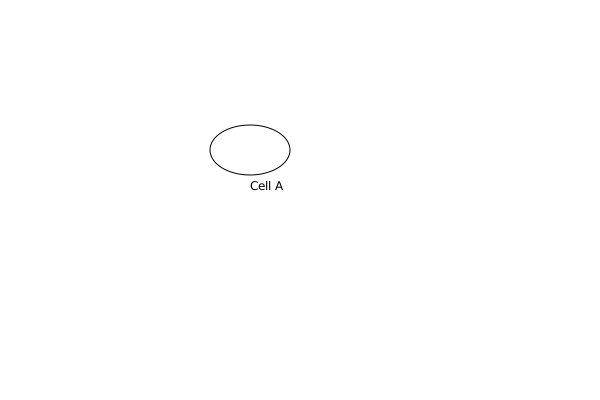
The diagram below shows the structure of a plant cell. What is the function of the cell wall?
A. Provides structural support
B. Regulates the movement of materials in and out of the cell
C. Produces ATP for the cell
D. Stores genetic information
Question 3
A diagram of a simple circuit is shown below. Identify the part labeled 'B'.
A. Resistor
B. Capacitor
C. Inductor
D. Battery
Question 4
In the human circulatory system, the heart pumps blood through a network of blood vessels, including arteries, veins, and capillaries. Which of the following is a function of the capillaries?
A. To carry oxygenated blood from the lungs to the heart
B. To carry deoxygenated blood from the heart to the lungs
C. To exchange oxygen and carbon dioxide between the blood and tissues
D. To regulate blood pressure
Question 5
In a study on the genetic basis of antibiotic resis\tance in bacteria, researchers isolated a strain of E. coli that exhibited high-level resis\tance to ampicillin. The researchers sequenced the bacterial genome and identified a point mutation in the gene encoding the \beta-lactamase enzyme, which is responsible for conferring resis\tance to ampicillin. The mutation resulted in a change from glutamic acid to valine at position 240 of the enzyme. What is the likely effect of this mutation on the enzyme's activity?
A. The mutation will increase the enzyme's activity, leading to increased resis\tance to ampicillin.
B. The mutation will decrease the enzyme's activity, leading to decreased resis\tance to ampicillin.
C. The mutation will have no effect on the enzyme's activity.
D. The mutation will alter the enzyme's substrate specificity, leading to increased resis\tance to other antibiotics.
Question 6
A diagram of a plant cell is shown below. What is the function of the cell wall?
A. To provide structural support to the cell
B. To regulate the movement of materials in and out of the cell
C. To produce energy for the cell
D. To synthesize proteins for the cell
Question 7
In the context of hormonal coordination, what is the primary function of the hypothalamus in regulating the pituitary gland?
A. To produce hormones that stimulate the pituitary gland
B. To produce hormones that inhibit the pituitary gland
C. To regulate the release of hormones from the pituitary gland
D. To produce hormones that stimulate the thyroid gland
Question 8
In the context of excretion and osmoregulation, what is the primary function of the kidneys?
A. To regulate the amount of water in the body
B. To regulate the amount of electrolytes in the body
C. To regulate the amount of waste products in the body
D. To regulate the amount of blood pressure in the body
Question 9
The genetic code is a set of rules that translates nucleotide sequences into:
A. Proteins
B. DNA
C. RNA
D. Enzymes
Question 10
The process of meiosis results in the production of four haploid cells, each with half the number of chromosomes as the parent cell. What is the term for this reduction in chromosome number?
A. Mitosis
B. Meiosis
C. Haploidization
D. Diploidization
Question 11
A 10.0 mL sample of a solution containing 0.5 M NaCl is added to 50.0 mL of water. What is the concentration of the resulting solution?
A. 0.1 M
B. 0.2 M
C. 0.3 M
D. 0.4 M
Question 12
The process by which the nervous system coordinates the contraction and relaxation of muscles to produce movement is known as
A. Reflex Action
B. Muscle Tone
C. Motor Control
D. Proprioception
Question 13
The diagram below shows the structure of a neuron. What is the function of the d\endrites?
A. Receive signals from other neurons
B. Transmit signals to other neurons
C. Produce ATP for the neuron
D. Store genetic information
Question 14
The sense organ responsible for detecting changes in sound pressure is known as the
A. Eye
B. Ear
C. Nose
D. Mouth
Question 15
In a eukaryotic cell, the process of mitosis involves the division of the nucleus into two daughter nuclei, each containing the same number and type of chromosomes as the parent nucleus. Which of the following stages of mitosis is characterized by the condensation of chromosomes and the formation of the metaphase plate?
A. Prophase
B. Metaphase
C. Anaphase
D. Telophase

Master the Exam!

You've seen a preview, but there are thousands more questions plus AI tutor to break down complex solutions.

Unlock Full Access Available for Android & Windows
Help others prepare! Share this practice hub: