POST UTME AFE BABALOLA UNIVERSITY 2019 General Studies | Objective

Practice these randomly selected questions to test your readiness.

Question 1
The concept of 'separation of powers' in the Nigerian Constitution is based on which of the following principles?
A. Federalism
B. Unitarism
C. Confederalism
D. Separation of Powers
Question 2
The diagram below shows a simple harmonic motion. What is the phase angle of the motion?
A.
B. 30°
C. 60°
D. 90°
Question 3
A diagram of a simple mechanical system is shown below.
A. The system is in equilibrium
B. The system is in motion
C. The system is a combination of equilibrium and motion
D. The system is not a valid system
Question 4
The diagram below shows the structure of a typical Nigerian government.
A. The government is a federal system.
B. The government is a unitary system.
C. The government is a parliamentary system.
D. All of the above.
Question 5
The diagram below shows the structure of a typical Nigerian economy.
Question 6
The 1999 Constitution of Nigeria provides for the creation of which of the following types of local government?
A. Local Government Areas (LGAs)
B. State Governments
C. Federal Capital Territory (FCT)
D. Traditional Rulers
Question 7
The 1979 Constitution of Nigeria established a presidential system of government. Which of the following is a characteristic of this system?
A. Separation of powers between the executive, legislative, and judicial branches
B. A parliamentary system with a prime minister as head of government
C. A federal system with a strong central government
D. A unitary system with a weak central government
Question 8
The Niger Delta region is rich in which of the following natural resources?
A. Oil
B. Natural Gas
C. Coal
D. Iron Ore
Question 9
The diagram below shows the structure of a typical Nigerian savanna ecosystem. Which of the following organisms is a primary consumer?
A. Herbivore
B. Carnivore
C. Decomposer
D. Primary Producer
Question 10
The United Nations (UN) has which of the following as its main goals?
A. To promote peace and security worldwide.
B. To eradicate poverty and hunger.
C. To protect the environment.
D. All of the above.
Question 11
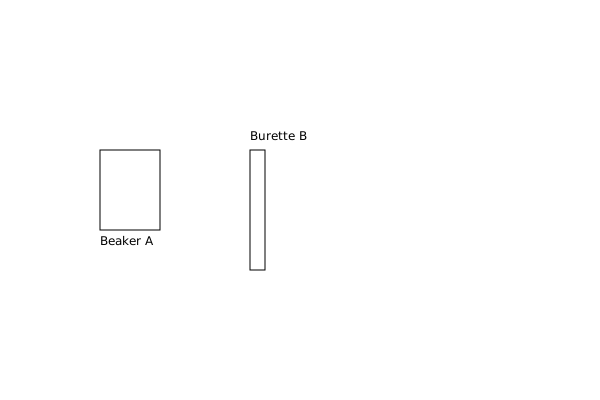
The diagram below shows a simple titration setup.
A. The setup is used to determine the concentration of a solution
B. The setup is used to determine the pH of a solution
C. The setup is used to determine the volume of a solution
D. The setup is used to determine the temperature of a solution
Question 12
The diagram below shows the structure of a typical Nigerian family.
A. The family is a nuclear family.
B. The family is an extended family.
C. The family has a matriarchal structure.
D. The family has a patriarchal structure.
Question 13
A diagram of a simple electric circuit is shown below.
A. The circuit is a series circuit
B. The circuit is a parallel circuit
C. The circuit is a combination of series and parallel circuits
D. The circuit is not a valid circuit
Question 14
The concept of 'checks and balances' in the Nigerian political system is primarily aimed at?
A. Preventing the concentration of power in the hands of the President
B. Ensuring that the National Assembly has absolute power over the Executive
C. Providing a framework for the peaceful transfer of power
D. Promoting the unity and stability of Nigeria
Question 15
The 1999 Constitution of the Federal Republic of Nigeria is a product of which of the following processes?
A. Military Rule
B. Constitutional Conference
C. National Assembly
D. Executive Decree

Master the Exam!

You've seen a preview, but there are thousands more questions plus AI tutor to break down complex solutions.

Unlock Full Access Available for Android & Windows
Help others prepare! Share this practice hub: