POST UTME ABU 2022 Chemistry | Objective

Practice these randomly selected questions to test your readiness.

Question 1
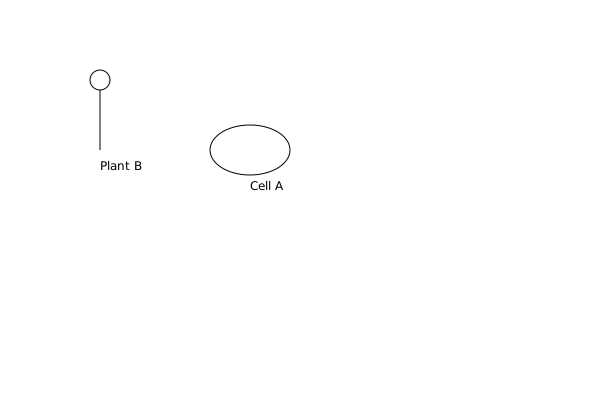
A diagram of a plant cell is shown below. Identify the part labeled A.
A. Mitochondria
B. Chloroplast
C. Nucleus
D. Vacuole
Question 2
The s\tandard enthalpy of formation of CO2(g) is -393.5 kJ/mol. Calculate the s\tandard enthalpy of formation of CO(g) if the s\tandard enthalpy of formation of H2O(l) is -285.8 kJ/mol.
A. -110.5 kJ/mol
B. +110.5 kJ/mol
C. -130.5 kJ/mol
D. +130.5 kJ/mol
Question 3
A metal M \( atomic mass 50 g/mol \) reacts with HCl to form a compound MCl2. If 2.5 g of M is reacted with 10 mL of 1 M HCl, what is the mass of the unreacted HCl?
A. 0.5 g
B. 1 g
C. 1.5 g
D. 2 g
Question 4
A 2 M solution of sodium hydroxide (NaOH) is mixed with a 1 M solution of hydrochloric acid (HCl). What is the pH of the resulting solution?
A. 10
B. 7
C. 9
D. 14
Question 5
The rate cons\tant (k) for a first-order reaction is 0.05 min^-1. If the initial concentration of the reac\tant is 0.1 M, what is the concentration after 10 minutes?
A. 0.01 M
B. 0.05 M
C. 0.1 M
D. 0.2 M
Question 6
A 0.5 M solution of sulfuric acid (H2SO4) is mixed with a 0.2 M solution of sodium hydroxide (NaOH). What is the concentration of the resulting solution?
A. 0.3 M
B. 0.4 M
C. 0.5 M
D. 0.6 M
Question 7
The half-life of a radioactive subs\tance is 5 years. If the initial amount of the subs\tance is 100 g, what is the amount remaining after 10 years?
A. 50 g
B. 25 g
C. 12.5 g
D. 6.25 g
Question 8
A 0.1 M solution of NaOH is titrated with 0.1 M HCl. Calculate the pH of the solution after 25 mL of HCl has been added.
A. 1
B. 2
C. 3
D. 4
Question 9
A metal (M) reacts with oxygen to form a basic oxide. The reaction is as follows: 4M + 3O2 → 2M2O3. If 2 moles of M react with 3 moles of O2, what is the mass of M2O3 formed?
A. 100 g
B. 200 g
C. 50 g
D. 150 g
Question 10
A 2.5 L flask contains 0.5 mol of an ideal gas at 25°C. Calculate the pressure of the gas.
A. 1.5 atm
B. 2.5 atm
C. 3.5 atm
D. 4.5 atm
Question 11
The s\tandard enthalpy of formation of CO2(g) is -393.5 kJ/mol. Calculate the s\tandard enthalpy of formation of CO(g) if the s\tandard enthalpy of formation of O2(g) is 0 kJ/mol.
A. -110.5 kJ/mol
B. -110.5 kJ/mol
C. -110.5 kJ/mol
D. -110.5 kJ/mol
Question 12
A 1.00 M solution of HCl is mixed with a 1.00 M solution of NaOH. What is the pH of the resulting solution?
A. 1.00
B. 2.00
C. 3.00
D. 4.00
Question 13
The s\tandard enthalpy of formation of CO2(g) is -393.5 kJ/mol. What is the s\tandard enthalpy of formation of CO(g)?
A. -110.5 kJ/mol
B. -110.5 kJ/mol
C. -110.5 kJ/mol
D. -110.5 kJ/mol
Question 14
The reaction of sulfur with oxygen to form sulfur dioxide is an example of a redox reaction. What is the oxidation state of sulfur in the reac\tant and product?
A. S: +4, SO2: +4
B. S: 0, SO2: +4
C. S: +4, SO2: 0
D. S: 0, SO2: 0
Question 15
The s\tandard enthalpy of formation of CO2(g) is -393.5 kJ/mol. Calculate the s\tandard enthalpy of formation of CaCO3(s) u\sing the following reaction: CaO(s) + CO2(g) → CaCO3(s).
A. -1793.5 kJ/mol
B. -1793.5 kJ/mol
C. -1793.5 kJ/mol
D. -1793.5 kJ/mol

Master the Exam!

You've seen a preview, but there are thousands more questions plus AI tutor to break down complex solutions.

Unlock Full Access Available for Android & Windows
Help others prepare! Share this practice hub: