neco model questions vol1 2025 physics | Objective

Prepare for your exams with neco model questions vol1 questions? Reviewing past/model questions is one of the most effective ways to guarantee a high score. This practice hub features authentic 2025 physics (Objective) questions designed to simulate the real exam environment.

Practice these randomly selected questions to test your readiness.

Question 1 View Details
A \(2.0\ \text{L}\) sealed container holds an ideal gas at a pressure of \(1.00\ \text{atm}\) and a temperature of \(300\ \text{K}\). The gas is first compressed isothermally to a volume of \(1.2\ \text{L}\) and then heated at constant volume to \(350\ \text{K}\). What is the final pressure of the gas in atm? Give your answer to three significant figures.
A. 1.20 atm
B. 2.10 atm
C. 1.68 atm
Correct D. 1.94 atm

Correct Answer: D

Want to see the full step-by-step solution? Unlock AI Explanation & Analytics
Question 2 View Details
A sample contains \(5.0\times10^{12}\) atoms of a radionuclide whose half‑life is \(8.0\ \text{h}\). Each decay emits a beta particle of kinetic energy \(0.5\ \text{MeV}\). After \(24\ \text{h}\) the sample is placed near a detector that records \(2.0\times10^{5}\) counts per minute. The detector efficiency is 25 % and every decay produces a detectable beta. (a) Determine the activity of the sample at the start of the \(24\ \text{h}\) period in becquerels (Bq). (b) Calculate the total energy released during the \(24\ \text{h}\) period in joules. Give your answers in scientific notation with two significant figures.
A. 1.3×10^5 Bq; 3.5×10^-4 J
B. 1.1×10^5 Bq; 2.5×10^-4 J
C. 9.5×10^4 Bq; 2.8×10^-4 J
Correct D. 1.1×10^5 Bq; 3.1×10^-4 J

Correct Answer: D

Want to see the full step-by-step solution? Unlock AI Explanation & Analytics
Question 3 View Details
A \(5.0\ \text{kg}\) block is released from rest at the top of a \(30^{\circ}\) incline that is \(8.0\ \text{m}\) long. The coefficient of kinetic friction between the block and the incline is \(0.15\). (a) Find the speed of the block at the bottom of the incline. (b) Determine the average power delivered by the block's weight during the descent. (c) If a motor raises the block back to the top at constant speed in \(4.0\ \text{s}\), what power must the motor supply? Give all answers to three significant figures.
A. 6.9 m/s; 1.05×10^2 W; 6.50×10^1 W
B. 7.2 m/s; 9.00×10^1 W; 5.80×10^1 W
Correct C. 7.6 m/s; 9.33×10^1 W; 6.18×10^1 W
D. 8.1 m/s; 9.00×10^1 W; 5.90×10^1 W

Correct Answer: C

Want to see the full step-by-step solution? Unlock AI Explanation & Analytics
Question 4 View Details
200 g of water at \(80^{\circ}\text{C}\) is mixed with 100 g of ice at \(-10^{\circ}\text{C}\). The mixture is placed in an insulated container and heated by a \(60\ \text{W}\) electric heater for \(5\) min. Specific heat capacities are \(c_{\text{water}}=4.18\ \text{J g}^{-1}\text{K}^{-1}\), \(c_{\text{ice}}=2.09\ \text{J g}^{-1}\text{K}^{-1}\), and the latent heat of fusion of ice is \(L_f=334\ \text{J g}^{-1}\). Assuming no heat loss to the surroundings, determine the final temperature of the system in degrees Celsius, to one decimal place.
A. 17.8 °C
Correct B. 15.0 °C
C. 12.5 °C
D. 20.3 °C

Correct Answer: B

Want to see the full step-by-step solution? Unlock AI Explanation & Analytics
Question 5 View Details
A movable pulley supports a load of \(200\ \text{N}\). The rope passes over a frictionless fixed pulley and is pulled by a person at constant speed. The movable pulley has an efficiency of 85 % because of bearing friction. (a) What is the tension in each rope segment that directly supports the load? (b) What force must the person apply to the free end of the rope? (c) If the person pulls the rope with a speed of \(0.50\ \text{m\ s}^{-1}\), what is the mechanical power output of the system? Give your answers to three significant figures.
A. 95 N; 1.10×10^2 N; 4.5×10^1 W
B. 105 N; 1.25×10^2 N; 5.5×10^1 W
Correct C. 100 N; 1.18×10^2 N; 5.0×10^1 W
D. 90 N; 1.00×10^2 N; 4.0×10^1 W

Correct Answer: C

Want to see the full step-by-step solution? Unlock AI Explanation & Analytics
Question 6 View Details
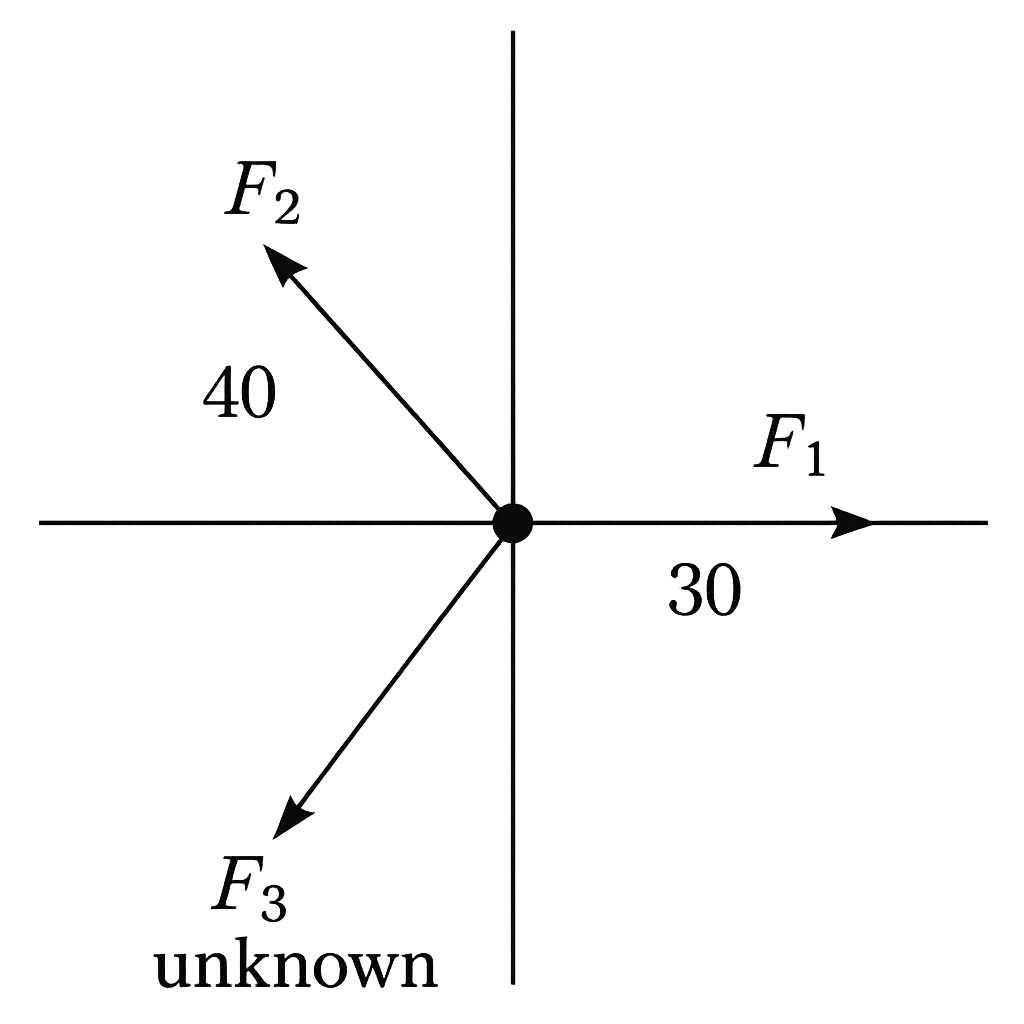
A particle is acted upon by three coplanar forces as shown in the diagram. Force \(F_{1}=30\text{ N}\) acts horizontally to the right (\(0^{\circ}\)). Force \(F_{2}=40\text{ N}\) acts at \(120^{\circ}\) measured anticlockwise from the positive x‑axis. The third force \(F_{3}\) acts at an angle of \(254^{\circ}\) and its magnitude is unknown. If the particle is in equilibrium, determine the magnitude of \(F_{3}\).
A. 10\sqrt{7}\ \text{N}
Correct B. 10\sqrt{13}\ \text{N}
C. 5\sqrt{13}\ \text{N}
D. 12\sqrt{13}\ \text{N}

Correct Answer: B

Want to see the full step-by-step solution? Unlock AI Explanation & Analytics
Question 7 View Details
A rectangular coil of \(N=200\) turns and area \(A=0.01\ \text{m}^{2}\) rotates uniformly in a uniform magnetic field. The coil makes 5 revolutions in 2 s and the maximum induced emf observed is \(0.5\ \text{V}\). (a) Determine the magnetic field strength \(B\). (b) If the coil is connected to a resistor of \(R=10\ \Omega\), calculate the average power dissipated in the resistor over one full rotation.
A. B = \frac{1}{20\pi}\ \text{T} \;(\approx0.0159\ \text{T});\; P_{\rm avg}=0.025\ \text{W}
B. B = \frac{1}{10\pi}\ \text{T} \;(\approx0.0318\ \text{T});\; P_{\rm avg}=0.025\ \text{W}
Correct C. B = \frac{1}{20\pi}\ \text{T} \;(\approx0.0159\ \text{T});\; P_{\rm avg}=0.0125\ \text{W}
D. B = \frac{1}{40\pi}\ \text{T} \;(\approx0.00796\ \text{T});\; P_{\rm avg}=0.00625\ \text{W}

Correct Answer: C

Want to see the full step-by-step solution? Unlock AI Explanation & Analytics
Question 8 View Details
Two vectors \(\mathbf{A}\) and \(\mathbf{B}\) have magnitudes \(|\mathbf{A}|=8\) units and \(|\mathbf{B}|=6\) units respectively, and the angle between them is \(60^{\circ}\). Find (a) the magnitude of the resultant vector \(\mathbf{R}=\mathbf{A}+\mathbf{B}\) and (b) the angle that \(\mathbf{R}\) makes with \(\mathbf{A}\).
Correct A. Resultant magnitude = 2\sqrt{37}\ (≈12.2) units; direction ≈25.3^{\circ} above \mathbf{A}
B. Resultant magnitude = 2\sqrt{30}\ (≈10.95) units; direction ≈15^{\circ} above \mathbf{A}
C. Resultant magnitude = \sqrt{200}\ (≈14.1) units; direction ≈40^{\circ} above \mathbf{A}
D. Resultant magnitude = \sqrt{150}\ (≈12.2) units; direction ≈35^{\circ} above \mathbf{A}

Correct Answer: A

Want to see the full step-by-step solution? Unlock AI Explanation & Analytics
Question 9 View Details
An electron in a hydrogen atom drops from the \(n=5\) level to the \(n=2\) level, emitting a photon. (a) Calculate the wavelength of the emitted photon using the Rydberg constant \(R_{H}=1.097\times10^{7}\ \text{m}^{-1}\). (b) Determine the energy of the photon in electron‑volts and state whether this photon has enough energy to ionise a hydrogen atom (ionisation energy \=13.6\ \text{eV}).
A. λ ≈ 300\ nm; photon energy ≈ 4.13\ eV; insufficient to ionise hydrogen.
Correct B. λ ≈ 434\ nm; photon energy ≈ 2.86\ eV; insufficient to ionise hydrogen.
C. λ ≈ 500\ nm; photon energy ≈ 2.48\ eV; insufficient to ionise hydrogen.
D. λ ≈ 410\ nm; photon energy ≈ 3.02\ eV; insufficient to ionise hydrogen.

Correct Answer: B

Want to see the full step-by-step solution? Unlock AI Explanation & Analytics
Question 10 View Details
Two harmonic waves travel in the same direction along a string and are described by \(y_{1}=3\sin(kx-\omega t)\) and \(y_{2}=4\sin(kx-\omega t+60^{\circ})\). Find (a) the amplitude of the resultant wave obtained by superposition, and (b) the ratio of the intensity of the resultant wave to the intensity of the first wave alone.
A. Resultant amplitude = \\sqrt{41}\\ (≈6.40); intensity ratio = 41/9 ≈ 4.56
B. Resultant amplitude = \\sqrt{25}\\ (≈5); intensity ratio = 25/9 ≈ 2.78
C. Resultant amplitude = \\sqrt{33}\\ (≈5.74); intensity ratio = 33/9 ≈ 3.67
Correct D. Resultant amplitude = \sqrt{37}\ (≈6.08); intensity ratio = 37/9 ≈ 4.11

Correct Answer: D

Want to see the full step-by-step solution? Unlock AI Explanation & Analytics
Question 11 View Details
A block of mass (5\ \text{kg}\) rests on a smooth wedge that makes an angle of (30^{\circ}\) with the horizontal. The wedge is accelerated horizontally to the right such that the block remains at rest relative to the wedge. Determine the magnitude of the horizontal acceleration of the wedge in \(\text{m s}^{-2}\) (give your answer to two decimal places).
A. 4.33
B. 3.33
Correct C. 5.66
D. 6.93

Correct Answer: C

Want to see the full step-by-step solution? Unlock AI Explanation & Analytics
Question 12 View Details
A train moving towards a stationary observer emits a horn of frequency \(500\ \text{Hz}\). The observer hears a frequency of \(540\ \text{Hz}\). If the speed of sound in air is \(340\ \text{m s}^{-1}\), calculate the speed of the train in \(\text{m s}^{-1}\) (to one decimal place).
A. 28.7
Correct B. 25.2
C. 30.0
D. 22.5

Correct Answer: B

Want to see the full step-by-step solution? Unlock AI Explanation & Analytics
Question 13 View Details
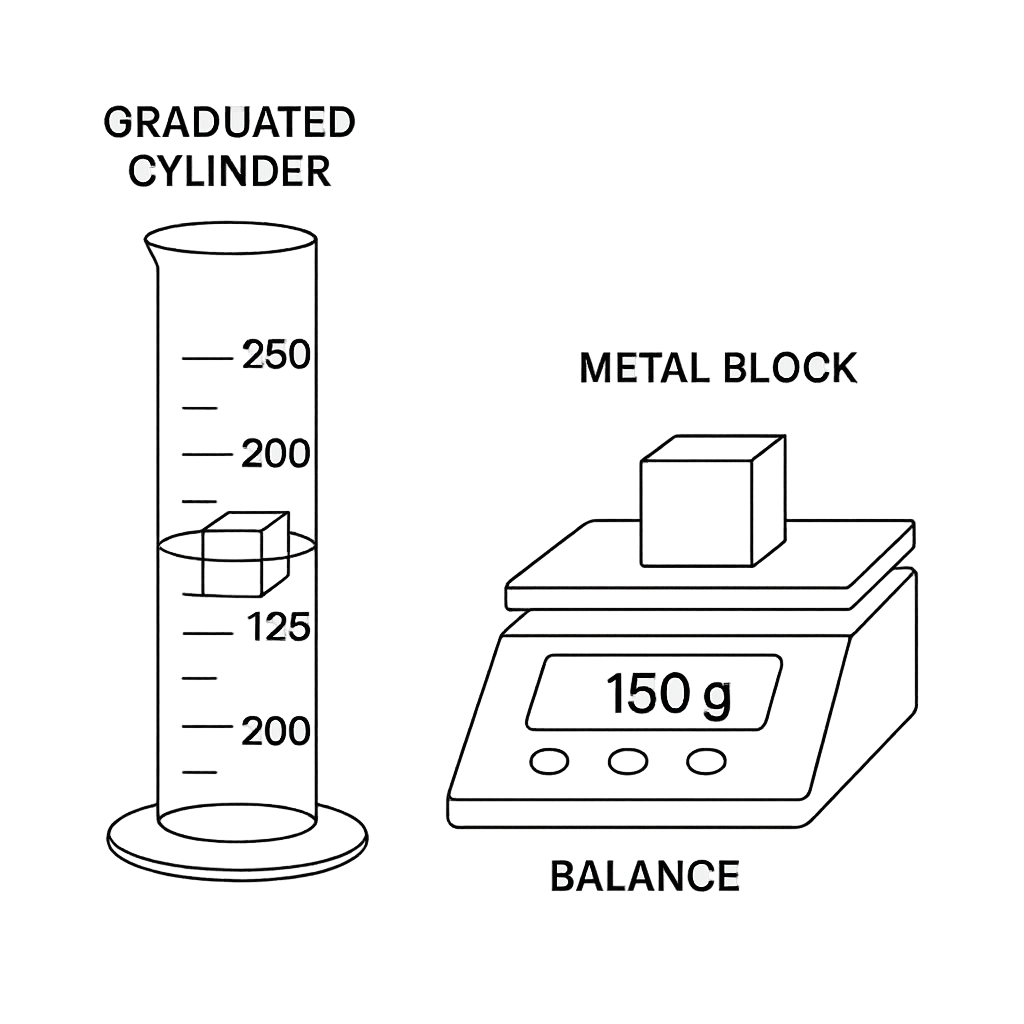
In the laboratory setup shown, a metal block is weighed on a balance and found to have a mass of \(150\ \text{g}\). When the block is immersed in a graduated cylinder containing water, the water level rises from \(200\ \text{mL}\) to \(225\ \text{mL}\). Using the diagram, determine the density of the metal block in \(\text{g cm}^{-3}\).
A. 7.5
B. 5
C. 4.2
Correct D. 6

Correct Answer: D

Want to see the full step-by-step solution? Unlock AI Explanation & Analytics
Question 14 View Details
A \(8\ \text{kg}\) block rests on a horizontal frictional table and is attached by a light string over a frictionless pulley to a hanging \(5\ \text{kg}\) mass. The system accelerates such that the hanging mass moves downward with an acceleration of \(0.5\ \text{m s}^{-2}\). Calculate the coefficient of kinetic friction between the block and the table (give your answer to two decimal places).
A. 0.60
B. 0.72
C. 0.45
Correct D. 0.54

Correct Answer: D

Want to see the full step-by-step solution? Unlock AI Explanation & Analytics
Question 15 View Details
A radioactive isotope \(A\) decays to isotope \(B\) with a half‑life of \(30\ \text{min}\). Isotope \(B\) further decays to a stable isotope \(C\) with a half‑life of \(10\ \text{min}\). Initially the sample contains \(1.0\times10^{6}\) atoms of \(A\) and none of \(B\). After exactly \(1\ \text{hour}\), how many atoms of \(B\) are present? (Give your answer as an integer, rounding to the nearest whole atom.)
A. 100000
Correct B. 117150
C. 80000
D. 150000

Correct Answer: B

Want to see the full step-by-step solution? Unlock AI Explanation & Analytics
Question 16 View Details
A glass prism has an apex angle of \(60^{\circ}\). When a ray of monochromatic light of wavelength \(600\ \text{nm}\) passes through the prism, the angle of minimum deviation is measured to be \(40^{\circ}\). (i) Determine the refractive index \(n\) of the glass. (ii) Using this value of \(n\), calculate the critical angle for total internal reflection at the glass-air interface.
A. n = 1.48, \theta_c = 42.0^{\circ}
B. n = 1.60, \theta_c = 38.7^{\circ}
Correct C. n = 1.53, \theta_c = 40.8^{\circ}
D. n = 1.53, \theta_c = 45.0^{\circ}

Correct Answer: C

Want to see the full step-by-step solution? Unlock AI Explanation & Analytics
Question 17 View Details
Three point charges are placed on a straight line. Charge \(q_{1}=+2\ \mu\text{C}\) is at the origin, \(q_{2}=-5\ \mu\text{C}\) is at \(x=0.10\ \text{m}\), and \(q_{3}=+3\ \mu\text{C}\) is at \(x=0.20\ \text{m}\). (i) Find the position(s) on the line where the net electric field is zero. (ii) Compute the electric potential at that position due to all three charges. Use \(k=9.0\times10^{9}\ \text{N·m}^{2}\!\!/\text{C}^{2}\).
Correct A. x = 0.157 m, V = -4.7×10^4 V
B. x = 0.157 m, V = -5.0\times10^4 V
C. x = 0.200 m, V = -5.2\times10^4 V
D. x = 0.125 m, V = -3.9\times10^4 V

Correct Answer: A

Want to see the full step-by-step solution? Unlock AI Explanation & Analytics
Question 18 View Details
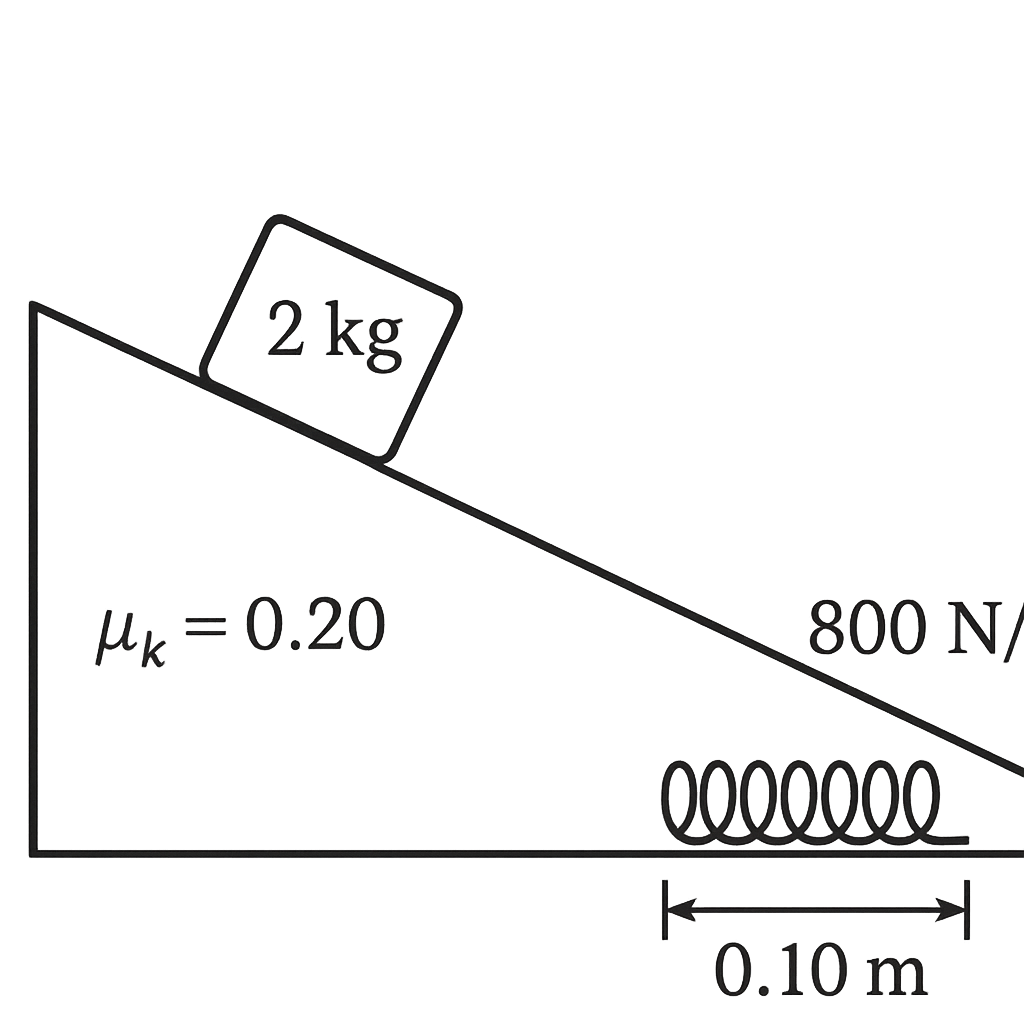
An inclined plane makes an angle of \(30^{\circ}\) with the horizontal. A block of mass \(m=2.0\ \text{kg}\) starts from rest at the top of the plane, which is \(5.0\ \text{m}\) long. The coefficient of kinetic friction between the block and the plane is \(\mu_{k}=0.20\). At the bottom of the plane a horizontal spring of force constant \(k=800\ \text{N·m}^{-1}\) is attached to the block. The block compresses the spring by \(x=0.10\ \text{m}\) as it moves down the plane. (i) Determine the speed of the block when the spring is compressed by \(0.10\ \text{m}\).
A. v ≈ 4.1 m/s
B. v ≈ 6.0 m/s
C. v ≈ 3.9 m/s
Correct D. v \approx 5.3 m/s

Correct Answer: D

Want to see the full step-by-step solution? Unlock AI Explanation & Analytics
Question 19 View Details
A biconvex lens is made of glass with refractive index \(n_{\text{glass}}=1.50\). Its radii of curvature are \(R_{1}=+15\ \text{cm}\) and \(R_{2}=-20\ \text{cm}\) (sign convention: convex surface facing the object is positive). (i) When the lens is immersed in water (\(n_{\text{water}}=1.33\)), determine its focal length in water. (ii) When the same lens is used in air, find its focal length in air, and then determine the image distance and magnification for an object placed \(40\ \text{cm}\) from the lens in air.
Correct A. f_water ≈ 67 cm; f_air ≈ 17.1 cm; image distance v ≈ 30 cm; magnification m = -0.75
B. f_water ≈ 72 cm; f_air ≈ 18.3 cm; image distance v ≈ 32 cm; magnification m = -0.80
C. f_water ≈ 55 cm; f_air ≈ 14.0 cm; image distance v ≈ 26 cm; magnification m = -0.65
D. f_water ≈ 60 cm; f_air ≈ 15.5 cm; image distance v ≈ 28 cm; magnification m = -0.70

Correct Answer: A

Want to see the full step-by-step solution? Unlock AI Explanation & Analytics
Question 20 View Details
A source emits a sound of frequency \(f_{1}=800\ \text{Hz}\). An observer moves directly towards this source with speed \(v_{o}=10\ \text{m s}^{-1}\). The speed of sound in air is \(v=340\ \text{m s}^{-1}\). At the same time, a second stationary source located \(30\ \text{m}\) behind the observer emits sound of frequency \(f_{2}=820\ \text{Hz}\). (i) Find the frequencies heard by the observer from each source. (ii) Determine the beat frequency produced by the superposition of the two received sounds.
A. f'1 ≈ 830 Hz, f'2 ≈ 790 Hz, beat frequency ≈ 40 Hz
B. f'1 ≈ 818 Hz, f'2 ≈ 803 Hz, beat frequency ≈ 15 Hz
C. f'1 ≈ 824 Hz, f'2 ≈ 820 Hz, beat frequency ≈ 4 Hz
Correct D. f'1 ≈ 824 Hz, f'2 ≈ 797 Hz, beat frequency ≈ 27 Hz

Correct Answer: D

Want to see the full step-by-step solution? Unlock AI Explanation & Analytics
Question 21 View Details
A metal container of mass \(0.5\ \text{kg}\) and specific heat capacity \(0.9\ \text{kJ\,kg}^{-1}\text{K}^{-1}\) contains \(2.0\ \text{kg}\) of water at \(20^{\circ}\text{C}\). The container is placed on a stove that supplies \(500\ \text{kJ}\) of heat, but \(15\%\) of the supplied heat is lost to the surroundings. Assuming the container and the water reach the same final temperature, what is the final temperature of the water (to the nearest \(0.1^{\circ}\text{C}\))?
Correct A. 68.2 °C
B. 73.1 °C
C. 65.0 °C
D. 70.5 °C

Correct Answer: A

Want to see the full step-by-step solution? Unlock AI Explanation & Analytics
Question 22 View Details
A sealed rigid container holds \(0.8\ \text{mol}\) of an ideal gas at \(27^{\circ}\text{C}\) and a pressure of \(1.2\ \text{atm}\). The gas is heated at constant volume until its pressure rises to \(2.0\ \text{atm}\). Then a movable piston is attached and the gas expands isobarically until its temperature reaches \(350\ \text{K}\). What is the final volume of the gas in litres (to one decimal place)?
A. 13.8 L
B. 10.2 L
C. 9.5 L
Correct D. 11.5 L

Correct Answer: D

Want to see the full step-by-step solution? Unlock AI Explanation & Analytics
Question 23 View Details
A rectangular conducting loop of resistance \(2\ \Omega\) has dimensions \(0.10\ \text{m}\) (width) by \(0.20\ \text{m}\) (length). It is pulled at constant speed into a uniform magnetic field of magnitude \(0.5\ \text{T}\) directed into the page. The loop is initially completely outside the field and becomes fully inside after \(0.4\ \text{s}\). Determine (a) the speed of the loop, (b) the magnitude of the induced current while the loop is partially inside, (c) the magnetic force acting on the loop during this interval, and (d) the mechanical power required to pull the loop at constant speed. Give your answers in SI units, using appropriate significant figures.
Correct A. v = 0.5 m/s; I = 0.0125 A; F = 1.25×10⁻³ N; P = 6.3×10⁻⁴ W
B. v = 0.5 m/s; I = 0.0125 A; F = 2.0×10⁻³ N; P = 8.0×10⁻⁴ W
C. v = 0.6 m/s; I = 0.015 A; F = 1.5×10⁻³ N; P = 7.5×10⁻⁴ W
D. v = 0.4 m/s; I = 0.010 A; F = 1.0×10⁻³ N; P = 5.0×10⁻⁴ W

Correct Answer: A

Want to see the full step-by-step solution? Unlock AI Explanation & Analytics
Question 24 View Details
A block of mass \(12\ \text{kg}\) is lifted vertically by a rope that passes over a fixed pulley of radius \(0.15\ \text{m}\). The pulley's axle has a bearing that exerts a constant frictional torque of \(0.30\ \text{N·m}\) opposing rotation. The system raises the block at constant speed. If the rope is pulled with a force \(F\), (a) find the magnitude of \(F\) required, and (b) calculate the overall mechanical efficiency of the system (output work divided by input work). Take \(g = 9.8\ \text{m s}^{-2}\).
A. F = 119.6 N; efficiency ≈ 90 %
B. F = 115 N; efficiency ≈ 95 %
C. F = 124 N; efficiency ≈ 99 %
Correct D. F = 119.6 N; efficiency ≈ 98 %

Correct Answer: D

Want to see the full step-by-step solution? Unlock AI Explanation & Analytics
Question 25 View Details
A force of \(30\ \text{N}\) acts at \(40^{\circ}\) north of east, and a second force of \(40\ \text{N}\) acts at \(30^{\circ}\) south of east. Determine the magnitude of the resultant force (to one decimal place) and its direction expressed as an angle south of east (to one decimal place).
A. 57.6 N, 5.0° south of east
B. 61.2 N, 2.5° south of east
Correct C. 57.6 N, 0.7° south of east
D. 53.4 N, 1.3° south of east

Correct Answer: C

Want to see the full step-by-step solution? Unlock AI Explanation & Analytics

Master the Exam!

You've seen a preview, but there are thousands more questions plus AI tutor to break down complex solutions.

Unlock Full Access Available for Android & Windows
Help others prepare! Share this practice hub:
Chat with Support