neco model questions vol1 2025 mathematics | Essay

Prepare for your exams with neco model questions vol1 questions? Reviewing past/model questions is one of the most effective ways to guarantee a high score. This practice hub features authentic 2025 mathematics (Essay) questions designed to simulate the real exam environment.

Practice these randomly selected questions to test your readiness.

Question 1 View Details
A positive integer N satisfies the following conditions: (i) when divided by 7 the remainder is 3; (ii) when divided by 9 the remainder is 5; (iii) N is a three‑digit number whose digits are in strictly increasing order.
Question Parts
(a)
Determine the smallest possible value of N.
(b)
Find the sum of the digits of N.
(c)
If N = 100a + 10b + c, where a, b, c are its digits, determine the value of a × b × c.
Detailed Essay Solution & Marking Scheme Available

Get the step-by-step mathematical proofs, key points required by examiners, and a comprehensive breakdown from our AI Tutor.
Question 2 View Details
A shopkeeper bought a batch of 120 identical items at a total cost of ₦18,000. He sold some of the items at a profit of 20 % on the cost price per item and the remaining items at a loss of 10 % on the cost price per item. The overall profit on the whole batch was 8 %.
Question Parts
(a)
Determine how many items were sold at a profit.
(b)
Find the selling price per item for the profit sales and for the loss sales (in ₦).
(c)
Verify that the overall profit is indeed 8 % by calculating the total revenue.
Detailed Essay Solution & Marking Scheme Available

Get the step-by-step mathematical proofs, key points required by examiners, and a comprehensive breakdown from our AI Tutor.
Question 3 View Details
The number of bacteria in a culture after t hours is given by \[ Q = \frac{3\,2^{t}}{\sqrt{2^{\,t+2}}} \] where Q is the population (in millions).
Question Parts
(a)
Simplify the expression for Q so that it is written as \( Q = k\,2^{m}\) where k is a rational number and m is expressed in terms of t.
(b)
If the population after t hours is 24 million, determine the value of t (in hours) correct to two decimal places.
(c)
Find the initial population (at t = 0) and comment on whether the bacteria are increasing or decreasing with time.
Detailed Essay Solution & Marking Scheme Available

Get the step-by-step mathematical proofs, key points required by examiners, and a comprehensive breakdown from our AI Tutor.

Question 4 View Details
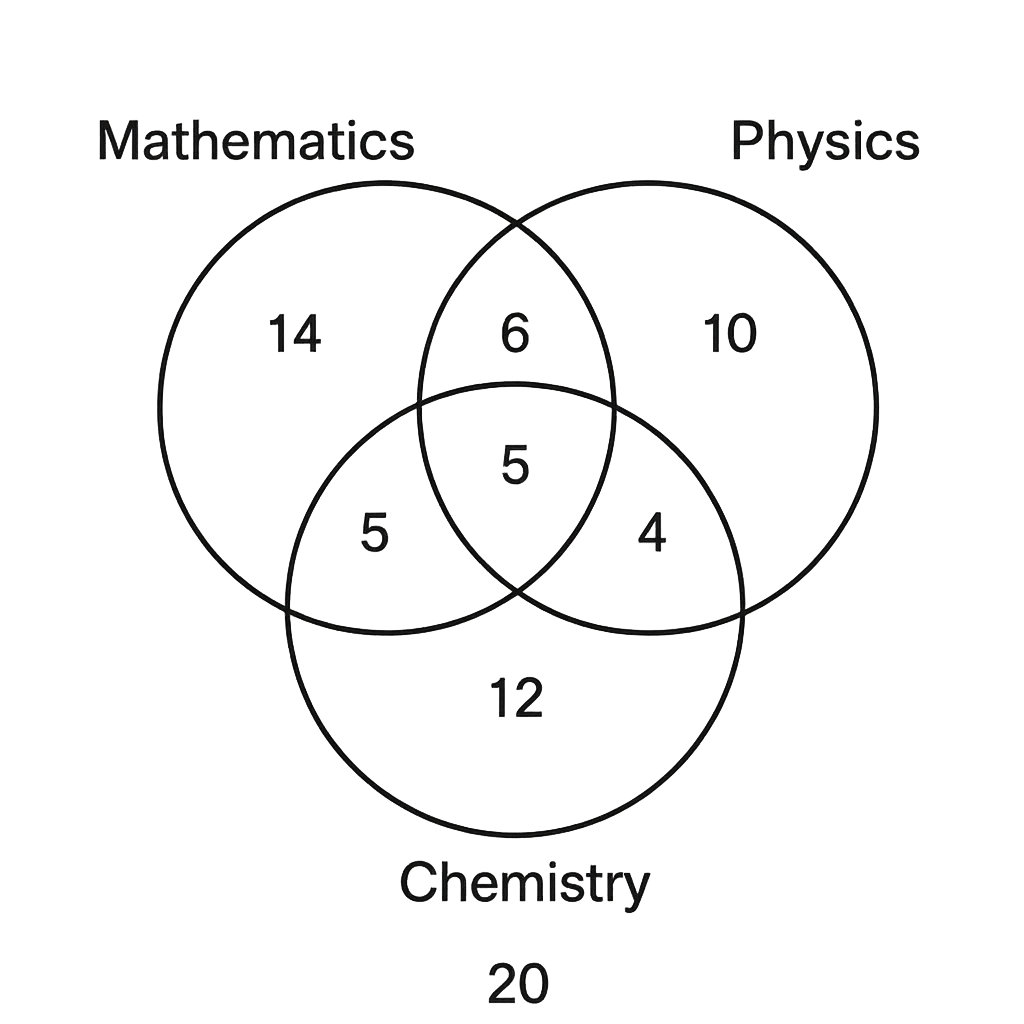
In a senior secondary school, 100 students were surveyed about the science subjects they study. The results are represented in the Venn diagram below. The diagram shows three intersecting circles labelled Mathematics (M), Physics (P) and Chemistry (C). The numbers given in the diagram are: - Only Mathematics: 14 - Only Physics: 10 - Only Chemistry: 12 - Mathematics and Physics only (not Chemistry): 6 - Mathematics and Chemistry only (not Physics): 5 - Physics and Chemistry only (not Mathematics): 4 - Students who study none of the three subjects: 20 All other regions are left blank.
Question Parts
(a)
Determine the number of students who study all three subjects.
(b)
What percentage of the total students study at least one of the three subjects?
(c)
A student is selected at random. Find the probability that the student studies Mathematics but not Physics.
Detailed Essay Solution & Marking Scheme Available

Get the step-by-step mathematical proofs, key points required by examiners, and a comprehensive breakdown from our AI Tutor.

Question 5 View Details
Let a and b be two real numbers such that a + b = 5 and ab = 6.
Question Parts
(a)
Find the value of a² + b².
(b)
Find the value of a³ + b³.
(c)
Write the quadratic equation of which a and b are the roots.
(d)
If a > b, determine the ordered pair (a, b).
Detailed Essay Solution & Marking Scheme Available

Get the step-by-step mathematical proofs, key points required by examiners, and a comprehensive breakdown from our AI Tutor.

Question 6 View Details
Consider the system of linear equations k·x + 2y = 4 2x + k·y = 4 where k is a real parameter.
Question Parts
(a)
Determine the value(s) of k for which the system has no solution.
(b)
Determine the value(s) of k for which the system has infinitely many solutions.
(c)
For k = 1, solve the system for x and y.
(d)
For k = 3, find the point of intersection of the two lines and verify that the point satisfies both equations.
Detailed Essay Solution & Marking Scheme Available

Get the step-by-step mathematical proofs, key points required by examiners, and a comprehensive breakdown from our AI Tutor.

Question 7 View Details
The quadratic equation 2x^2 - kx + 8 = 0 has two distinct real roots whose difference is 3 units.
Question Parts
(a)
Determine the value of the constant k.
(b)
Find the two roots of the equation.
(c)
Calculate the sum of the reciprocals of the two roots.
Detailed Essay Solution & Marking Scheme Available

Get the step-by-step mathematical proofs, key points required by examiners, and a comprehensive breakdown from our AI Tutor.

Question 8 View Details
A retailer offers a bulk‑purchase discount. After discount, the price per item (in naira) is given by P = 120 - \dfrac{20}{x-2}, where x (in dozens) is the quantity purchased and x > 2.
Question Parts
(a)
Find the range of x for which the price per item does not exceed 100 naira.
(b)
Find the range of x for which the discount per item does not exceed 30 naira.
(c)
Combine the results of (a) and (b) and state the integer values of x (in dozens) that satisfy both conditions.
Detailed Essay Solution & Marking Scheme Available

Get the step-by-step mathematical proofs, key points required by examiners, and a comprehensive breakdown from our AI Tutor.

Question 9 View Details
The first five terms of a sequence form an arithmetic progression. The sum of the first five terms is 70 and the sum of the first three terms is 33.
Question Parts
(a)
Determine the common difference of the progression.
(b)
Find the fifth term of the progression.
(c)
Using the value of the fifth term as n, evaluate the sum of the first n terms of the progression.
Detailed Essay Solution & Marking Scheme Available

Get the step-by-step mathematical proofs, key points required by examiners, and a comprehensive breakdown from our AI Tutor.

Question 10 View Details
A boat travels on a river where the speed of the current is c km/h and the speed of the boat in still water is v km/h. When moving upstream, the time T taken is directly proportional to the distance d travelled and inversely proportional to the effective speed (v – c). When moving downstream, T is directly proportional to d and inversely proportional to (v + c).
Question Parts
(a)
State the variation equations for (i) upstream travel and (ii) downstream travel, and derive the explicit expressions for the time taken in each case.
(b)
Given that the boat travels 150 km upstream against a current of 2 km/h in 10 h, calculate the speed of the boat in still water (v).
(c)
If the current speed doubles to 4 km/h, find the time required for the boat to travel 210 km downstream.
(d)
Explain qualitatively how the change in current speed affects the travel time for upstream and downstream journeys.
Detailed Essay Solution & Marking Scheme Available

Get the step-by-step mathematical proofs, key points required by examiners, and a comprehensive breakdown from our AI Tutor.

Question 11 View Details
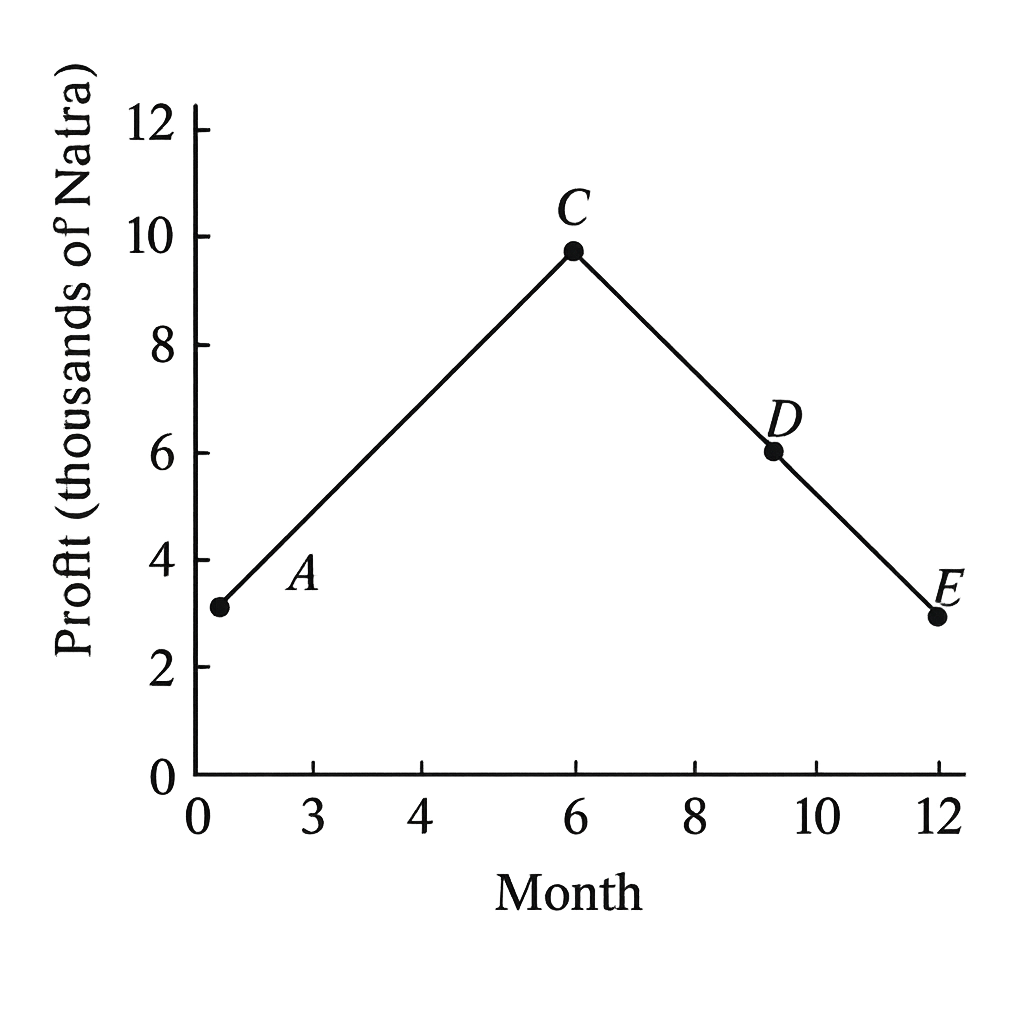
The graph below shows the monthly profit (in thousands of Naira) of a small trading business over a ten‑month period. The points A, B, C, D and E are plotted at the coordinates: A(1, 2), B(3, 5), C(6, 9), D(8, 6) and E(10, 3). The profit curve is drawn by joining the consecutive points with straight line segments. Using the information from the graph answer the following:
Question Parts
(a)
Calculate the gradient of the segment joining points B and C.
(b)
Find the equation of the straight line that passes through points D and E. Express the equation in the form y = mx + c.
(c)
Determine the total area enclosed between the profit curve and the x‑axis from x = 3 (point B) to x = 8 (point D). Give your answer in thousand‑Naira·months.
(d)
State, in the context of the business, what the maximum profit value shown on the graph represents.
Detailed Essay Solution & Marking Scheme Available

Get the step-by-step mathematical proofs, key points required by examiners, and a comprehensive breakdown from our AI Tutor.

Question 12 View Details
In the diagram, triangle ABC is shown. Side AB = 12 cm and lies on the x‑axis with A at the origin (0,0) and B at (12,0). ∠A = 40° and ∠B = 70°.
Question Parts
(a)
Determine the coordinates of point C (to two decimal places).
(b)
Write the equation of the straight line that passes through C and is perpendicular to AB.
(c)
The vertical line from part (b) meets the extension of AB at point D. Find the length CD (to two decimal places).
(d)
Using the coordinates obtained, calculate the area of triangle ABC and verify that it equals \(\frac12 \times AC \times BC \times \sin C\) (give the area to two decimal places).
Detailed Essay Solution & Marking Scheme Available

Get the step-by-step mathematical proofs, key points required by examiners, and a comprehensive breakdown from our AI Tutor.

Question 13 View Details
In triangle ABC the incircle touches side BC at D. The lengths of sides AB and AC are 13 cm and 15 cm respectively, and BD = 6 cm.
Question Parts
(a)
Find the length of side BC.
(b)
Determine the radius of the incircle.
(c)
Calculate the area of triangle ABC.
(d)
If the incircle touches side AB at point E, find the lengths of AE and EB.
Detailed Essay Solution & Marking Scheme Available

Get the step-by-step mathematical proofs, key points required by examiners, and a comprehensive breakdown from our AI Tutor.

Master the Exam!

You've seen a preview, but there are thousands more questions plus AI tutor to break down complex solutions.

Unlock Full Access Available for Android & Windows
Help others prepare! Share this practice hub:
Chat with Support