neco model questions vol1 2025 geography | Objective

Prepare for your exams with neco model questions vol1 questions? Reviewing past/model questions is one of the most effective ways to guarantee a high score. This practice hub features authentic 2025 geography (Objective) questions designed to simulate the real exam environment.

Practice these randomly selected questions to test your readiness.

Question 1 View Details
Based on the following classification criteria, determine the category of a settlement that has a population of 12,000, 60 % of its workforce employed in agriculture, is located 10 km from the nearest market, and possesses a secondary school and a health centre. The criteria are: - Rural settlement: population < 5,000, agricultural employment > 70 %, distance to market > 15 km. - Town: population between 5,000 and 20,000, agricultural employment between 30 % and 70 %, distance to market ≤ 12 km, and at least one secondary school. - Urban centre: population > 20,000 or agricultural employment < 30 % or distance to market ≤ 5 km, and has a hospital. Provide the settlement category.
Correct A. Town
B. Village
C. Rural settlement
D. Urban centre

Correct Answer: A

Want to see the full step-by-step solution? Unlock AI Explanation & Analytics
Question 2 View Details
Two alternative routes connect point A to point B. Route 1: total distance 120 km. The first 60 km can be travelled at a speed limit of \(80\ \text{km h}^{-1}\); the remaining 60 km at \(60\ \text{km h}^{-1}\). A mandatory toll stop adds 15 minutes. Route 2: total distance 150 km travelled at a uniform speed limit of \(70\ \text{km h}^{-1}\). The route includes a ferry crossing that lasts 20 minutes, during which the vehicle is stationary. Which route yields the shorter total travel time? State the difference in travel time (Route 2 minus Route 1) in minutes, rounded to one decimal place.
Correct A. 28.6
B. 24.5
C. 32.0
D. 15.2

Correct Answer: A

Want to see the full step-by-step solution? Unlock AI Explanation & Analytics
Question 3 View Details
An environmental risk assessment for a community considers three factors: the probability \(P\) of a flood occurring in the next ten years, the estimated economic loss \(L\) if a flood occurs, and the community's vulnerability index \(V\) (on a scale of 1 to 5). The risk score is calculated as \[ R = P \times L \times \frac{V}{5}. \] Given \(P = 0.12\), \(L = \text{₦}250{,}000{,}000\), and \(V = 4\), compute the risk score \(R\) and state whether it exceeds the high‑risk threshold of \text{₦}150{,}000{,}000.
Correct A. ₦24,000,000; not high risk
B. ₦20,000,000; not high risk
C. ₦30,000,000; high risk
D. ₦24,000,000; high risk

Correct Answer: A

Want to see the full step-by-step solution? Unlock AI Explanation & Analytics
Question 4 View Details
A settlement had a population of 18 000 in the year 2020. It experiences a natural increase at an annual rate of 2.5 % and a net migration gain of 150 persons each year. Assuming these rates remain constant, in which year will the population first exceed 30 000? Give the calendar year.
A. 2038
B. 2035
C. 2040
Correct D. 2037

Correct Answer: D

Want to see the full step-by-step solution? Unlock AI Explanation & Analytics
Question 5 View Details
A catchment area of 2.5 km\(^2\) consists of 40 % residential land (runoff coefficient \(C_r = 0.55\)), 30 % commercial land (\(C_c = 0.70\)), and 30 % open land (\(C_o = 0.30\)). For a design storm of 30 minutes, the rainfall intensity is 80 mm h\(^{-1}\). Using the Rational Method \(Q = 0.00278\,C\,I\,A\) (where \(Q\) is in m\(^3\) s\(^{-1}\), \(C\) is the composite runoff coefficient, \(I\) the intensity in mm h\(^{-1}\), and \(A\) the area in hectares), determine whether an existing culvert with a capacity of 0.25 m\(^3\) s\(^{-1}\) is adequate. Answer "Yes" if adequate, otherwise "No".
Correct A. No
B. Undecided
C. Yes
D. Maybe

Correct Answer: A

Want to see the full step-by-step solution? Unlock AI Explanation & Analytics
Question 6 View Details
The population of State X was \(4.2\) million in the year 2000 and increased to \(5.1\) million in 2010. Assuming the population grew exponentially at a constant annual rate \(r\) during this period, the government introduced a policy in 2010 that reduced the annual growth rate by 0.5 percentage points (i.e., the new rate becomes \(r\! -\!0.005\)). Estimate the population of State X in 2025. Give your answer in millions to two decimal places.
A. 6.55
Correct B. 6.33
C. 5.98
D. 6.10

Correct Answer: B

Want to see the full step-by-step solution? Unlock AI Explanation & Analytics
Question 7 View Details
In 2015, Region Y had an area of \(2,500\) km\(^2\) and a population of \(3.75\) million. From 2015 to 2020 the population grew at an annual compound rate of 2 %. In 2020 the region annexed an adjacent area of \(400\) km\(^2\) that had a population of \(0.48\) million. What was the overall population density (people per km\(^2\)) of the enlarged region in 2020? Give your answer rounded to the nearest whole number.
Correct A. 1593
B. 1490
C. 1620
D. 1550

Correct Answer: A

Want to see the full step-by-step solution? Unlock AI Explanation & Analytics
Question 8 View Details
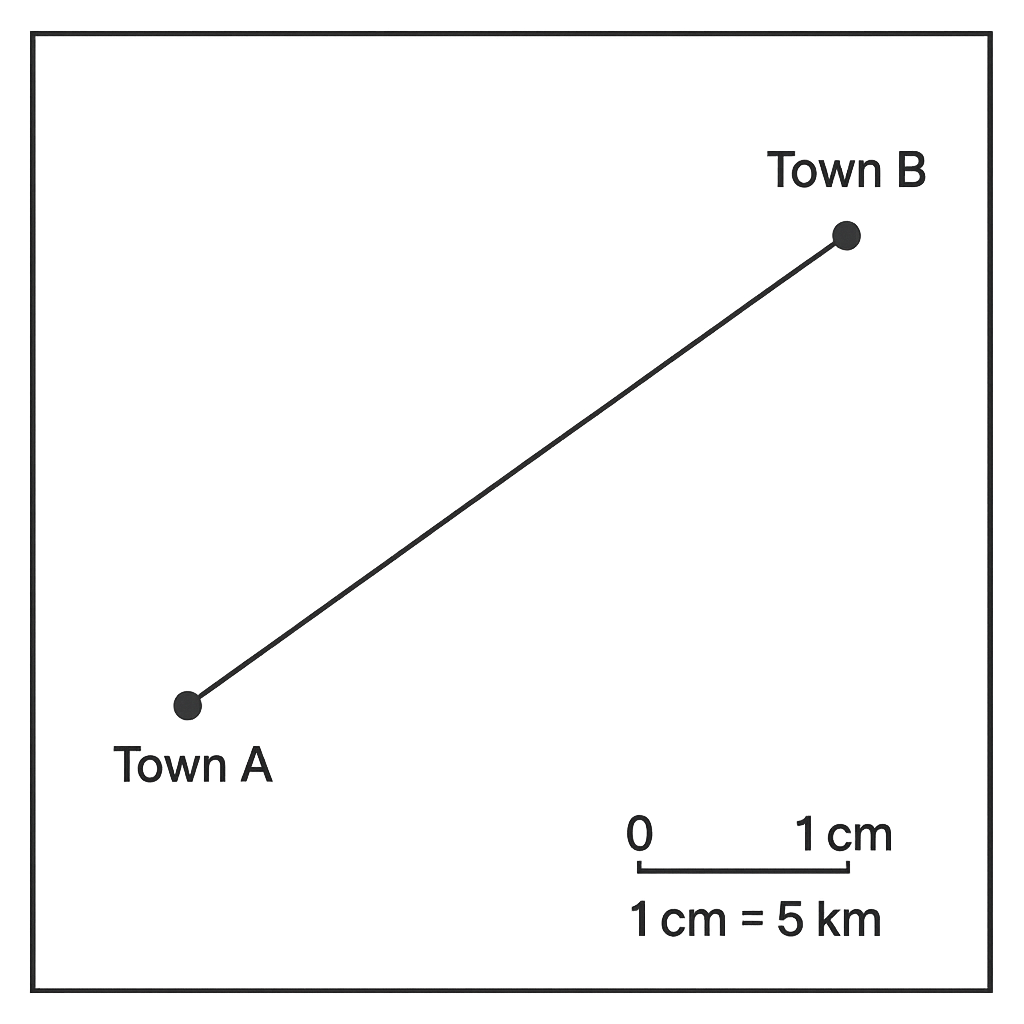
On the map, the distance between Town A and Town B measures \(7\) cm. The map scale is \(1\) cm : \(5\) km. What is the actual distance between the two towns in kilometres?
Correct A. 35
B. 30
C. 40
D. 25

Correct Answer: A

Want to see the full step-by-step solution? Unlock AI Explanation & Analytics
Question 9 View Details
A farmer has \(120\) ha of land to allocate between maize and soybeans. Maize yields \(3.2\) t ha\(^{-1}\) and requires \(120\) kg of fertilizer per hectare. Soybeans yield \(2.5\) t ha\(^{-1}\) and require \(80\) kg of fertilizer per hectare. The farmer has only \(10,000\) kg of fertilizer available. Market prices are ₦150 per kg for maize and ₦200 per kg for soybeans. Assuming the farmer wants to maximise total revenue, determine how many hectares of each crop should be planted and the maximum possible revenue. Give the revenue in millions of naira to two decimal places.
Correct A. 60.00
B. 70.00
C. 65.00
D. 55.00

Correct Answer: A

Want to see the full step-by-step solution? Unlock AI Explanation & Analytics
Question 10 View Details
A coastal plain can be approximated as a right‑angled triangle with a base of \(12\) km along the shoreline and a height of \(8\) km inland. Adjacent to this plain is a hill that occupies a sector of a circle of radius \(5\) km, covering a central angle of \(60^\circ\). If the hill area is unsuitable for agriculture, what is the total area (in km\(^2\)) of land available for agriculture in the plain? Give your answer to one decimal place.
A. 33.9
B. 35.5
Correct C. 34.9
D. 41.5

Correct Answer: C

Want to see the full step-by-step solution? Unlock AI Explanation & Analytics
Question 11 View Details
A tropical woodland type establishes only where the annual rainfall exceeds the annual potential evapotranspiration (PET) by at least 20 %. PET for a region can be approximated by \( PET = 0.6 \times T_{avg} \times N \times 10 \) mm, where \(T_{avg}\) is the mean annual temperature in °C and \(N\) is the number of months in the year receiving more than 100 mm of rain. In a particular area the mean annual temperature is \(28^{\circ}\text{C}\) and exactly five months receive more than 100 mm of rain. What is the minimum total annual rainfall (in mm) required for the woodland to occur?
A. 1120
B. 960
C. 840
Correct D. 1008

Correct Answer: D

Want to see the full step-by-step solution? Unlock AI Explanation & Analytics
Question 12 View Details
A river descends from its source at an elevation of 1500 m to sea level. In its upper course the gradient is \(30\ \text{m\ km}^{-1}\) for the first 20 km. In the middle course the gradient reduces to \(5\ \text{m\ km}^{-1}\) until the cumulative drop reaches 1200 m above sea level. The remaining descent to sea level occurs in the lower course with a gradient of \(1\ \text{m\ km}^{-1}\). What is the total length of the river (in km)?
A. 460
Correct B. 440
C. 500
D. 380

Correct Answer: B

Want to see the full step-by-step solution? Unlock AI Explanation & Analytics
Question 13 View Details
A farmer cultivates maize on 10 ha. The expected yield without fertilizer is \(2.5\ \text{t\ ha}^{-1}\). Applying nitrogen fertilizer increases the yield by \(0.8\ \text{t}\) per ha for each 50 kg of N applied per ha. Each 50 kg of N costs ₦500. The market price of maize is ₦2 000 per tonne. The farmer wishes to achieve a total profit of at least ₦500 000 after deducting the cost of fertilizer. Assuming the farmer applies the same amount of nitrogen uniformly over the whole area, what is the minimum amount of nitrogen (in kg per ha) that must be applied?
A. 2100
Correct B. 2050
C. 2000
D. 1900

Correct Answer: B

Want to see the full step-by-step solution? Unlock AI Explanation & Analytics
Question 14 View Details
A region has an annual precipitation of 1200 mm. The monthly distribution is such that eight months receive 80 mm each and the remaining four months receive 200 mm each. The mean annual temperature is \(22^{\circ}\text{C}\); the hottest month averages \(30^{\circ}\text{C}\) and the coldest month averages \(14^{\circ}\text{C}\). Using the Köppen climate classification, determine the appropriate climate type code (e.g., Cfa, Aw) for this region.
A. Aw
Correct B. Cfa
C. Cfb
D. Dfa

Correct Answer: B

Want to see the full step-by-step solution? Unlock AI Explanation & Analytics
Question 15 View Details
Longshore drift transports sediment northwards along a 15 km stretch of coast at a rate of 0.8 million tonnes per year. A groyne built at the western end traps 30 % of the incoming sediment. The downstream beach loses sediment at a rate equal to 50 % of the untrapped sediment flux. Calculate the net annual sediment loss (in million tonnes) from the downstream beach segment.
A. 0.40
Correct B. 0.28
C. 0.12
D. 0.56

Correct Answer: B

Want to see the full step-by-step solution? Unlock AI Explanation & Analytics
Question 16 View Details
A soil sample contains 40 % sand, 35 % silt and 25 % clay. (a) Identify its USDA texture class. (b) Using the empirical field‑capacity relation \(FC = 0.2\,S + 0.4\,Si + 0.5\,C\) where \(S\), \(Si\) and \(C\) are the percentages of sand, silt and clay respectively, calculate the field capacity (as a percentage of volume).
Correct A. Loam; 34.5 %
B. Sandy loam; 33.0 %
C. Silt loam; 31.5 %
D. Clay loam; 36.0 %

Correct Answer: A

Want to see the full step-by-step solution? Unlock AI Explanation & Analytics
Question 17 View Details
A bus must travel a 240 km route. The first 120 km are through an urban area where the speed is limited to 60 km h\(^{-1}\) and fuel consumption is 0.07 L km\(^{-1}\). For the remaining 120 km the driver may choose a constant speed \(v\) (km h\(^{-1}\)) with \(80 \le v \le 120\). Fuel consumption on this section is \(f(v)=0.05+0.0002\,(v-80)^{2}\) L km\(^{-1}\). Fuel costs ₦200 per litre and the driver is paid a wage of ₦500 per hour. Determine the speed \(v\) that minimises the total trip cost (fuel + wage) and give that minimum cost in naira.
A. Optimal speed ≈ 90 km h\(^{-1}\); minimum total cost ≈ ₦4 750
Correct B. Optimal speed ≈ 81 km h\(^{-1}\); minimum total cost ≈ ₦4 626
C. Optimal speed ≈ 100 km h\(^{-1}\); minimum total cost ≈ ₦4 900
D. Optimal speed ≈ 85 km h\(^{-1}\); minimum total cost ≈ ₦4 680

Correct Answer: B

Want to see the full step-by-step solution? Unlock AI Explanation & Analytics
Question 18 View Details
A factory's output follows the Cobb‑Douglas function \(Q = 20\sqrt{LK}\), where \(L\) is the number of labour‑hours and \(K\) the number of capital units used in a month. Labour costs ₦150 per hour, capital costs ₦200 per unit per month and fixed overheads are ₦10 000 per month. Each widget sells for ₦500. The firm must produce at least 5 000 widgets per month. Find the integer values of \(L\) and \(K\) that minimise the total monthly cost while satisfying the output requirement, and compute the resulting monthly profit.
A. L = 291 hours, K = 215 units; profit ≈ ₦2 300 000
B. L = 300 hours, K = 210 units; profit ≈ ₦2 350 000
C. L = 280 hours, K = 220 units; profit ≈ ₦2 420 000
Correct D. L = 291 hours, K = 215 units; profit ≈ ₦2 404 650

Correct Answer: D

Want to see the full step-by-step solution? Unlock AI Explanation & Analytics
Question 19 View Details
Town A is situated at latitude \(5^{\circ}\mathrm{N}\) on a meridian. Town B lies on the same meridian 780 km south of A. Assuming the Earth's radius is 6371 km, (a) determine the latitude of B (state north or south), and (b) if town C is 150 km east of B along the parallel of B's latitude, find the difference in longitude between B and C (in degrees, to two decimal places).
A. B is at 2.02° N; longitude difference ≈ 1.35°
B. B is at 2.12° S; longitude difference ≈ 1.30°
C. B is at 1.95° S; longitude difference ≈ 1.40°
Correct D. B is at 2.02° S; longitude difference ≈ 1.35°

Correct Answer: D

Want to see the full step-by-step solution? Unlock AI Explanation & Analytics
Question 20 View Details
The following are the average monthly temperatures (°C) and precipitation (mm) for a region:\n\nJan 28/12, Feb 27/15, Mar 25/20, Apr 22/45, May 20/80, Jun 18/120, Jul 17/150, Aug 18/130, Sep 20/90, Oct 23/50, Nov 25/30, Dec 27/15.\n\n(a) Calculate the annual mean temperature. (b) Calculate the total annual precipitation. (c) Using the Köppen system, classify the climate (assume the criteria: if the coldest month ≤ 18 °C and the driest winter month receives < 40 mm and < 10 % of the wettest summer month, the climate is Cwa).
Correct A. Mean temperature 22.5 °C; total precipitation 757 mm; Köppen classification Cwa
B. Mean temperature 23.0 °C; total precipitation 750 mm; Köppen classification Cwb
C. Mean temperature 21.8 °C; total precipitation 800 mm; Köppen classification Cwa
D. Mean temperature 22.5 °C; total precipitation 757 mm; Köppen classification Cfa

Correct Answer: A

Want to see the full step-by-step solution? Unlock AI Explanation & Analytics
Question 21 View Details
Three rock samples have the following mineral composition (percent by weight):\n\n- Sample A: quartz \(55\%\), feldspar \(20\%\), clay minerals \(15\%\)\n- Sample B: quartz \(45\%\), feldspar \(10\%\), clay minerals \(30\%\)\n- Sample C: quartz \(65\%\), feldspar \(5\%\), clay minerals \(20\%\)\n\nFor classification, use these criteria:\n\n* Igneous rocks: quartz + feldspar > 70 % and clay < 10 %\n* Sedimentary rocks: quartz + clay > 80 % and feldspar < 15 %\n* Metamorphic rocks: quartz + feldspar between 40 % and 60 % and clay between 20 % and 30 %\n\nWhich sample is metamorphic?
A. Sample C
Correct B. Sample B
C. Sample A
D. Sample D

Correct Answer: B

Want to see the full step-by-step solution? Unlock AI Explanation & Analytics
Question 22 View Details
An agricultural catchment of \(12\) km\(^{2}\) receives a uniform rainfall of \(120\) mm in a day. The land‑use distribution is 40 % forest (runoff coefficient \(0.15\)), 35 % agriculture (coefficient \(0.30\)) and 25 % urban (coefficient \(0.70\)). Assuming the runoff coefficient for the whole catchment is the area‑weighted average, calculate the total runoff volume in cubic metres.
A. 398400
B. 432000
Correct C. 489600
D. 560000

Correct Answer: C

Want to see the full step-by-step solution? Unlock AI Explanation & Analytics
Question 23 View Details
The following are the average monthly temperatures (°C) recorded at a weather station:\n\nJan 28, Feb 30, Mar 32, Apr 33, May 31, Jun 28, Jul 26, Aug 25, Sep 24, Oct 26, Nov 27, Dec 28.\n\n(a) Determine the annual temperature range.\n(b) The Köppen classification uses these rules: if the mean annual temperature is above 18 °C and the annual range is less than 3 °C the climate is tropical; if the mean annual temperature is above 10 °C and the range exceeds 7 °C the climate is temperate. Based on the data, state the main climate type.
A. Arid
B. Tropical
Correct C. Temperate
D. Mediterranean

Correct Answer: C

Want to see the full step-by-step solution? Unlock AI Explanation & Analytics
Question 24 View Details
A farmer intends to fertilise \(12\) ha of land. Soil tests indicate a nitrogen deficiency of \(45\) kg ha\(^{-1}\) and a phosphorus deficiency of \(30\) kg ha\(^{-1}\). Two fertilizer blends are available:\n\n* Blend A: 20 % N, 10 % P, cost ₦13 500 per tonne.\n* Blend B: 15 % N, 20 % P, cost ₦13 000 per tonne; a 5 % discount is applied if more than 3 tonnes are purchased.\n\nThe farmer will use only one blend to meet both nutrient deficiencies (excess is acceptable). Which blend results in the lower total cost and what is that cost?
A. Blend A - ₦44,460
B. Blend B - ₦45,500
Correct C. Blend B - ₦44,460
D. Blend A - ₦48,600

Correct Answer: C

Want to see the full step-by-step solution? Unlock AI Explanation & Analytics
Question 25 View Details
In a shallow water‑logged area, the hydraulic conductivity of the soil is \(K = 0.8\) m day\(^{-1}\). Drains are to be placed at a depth \(d = 1.5\) m above an impermeable layer located at depth \(D = 4.0\) m. The permissible discharge per unit area is \(q = 0.02\) m\(^{3}\) day\(^{-1}\) m\(^{-2}\). Using the simplified Hooghoudt equation \(S = \sqrt{\dfrac{4Kd(D-d)}{q}}\), where \(S\) is the maximum spacing between parallel drains (m), calculate the greatest allowable spacing (rounded to one decimal place).
A. 21.9
B. 31.0
C. 12.2
Correct D. 24.5

Correct Answer: D

Want to see the full step-by-step solution? Unlock AI Explanation & Analytics

Master the Exam!

You've seen a preview, but there are thousands more questions plus AI tutor to break down complex solutions.

Unlock Full Access Available for Android & Windows
Help others prepare! Share this practice hub:
Chat with Support