neco model questions vol1 2025 biology | Objective

Prepare for your exams with neco model questions vol1 questions? Reviewing past/model questions is one of the most effective ways to guarantee a high score. This practice hub features authentic 2025 biology (Objective) questions designed to simulate the real exam environment.

Practice these randomly selected questions to test your readiness.

Question 1 View Details
A subject has a glomerular filtration rate (GFR) of \(100\ \text{mL min}^{-1}\). Plasma glucose concentration is \(90\ \text{mg dL}^{-1}\). Urine flow rate is \(1.2\ \text{mL min}^{-1}\) and urine glucose concentration is \(150\ \text{mg dL}^{-1}\). Assuming glucose is freely filtered and not secreted, calculate the amount of glucose reabsorbed per minute (in mg min\(^{-1}\)).
A. 86.4 mg min⁻¹
B. 89.0 mg min⁻¹
Correct C. 88.2 mg min⁻¹
D. 90 mg min⁻¹

Correct Answer: C

Want to see the full step-by-step solution? Unlock AI Explanation & Analytics
Question 2 View Details
In a kidney, the glomerular filtration rate is \(120\ \text{mL min}^{-1}\). Plasma bicarbonate concentration is \(24\ \text{mEq L}^{-1}\). Urine is excreted at a flow rate of \(2.0\ \text{mL min}^{-1}\) with a bicarbonate concentration of \(12\ \text{mEq L}^{-1}\). Determine the net renal reabsorption of bicarbonate per minute (in mEq min\(^{-1}\)).
Correct A. 2.86 mEq min⁻¹
B. 2.88 mEq min⁻¹
C. 2.84 mEq min⁻¹
D. 2.70 mEq min⁻¹

Correct Answer: A

Want to see the full step-by-step solution? Unlock AI Explanation & Analytics
Question 3 View Details
A segment of human intestine weighing \(0.2\ \text{kg}\) contains a glucose transporter with a maximal uptake rate \(V_{\max}=500\ \mu\text{mol min}^{-1}\text{kg}^{-1}\) and a Michaelis constant \(K_{m}=5\ \text{mM}\). The luminal glucose concentration is \(8\ \text{mM}\). Using Michaelis-Menten kinetics, calculate the total rate of glucose absorption (in \(\mu\text{mol min}^{-1}\)) and the percentage of \(V_{\max}\) that this rate represents.
A. 153.8 µmol min⁻¹ (≈61.5% of Vₘₐₓ)
B. 307.7 µmol min⁻¹ (≈307.7% of Vₘₐₓ)
Correct C. 61.5 µmol min⁻¹ (≈61.5% of Vₘₐₓ)
D. 44.4 µmol min⁻¹ (≈44.4% of Vₘₐₓ)

Correct Answer: C

Want to see the full step-by-step solution? Unlock AI Explanation & Analytics
Question 4 View Details
In a simple spinal reflex, the sensory neuron conducts impulses over a distance of \(0.8\ \text{m}\) at \(55\ \text{m s}^{-1}\), and the motor neuron conducts over \(0.6\ \text{m}\) at \(45\ \text{m s}^{-1}\). Each synapse in the reflex arc introduces a delay of \(0.5\ \text{ms}\). Calculate the total time from stimulus onset to muscle contraction (in ms) and state whether this reflex qualifies as a fast reflex (≤ 5 ms).
Correct A. ≈28.9 ms (not a fast reflex)
B. ≈27.9 ms (not a fast reflex)
C. ≈4.8 ms (fast reflex)
D. ≈29.4 ms (not a fast reflex)

Correct Answer: A

Want to see the full step-by-step solution? Unlock AI Explanation & Analytics
Question 5 View Details
A diploid human somatic cell (2n = 46) has completed DNA replication but has not yet entered mitosis. How many chromatids are present in the cell?
A. 48
B. 46
C. 184
Correct D. 92

Correct Answer: D

Want to see the full step-by-step solution? Unlock AI Explanation & Analytics
Question 6 View Details
An unknown fungus shows the following characteristics: (i) multicellular eukaryote with cell walls containing chitin; (ii) reproduces by external spores borne on club‑shaped structures; (iii) hyphae are septate and possess clamp connections; (iv) a prolonged dikaryotic stage lasting several months; (v) forms a mushroom‑type fruiting body. To which taxonomic class does this organism belong?
A. Basidiomycetes
B. Ascomycetes
Correct C. Agaricomycetes
D. Zygomycetes

Correct Answer: C

Want to see the full step-by-step solution? Unlock AI Explanation & Analytics
Question 7 View Details
Two species have mitochondrial DNA sequences that differ at 12 % of nucleotide sites (observed proportion of differences \(p = 0.12\)). Assuming a Jukes‑Cantor correction, the corrected genetic distance \(D\) is given by \(D = -\frac{3}{4}\ln\!\left(1-\frac{4}{3}p\right)\). If the average substitution rate is \( \mu = 2 \times 10^{-8}\) substitutions per site per year, estimate the divergence time (in million years) between the species.
Correct A. 3.3 million years
B. 4.1 million years
C. 5.0 million years
D. 2.5 million years

Correct Answer: A

Want to see the full step-by-step solution? Unlock AI Explanation & Analytics
Question 8 View Details
In a hormonal feedback system the secretion rate \(S\) (units h\(^{-1}\)) follows \(S = \frac{S_{\max}}{1+(C/K)^{n}}\) where \(C\) is the hormone concentration (µg dL\(^{-1}\)), \(S_{\max}=100\), \(K=5\) and \(n=2\). Clearance is proportional to concentration: clearance \(= kC\) with \(k=10\). A drug reduces \(S_{\max}\) by 20 % and increases \(k\) by 15 %. Determine the new steady‑state concentration \(C\) (µg dL\(^{-1}\)).
Correct A. 4.13 µg/dL
B. 2.64 µg/dL
C. 5.12 µg/dL
D. 3.87 µg/dL

Correct Answer: A

Want to see the full step-by-step solution? Unlock AI Explanation & Analytics
Question 9 View Details
A cell oxidises glucose (\(\mathrm{C}_{6}\mathrm{H}_{12}\mathrm{O}_{6}\)) and palmitic acid (\(\mathrm{C}_{16}\mathrm{H}_{32}\mathrm{O}_{2}\)). For every 3 molecules of glucose oxidised, 1 molecule of palmitic acid is oxidised. The respiratory quotient (RQ) for a substrate is the ratio of \(\mathrm{CO}_{2}\) produced to \(\mathrm{O}_{2}\) consumed. Given that glucose yields an RQ of 1 and palmitic acid yields an RQ of \(16/23\), calculate the overall RQ for the mixture.
Correct A. 0.83
B. 0.75
C. 0.91
D. 0.68

Correct Answer: A

Want to see the full step-by-step solution? Unlock AI Explanation & Analytics
Question 10 View Details
An animal originally has a cylindrical body (including ends) of length \(L = 20\) cm and radius \(r = 4\) cm. It evolves a more compact shape approximated by a sphere of the same volume. Calculate the percentage reduction in the surface‑area‑to‑volume ratio (\(SA/V\)) resulting from this change. Express your answer to the nearest whole percent.
A. 17
Correct B. 19
C. 22
D. 25

Correct Answer: B

Want to see the full step-by-step solution? Unlock AI Explanation & Analytics
Question 11 View Details
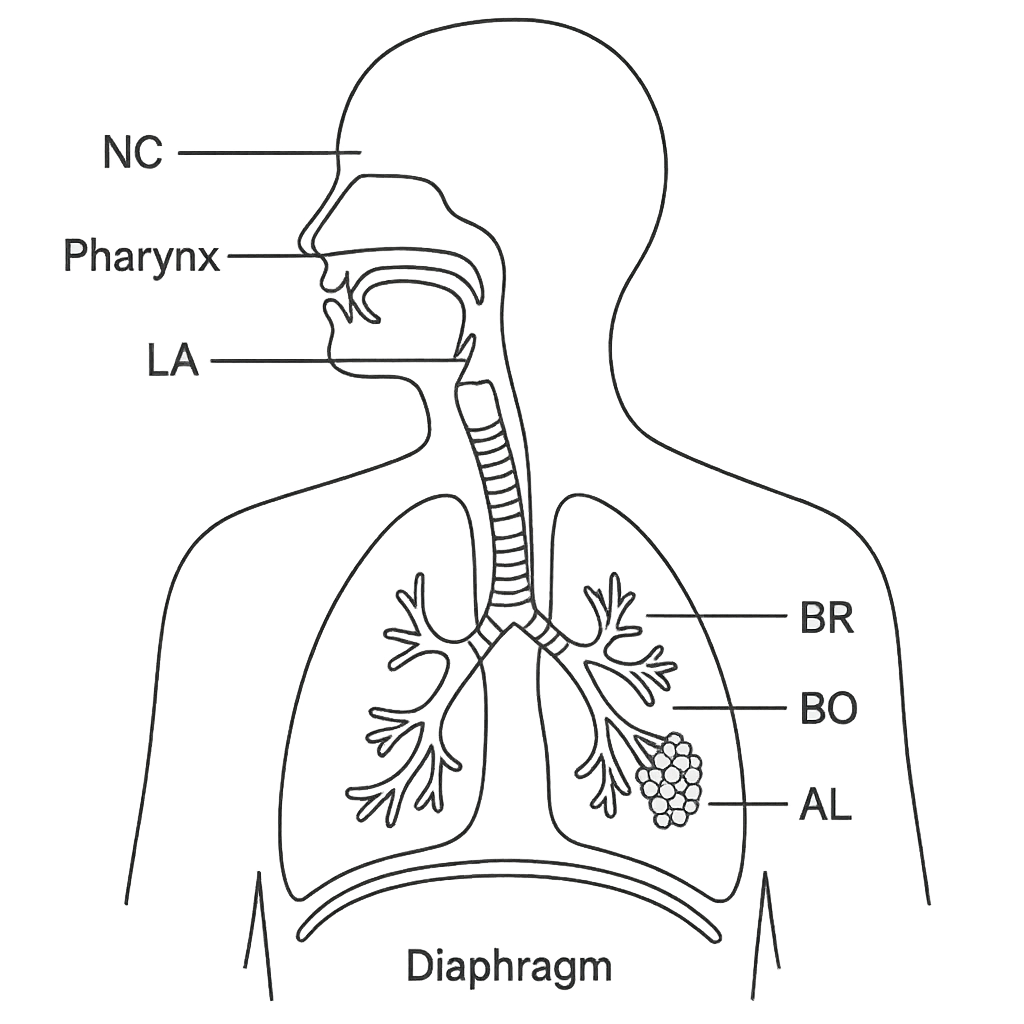
The diagram shows the major parts of the human respiratory system. The tidal volume of air inhaled per breath is 500 mL and the anatomical dead‑space volume is 150 mL per breath. A person breathes 12 times per minute at rest.\n\na) Calculate the alveolar ventilation (in litres per minute) at rest.\n\nb) If the breathing rate increases to 20 breaths per minute while the tidal volume remains the same, calculate the new alveolar ventilation and the percentage increase relative to the resting value.
A. Resting alveolar ventilation = 6.0 L min⁻¹; at 20 breaths min⁻¹ = 10.0 L min⁻¹; percentage increase ≈ 66.7 %
B. Resting alveolar ventilation = 3.5 L min⁻¹; at 20 breaths min⁻¹ = 7.0 L min⁻¹; percentage increase ≈ 100 %
C. Resting alveolar ventilation = 4.2 L min⁻¹; at 20 breaths min⁻¹ = 7.0 L min⁻¹; percentage increase ≈ 40 %
Correct D. Resting alveolar ventilation = 4.2 L min⁻¹; at 20 breaths min⁻¹ = 7.0 L min⁻¹; percentage increase ≈ 66.7 %.

Correct Answer: D

Want to see the full step-by-step solution? Unlock AI Explanation & Analytics
Question 12 View Details
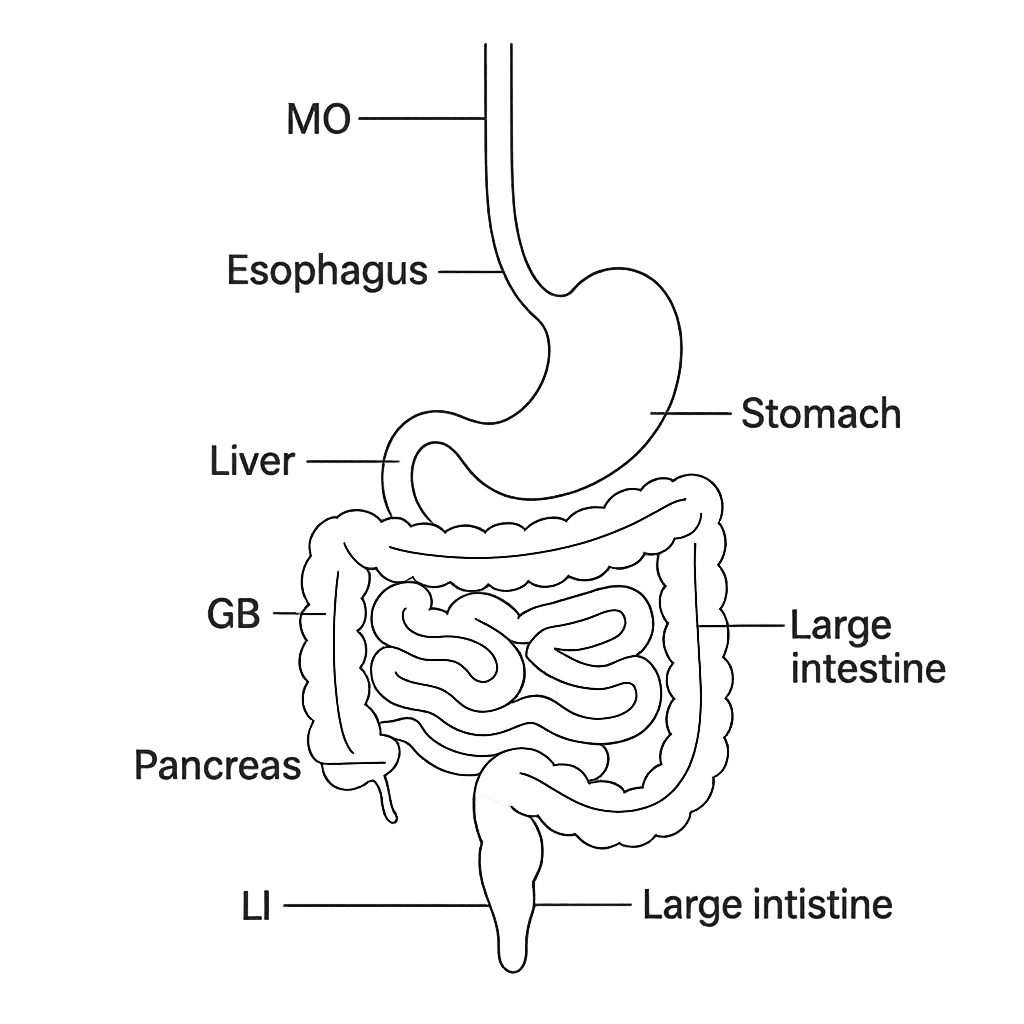
The diagram depicts the human digestive system. A mixed meal contains 60 g carbohydrate, 20 g protein and 30 g fat. The percentages of each macronutrient that are absorbed are 95 % for carbohydrate, 90 % for protein and 85 % for fat. Using the Atwater factors (carbohydrate = 4 kcal g⁻¹, protein = 4 kcal g⁻¹, fat = 9 kcal g⁻¹),\n\na) Determine the total caloric energy absorbed from the meal.\n\nb) If the individual's daily energy requirement is 2500 kcal, what percentage of the requirement is supplied by this meal?
Correct A. Absorbed energy = 529.5 kcal; this is about 21.2 % of a 2500 kcal daily requirement.
B. Absorbed energy = 504 kcal; this is about 20.2 % of a 2500 kcal daily requirement
C. Absorbed energy = 590 kcal; this is about 23.6 % of a 2500 kcal daily requirement
D. Absorbed energy = 533.5 kcal; this is about 21.3 % of a 2500 kcal daily requirement

Correct Answer: A

Want to see the full step-by-step solution? Unlock AI Explanation & Analytics
Question 13 View Details
Desert plants use structural and physiological adaptations to minimise water loss.\n\nA cactus employs CAM photosynthesis, opening its stomata only at night for 8 h at a transpiration rate of \(0.2\ \text{g h}^{-1}\). During the day its stomata are closed, so water loss is negligible.\n\nA typical non‑CAM desert shrub keeps its stomata open during the day for 12 h at \(0.8\ \text{g h}^{-1}\) and at night for 12 h at \(0.3\ \text{g h}^{-1}\).\n\nCalculate the total water loss (in grams) for each plant over a 24‑hour period and the percentage reduction in water loss achieved by the cactus. Which type of adaptation (structural - spines reducing surface area, or physiological - CAM) contributes most to this reduction? Provide a brief justification.
A. Cactus loss = 2.4 g; shrub loss = 13.2 g; water‑loss reduction ≈ 81.8 %; the physiological CAM adaptation is the dominant factor.
Correct B. Cactus loss = 1.6 g; shrub loss = 13.2 g; water‑loss reduction ≈ 87.9 %; the physiological CAM adaptation is the dominant factor.
C. Cactus loss = 1.6 g; shrub loss = 13.2 g; water‑loss reduction ≈ 87.9 %; the structural spines adaptation is the dominant factor.
D. Cactus loss = 1.6 g; shrub loss = 9.6 g; water‑loss reduction ≈ 87.9 %; the structural spines adaptation is the dominant factor.

Correct Answer: B

Want to see the full step-by-step solution? Unlock AI Explanation & Analytics
Question 14 View Details
In a 30‑day menstrual cycle the estrogen level peaks on day 14. The luteinising hormone (LH) surge occurs 36 hours after the estrogen peak and triggers ovulation. The luteal phase lasts a constant 14 days.\n\na) On which day of the cycle does ovulation occur?\n\nb) On which day does the next menstruation begin?
A. Ovulation occurs on day 15; menstruation begins on day 30.
Correct B. Ovulation occurs on day 16; menstruation begins on day 30.
C. Ovulation occurs on day 17; menstruation begins on day 31.
D. Ovulation occurs on day 16; menstruation begins on day 29.

Correct Answer: B

Want to see the full step-by-step solution? Unlock AI Explanation & Analytics
Question 15 View Details
A flower has 5 stamens, each producing 100 pollen grains. Only 2 % of the pollen grains reach the stigma of a compatible flower. Of the grains that land, 60 % germinate and grow pollen tubes, and 70 % of the germinated tubes achieve fertilisation of an ovule.\n\na) How many ovules are fertilised per flower?\n\nb) If each fertilised ovule develops into a seed weighing \(0.02\ \text{g}\), calculate the total seed mass produced by the flower.
A. Approximately 3 ovules are fertilised; total seed mass ≈ 0.06 g.
B. Approximately 2 ovules are fertilised; total seed mass ≈ 0.04 g.
Correct C. Approximately 4 ovules are fertilised; total seed mass ≈ 0.08 g.
D. Approximately 5 ovules are fertilised; total seed mass ≈ 0.10 g.

Correct Answer: C

Want to see the full step-by-step solution? Unlock AI Explanation & Analytics
Question 16 View Details
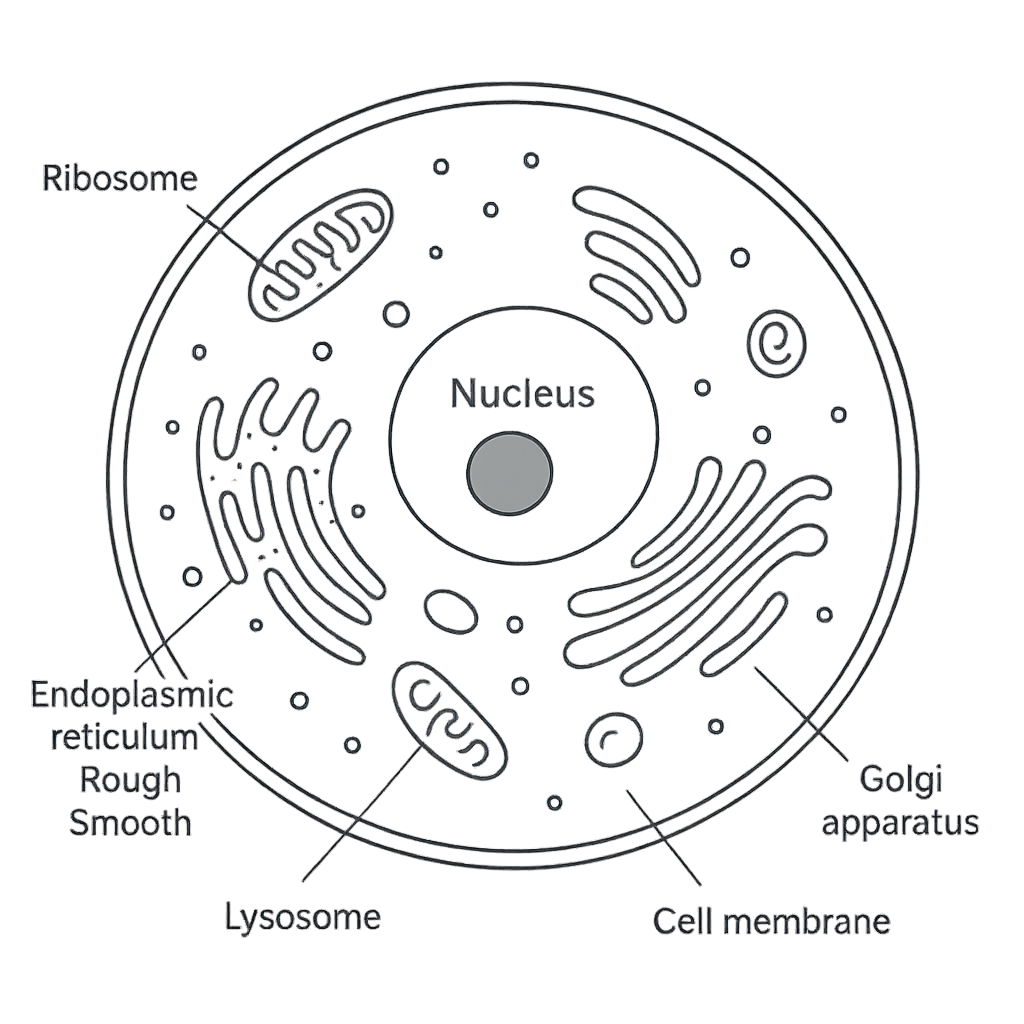
The diagram of a typical animal cell shows labelled organelles including the nucleus, mitochondrion, ribosome, endoplasmic reticulum, Golgi apparatus, lysosome and cell membrane. Which organelle is primarily responsible for producing ATP?
A. Golgi apparatus
Correct B. Mitochondrion
C. Nucleus
D. Ribosome

Correct Answer: B

Want to see the full step-by-step solution? Unlock AI Explanation & Analytics
Question 17 View Details
In a community of 10,000 people a malaria outbreak begins with 120 reported cases. The disease has a basic reproduction number \(R_{0}=2.5\). Control measures reduce the effective reproduction number by 40\%. Assuming the reduced reproduction number remains constant, how many total cases will be present after two successive infection cycles (i.e., after the original cases generate secondary cases and those secondary cases generate tertiary cases)?
A. 360
B. 450
Correct C. 570
D. 1170

Correct Answer: C

Want to see the full step-by-step solution? Unlock AI Explanation & Analytics
Question 18 View Details
A desert plant has a leaf surface area of \(30\,\text{cm}^2\) and a stomatal density of \(200\) stomata per \(\text{mm}^2\). Each open stomata loses \(0.05\,\mu\text{L}\) of water per hour. During peak heat the plant can close 80\% of its stomata. Calculate the reduction in water loss per hour (in \(\text{mL}\)) compared with fully open leaves.
A. 12
Correct B. 24
C. 48
D. 30

Correct Answer: B

Want to see the full step-by-step solution? Unlock AI Explanation & Analytics
Question 19 View Details
An organism is multicellular, eukaryotic, has cell walls composed of chitin, reproduces by producing basidiospores, and forms macroscopic fruiting bodies with gills that are commonly called mushrooms. Based on these characteristics, identify the taxonomic class to which this organism belongs.
A. Basidiomycetes
B. Zygomycetes
Correct C. Agaricomycetes
D. Ascomycetes

Correct Answer: C

Want to see the full step-by-step solution? Unlock AI Explanation & Analytics
Question 20 View Details
During intense muscle activity, which cellular organelle typically increases in number to meet the higher energy demand?
Correct A. Mitochondria
B. Lysosomes
C. Golgi apparatus
D. Ribosomes

Correct Answer: A

Want to see the full step-by-step solution? Unlock AI Explanation & Analytics
Question 21 View Details
In a forest ecosystem the net primary productivity (NPP) is \(1200\) g C m\(^{-2}\) yr\(^{-1}\). Herbivores consume \(15\%\) of the NPP and only \(10\%\) of the consumed plant biomass is converted into herbivore biomass. Carnivores consume \(20\%\) of the herbivore biomass and convert \(25\%\) of what they consume into carnivore biomass. In a grassland ecosystem the NPP is \(800\) g C m\(^{-2}\) yr\(^{-1}\); herbivores consume \(30\%\) of the NPP with a \(12\%\) conversion efficiency, and carnivores consume \(25\%\) of the herbivore biomass with a \(20\%\) conversion efficiency. Which ecosystem supports the greater carnivore biomass per square metre?
Correct A. Grassland ecosystem
B. Both ecosystems support equal carnivore biomass
C. Neither ecosystem supports carnivore biomass
D. Forest ecosystem

Correct Answer: A

Want to see the full step-by-step solution? Unlock AI Explanation & Analytics
Question 22 View Details
A diploid population contains 200 individuals with an initial allele \(A\) frequency of \(0.60\). Each generation, 10 individuals migrate into the population from a neighboring population where the allele \(A\) frequency is \(0.30\). Assuming random mating, no selection and that the migrants join the gene pool before mating, what is the allele \(A\) frequency after one generation? Express your answer to three decimal places.
A. 0.600
Correct B. 0.586
C. 0.543
D. 0.572

Correct Answer: B

Want to see the full step-by-step solution? Unlock AI Explanation & Analytics
Question 23 View Details
Three insect species (X, Y and Z) share the following traits: all have an exoskeleton; X and Y have wings; Y alone has halteres; X and Z undergo complete metamorphosis. Using the principle of parsimony, identify the trait that is a synapomorphy for the clade containing species X and Y, and the trait that represents an autapomorphy for species Y.
A. Complete metamorphosis is the synapomorphy for X and Y; wings are the autapomorphy for Y.
B. Wings are the synapomorphy for X and Y; exoskeleton is the autapomorphy for Y.
C. Exoskeleton is the synapomorphy for X and Y; halteres are the autapomorphy for Y.
Correct D. Wings are the synapomorphy for X and Y; halteres are the autapomorphy for Y.

Correct Answer: D

Want to see the full step-by-step solution? Unlock AI Explanation & Analytics
Question 24 View Details
During which phase of mitosis are the chromosomes aligned at the cell's equatorial plate?
A. Prophase
B. Telophase
C. Anaphase
Correct D. Metaphase

Correct Answer: D

Want to see the full step-by-step solution? Unlock AI Explanation & Analytics
Question 25 View Details
A mammal has a glomerular filtration rate (GFR) of \(120\) mL·min\(^{-1}\). Of the filtrate, \(99\%\) of water and \(85\%\) of urea are reabsorbed in the proximal tubule; an additional \(10\%\) of water and \(5\%\) of urea are reabsorbed in the loop of Henle; finally, \(5\%\) of water and \(2\%\) of urea are reabsorbed in the distal tubule before excretion. What percentage of the original filtered urea is excreted in the final urine? Give your answer to two decimal places.
A. 16.04
B. 14.25
Correct C. 13.97
D. 8.00

Correct Answer: C

Want to see the full step-by-step solution? Unlock AI Explanation & Analytics

Master the Exam!

You've seen a preview, but there are thousands more questions plus AI tutor to break down complex solutions.

Unlock Full Access Available for Android & Windows
Help others prepare! Share this practice hub:
Chat with Support