neco model questions vol1 2025 agricultural_science | Objective

Prepare for your exams with neco model questions vol1 questions? Reviewing past/model questions is one of the most effective ways to guarantee a high score. This practice hub features authentic 2025 agricultural_science (Objective) questions designed to simulate the real exam environment.

Practice these randomly selected questions to test your readiness.

Question 1 View Details
A forest stand of a fast‑growing species has its timber volume (in m³) modelled by \(V(t)=V_0 e^{kt}\), where \(V_0=2000\) m³ is the initial volume and the annual growth rate \(k=0.04\). Each year a constant volume \(C\) (in m³) is harvested. To preserve ecological function the remaining volume after 20 years must be at least 2500 m³. What is the greatest constant annual cut \(C\) that satisfies this condition? Give your answer to one decimal place.
A. 88.0
Correct B. 97.6
C. 92.3
D. 104.5

Correct Answer: B

Want to see the full step-by-step solution? Unlock AI Explanation & Analytics
Question 2 View Details
Cassava roots stored in a sealed container lose weight by respiration. The daily percentage loss at temperature \(T\) (in °C) is given by \(R(T)=0.5\,e^{0.07(T-20)}\) % per day. An initial batch weighs 500 kg. The farmer wants the total loss after 10 days to be no more than 8% of the initial weight. What is the highest storage temperature (in °C, to one decimal place) that can be used without exceeding this loss?
A. 29.1
Correct B. 26.7
C. 22.5
D. 24.3

Correct Answer: B

Want to see the full step-by-step solution? Unlock AI Explanation & Analytics
Question 3 View Details
A hand hoe has a total handle length of 1.2 m. The farmer applies a force at the end of the handle to lift a soil load of 150 N that is located 0.2 m from the blade pivot (the opposite end of the handle). The fulcrum (pivot) can be placed anywhere along the handle but must be at least 0.1 m away from the load point. Determine the position of the fulcrum measured from the effort end that minimises the required effort force, and state that minimum effort (in newtons, to one decimal place).
A. 0.7; 15.0
B. 1.0; 20.5
Correct C. 0.9; 16.7
D. 0.8; 18.2

Correct Answer: C

Want to see the full step-by-step solution? Unlock AI Explanation & Analytics
Question 4 View Details
In a maize field of 2000 plants, 12% show symptoms of blight (B), 9% show leaf‑spot (L) and 3% show both diseases. A fungicide is 80% effective against blight, 70% effective against leaf‑spot and only 60% effective on plants suffering both diseases. After uniform application, how many plants are expected to remain diseased (showing at least one symptom)?
A. 84
Correct B. 96
C. 108
D. 120

Correct Answer: B

Want to see the full step-by-step solution? Unlock AI Explanation & Analytics
Question 5 View Details
The proportion of wheat plants infected by a new fungal disease follows the logistic model \(p(t)=\frac{1}{1+9e^{-0.3t}}\), where \(t\) is weeks after first detection. Starting from week 4, a control measure reduces the current infection proportion by 15% each week (i.e., the proportion is multiplied by 0.85 each week). After which integer week will the infection proportion first fall below 5%?
A. 16
B. 12
C. 13
Correct D. 15

Correct Answer: D

Want to see the full step-by-step solution? Unlock AI Explanation & Analytics
Question 6 View Details
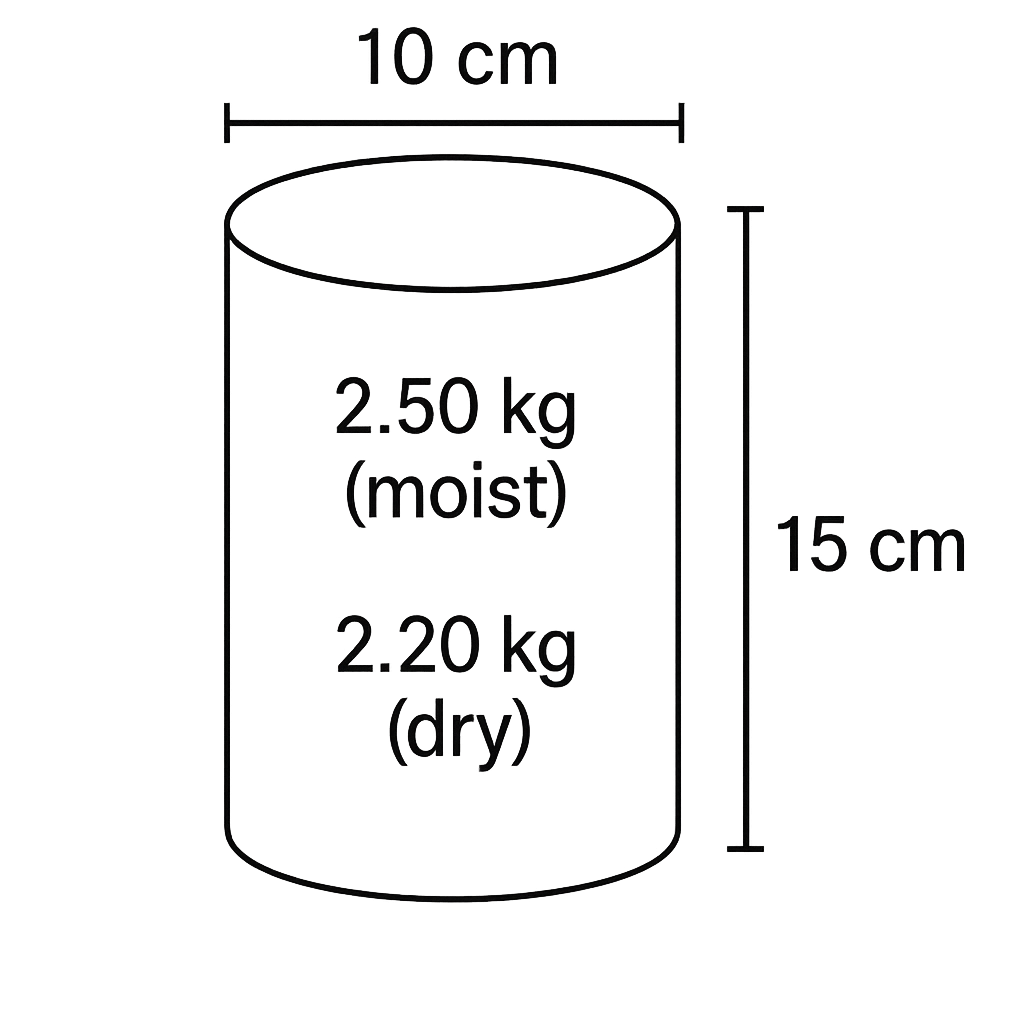
The diagram shows a cylindrical soil core of diameter \(10\) cm and height \(15\) cm taken from a field. The moist soil in the core weighed \(2.50\) kg. After oven‑drying at \(105^{\circ}\)C, the dry weight was \(2.20\) kg. Calculate the bulk density of the soil in \(\text{g\,cm}^{-3}\) (to two decimal places).
A. 1.65
Correct B. 1.87
C. 1.44
D. 2.05

Correct Answer: B

Want to see the full step-by-step solution? Unlock AI Explanation & Analytics
Question 7 View Details
A forest manager wants to determine the sustainable Annual Allowable Cut (AAC) from a \(100\) ha teak stand. The average tree height is \(20\) m and the average diameter at breast height (DBH) is \(30\) cm. Tree volume (in m\(^3\)) is approximated by \(V = 0.0005\,D^{2}\,H\), where \(D\) is in cm and \(H\) in metres. The stand density is \(500\) trees per ha. Annual volume growth is \(2.5\)% of the standing volume after harvest, and the manager requires that the standing volume after harvest and growth be at least \(80\)% of the initial volume. What is the maximum volume (in m\(^3\)) that can be harvested each year while meeting this condition?
A. 87,300
B. 95,000
Correct C. 98,800
D. 102,500

Correct Answer: C

Want to see the full step-by-step solution? Unlock AI Explanation & Analytics
Question 8 View Details
A farmer intends to grow maize on \(2\) ha. Soil analysis shows the following available nutrients per hectare: nitrogen \(45\) kg, phosphorus \(12\) kg and potassium \(30\) kg. The recommended nutrient uptake for optimum yield is nitrogen \(120\) kg/ha, phosphorus \(60\) kg/ha and potassium \(80\) kg/ha. The farmer will use three fertilizers:\n- Urea containing \(46\)% N,\n- Single superphosphate (SSP) containing \(16\)% P\(_2\)O\(_5\) (elemental P = 0.44 × P\(_2\)O\(_5\)),\n- Muriate of potash (KCl) containing \(60\)% K\(_2\)O (elemental K = 0.83 × K\(_2\)O).\nCalculate the amount (kg) of each fertilizer that must be applied per hectare to meet the nutrient gaps exactly. Round each answer to the nearest kilogram.
Correct A. Urea: 163 kg/ha; SSP: 682 kg/ha; KCl: 100 kg/ha
B. Urea: 150 kg/ha; SSP: 700 kg/ha; KCl: 110 kg/ha
C. Urea: 180 kg/ha; SSP: 650 kg/ha; KCl: 105 kg/ha
D. Urea: 170 kg/ha; SSP: 660 kg/ha; KCl: 95 kg/ha

Correct Answer: A

Want to see the full step-by-step solution? Unlock AI Explanation & Analytics
Question 9 View Details
An extension officer wishes to estimate the adoption rate of a new pest‑control technique among 500 cocoa farmers in a district. He uses a two‑stage sampling design: first, 5 villages are randomly selected from 20 villages; second, within each selected village, 12 farmers are randomly chosen. After surveying, 30 of the 60 sampled farmers report using the technique. Estimate the overall adoption proportion for the district and construct a 95 % confidence interval using the normal approximation for proportions. Also, identify one possible source of bias in this sampling design and suggest a way to reduce it.
A. Estimated adoption = 0.55; 95 % CI = (0.42, 0.68). Possible bias: under‑sampling of larger villages; mitigation: stratify by village size.
Correct B. Estimated adoption = 0.50; 95 % CI = (0.37, 0.63). Possible bias: non‑representative village selection; mitigation: use PPS sampling of villages.
C. Estimated adoption = 0.45; 95 % CI = (0.32, 0.58). Possible bias: selection of villages by convenience; mitigation: randomize village selection.
D. Estimated adoption = 0.60; 95 % CI = (0.47, 0.73). Possible bias: respondent fatigue leading to under‑reporting; mitigation: shorten questionnaire.

Correct Answer: B

Want to see the full step-by-step solution? Unlock AI Explanation & Analytics
Question 10 View Details
A tomato farmer monitors the leafminer pest. The economic injury level (EIL) is given by \(EIL = \dfrac{C}{V \times I \times D}\), where \(C\) is the cost of control per hectare (₦1500), \(V\) is the market value per kilogram of tomatoes (₦200), \(I\) is the injury per pest (0.02 kg loss per leafminer per hectare), and \(D\) is the damage factor (0.5). The farmer counts an average of 8 leafminers per plant. The field density is 25 plants per m\(^2\) and the farm size is 1 ha (10,000 m\(^2\)). Determine whether the current pest density exceeds the economic threshold and state the appropriate action (apply control or no control).
Correct A. Apply control
B. Apply control only if threshold is exceeded
C. No control
D. Delay control

Correct Answer: A

Want to see the full step-by-step solution? Unlock AI Explanation & Analytics
Question 11 View Details
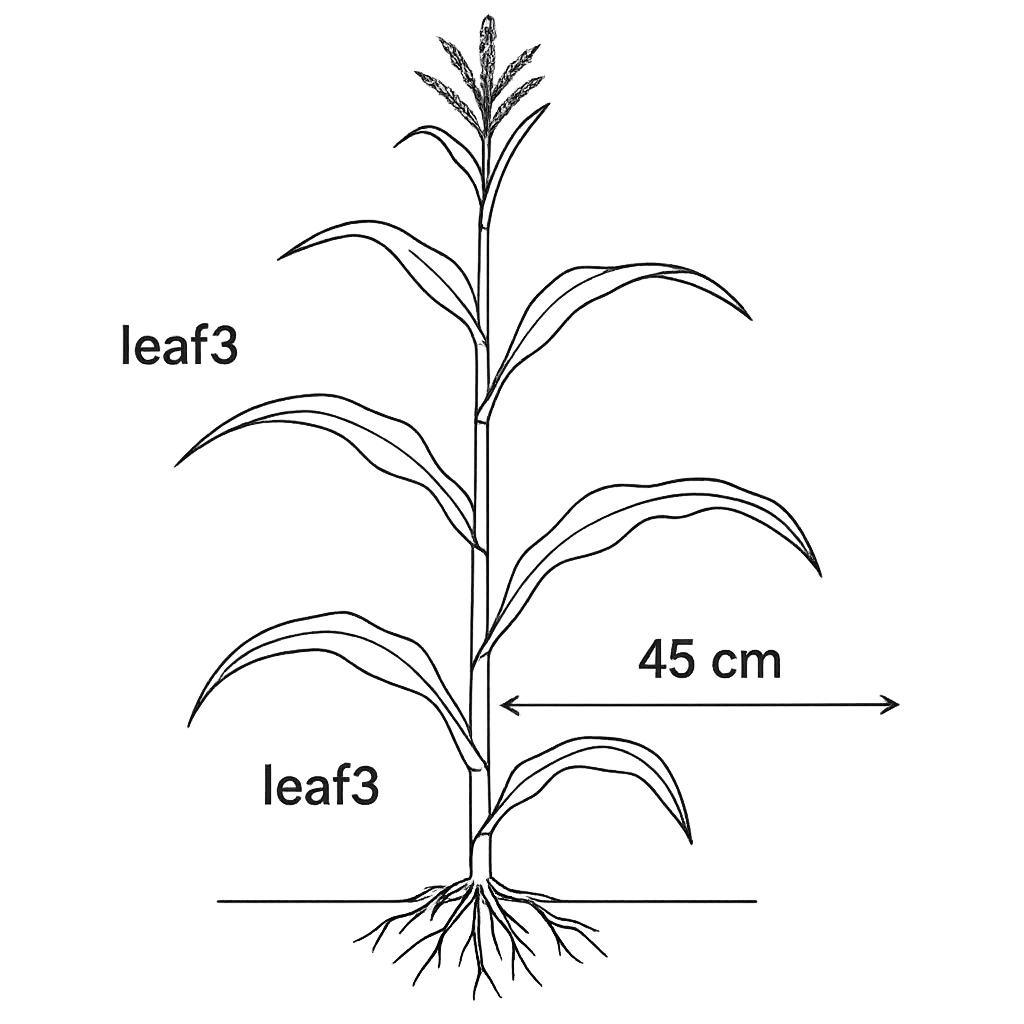
The diagram shows a mature maize plant with leaf 3 measuring 30 cm in length and 5 cm in width, and leaf 5 measuring 45 cm in length and 6 cm in width. Leaf area can be estimated by \( \text{Area}= \text{length}\times \text{width}\times 0.75\). During a 12‑hour daylight period the average photosynthetic rate is \(20\ \mu\text{mol CO}_2\ \text{m}^{-2}\text{s}^{-1}\). Each micromole of CO₂ fixed produces \(0.0005\) g of dry biomass. Assuming only these two leaves contribute proportionally to the plant's total biomass, calculate the grain weight produced in one day if 20 % of the dry biomass is allocated to grain. Give your answer in grams to two decimal places.
A. 2.15
Correct B. 2.72
C. 3.20
D. 3.05

Correct Answer: B

Want to see the full step-by-step solution? Unlock AI Explanation & Analytics
Question 12 View Details
A tractor pulls a moldboard plough. The soil resistance is \(150\ \text{kN m}^{-1}\) of plough width. The plough width is \(0.30\) m and the tractor moves at \(5\ \text{km h}^{-1}\). The overall mechanical efficiency of the power train is 85 % and the engine's specific fuel consumption is \(0.25\ \text{L kW}^{-1}\text{h}^{-1}\). Determine the fuel consumption of the tractor in litres per hour.
A. 22.10
B. 15.60
C. 20.45
Correct D. 18.38

Correct Answer: D

Want to see the full step-by-step solution? Unlock AI Explanation & Analytics
Question 13 View Details
A field receives nitrogen inputs as follows: 120 kg N ha\(^{-1}\) from fertilizer, 30 kg N ha\(^{-1}\) from biological fixation and 5 kg N ha\(^{-1}\) from atmospheric deposition. Losses occur by volatilisation amounting to 10 % of the total input and by leaching amounting to 15 % of the total input. Calculate the net amount of nitrogen remaining in the soil after these losses (in kg N ha\(^{-1}\)).
A. 139.5
Correct B. 116.25
C. 115.0
D. 120.0

Correct Answer: B

Want to see the full step-by-step solution? Unlock AI Explanation & Analytics
Question 14 View Details
The pH of a soil is 5.5. To raise the pH to 6.5, a farmer plans to apply agricultural lime. The lime has a neutralising value such that applying 100 kg ha\(^{-1}\) raises the pH by 0.1 unit. How many kilograms of lime per hectare are required to achieve the desired pH?
A. 500
B. 1100
Correct C. 1000
D. 900

Correct Answer: C

Want to see the full step-by-step solution? Unlock AI Explanation & Analytics
Question 15 View Details
In a field survey four plant species were recorded with the following individual counts: Species A - 20, Species B - 30, Species C - 25, Species D - 25. Using Simpson's diversity index \(D = \frac{\sum n_i (n_i-1)}{N(N-1)}\), where \(N\) is the total number of individuals, calculate the index value (to three decimal places).
Correct A. 0.248
B. 0.312
C. 0.225
D. 0.180

Correct Answer: A

Want to see the full step-by-step solution? Unlock AI Explanation & Analytics
Question 16 View Details
A farmer has 2 ha of land and wants to incorporate 10 tonnes of organic matter (58\% carbon) into the top 15 cm of soil. The soil bulk density is 1.3 g cm\(^{-3}\). By how many percentage points does the soil organic carbon content increase?
A. 0.12\%
B. 0.18\%
Correct C. 0.15\%
D. 0.20\%

Correct Answer: C

Want to see the full step-by-step solution? Unlock AI Explanation & Analytics
Question 17 View Details
A batch of cassava chips weighs 100 kg with an initial moisture content of 45\% (wet basis). The chips are first dried in Dryer A, which removes 10\% of the water present each hour for 4 h. They are then transferred to Dryer B, which removes 5\% of the remaining water each hour for 6 h. Determine the final moisture content (wet basis) of the chips and the total weight loss after both drying stages.
A. 29.0\% moisture, 22.0 kg loss
Correct B. 28.3\% moisture, 23.3 kg loss
C. 25.7\% moisture, 24.8 kg loss
D. 30.1\% moisture, 21.5 kg loss

Correct Answer: B

Want to see the full step-by-step solution? Unlock AI Explanation & Analytics
Question 18 View Details
A fish population in a lake follows logistic growth \( \frac{dN}{dt}= rN\left(1-\frac{N}{K}\right) \) with intrinsic rate \( r =0.4\ \text{yr}^{-1} \) and carrying capacity \( K = 5000 \) fish. A constant harvest of \( H \) fish per year is applied. Find the maximum sustainable harvest \( H_{\max} \) that allows a non‑zero equilibrium and give the corresponding equilibrium population size.
A. Maximum sustainable harvest = 400 fish/yr; equilibrium population = 2000 fish
B. Maximum sustainable harvest = 600 fish/yr; equilibrium population = 3000 fish
C. Maximum sustainable harvest = 450 fish/yr; equilibrium population = 2250 fish
Correct D. Maximum sustainable harvest = 500 fish/yr; equilibrium population = 2500 fish

Correct Answer: D

Want to see the full step-by-step solution? Unlock AI Explanation & Analytics
Question 19 View Details
An agricultural extension service must train 1200 smallholder farmers on integrated pest management within 24 weeks. Each training session can accommodate up to 30 farmers and lasts 3 h. An extension agent can conduct at most 1 session per week because of travel and preparation time. How many extension agents are required to meet the target, and how many hours of training will each agent deliver?
Correct A. 2 agents; each agent delivers 60 hours of training
B. 4 agents; each agent delivers 30 hours of training
C. 3 agents; each agent delivers 40 hours of training
D. 1 agent; each agent delivers 120 hours of training

Correct Answer: A

Want to see the full step-by-step solution? Unlock AI Explanation & Analytics
Question 20 View Details
A farmer plans a broiler operation raising 800 birds per year. Fixed costs are ₦1,200,000 per year. Variable cost per bird is ₦12,000, and the expected market price per bird at harvest is ₦18,000. There is a 10\% chance of a disease outbreak that reduces the number of birds sold by 30\% and raises the variable cost of the affected birds by ₦3,000 each. Compute the expected annual profit taking the disease risk into account, and determine the break‑even number of birds if no disease occurs.
Correct A. Expected profit = ₦3,096,000; break‑even quantity = 200 birds
B. Expected profit = ₦2,880,000; break‑even quantity = 200 birds
C. Expected profit = ₦3,240,000; break‑even quantity = 250 birds
D. Expected profit = ₦2,700,000; break‑even quantity = 180 birds

Correct Answer: A

Want to see the full step-by-step solution? Unlock AI Explanation & Analytics
Question 21 View Details
A herd of 150 cattle is disease‑free except for an outbreak that starts with 5 infected animals. Each infected animal, after a 4‑day infectious period, gives rise to exactly 2 new infections and then either recovers (80 % chance) or dies (20 % chance). Assuming no other sources of infection and that the herd size is sufficient, how many cattle will have died by the end of day 8?
A. 2
B. 4
Correct C. 3
D. 5

Correct Answer: C

Want to see the full step-by-step solution? Unlock AI Explanation & Analytics
Question 22 View Details
A farmer has a plough that can till \(0.75\) ha per hour and a harrow that can harrow \(0.5\) ha per hour. He works 6 hours each day but after every 3 hours of work he must stop for 15 minutes for maintenance. He alternates the tools each working hour, starting with the plough. How many hectares can be prepared (till + harrow) in 3 days?
A. 12.0
B. 9.5
C. 11.0
Correct D. 10.5

Correct Answer: D

Want to see the full step-by-step solution? Unlock AI Explanation & Analytics
Question 23 View Details
A tractor consumes a base \(5\) L h\(^{-1}\) with no load. For each 10 % increase in load it uses an additional \(0.8\) L h\(^{-1}\). The plough requires 30 % load on light soil, 60 % on medium soil and 90 % on heavy soil. The farmer works 4 h on light soil, then 3 h on medium soil and finally 2 h on heavy soil. If fuel costs ₦250 per litre, what is the total fuel cost for the operation?
A. 21000
Correct B. 20850
C. 20750
D. 20500

Correct Answer: B

Want to see the full step-by-step solution? Unlock AI Explanation & Analytics
Question 24 View Details
Early blight infects 2 % of the leaf area of a 5‑ha tomato field on day 0. Each day the infected area increases by 15 % of the remaining healthy area. A fungicide applied reduces the infected area instantly by 40 % and its effectiveness decays exponentially with a half‑life of 3 days (i.e., each day the reduction factor is multiplied by \(2^{-1/3}\)). The farmer applies the fungicide on day 0 and again on day 4. What is the percentage of leaf area infected at the end of day 7? Give your answer to one decimal place.
A. 38.5
B. 31.2
Correct C. 35.0
D. 34.0

Correct Answer: C

Want to see the full step-by-step solution? Unlock AI Explanation & Analytics
Question 25 View Details
A farmer plans to plant maize on 2 ha. The recommended seed rate is 25 kg ha\(^{-1}\) and the recommended fertilizer rate is 60 kg ha\(^{-1}\). If the seed rate is reduced by 20 % the yield per hectare falls by 12 % but fertilizer use can be reduced by 15 %. The farmer has 40 kg of seed and 120 kg of fertilizer. Seed costs ₦150 kg\(^{-1}\) and fertilizer costs ₦200 kg\(^{-1}\). The market price of maize is ₦500 kg\(^{-1}\) and the expected yield at the recommended rate is 5 000 kg ha\(^{-1}\). Assuming the farmer purchases any additional seed needed, what is the net cost saving (in Naira) when using the reduced seed and fertilizer rates compared to the recommended rates?
A. 4600
B. 6100
Correct C. 5100
D. 5600

Correct Answer: C

Want to see the full step-by-step solution? Unlock AI Explanation & Analytics

Master the Exam!

You've seen a preview, but there are thousands more questions plus AI tutor to break down complex solutions.

Unlock Full Access Available for Android & Windows
Help others prepare! Share this practice hub:
Chat with Support