neco model questions vol1 2025 agricultural_science | Essay

Prepare for your exams with neco model questions vol1 questions? Reviewing past/model questions is one of the most effective ways to guarantee a high score. This practice hub features authentic 2025 agricultural_science (Essay) questions designed to simulate the real exam environment.

Practice these randomly selected questions to test your readiness.

Question 1 View Details
A farmer in the savanna zone maintains a 5‑hectare mixed farm where crops (maize and cowpea) are grown together with a herd of goats.
Question Parts
(a)
Define agricultural ecology and list its three main components.
(b)
Analyse two possible ecological consequences of converting the mixed farm into a monoculture maize farm.
(c)
Recommend two management practices that could mitigate the negative impacts identified in part (b) and explain how they work.
Detailed Essay Solution & Marking Scheme Available

Get the step-by-step mathematical proofs, key points required by examiners, and a comprehensive breakdown from our AI Tutor.
Question 2 View Details
A soil laboratory is set up to determine the texture of a field soil sample using the sedimentation (hydrometer) method. The diagram shows the practical arrangement.
Question Parts
(a)
Identify each apparatus shown in the diagram and state its purpose.
(b)
Explain the principle behind the sedimentation method for soil texture determination.
(c)
Using the measurements indicated in the diagram, calculate the percentage by volume of sand, silt and clay in the soil sample. Show all steps.
Detailed Essay Solution & Marking Scheme Available

Get the step-by-step mathematical proofs, key points required by examiners, and a comprehensive breakdown from our AI Tutor.

Question 3 View Details
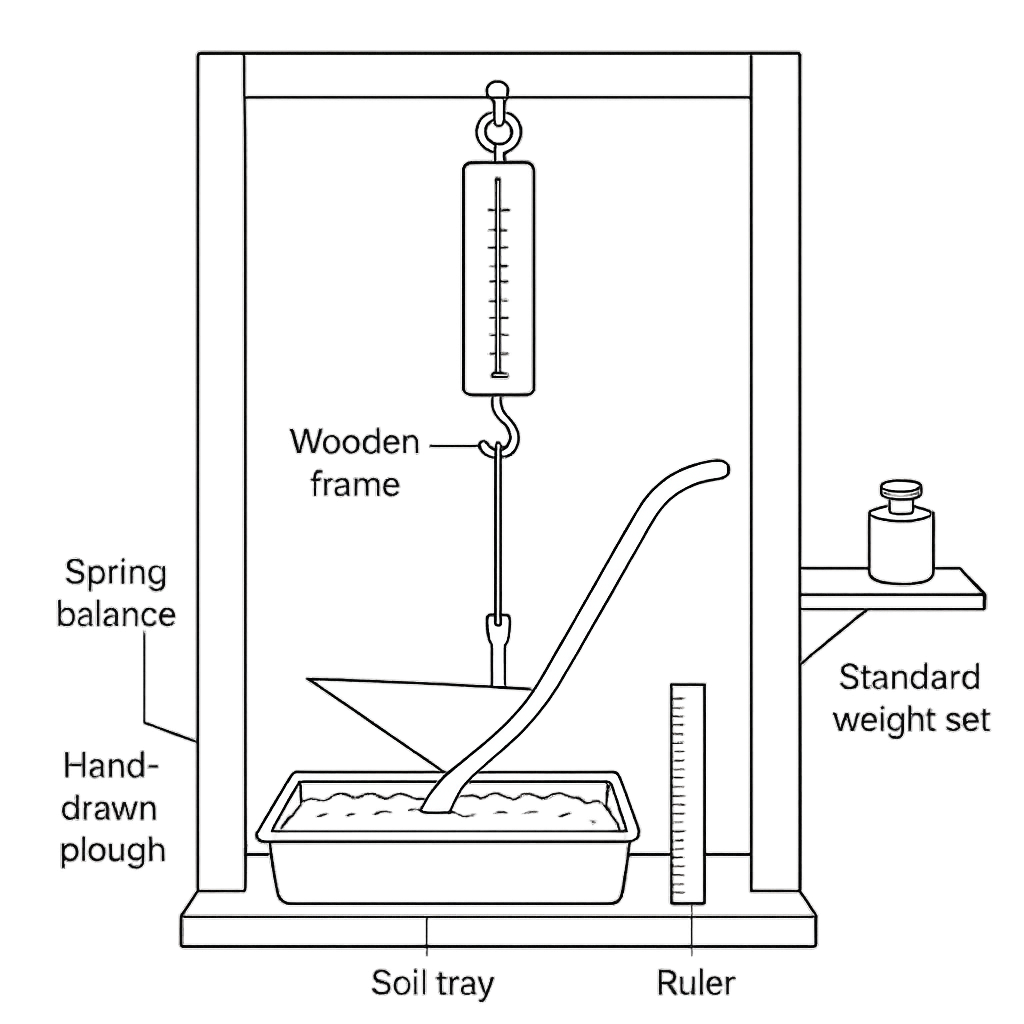
The diagram shows a practical setup used to determine the pulling force required to operate a small hand‑drawn plough in a loamy soil.
Question Parts
(a)
Identify each component shown in the diagram and state its specific purpose in the experiment.
(b)
The experiment was carried out three times with the plough inserted to a depth of 10 cm. The spring‑balance readings obtained were 12.5 N, 13.0 N and 12.8 N. Calculate the average pulling force required and comment on whether the force is within the acceptable range of 10 N – 15 N for small hand‑drawn ploughs.
(c)
Suggest two ways to reduce the pulling force required when operating the same plough in the field.
Detailed Essay Solution & Marking Scheme Available

Get the step-by-step mathematical proofs, key points required by examiners, and a comprehensive breakdown from our AI Tutor.

Question 4 View Details
A farmer intends to use a motorised rotary tiller to prepare a 2.5‑hectare field that has a medium‑hard loamy soil.
Question Parts
(a)
List three major components of a motorised rotary tiller and briefly describe the function of each.
(b)
The tiller consumes fuel at a rate of 0.8 L h⁻¹ when operating at full load. In medium‑hard loamy soil the actual load is about 75 % of full load. The tiller requires 6 h of operation per hectare at this load. Calculate the total volume of fuel required to till the entire 2.5‑hectare field.
(c)
Discuss two maintenance practices that will help keep the rotary tiller operating efficiently and extend its service life.
Detailed Essay Solution & Marking Scheme Available

Get the step-by-step mathematical proofs, key points required by examiners, and a comprehensive breakdown from our AI Tutor.

Question 5 View Details
A farmer intends to cultivate maize on a 5‑hectare field. Soil analysis of the top 15 cm shows an available phosphorus (P) level of 12 mg kg⁻¹, whereas the recommended level for optimum maize production is 20 mg kg⁻¹. The farmer plans to use triple superphosphate (TSP) that contains 46 % P₂O₅ by weight.
Question Parts
(a)
Calculate the amount of TSP (in kilograms) that must be applied per hectare to raise the soil P level to the recommended value. Show all steps of your calculation.
(b)
Discuss two advantages of applying organic manure together with the inorganic TSP fertilizer on the same field.
(c)
Outline a three‑year crop‑rotation plan for the field that will help sustain soil fertility for continuous maize production. Include the main crop(s) for each year and the purpose of each crop in the rotation.
Detailed Essay Solution & Marking Scheme Available

Get the step-by-step mathematical proofs, key points required by examiners, and a comprehensive breakdown from our AI Tutor.

Question 6 View Details
A smallholder dairy farmer keeps 20 lactating cows, each producing an average of 15 L of milk per day. The cows require 1.2 kg of crude protein (CP) per day from concentrate feed.
Question Parts
(a)
The farmer wants to formulate a 5 kg concentrate mix using maize grain (CP = 9 %), groundnut cake (CP = 48 %) and wheat bran (CP = 12 %). The mix must contain at least 10 % groundnut cake for palatability and not more than 30 % wheat bran. Determine the kilogram amount of each ingredient (maize, groundnut cake, wheat bran) in the 5 kg mix that will supply the required 1.2 kg CP per cow per day.
(b)
Identify and briefly explain two management practices that can be adopted to improve udder health and reduce the incidence of mastitis in the herd.
Detailed Essay Solution & Marking Scheme Available

Get the step-by-step mathematical proofs, key points required by examiners, and a comprehensive breakdown from our AI Tutor.

Question 7 View Details
A farmer cultivates 2.5 hectares of maize. Recent field scouting shows leaf rolling and yellowing of the leaves. Laboratory analysis identifies the pest as the African maize stalk borer (Busseola fusca).
Question Parts
(a)
Describe the life cycle of Busseola fusca and indicate which stage causes the greatest damage to the crop.
(b)
The recommended insecticide dosage is 0.75 L per hectare at a concentration of 200 g active ingredient (a.i.) per litre. Calculate the total volume of insecticide required for the whole field and the total amount of active ingredient needed.
(c)
Discuss at least three cultural or biological control methods that could be incorporated into an Integrated Pest Management (IPM) programme for Busseola fusca, and explain how each method reduces reliance on chemical insecticides.
(d)
The economic injury level (EIL) for Busseola fusca is a 5 % yield loss. Each hectare normally yields 6 tonnes of maize valued at ₦30 000 per tonne. Estimate the monetary loss if the pest reaches the EIL, and comment on whether the cost of applying the insecticide (₦12 000 per hectare) is justified.
Detailed Essay Solution & Marking Scheme Available

Get the step-by-step mathematical proofs, key points required by examiners, and a comprehensive breakdown from our AI Tutor.

Question 8 View Details
A farmer observes wilted leaves, brown streaks on stems and a reduced pod set in a 3‑hectare soybean field. Laboratory tests confirm Fusarium oxysporum f. sp. glycines as the causal agent of Fusarium wilt.
Question Parts
(a)
Explain the disease cycle of Fusarium wilt in soybean, highlighting the role of soil moisture and crop residues.
(b)
The farmer intends to use a soil fumigant that requires 2.5 kg per 100 m² at a concentration of 1.2 % active ingredient (a.i.). Determine the total amount of active ingredient required for the 3‑hectare field.
Detailed Essay Solution & Marking Scheme Available

Get the step-by-step mathematical proofs, key points required by examiners, and a comprehensive breakdown from our AI Tutor.

Master the Exam!

You've seen a preview, but there are thousands more questions plus AI tutor to break down complex solutions.

Unlock Full Access Available for Android & Windows
Help others prepare! Share this practice hub:
Chat with Support