neco model questions vol1 2024 physics | Objective

Prepare for your exams with neco model questions vol1 questions? Reviewing past/model questions is one of the most effective ways to guarantee a high score. This practice hub features authentic 2024 physics (Objective) questions designed to simulate the real exam environment.

Practice these randomly selected questions to test your readiness.
Question 1 View Details
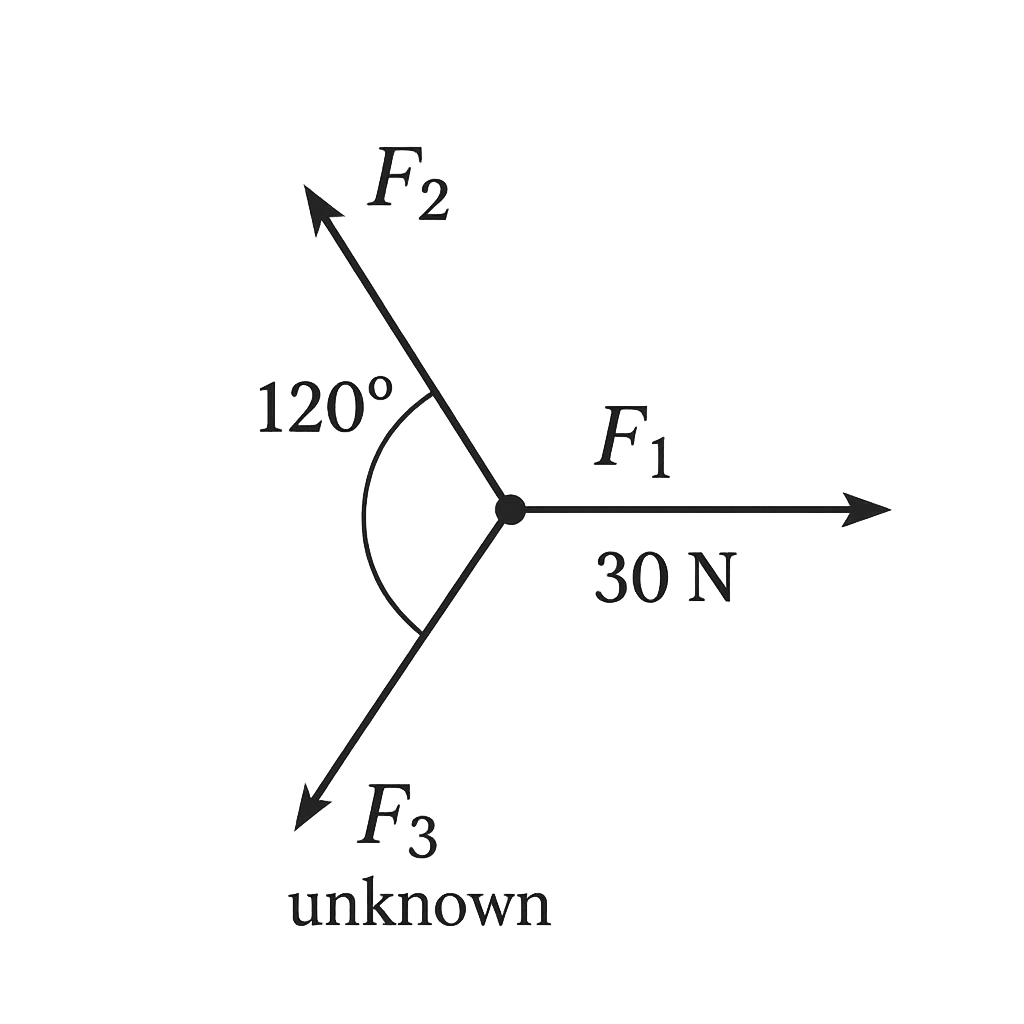
From the force diagram, a particle is acted upon by three coplanar forces. Force \(F_{1}\) has magnitude 30 N and is directed horizontally to the right. Force \(F_{2}\) has magnitude 40 N and makes an angle of \(120^{\circ}\) measured counter‑clockwise from the positive x‑axis. The third force \(F_{3}\) acts in a direction that makes the particle in equilibrium (its direction is unknown). Calculate the magnitude of \(F_{3}\) (in newtons).
A. 10\\sqrt{12} \\text{ N} \\; (\\approx 34.6 \\text{ N})
B. 12\\sqrt{13} \\text{ N} \\; (\\approx 43.3 \\text{ N})
Correct C. 10\sqrt{13} \text{ N} \; (\approx 36.1 \text{ N})
D. 8\\sqrt{13} \\text{ N} \\; (\\approx 28.8 \\text{ N})

Correct Answer: C

Want to see the full step-by-step solution? Unlock AI Explanation & Analytics
Question 2 View Details
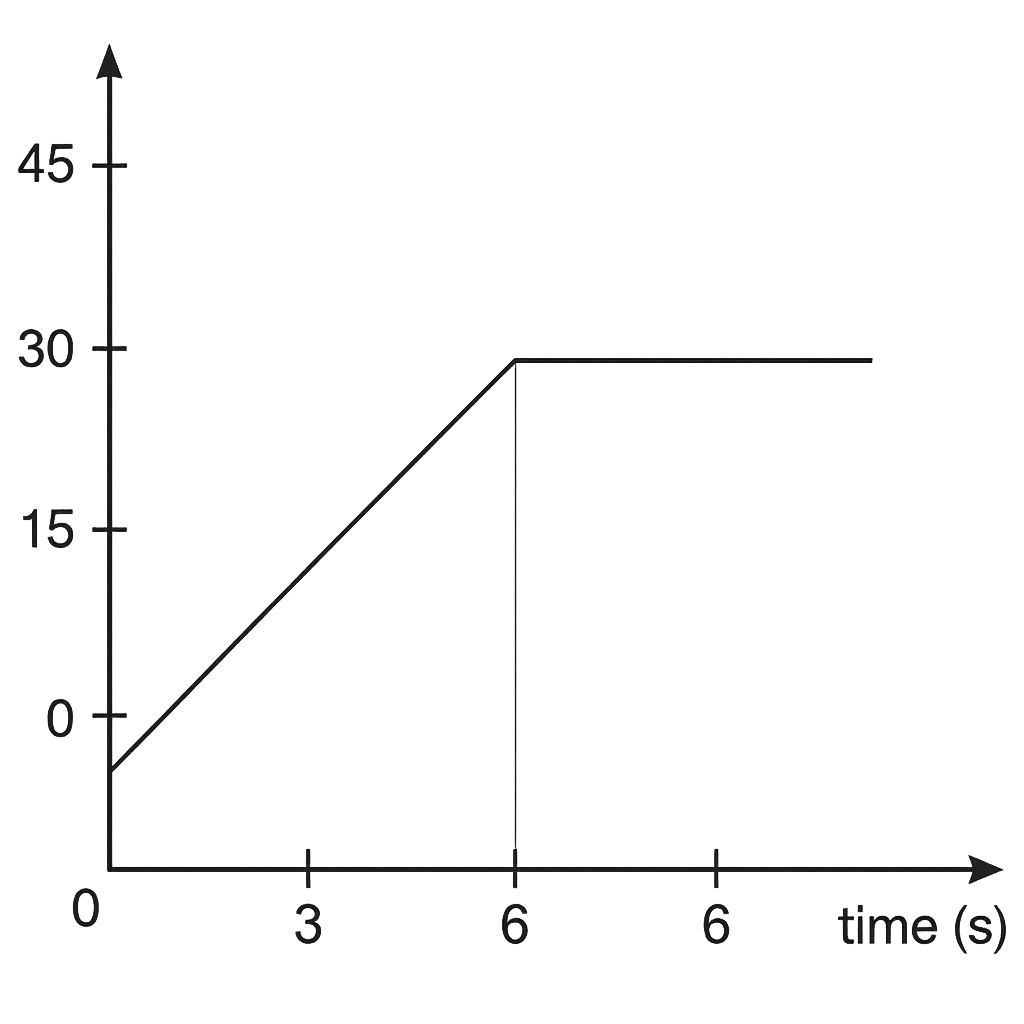
A distance-time graph shows a particle starting from rest at the origin, moving uniformly to a distance of 45 m in 3 s, then remaining stationary for the next 3 s. Determine the average speed of the particle over the whole 6‑second interval.
Correct A. 7.5 \text{ m/s}
B. 5.0 \\text{ m\\/s}
C. 12.5 \\text{ m\\/s}
D. 9.0 \\text{ m\\/s}

Correct Answer: A

Want to see the full step-by-step solution? Unlock AI Explanation & Analytics
Question 3 View Details
Block A (mass \(2.0\) kg, specific heat \(0.90\) kJ·kg⁻¹·K⁻¹) is initially at \(80^{\circ}\)C. Block B (mass \(3.0\) kg, unknown specific heat \(c_{B}\) kJ·kg⁻¹·K⁻¹) is initially at \(20^{\circ}\)C. The two blocks are placed in contact in an insulated container, but during the process 5.0 kJ of heat is lost to the surroundings. When thermal equilibrium is reached the common temperature is \(50^{\circ}\)C. Determine the specific heat \(c_{B}\) of block B (in kJ·kg⁻¹·K⁻¹).
A. 0.600 \\text{ kJ·kg}^{-1}\\text{·K}^{-1}
Correct B. 0.544 \text{ kJ·kg}^{-1}\text{·K}^{-1}
C. 0.450 \\text{ kJ·kg}^{-1}\\text{·K}^{-1}
D. 0.720 \\text{ kJ·kg}^{-1}\\text{·K}^{-1}

Correct Answer: B

Want to see the full step-by-step solution? Unlock AI Explanation & Analytics
Question 4 View Details
A rectangular coil of \(N=200\) turns and area \(A=0.020\) m\(^2\) rotates at a constant angular speed \(\omega\) in a uniform magnetic field of magnitude \(B=0.50\) T. The average emf induced during a quarter turn (from \(\theta=0\) to \(\theta=\pi/2\)) is measured to be 5.0 V.\n(a) Determine the angular speed \(\omega\) in rad·s\(^{-1}\).\n(b) If the coil is connected to a resistor of \(R=10\) \(\Omega\), find the maximum current that flows in the circuit.\n(c) Using the maximum current, calculate the mechanical power required to keep the coil rotating, assuming the only torque is the magnetic torque \(\tau = N I A B \sin\theta\) evaluated at the instant of maximum current (\(\theta=90^{\circ}\)). Give the power in watts.
A. \\omega = 3.50 \\text{ rad s}^{-1}, \\; I_{\\max}=0.900 \\text{ A}, \\; P = 7.00 \\text{ W}
Correct B. \omega = 3.93 \text{ rad s}^{-1}, \; I_{\max}=0.785 \text{ A}, \; P = 6.17 \text{ W}
C. \\omega = 4.10 \\text{ rad s}^{-1}, \\; I_{\\max}=0.720 \\text{ A}, \\; P = 5.80 \\text{ W}
D. \\omega = 4.20 \\text{ rad s}^{-1}, \\; I_{\\max}=0.650 \\text{ A}, \\; P = 5.20 \\text{ W}

Correct Answer: B

Want to see the full step-by-step solution? Unlock AI Explanation & Analytics
Question 5 View Details
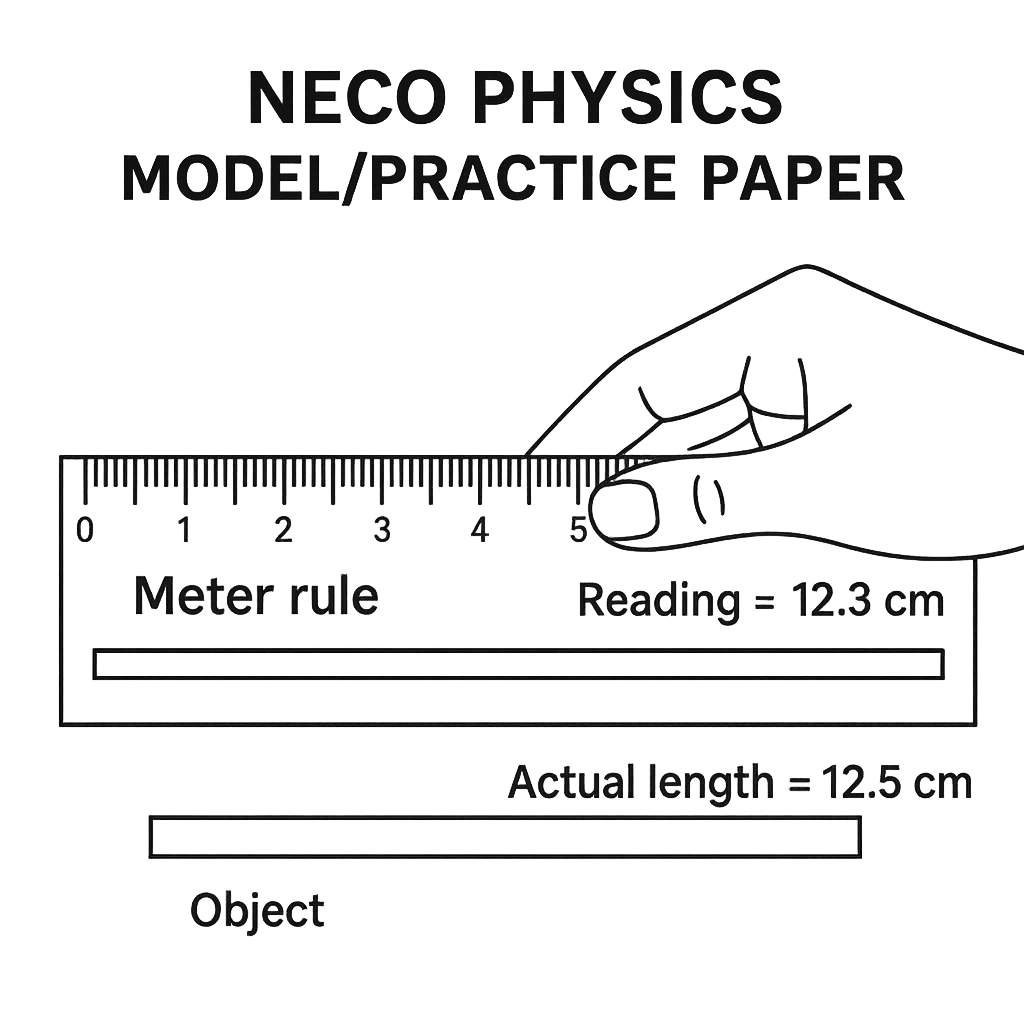
In a laboratory setup a metre rule is used to measure the length of a metal rod. The reading on the rule is 12.3 cm, while the true length of the rod (determined by a calibrated instrument) is 12.5 cm. Calculate the percentage error of the measurement. State whether the measurement is an over‑estimate or an under‑estimate.
A. 2.0% under‑estimate
B. 1.6% over‑estimate
Correct C. 1.6\% under‑estimate
D. 1.2% under‑estimate

Correct Answer: C

Want to see the full step-by-step solution? Unlock AI Explanation & Analytics
Question 6 View Details
A rectangular block measures \(12\ \text{cm} \times 8\ \text{cm} \times 5\ \text{cm}\) and has a mass of \(960\ \text{g}\). What is its density in \(\text{kg}\,\text{m}^{-3}\)?
A. 1500
Correct B. 2000
C. 3000
D. 2500

Correct Answer: B

Want to see the full step-by-step solution? Unlock AI Explanation & Analytics
Question 7 View Details
Two point charges are placed on the x‑axis. Charge \(q_{1}=+8\ \mu\text{C}\) is at the origin and charge \(q_{2}=-2\ \mu\text{C}\) is at \(x=0.20\ \text{m}\). (i) Find the position on the x‑axis between the charges where the net electric field is zero. (ii) Determine the electric potential at that point relative to infinity. Give your answer in volts.
A. 5.5×10^5 V
B. 1.3×10^5 V
C. 4.0×10^5 V
Correct D. 2.7×10^5 V

Correct Answer: D

Want to see the full step-by-step solution? Unlock AI Explanation & Analytics
Question 8 View Details
A \(5\ \text{kg}\) block is released from rest at the top of a \(30^{\circ}\) incline that is \(8\ \text{m}\) long. The coefficient of kinetic friction on the incline is \(0.15\). After reaching the bottom, the block moves onto a horizontal surface where the coefficient of kinetic friction is \(0.20\). A constant horizontal force is applied opposite to the motion and brings the block to rest after it has travelled an additional \(2\ \text{m}\). What is the magnitude of this applied force (in newtons)?
A. 48.5
Correct B. 62.7
C. 55.0
D. 70.2

Correct Answer: B

Want to see the full step-by-step solution? Unlock AI Explanation & Analytics
Question 9 View Details
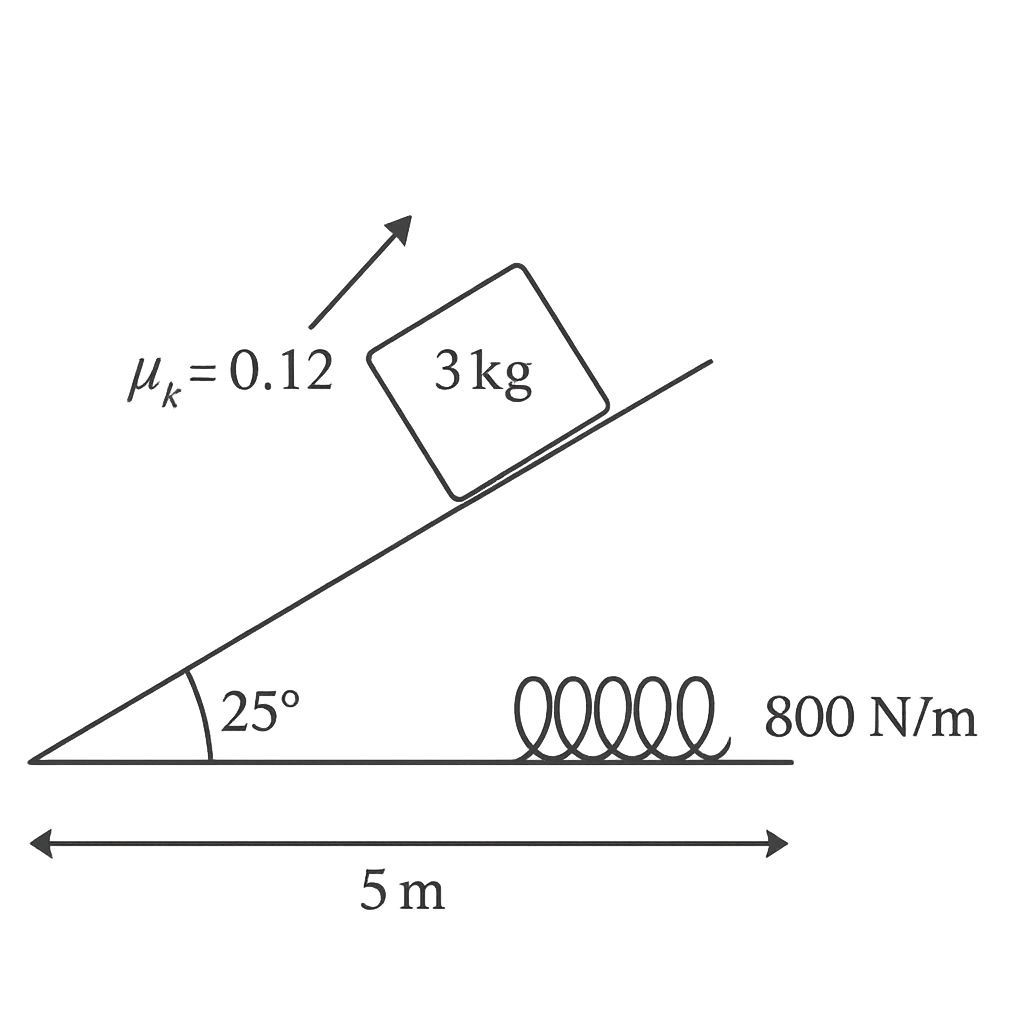
A \(3\ \text{kg}\) block slides down a rough inclined plane that makes an angle of \(25^{\circ}\) with the horizontal and has a length of \(5\ \text{m}\). The coefficient of kinetic friction between the block and the plane is \(0.12\). At the bottom of the incline the block compresses a spring of spring constant \(k = 800\ \text{N\,m}^{-1}\) and comes to rest after compressing the spring by a distance \(x\). Determine the compression \(x\) (in metres). Refer to the diagram showing the inclined plane, the block at the top, and the spring at the bottom.
Correct A. 0.34
B. 0.22
C. 0.28
D. 0.41

Correct Answer: A

Want to see the full step-by-step solution? Unlock AI Explanation & Analytics
Question 10 View Details
A single‑turn rectangular coil of dimensions \(0.10\ \text{m} \times 0.20\ \text{m}\) rotates with an angular speed of \(\omega = 300\ \text{rad s}^{-1}\) in a uniform magnetic field of magnitude \(B = 0.5\ \text{T}\). The axis of rotation is perpendicular to the field and passes through the centre of the coil. The coil has a resistance of \(2\ \Omega\). (i) What is the maximum induced emf in the coil? (ii) What is the average electrical power dissipated in the coil over one complete rotation? Express your answers in volts and watts respectively.
Correct A. 3 V, 2.25 W
B. 3 V, 3.0 W
C. 3.5 V, 2.75 W
D. 2.5 V, 1.56 W

Correct Answer: A

Want to see the full step-by-step solution? Unlock AI Explanation & Analytics
Question 11 View Details
A block and tackle system consisting of 3 movable pulleys is used to lift a load of 200 N. The free end of the rope is pulled through a distance of 2.0 m, and the system operates with an efficiency of 80%. Assuming the ideal mechanical advantage of the arrangement equals the number of supporting rope sections, calculate the magnitude of the input force applied to the rope.
A. 50 N
Correct B. 62.5 N
C. 100 N
D. 75 N

Correct Answer: B

Want to see the full step-by-step solution? Unlock AI Explanation & Analytics
Question 12 View Details
A source of sound emits a frequency of 500 Hz. An observer standing still hears the frequency as 540 Hz because the source is moving directly towards the observer. If the speed of sound in air is 340 m s(^{-1}), determine the speed of the source.
A. 28.0 m/s
Correct B. 25.2 m/s
C. 30.1 m/s
D. 22.5 m/s

Correct Answer: B

Want to see the full step-by-step solution? Unlock AI Explanation & Analytics
Question 13 View Details
A U‑tube manometer is open to the atmosphere at both ends. One leg contains oil of unknown density; the oil column has a height of 0.30 m. The other leg contains mercury (density \(13\,600\ \text{kg\,m}^{-3}\)). The mercury level in the oil leg is lower by 0.02 m compared with the mercury level in the other leg. Assuming the same atmospheric pressure acts on both sides, calculate the density of the oil (in kg\,m(^{-3}\)).
A. 7.20×10^2 kg\/m^3
B. 1.12×10^3 kg\/m^3
Correct C. 9.07×10^2 kg/m^3
D. 8.45×10^2 kg\/m^3

Correct Answer: C

Want to see the full step-by-step solution? Unlock AI Explanation & Analytics
Question 14 View Details
A loudspeaker produces a sound intensity level of 100 dB at a distance of 2.0 m from the source. Assuming the sound spreads uniformly in all directions, at what distance from the speaker will the intensity level be reduced to 80 dB? (Take the reference intensity \(I_0 = 10^{-12}\ \text{W\,m}^{-2}\).)
A. 40 m
Correct B. 20 m
C. 10 m
D. 5 m

Correct Answer: B

Want to see the full step-by-step solution? Unlock AI Explanation & Analytics
Question 15 View Details
A ball is thrown vertically upward from the ground with an initial speed of 20 m s(^{-1}). At the same instant a second ball is released from rest from a height of 30 m above the ground, but the release occurs 0.5 s later than the throw of the first ball. Assuming the acceleration due to gravity is \(10\ \text{m\,s}^{-2}\) downward, determine the time (in seconds) after the first ball is thrown when the two balls meet.
A. 1.45 s
B. 2.10 s
C. 2.35 s
Correct D. 1.92 s

Correct Answer: D

Want to see the full step-by-step solution? Unlock AI Explanation & Analytics
Question 16 View Details
A Li^{2+} ion (Z = 3) has an electron in the n = 3 orbit. The ion absorbs a photon and the electron jumps to the n = 5 orbit. (i) Calculate the minimum wavelength of the photon required for this transition. (ii) After the transition the electron is ionised from the n = 5 level; the excess energy appears as kinetic energy of the freed electron. Determine this kinetic energy. (Use (hc = 1240\,\text{eV·nm}\)).
Correct A. λ = 1.43×10^2 nm; K.E. = 3.81 eV
B. λ = 1.27×10^2 nm; K.E. = 4.12 eV
C. λ = 1.35×10^2 nm; K.E. = 4.00 eV
D. λ = 1.58×10^2 nm; K.E. = 3.45 eV

Correct Answer: A

Want to see the full step-by-step solution? Unlock AI Explanation & Analytics
Question 17 View Details
A 4.0 kg block rests on a smooth incline that makes an angle of \(20^{\circ}\) with the horizontal. The block is attached to a light string that passes over a frictionless pulley at the top of the incline and is connected to a hanging mass \(m_2\). The coefficient of kinetic friction between the block and the incline is \(\mu_k = 0.20\). The system is required to accelerate up the incline with a magnitude of \(2.0\,\text{m s}^{-2}\). Determine the mass \(m_2\) (in kilograms) that will produce this motion.
A. 2.85 kg
Correct B. 3.69 kg
C. 4.12 kg
D. 5.00 kg

Correct Answer: B

Want to see the full step-by-step solution? Unlock AI Explanation & Analytics
Question 18 View Details
A 150 g metal block (specific heat \(c_m = 0.385\,\text{J g}^{-1}\text{°C}^{-1}\)) at \(120^{\circ}\text{C}\) is placed into a calorimeter containing 200 g of water (specific heat \(c_w = 4.18\,\text{J g}^{-1}\text{°C}^{-1}\)) initially at \(25^{\circ}\text{C}\). After thermal equilibrium the temperature of the system is \(30^{\circ}\text{C}\). If the calorimeter itself has an unknown heat capacity \(C_{\text{cal}}\) (in J/°C), determine \(C_{\text{cal}}\).
A. 2.44×10^2 J/°C
B. 2.04×10^3 J/°C
C. 1.84×10^2 J/°C
Correct D. 2.04×10^2 J/°C

Correct Answer: D

Want to see the full step-by-step solution? Unlock AI Explanation & Analytics
Question 19 View Details
A source emits sound of frequency \(f = 500\,\text{Hz}\) and moves towards a rigid wall with speed \(v_s = 20\,\text{m s}^{-1}\). The speed of sound in air is \(v = 340\,\text{m s}^{-1}\). The sound reflects from the wall and returns to the source, which continues to move towards the wall at the same speed. What frequency does the source hear in the reflected wave?
A. 600 Hz
B. 540 Hz
C. 580 Hz
Correct D. 562.5 Hz

Correct Answer: D

Want to see the full step-by-step solution? Unlock AI Explanation & Analytics
Question 20 View Details
Two point charges are placed on the x‑axis: a charge \(+8\,\mu\text{C}\) at the origin and a charge \(-2\,\mu\text{C}\) at \(x = 0.12\,\text{m}\). (i) Find the position on the x‑axis where the net electric field is zero. (ii) At that point, calculate the electric potential (taking the potential at infinity as zero). (Use \(k = 9.0\times10^{9}\,\text{N m}^{2}\text{C}^{-2}\)).
A. x = 0.08 m; V = 2.0×10^5 V
B. x = 0.24 m; V = 2.5×10^5 V
C. x = 0.36 m; V = 1.0×10^5 V
Correct D. x = 0.24 m; V = 1.5×10^5 V

Correct Answer: D

Want to see the full step-by-step solution? Unlock AI Explanation & Analytics
Question 21 View Details
A car travels at a speed of \(72\ \text{km h}^{-1}\). How many metres does it travel in \(45\ \text{s}\)?
A. 3240
B. 1000
Correct C. 900
D. 800

Correct Answer: C

Want to see the full step-by-step solution? Unlock AI Explanation & Analytics
Question 22 View Details
A string of length \(0.80\ \text{m}\) is fixed at both ends and vibrates in its fundamental mode with a frequency of \(120\ \text{Hz}\) when the tension in the string is \(T\). The tension is then increased by 25 %. Assuming the linear mass density of the string does not change, what is the new fundamental frequency (in Hz, to the nearest whole number)?
A. 133
B. 135
Correct C. 134
D. 150

Correct Answer: C

Want to see the full step-by-step solution? Unlock AI Explanation & Analytics
Question 23 View Details
A converging thin lens forms a real image of a candle on a screen. The image distance is \(30\ \text{cm}\) and the linear magnification of the image is 2 (the image is twice as tall as the object). Determine the focal length of the lens in centimetres.
A. 5
B. 20
Correct C. 10
D. 15

Correct Answer: C

Want to see the full step-by-step solution? Unlock AI Explanation & Analytics
Question 24 View Details
A metal block of mass \(0.50\ \text{kg}\) and specific heat capacity \(0.385\ \text{kJ\,kg}^{-1}\text{°C}^{-1}\) is heated to \(150\ \text{°C}\) and then placed into a calorimeter containing \(2.0\ \text{kg}\) of water at \(25\ \text{°C}\). The calorimeter has a heat capacity of \(0.5\ \text{kJ\,°C}^{-1}\). The specific heat capacity of water is \(4.18\ \text{kJ\,kg}^{-1}\text{°C}^{-1}\). Assuming no heat loss to the surroundings, find the final equilibrium temperature of the system in °C (to one decimal place).
A. 22.3
B. 30.0
Correct C. 27.7
D. 32.5

Correct Answer: C

Want to see the full step-by-step solution? Unlock AI Explanation & Analytics
Question 25 View Details
A sealed piston‑cylinder contains an ideal gas at an initial temperature of \(300\ \text{K}\), pressure \(1.0\ \text{atm}\) and volume \(2.0\ \text{L}\). The gas is first compressed isothermally to half its original volume and then heated at constant volume until its temperature reaches \(450\ \text{K}\). What is the final pressure of the gas in atmospheres?
A. 6
Correct B. 3
C. 4
D. 2

Correct Answer: B

Want to see the full step-by-step solution? Unlock AI Explanation & Analytics

Master the Exam!

You've seen a preview, but there are thousands more questions plus AI tutor to break down complex solutions.

Unlock Full Access Available for Android & Windows
Help others prepare! Share this practice hub:
Chat with Support