neco model questions vol1 2024 physics | Essay

Prepare for your exams with neco model questions vol1 questions? Reviewing past/model questions is one of the most effective ways to guarantee a high score. This practice hub features authentic 2024 physics (Essay) questions designed to simulate the real exam environment.

Practice these randomly selected questions to test your readiness.
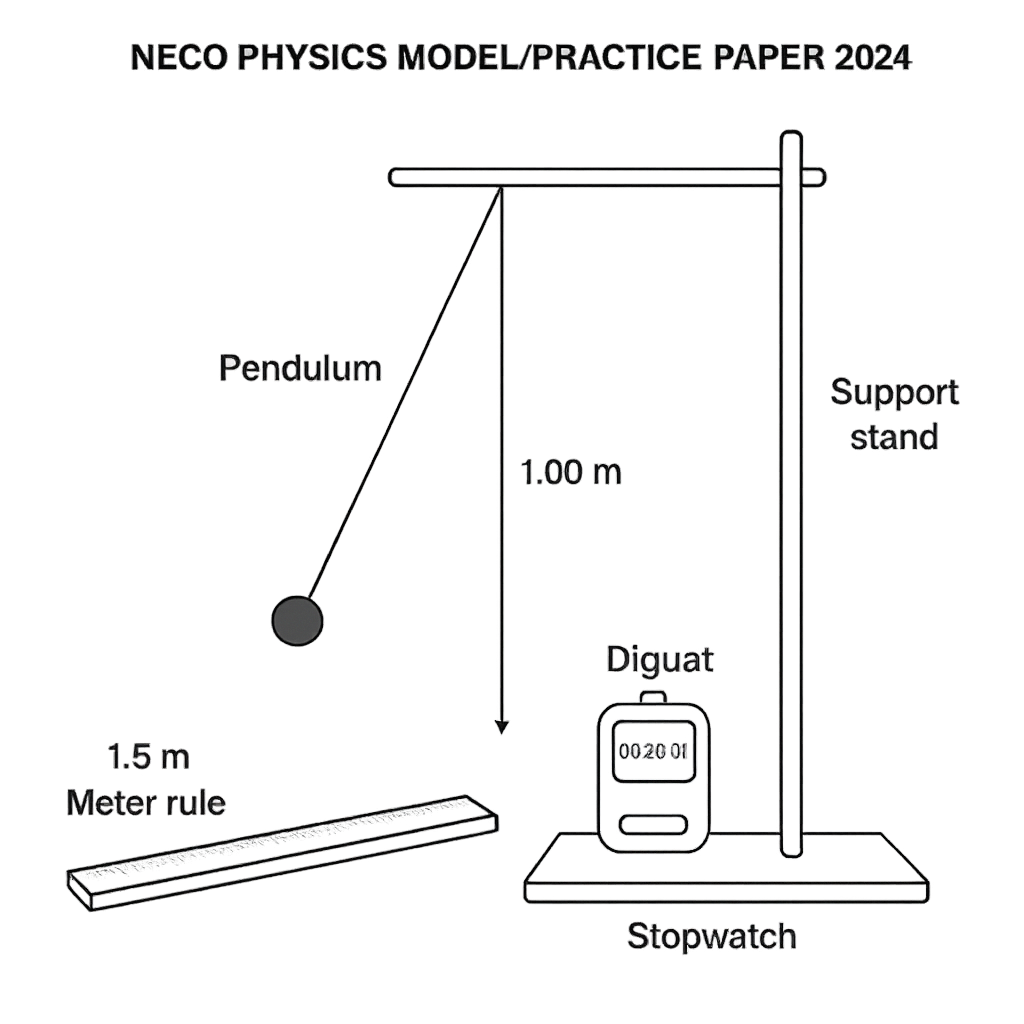
Question 1 View Details
A simple pendulum is set up in the laboratory as shown in the illustration. The length of the string from the point of suspension to the centre of the bob is 1.00 m. The bob is a small dense sphere. The period of the pendulum is measured by timing 20 complete oscillations on three separate trials, giving the total times recorded as 40.0 s, 40.2 s and 39.8 s. The experiment is to be used to determine the acceleration due to gravity and to discuss the reliability of the result.
Question Parts
(a)
State the length of the pendulum as shown in the illustration.
(b)
Calculate the value of the acceleration due to gravity (g) from the data provided. Show all steps and give your answer to two decimal places in m s⁻².
(c)
Identify two possible systematic errors in this experiment and suggest a method to reduce each error.
(d)
If the length of the pendulum were increased by 20 % while all other conditions remained the same, predict the new period of the pendulum (to two decimal places).
Detailed Essay Solution & Marking Scheme Available

Get the step-by-step mathematical proofs, key points required by examiners, and a comprehensive breakdown from our AI Tutor.

Question 2 View Details
A boat can move at a speed of 4.0 m s⁻¹ relative to still water. It attempts to cross a river that is 200 m wide. The river flows downstream at a uniform speed of 2.0 m s⁻¹. The boat is steered so that its direction relative to the water is exactly perpendicular to the banks of the river.
Question Parts
(a)
Represent the velocity of the boat relative to the water and the velocity of the river current as vectors. State the magnitude and direction of each vector with respect to the river banks.
(b)
Determine the magnitude and direction of the resultant velocity of the boat with respect to the ground.
Detailed Essay Solution & Marking Scheme Available

Get the step-by-step mathematical proofs, key points required by examiners, and a comprehensive breakdown from our AI Tutor.

Question 3 View Details
A 150 g block of copper at 150°C is placed into 200 g of water at 25°C in an insulated container. The specific heat capacities are: copper 0.385 J g⁻¹ K⁻¹, water 4.18 J g⁻¹ K⁻¹. Assume no heat loss to the surroundings.
Question Parts
(a)
Write the energy‑balance equation for the system.
(b)
Calculate the final equilibrium temperature of the water and copper.
(c)
Determine the amount of heat transferred from the copper to the water.
Detailed Essay Solution & Marking Scheme Available

Get the step-by-step mathematical proofs, key points required by examiners, and a comprehensive breakdown from our AI Tutor.

Question 4 View Details
A battery of unknown emf E and internal resistance r is connected to a circuit as shown in the diagram. The circuit contains a switch S, an ammeter A placed in series with the battery, a voltmeter V connected across resistor R1, and two external resistors R1 = 4 Ω and R2 = 6 Ω that are placed in parallel when the switch is closed. When the switch S is closed the ammeter reads a total current I_total = 4.00 A and the voltmeter reads a voltage V_R1 = 9.60 V. When the switch is open (so that only R1 remains in the circuit) the ammeter reads I_R1_only = 2.50 A. Using the information above, answer the following: a) Determine the current through each external resistor (I_R1 and I_R2) when the switch is closed. b) Calculate the internal resistance r of the battery and its emf E. c) Compute: i) the total power supplied by the battery, ii) the power dissipated in each external resistor, iii) the power loss in the internal resistance, and iv) the efficiency of the circuit (percentage of the total power that is useful). d) A third resistor R3 = 12 Ω is now added in parallel with R1 and R2 (the switch remains closed). Determine the new total current drawn from the battery and the new terminal voltage across the parallel combination. Comment briefly on how the addition of R3 influences the efficiency of the circuit.
Question Parts
(a)
Determine the current through each external resistor (I_R1 and I_R2) when the switch is closed.
(b)
Calculate the internal resistance r of the battery and its emf E.
Detailed Essay Solution & Marking Scheme Available

Get the step-by-step mathematical proofs, key points required by examiners, and a comprehensive breakdown from our AI Tutor.

Question 5 View Details
A 5.0 kg block is released from rest at the top of a smooth inclined plane that is 4.0 m high and makes an angle of 30° with the horizontal. The coefficient of kinetic friction between the block and the plane is 0.20. After reaching the bottom, the block continues onto a horizontal rough surface where the coefficient of kinetic friction is 0.15 and it comes to rest after travelling 2.0 m. (a) Determine the speed of the block at the instant it reaches the bottom of the incline. (b) Calculate the total work done by friction during the whole motion (incline + horizontal). (c) If a motor pulls the block up the same incline at a constant speed of 2.0 m s⁻¹, what is the minimum power output of the motor? (Assume the same coefficient of friction on the incline.)
Question Parts
(a)
Determine the speed of the block at the instant it reaches the bottom of the incline.
(b)
Calculate the total work done by friction during the whole motion (incline + horizontal).
(c)
If a motor pulls the block up the same incline at a constant speed of 2.0 m s⁻¹, what is the minimum power output of the motor? (Assume the same coefficient of friction on the incline.)
Detailed Essay Solution & Marking Scheme Available

Get the step-by-step mathematical proofs, key points required by examiners, and a comprehensive breakdown from our AI Tutor.

Question 6 View Details
The diagram shows a smooth inclined plane making an angle of 30° with the horizontal. A block of mass 10 kg rests on the plane. A light inextensible string is attached to the block, runs up the plane, over a fixed frictionless pulley at the top of the plane, and then down vertically where it supports a hanging mass M. The other end of the same string is attached to the long arm of a lever. The lever is a rigid bar AB of total length 0.5 m, pivoted at point O which is 0.2 m from end A (the short arm AO) and 0.3 m from end B (the long arm OB). A downward force F is applied at point A. The coefficient of kinetic friction between the block and the plane is 0.2. The system moves at constant speed. Answer the following:
Question Parts
(a)
Determine the tension T in the string.
(b)
Find the mass M of the hanging load.
(c)
Calculate the magnitude of the applied force F required to keep the system in equilibrium.
(d)
Compute the mechanical advantage (MA) of the whole compound machine, defined as load force divided by effort force.
(e)
If the point of application of the effort moves through a distance of 0.10 m, calculate the efficiency of the machine as a percentage. Assume the block moves the corresponding distance along the plane.
Detailed Essay Solution & Marking Scheme Available

Get the step-by-step mathematical proofs, key points required by examiners, and a comprehensive breakdown from our AI Tutor.

Question 7 View Details
A vertical U‑tube manometer is closed at the top and contains three immiscible fluids as shown: from the bottom upward the tube contains mercury, then a layer of oil, and finally a trapped pocket of air. The height of the mercury column is 0.30 m, the height of the oil column above the mercury is 0.20 m, and the atmospheric pressure is 1.01×10⁵ Pa. The pressure measured at the oil‑mercury interface is 1.20×10⁵ Pa. The trapped air occupies a volume of 2.0×10⁻⁴ m³ at 300 K.
Question Parts
(a)
Determine the density of the oil.
(b)
Find the gauge pressure exerted by the combined oil‑mercury column at the bottom of the mercury layer.
(c)
If the temperature of the trapped air rises to 350 K while the liquid columns remain unchanged, determine the new pressure exerted by the air on the liquid column (assume ideal gas behaviour).
(d)
Explain qualitatively how the pressure reading would change if the whole apparatus were placed in an elevator accelerating upwards at 2.0 m s⁻².
Detailed Essay Solution & Marking Scheme Available

Get the step-by-step mathematical proofs, key points required by examiners, and a comprehensive breakdown from our AI Tutor.

Question 8 View Details
A 0.500 kg copper block (specific heat capacity c_Cu = 385 J kg⁻¹ K⁻¹) at 200 °C is quickly dropped into a calorimeter containing 1.20 kg of water (c_water = 4186 J kg⁻¹ K⁻¹) initially at 25 °C. The calorimeter itself has a heat capacity of 150 J K⁻¹ and is assumed to be perfectly insulated during the mixing process. After thermal equilibrium is reached, the temperature of the system is recorded as T₁. The calorimeter is then placed in a room maintained at 20 °C, and the temperature of the whole system falls to 30 °C after exactly 10 minutes. The cooling follows Newton’s law of cooling, dT/dt = –k(T – T_room), where k is the overall heat‑transfer coefficient (in s⁻¹).
Question Parts
(a)
Calculate the equilibrium temperature T₁ after the copper block has been placed in the water (neglect any heat loss to the surroundings).
(b)
Using the data that the temperature falls from T₁ to 30 °C in 10 minutes, determine the numerical value of the cooling coefficient k.
(c)
If the mass of water were increased to 2.0 kg while all other conditions remain the same, estimate the new equilibrium temperature T₁'.
(d)
Discuss how ignoring the calorimeter’s heat capacity would affect the determination of the copper block’s specific heat capacity if the experiment were used for that purpose.
Detailed Essay Solution & Marking Scheme Available

Get the step-by-step mathematical proofs, key points required by examiners, and a comprehensive breakdown from our AI Tutor.

Master the Exam!

You've seen a preview, but there are thousands more questions plus AI tutor to break down complex solutions.

Unlock Full Access Available for Android & Windows
Help others prepare! Share this practice hub:
Chat with Support