neco model questions vol1 2024 mathematics | Essay

Prepare for your exams with neco model questions vol1 questions? Reviewing past/model questions is one of the most effective ways to guarantee a high score. This practice hub features authentic 2024 mathematics (Essay) questions designed to simulate the real exam environment.

Practice these randomly selected questions to test your readiness.

Question 1 View Details
A positive integer N satisfies the following three conditions: - When N is divided by 7 the remainder is 3. - When N is divided by 9 the remainder is 5. - When N is divided by 11 the remainder is 7. Find the smallest such N and then determine the sum of the digits of this N.
Detailed Essay Solution & Marking Scheme Available

Get the step-by-step mathematical proofs, key points required by examiners, and a comprehensive breakdown from our AI Tutor.
Question 2 View Details
A shop marks an item at a price of M naira. A discount of 15 % is offered on the marked price. After the discount, a sales tax of 5 % is added to the discounted price. If the customer finally pays ₦2 040, determine: (a) the original marked price M (expressed as an exact fraction of naira and also to two decimal places); (b) the discount amount as a fraction of the marked price in its simplest form.
Question Parts
(a)
Find the original marked price M.
(b)
Express the discount amount as a fraction of the marked price in simplest form.
Detailed Essay Solution & Marking Scheme Available

Get the step-by-step mathematical proofs, key points required by examiners, and a comprehensive breakdown from our AI Tutor.
Question 3 View Details
A positive real number \(a\) satisfies \(\sqrt{a}=2^{\frac13}\). It is also given that \(2^{x}\,a^{2x}=8\).
Question Parts
(a)
Determine the value of \(a\).
(b)
Using the value of \(a\) found in part (a), solve for \(x\).
(c)
Evaluate the expression \(E = a^{x}+a^{-x}\) using the values of \(a\) and \(x\) obtained above. Give your answer in simplest surd form.
Detailed Essay Solution & Marking Scheme Available

Get the step-by-step mathematical proofs, key points required by examiners, and a comprehensive breakdown from our AI Tutor.

Question 4 View Details
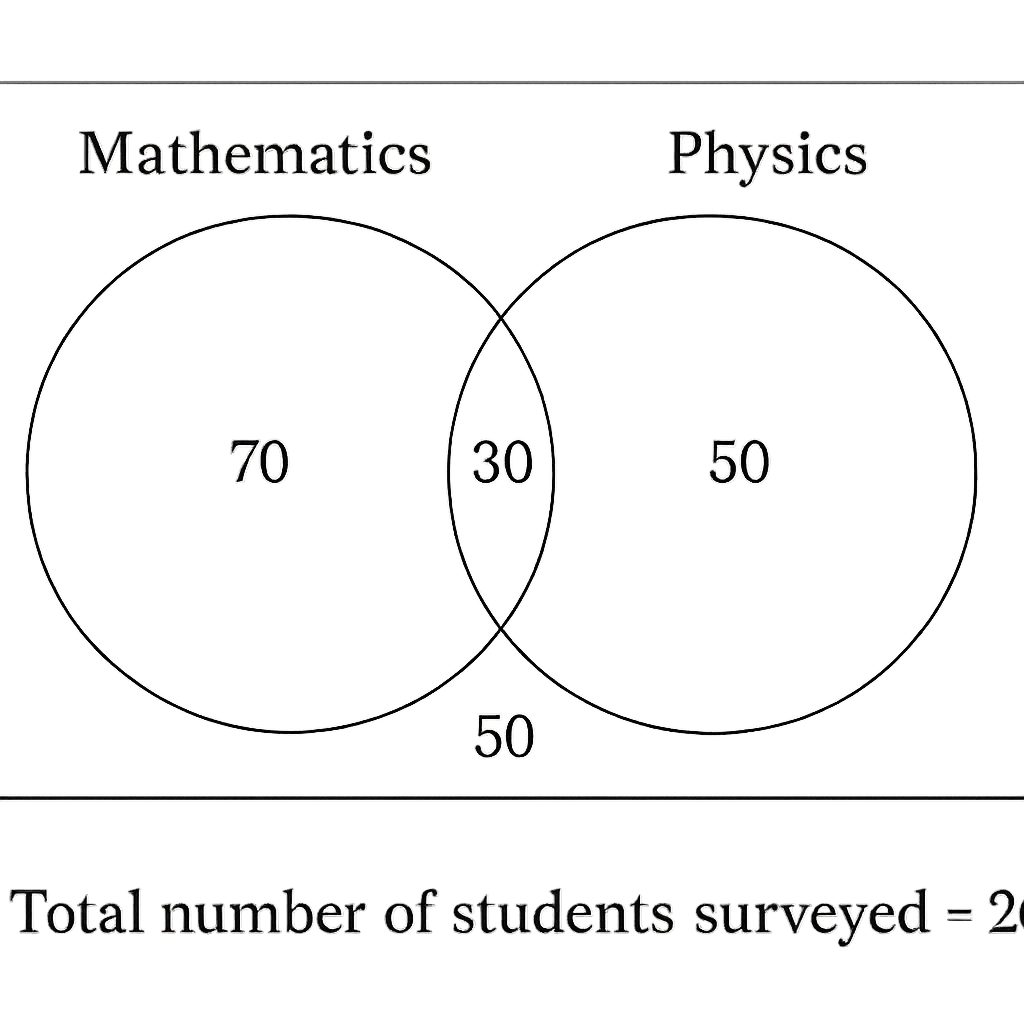
A secondary school conducted a survey of 200 senior secondary students to find out which of the two subjects – Mathematics (M) and Physics (P) – they study. The results are represented in the Venn diagram provided.
Question Parts
(a)
State the probability that a randomly selected student studies Mathematics.
(b)
Find the probability that a randomly selected student studies neither Mathematics nor Physics.
(c)
Given that a student studies Physics, calculate the probability that the same student also studies Mathematics.
(d)
Two students are selected at random without replacement. Find the probability that both students study at least one of the two subjects.
Detailed Essay Solution & Marking Scheme Available

Get the step-by-step mathematical proofs, key points required by examiners, and a comprehensive breakdown from our AI Tutor.

Question 5 View Details
Consider the algebraic expression \( (2a-3b)^2-(a-2b)^2 \).
Question Parts
(a)
Simplify the expression completely. State the simplified form in factored and expanded versions.
(b)
Given that \(a-b=5\) and \(a+2b=14\), determine the numerical values of \(a\) and \(b\).
(c)
Using the values of \(a\) and \(b\) from part (b), evaluate the simplified expression obtained in part (a).
Detailed Essay Solution & Marking Scheme Available

Get the step-by-step mathematical proofs, key points required by examiners, and a comprehensive breakdown from our AI Tutor.

Question 6 View Details
A school bus travels from Town X to Town Y. The distance between the towns is unknown. The driver covers the first half of the distance at a speed of 40 km/h and the second half at 60 km/h. The total journey takes 2.5 hours.
Question Parts
(a)
Form a linear equation in the total distance \(D\) (in kilometres) and solve for \(D\).
(b)
If the driver wishes to complete the same 120 km journey in exactly 2 hours by maintaining a constant speed throughout, determine the required speed (in km/h).
(c)
The bus consumes fuel at a rate of 0.15 L per kilometre when travelling at 40 km/h and 0.12 L per kilometre when travelling at 60 km/h. Calculate the total amount of fuel used for the original journey described in part (a).
Detailed Essay Solution & Marking Scheme Available

Get the step-by-step mathematical proofs, key points required by examiners, and a comprehensive breakdown from our AI Tutor.

Question 7 View Details
A composite solid consists of a right circular cylinder of radius 3 cm and height 10 cm standing on a square base of side 6 cm. A right circular cone of the same radius (3 cm) and height 6 cm is attached on the top of the cylinder. The square base rests on the floor and is not to be painted. All dimensions are shown in the diagram.
Question Parts
(a)
Determine the slant height of the cone.
(b)
Find the total surface area of the solid that will be painted (exclude the square base). Express the answer in terms of π and also give a numerical value correct to two decimal places (in cm²).
(c)
Determine the total volume of the solid. Give the answer in terms of π and also a numerical value correct to two decimal places (in cm³).
(d)
If the material of the solid costs ₦250 per cm³ and painting costs ₦150 per m², calculate: (i) the total cost of the material; (ii) the total painting cost for the exposed surface (use the area from part (b)). Give your answers in naira, rounded to the nearest naira.
Detailed Essay Solution & Marking Scheme Available

Get the step-by-step mathematical proofs, key points required by examiners, and a comprehensive breakdown from our AI Tutor.

Question 8 View Details
A company offers a discount scheme where the discount percentage D on a purchase of ₦x is given by D = 5 + 0.02x, but the discount cannot exceed 20%.
Question Parts
(a)
Determine the range of purchase amounts x (in naira) for which the discount formula can be used without the 20% cap being triggered.
Detailed Essay Solution & Marking Scheme Available

Get the step-by-step mathematical proofs, key points required by examiners, and a comprehensive breakdown from our AI Tutor.

Question 9 View Details
The terms of a sequence form an arithmetic progression. The sum of the first five terms is 70 and the sum of the first ten terms is 190.
Question Parts
(a)
Find the first term \(a_1\) and the common difference \(d\) of the progression.
(b)
Using the values found in part (a), determine the 12th term \(a_{12}\).
(c)
Find the sum of the first twelve terms \(S_{12}\).
Detailed Essay Solution & Marking Scheme Available

Get the step-by-step mathematical proofs, key points required by examiners, and a comprehensive breakdown from our AI Tutor.

Question 10 View Details
The time \(T\) (in minutes) required to paint a wall varies directly as the area \(A\) (in m²) of the wall, varies inversely as the number of painters \(p\), and also varies inversely as the square root of the average painting speed \(s\) (in m² per minute per painter).
Question Parts
(a)
When \(A = 40\) m², \(p = 4\) painters and \(s = 2\) m²·min⁻¹·painter⁻¹, the wall is painted in 10 minutes. Determine the constant of variation \(k\).
(b)
Using the constant found in part (a), calculate the time required to paint a wall of area \(A = 60\) m² if 5 painters work at a speed of \(s = 3\) m²·min⁻¹·painter⁻¹.
(c)
If the same wall (area 60 m²) must be painted in exactly 8 minutes with the same painting speed \(s = 3\) m²·min⁻¹·painter⁻¹, determine the minimum integer number of painters required.
Detailed Essay Solution & Marking Scheme Available

Get the step-by-step mathematical proofs, key points required by examiners, and a comprehensive breakdown from our AI Tutor.

Question 11 View Details
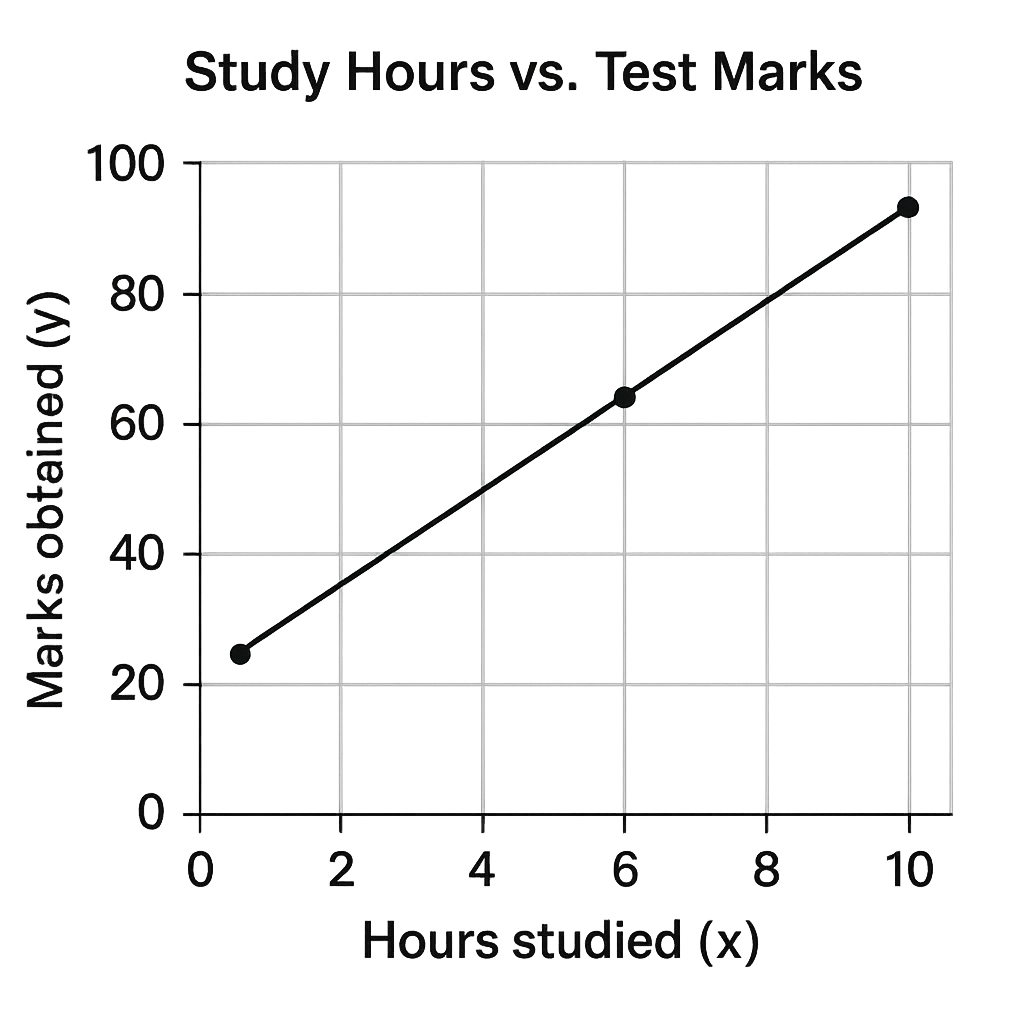
The graph below shows the relationship between the number of hours (x) a student studies and the marks (y) obtained in a mathematics test.
Question Parts
(a)
Determine the gradient of the straight‑line segment joining the points (4, 50) and (8, 80).
(b)
Using the graph, estimate the marks the student would obtain after studying for 6 hours. Show how you arrived at the estimate.
(c)
The graph shows that after 8 hours the increase in marks per additional hour becomes smaller. Explain, with reference to the shape of the graph, why the marginal increase in marks reduces.
Detailed Essay Solution & Marking Scheme Available

Get the step-by-step mathematical proofs, key points required by examiners, and a comprehensive breakdown from our AI Tutor.

Question 12 View Details
In the diagram, triangle ABC is shown. ∠A = 30°, ∠B = 70° and side AB = 12 cm. The triangle is placed in a rectangular coordinate system such that point A is at the origin (0,0) and side AB lies on the positive x‑axis.
Question Parts
(a)
Find the lengths of sides AC and BC. Give your answers correct to two decimal places.
(b)
Determine the coordinates of point C. Give each coordinate correct to two decimal places.
(c)
Write the equation of the straight line through C that is perpendicular to AB.
(d)
The perpendicular line in part (c) meets AB at point D. (i) Find the coordinates of D. (ii) Using points A, C and D, calculate the area of triangle ACD. Give the area to two decimal places.
Detailed Essay Solution & Marking Scheme Available

Get the step-by-step mathematical proofs, key points required by examiners, and a comprehensive breakdown from our AI Tutor.

Question 13 View Details
In a circle with centre O, chords AB and CD intersect at point E inside the circle. It is given that \(\angle AEC = 90^{\circ}\), \(AE = 6\) cm, \(EC = 4\) cm and \(EB = 9\) cm.
Question Parts
(a)
Find the radius of the circle.
(b)
Find the length of segment \(ED\).
(c)
Find the area of triangle \(AEC\).
(d)
Find the length of chord \(CD\).
Detailed Essay Solution & Marking Scheme Available

Get the step-by-step mathematical proofs, key points required by examiners, and a comprehensive breakdown from our AI Tutor.

Master the Exam!

You've seen a preview, but there are thousands more questions plus AI tutor to break down complex solutions.

Unlock Full Access Available for Android & Windows
Help others prepare! Share this practice hub:
Chat with Support