neco model questions vol1 2024 chemistry | Objective

Prepare for your exams with neco model questions vol1 questions? Reviewing past/model questions is one of the most effective ways to guarantee a high score. This practice hub features authentic 2024 chemistry (Objective) questions designed to simulate the real exam environment.

Practice these randomly selected questions to test your readiness.

Question 1 View Details
A buffer is prepared by mixing equal volumes of 0.250 M acetic acid (CH₃COOH, \(K_a = 1.8 \times 10^{-5}\)) and 0.250 M sodium acetate (CH₃COONa). The total volume of the buffer is 500 mL. How many milliliters of 0.100 M HCl must be added to lower the pH of the buffer by 0.30 units? Assume the volume change on addition is negligible.
Correct A. 208 mL (approximately)
B. 250 mL (approximately)
C. 150 mL (approximately)
D. 180 mL (approximately)

Correct Answer: A

Want to see the full step-by-step solution? Unlock AI Explanation & Analytics
Question 2 View Details
An element has two stable isotopes: isotope A with atomic mass 10.012 u and natural abundance 19.9 %, and isotope B with atomic mass 11.009 u and abundance 80.1 %. Calculate the average atomic mass of the element.
A. 9.95 u
B. 11.03 u
Correct C. 10.81 u
D. 10.12 u

Correct Answer: C

Want to see the full step-by-step solution? Unlock AI Explanation & Analytics
Question 3 View Details
In a 1.00 L solution, 0.30 mol of acetic acid (\(CH_3COOH\), \(K_a = 1.8 \times 10^{-5}\)) is mixed with 0.20 mol of ethanol (\(C_2H_5OH\)). The esterification reaction\n\n\(CH_3COOH + C_2H_5OH \rightleftharpoons CH_3COOC_2H_5 + H_2O\)\n\nhas an equilibrium constant \(K = 4.0\) at 25 °C. Assuming the reaction reaches equilibrium, what percentage of the initial acetic acid is converted to ethyl acetate?
Correct A. ≈ 52 % of the acetic acid is converted to ethyl acetate
B. ≈ 38 % of the acetic acid is converted to ethyl acetate
C. ≈ 65 % of the acetic acid is converted to ethyl acetate
D. ≈ 10 % of the acetic acid is converted to ethyl acetate

Correct Answer: A

Want to see the full step-by-step solution? Unlock AI Explanation & Analytics
Question 4 View Details
An electron in a hydrogen atom makes a transition from the \(n = 4\) level to the \(n = 2\) level. Calculate the wavelength of the emitted photon. Use the Rydberg constant \(R_H = 1.097 \times 10^{7}\ \text{m}^{-1}\). Give your answer in nanometres (nm).
A. 434 nm (approximately)
B. 410 nm (approximately)
C. 656 nm (approximately)
Correct D. 486 nm (approximately)

Correct Answer: D

Want to see the full step-by-step solution? Unlock AI Explanation & Analytics
Question 5 View Details
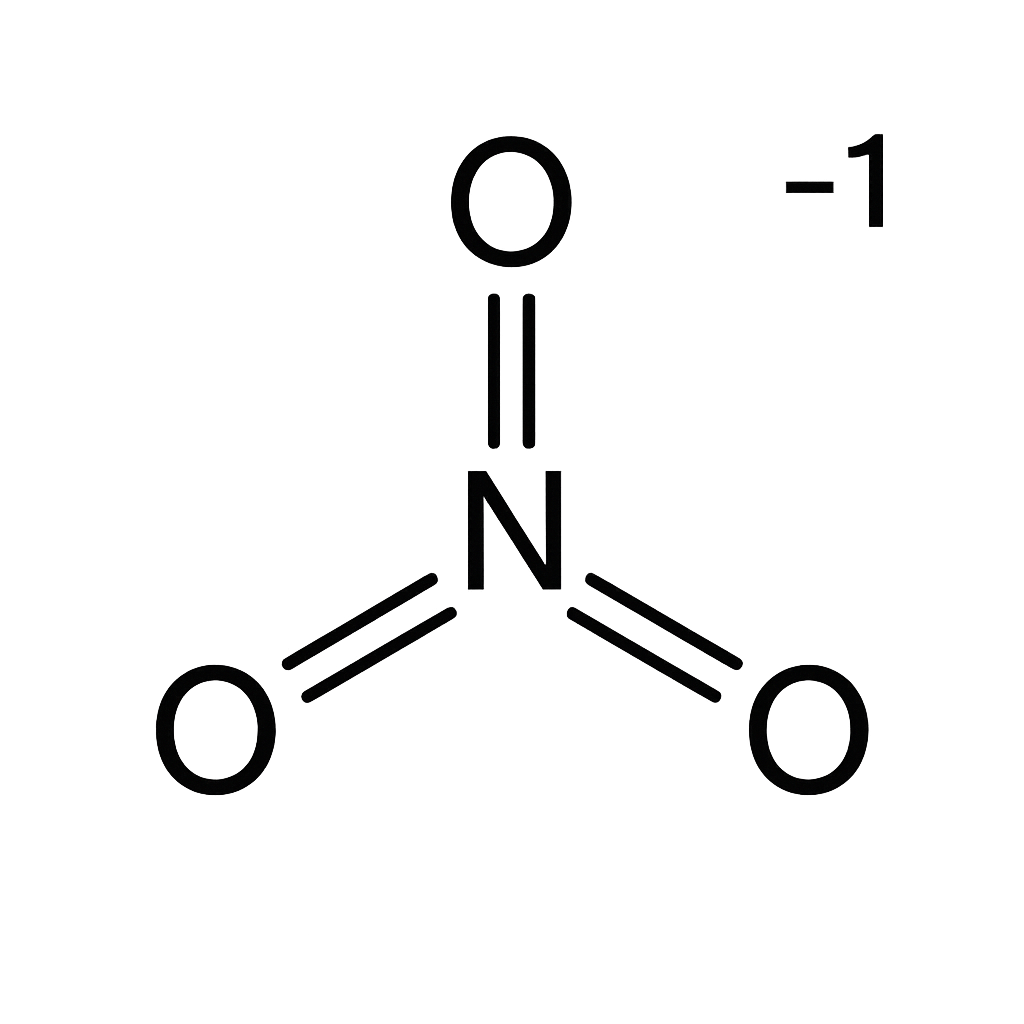
The diagram shows the Lewis structure of the nitrate ion (\(NO_3^{-}\)). Using this structure, determine the formal charge on each oxygen atom and state which oxygen atoms are involved in resonance.
A. One O has formal charge +1, the other two have -1; only two O atoms participate in resonance.
Correct B. One O has formal charge 0, the other two have -1; all three O atoms participate in resonance.
C. One O has formal charge -2, the other two have 0; all three O atoms participate in resonance.
D. All three O have formal charge 0; only one O participates in resonance.

Correct Answer: B

Want to see the full step-by-step solution? Unlock AI Explanation & Analytics
Question 6 View Details
A mixture containing 180 g of glucose (C\(_6\)H\(_{12}\)O\(_6\)) and 96 g of oxygen gas is reacted completely in a closed container. Identify the limiting reagent, calculate the theoretical mass of carbon dioxide produced, and given that the actual mass of CO\(_2\) obtained is 120 g, determine the percent yield of CO\(_2\).
A. 78.0 %
B. 85.2 %
Correct C. 90.9 %
D. 92.5 %

Correct Answer: C

Want to see the full step-by-step solution? Unlock AI Explanation & Analytics
Question 7 View Details
A 0.60 g sample of an unknown organic compound containing only C, H and O is completely combusted, producing 0.88 g of CO\(_2\) and 0.36 g of H\(_2\)O. The molar mass of the compound is known to be 180 g·mol⁻¹. Determine the molecular formula and give the IUPAC name of the compound, assuming it is a carbohydrate.
Correct A. C₆H₁₂O₆, glucose
B. C₇H₁₄O₇, sorbose
C. C₅H₁₀O₅, ribose
D. C₄H₈O₄, erythrose

Correct Answer: A

Want to see the full step-by-step solution? Unlock AI Explanation & Analytics
Question 8 View Details
In acidic solution the dichromate ion oxidises chloride ions to chlorine gas according to the overall reaction: \(\mathrm{Cr_2O_7^{2-} + 14 H^+ + 6 Cl^- \rightarrow 2 Cr^{3+} + 7 H_2O + 3 Cl_2}\). If 0.025 mol of \(\mathrm{K_2Cr_2O_7}\) is reacted with excess \(\mathrm{HCl}\), calculate the volume of \(\mathrm{Cl_2}\) gas produced at STP (22.4 L·mol⁻¹).
Correct A. 1.68 L
B. 0.84 L
C. 2.24 L
D. 1.12 L

Correct Answer: A

Want to see the full step-by-step solution? Unlock AI Explanation & Analytics
Question 9 View Details
The vapor pressure of a liquid at 298 K is 0.40 atm. Its enthalpy of vaporisation is 40 kJ·mol⁻¹ and can be assumed constant over the temperature range. Estimate its vapor pressure at 350 K using the Clausius-Clapeyron equation.
A. 2.75 atm
B. 5.00 atm
Correct C. 4.38 atm
D. 3.20 atm

Correct Answer: C

Want to see the full step-by-step solution? Unlock AI Explanation & Analytics
Question 10 View Details
The sparingly soluble salt AB₂(s) ⇌ A²⁺(aq) + 2 B⁻(aq) has a solubility product Kₛₚ = 4.0×10⁻¹⁰ at 25 °C. If the solution already contains 0.010 M B⁻ from another source, calculate the solubility of AB₂ in mol·L⁻¹.
A. 1.0×10⁻⁶ mol·L⁻¹
Correct B. 4.0×10⁻⁶ mol·L⁻¹
C. 2.0×10⁻⁵ mol·L⁻¹
D. 4.6×10⁻⁴ mol·L⁻¹

Correct Answer: B

Want to see the full step-by-step solution? Unlock AI Explanation & Analytics
Question 11 View Details
A wastewater contains phenol at a concentration of 150 mg L^{-1}. It is treated aerobically, where phenol degrades following first‑order kinetics with a rate constant \(k = 0.12\ \text{day}^{-1}\) at 25 °C. After treatment, the water is mixed with river water (phenol concentration negligible) in a volume ratio of 1 : 3 (treated : river) before discharge. The permissible phenol limit for discharge is 10 mg L^{-1}. Determine the minimum treatment time (in days) required so that, after mixing, the phenol concentration does not exceed the limit. Give your answer to two decimal places.
A. 12.57 days
B. 9.84 days
Correct C. 11.02 days
D. 13.21 days

Correct Answer: C

Want to see the full step-by-step solution? Unlock AI Explanation & Analytics
Question 12 View Details
In the reaction \(2\,\text{Al} + 3\,\text{Cl}_2 \rightarrow 2\,\text{AlCl}_3\), 5.0 g of aluminium is mixed with excess chlorine gas. However, 10 % of the aluminium is lost as an impurity and does not react. After the reaction, 85 % of the theoretical yield of aluminium chloride is actually obtained. Calculate the mass of \(\text{AlCl}_3\) isolated, giving your answer to one decimal place.
A. 21.5 g
B. 16.3 g
C. 20.0 g
Correct D. 18.9 g

Correct Answer: D

Want to see the full step-by-step solution? Unlock AI Explanation & Analytics
Question 13 View Details
A metal X reacts with dilute hydrochloric acid according to \(\text{X}(s) + 2\,\text{HCl}(aq) \rightarrow \text{XCl}_2(aq) + \text{H}_2(g)\). When 0.500 g of X is added to excess 1.0 M HCl, 0.187 L of hydrogen gas is collected at 25 °C and 1 atm pressure. Assuming ideal‑gas behaviour, determine the atomic mass of X (to the nearest whole number).
Correct A. 58
B. 62
C. 55
D. 60

Correct Answer: A

Want to see the full step-by-step solution? Unlock AI Explanation & Analytics
Question 14 View Details
A 2.00 g sample of an unknown compound containing only C, H and O is combusted completely. The combustion yields 4.55 g of \(\text{CO}_2\) and 1.86 g of \(\text{H}_2\text{O}\). Determine the empirical formula of the compound.
A. C3H4O2
B. C4H8O2
C. C2H4O
Correct D. C3H6O

Correct Answer: D

Want to see the full step-by-step solution? Unlock AI Explanation & Analytics
Question 15 View Details
The vapor pressure of a liquid is 0.40 atm at 298 K and 0.80 atm at 318 K. Assuming the enthalpy of vaporisation \(\Delta H_{vap}\) is constant over this temperature range, calculate \(\Delta H_{vap}\) in kJ·mol^{-1}. Use \(R = 8.314\ \text{J·mol}^{-1}\text{K}^{-1}\). Give your answer to one decimal place.
A. 30.1 kJ·mol^{-1}
B. 24.5 kJ·mol^{-1}
C. 22.8 kJ·mol^{-1}
Correct D. 27.3 kJ·mol^{-1}

Correct Answer: D

Want to see the full step-by-step solution? Unlock AI Explanation & Analytics
Question 16 View Details
A wastewater sample contains 120 mg L⁻¹ phenol and a COD of 300 mg L⁻¹. It is treated in two successive stages. The first stage is an adsorption process that removes 40 % of the phenol and reduces the COD by 25 % of its initial value. The second stage is a biological treatment that removes 70 % of the phenol remaining after the first stage and 60 % of the COD remaining after the first stage. The effluent standards are phenol ≤ 10 mg L⁻¹ and COD ≤ 50 mg L⁻¹.\n\n(a) Determine whether the combined treatment meets both standards.\n(b) If the phenol standard is not met, calculate the minimum overall percentage removal of phenol required in the second stage (keeping the COD removal unchanged) so that the phenol concentration just meets the standard.
A. The treatment does not meet either standard. To meet the phenol limit the second stage must remove at least 92 % of the phenol (≈22 % more than the 70 % originally assumed).
B. The treatment meets the COD standard but not the phenol standard. To meet the phenol limit the second stage must remove at least 78 % of the phenol (≈8 % more than the 70 % originally assumed).
C. The treatment meets both standards. No additional phenol removal is required in the second stage.
Correct D. The treatment does not meet either standard. To meet the phenol limit the second stage must remove at least 86 % of the phenol (≈16 % more than the 70 % originally assumed).

Correct Answer: D

Want to see the full step-by-step solution? Unlock AI Explanation & Analytics
Question 17 View Details
A 250 mL aqueous mixture contains 0.050 mol of acetic acid (CH₃COOH) and 0.075 mol of ethanol (C₂H₅OH). Under acid catalysis they react to form ethyl acetate (CH₃COOC₂H₅) and water. At 25 °C the equilibrium constant for the esterification is \(K_{eq}=4.0\).\n\n(a) Calculate the maximum mass of ethyl acetate that can be formed at equilibrium, assuming no side reactions and that the volume change is negligible.\n(b) Determine the percentage of the initial acetic acid that remains unreacted at equilibrium.
Correct A. 3.46 g of ethyl acetate; 21.5 % of the initial acetic acid remains unreacted.
B. 3.12 g of ethyl acetate; 25.0 % of the initial acetic acid remains unreacted.
C. 4.05 g of ethyl acetate; 18.3 % of the initial acetic acid remains unreacted.
D. 2.89 g of ethyl acetate; 30.2 % of the initial acetic acid remains unreacted.

Correct Answer: A

Want to see the full step-by-step solution? Unlock AI Explanation & Analytics
Question 18 View Details
Aluminium metal reacts with excess chlorine gas according to \(2\,Al + 3\,Cl_{2} \rightarrow 2\,AlCl_{3}\). In the laboratory, 5.0 g of Al are used. After the reaction, the AlCl₃ product is heated and 10 % of it decomposes to Al₂O₃ and Cl₂. The actual yield of AlCl₃ before heating is 85 %.\n\n(a) Determine the mass of AlCl₃ remaining after heating.\n(b) State the overall mass of AlCl₃ finally obtained, taking the 85 % yield into account.
A. 19.5 g of AlCl₃ remains after heating (overall mass obtained).
B. 20.0 g of AlCl₃ remains after heating (overall mass obtained).
Correct C. 18.9 g of AlCl₃ remains after heating (overall mass obtained).
D. 21.0 g of AlCl₃ remains after heating (overall mass obtained).

Correct Answer: C

Want to see the full step-by-step solution? Unlock AI Explanation & Analytics
Question 19 View Details
A 2.00 g sample of an unknown hydrocarbon CₓHᵧ is combusted completely, producing 5.50 g of CO₂ and 2.20 g of H₂O.\n\n(a) Determine the empirical formula of the hydrocarbon.\n(b) Calculate the mass of O₂ required for the combustion of 1.00 g of this hydrocarbon.
A. Empirical formula C₂H₅; 2.85 g O₂ required for 1.00 g of the hydrocarbon.
B. Empirical formula CH; 4.00 g O₂ required for 1.00 g of the hydrocarbon.
C. Empirical formula CH₃; 3.00 g O₂ required for 1.00 g of the hydrocarbon.
Correct D. Empirical formula CH₂; 3.42 g O₂ required for 1.00 g of the hydrocarbon.

Correct Answer: D

Want to see the full step-by-step solution? Unlock AI Explanation & Analytics
Question 20 View Details
Chlorine (Cl) and bromine (Br) each form interhalogen compounds with fluorine: ClF₃ and BrF₃. The bond dissociation energy for a Cl-F bond is 250 kJ mol⁻¹, and for a Br-F bond is 230 kJ mol⁻¹. Each molecule contains three identical X-F bonds. Assume that the standard enthalpy of formation of each interhalogen from its elements equals the sum of the energies of the three bonds (energy released, taken as negative). The standard enthalpies of formation of Cl₂(g), Br₂(g) and F₂(g) are zero.\n\nConsider the overall reaction: \(2\,Cl_{2} + 2\,Br_{2} + 6\,F_{2} \rightarrow 2\,ClF_{3} + 2\,BrF_{3}\).\n\n(a) Calculate the standard enthalpy change (ΔH°) for this reaction.\n(b) Based on the calculated ΔH°, state which interhalogen, ClF₃ or BrF₃, is thermodynamically more stable per mole of compound formed.
A. ΔH° = -2700 kJ for the reaction; BrF₃ is more stable than ClF₃ (‑690 kJ mol⁻¹ vs. ‑750 kJ mol⁻¹).
B. ΔH° = -3000 kJ for the reaction; ClF₃ is more stable than BrF₃ (‑760 kJ mol⁻¹ vs. ‑700 kJ mol⁻¹).
C. ΔH° = -2880 kJ for the reaction; BrF₃ is more stable than ClF₃ (‑720 kJ mol⁻¹ vs. ‑680 kJ mol⁻¹).
Correct D. ΔH° = -2880 kJ for the reaction; ClF₃ is more stable than BrF₃ (‑750 kJ mol⁻¹ vs. ‑690 kJ mol⁻¹).

Correct Answer: D

Want to see the full step-by-step solution? Unlock AI Explanation & Analytics
Question 21 View Details
2-methyl-1-butene (\(CH_2=C(CH_3)CH_2CH_3\)) is subjected to (i) ozonolysis followed by reductive work‑up, and then (ii) catalytic hydrogenation. List the IUPAC names of all organic products obtained after the complete sequence.
A. acetaldehyde and 2‑methylpropanal
B. formaldehyde and 2‑methylbutanal
Correct C. formaldehyde and 2‑methylpropanal
D. acetone and 2‑methylpropanal

Correct Answer: C

Want to see the full step-by-step solution? Unlock AI Explanation & Analytics
Question 22 View Details
Given the following bond dissociation energies: \(D_{\mathrm{H-H}} = 436\ \text{kJ mol}^{-1}\), \(D_{\mathrm{F-F}} = 158\ \text{kJ mol}^{-1}\), \(D_{\mathrm{Cl-Cl}} = 243\ \text{kJ mol}^{-1}\), \(D_{\mathrm{H-F}} = 565\ \text{kJ mol}^{-1}\), \(D_{\mathrm{H-Cl}} = 432\ \text{kJ mol}^{-1}\). Using these values, calculate the standard enthalpy change for the formation reactions \(\mathrm{H_2 + F_2 \rightarrow 2HF}\) and \(\mathrm{H_2 + Cl_2 \rightarrow 2HCl}\). Based on the calculated enthalpy changes, which acid, HF or HCl, is the stronger acid? Justify your answer.
Correct A. HF is the stronger acid (its formation releases -536 kJ mol⁻¹, much more exothermic than -185 kJ mol⁻¹ for HCl).
B. HCl is the stronger acid (its formation releases -536 kJ mol⁻¹, much more exothermic than -185 kJ mol⁻¹ for HF).
C. HCl is the stronger acid (its formation releases -185 kJ mol⁻¹, much more exothermic than -536 kJ mol⁻¹ for HF).
D. HF is the stronger acid (its formation releases -185 kJ mol⁻¹, much more exothermic than -536 kJ mol⁻¹ for HCl).

Correct Answer: A

Want to see the full step-by-step solution? Unlock AI Explanation & Analytics
Question 23 View Details
The solubility product of silver chloride at 25 °C is \(K_{sp}=1.8\times10^{-10}\). A solution is prepared by dissolving \(0.010\ \text{mol}\) of NaCl in \(1.0\ \text{L}\) of water, after which excess solid AgCl is added until equilibrium is reached. (a) Calculate the equilibrium concentration of \(\mathrm{Ag^+}\) ions in the solution. (b) If the solution is then diluted to a total volume of \(2.0\ \text{L}\) without adding or removing any solid, what is the new concentration of \(\mathrm{Ag^+}\) ions?
A. a) \(1.8\times10^{-7}\ \text{M}\); b) \(9.0\times10^{-8}\ \text{M}\)
B. a) \(9.0\times10^{-9}\ \text{M}\); b) \(4.5\times10^{-9}\ \text{M}\)
Correct C. a) \(1.8\times10^{-8}\ \text{M}\); b) \(9.0\times10^{-9}\ \text{M}\)
D. a) \(3.6\times10^{-8}\ \text{M}\); b) \(1.8\times10^{-8}\ \text{M}\)

Correct Answer: C

Want to see the full step-by-step solution? Unlock AI Explanation & Analytics
Question 24 View Details
The esterification of propanoic acid with ethanol has an equilibrium constant \(K = 4.0\) at \(25^{\circ}\text{C}\) (298 K). The standard enthalpy change for the reaction is \(\Delta H^{\circ} = -25\ \text{kJ mol}^{-1}\). Assuming \(\Delta H^{\circ}\) remains constant over the temperature range, at what temperature (in kelvin) will the equilibrium constant double (i.e., become 8.0)? Use the van't Hoff equation.
A. 285 K (≈ 12 °C)
Correct B. 279 K (≈ 6 °C)
C. 300 K (≈ 27 °C)
D. 260 K (≈ ‑13 °C)

Correct Answer: B

Want to see the full step-by-step solution? Unlock AI Explanation & Analytics
Question 25 View Details
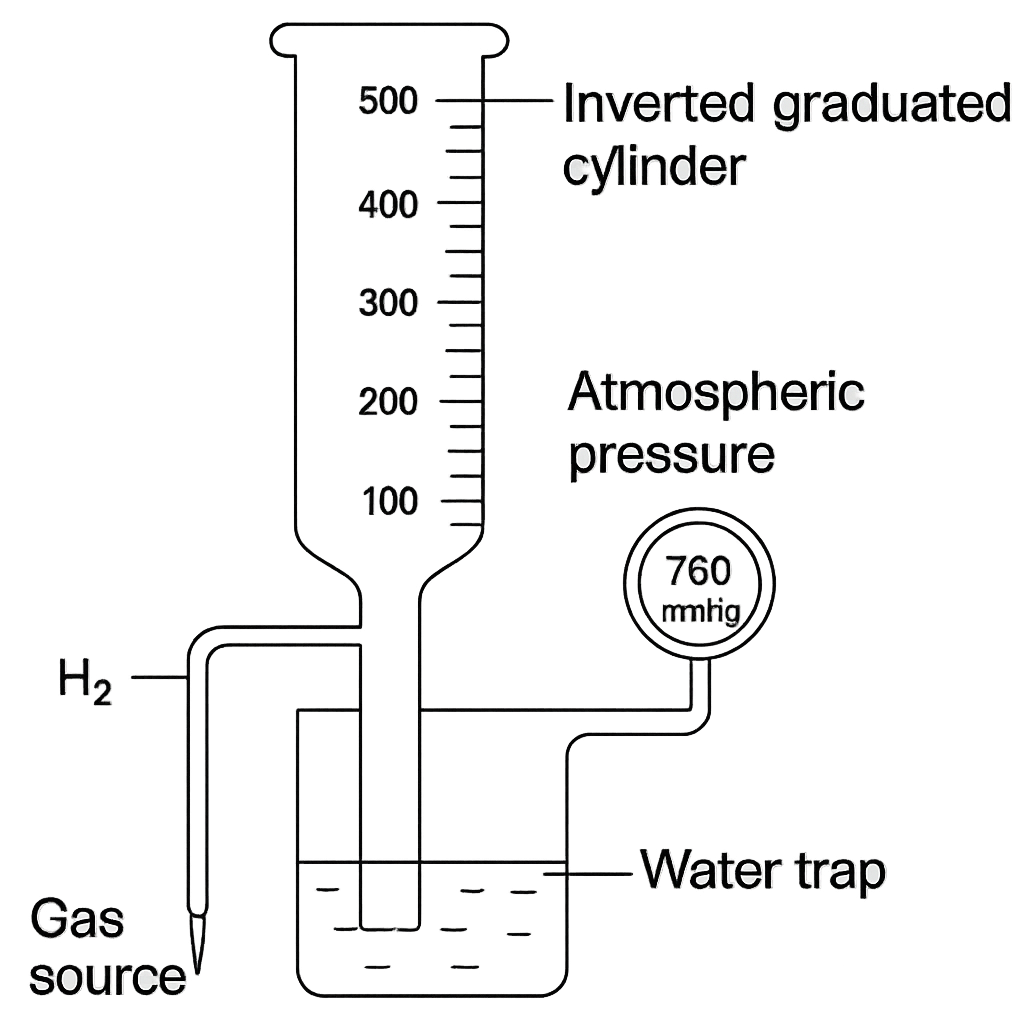
An experiment uses an inverted graduated cylinder to collect hydrogen gas over water at \(25^{\circ}\text{C}\). The volume of gas collected is \(250\ \text{mL}\). The atmospheric pressure is \(760\ \text{mmHg}\) and the vapor pressure of water at this temperature is \(23.8\ \text{mmHg}\). Using the ideal gas law, calculate the number of moles of hydrogen gas collected.
Correct A. 9.9×10⁻³ mol
B. 1.0×10⁻³ mol
C. 9.9×10⁻² mol
D. 1.1×10⁻³ mol

Correct Answer: A

Want to see the full step-by-step solution? Unlock AI Explanation & Analytics

Master the Exam!

You've seen a preview, but there are thousands more questions plus AI tutor to break down complex solutions.

Unlock Full Access Available for Android & Windows
Help others prepare! Share this practice hub:
Chat with Support