neco model questions vol1 2024 chemistry | Essay

Prepare for your exams with neco model questions vol1 questions? Reviewing past/model questions is one of the most effective ways to guarantee a high score. This practice hub features authentic 2024 chemistry (Essay) questions designed to simulate the real exam environment.

Practice these randomly selected questions to test your readiness.
Question 1 View Details
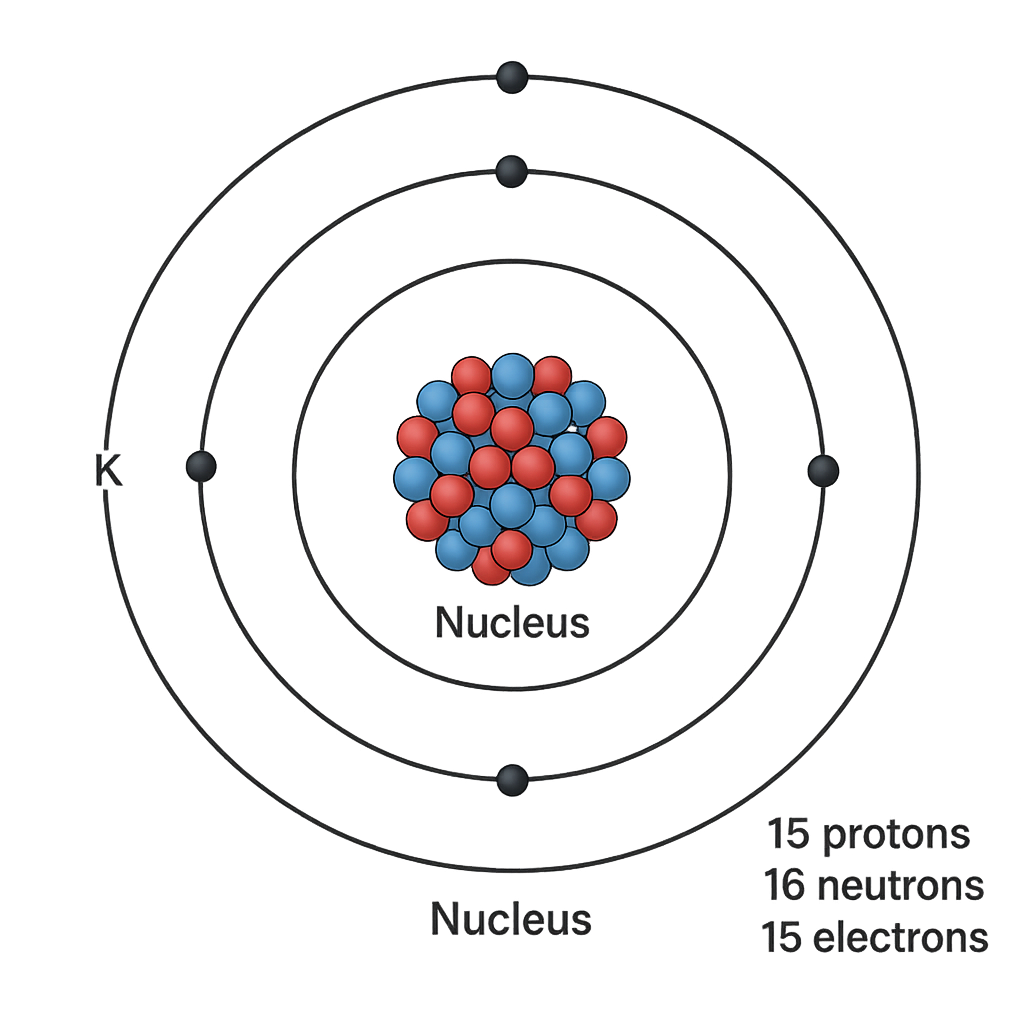
The diagram shows a simplified Bohr model of an atom of element X.
Question Parts
(a)
From the diagram state the atomic number (Z), the mass number (A) and give the numbers of protons, neutrons and electrons present in the atom.
(b)
Write the nuclear notation for the atom shown and for its most abundant naturally occurring isotope.
(c)
If one electron is removed to form a cation, write the symbol of the ion and state its charge.
(d)
Explain how the diagram illustrates the concept of isotopes. Give the nuclear notation for another isotope of element X that has a mass number of 33 and state how many neutrons it contains.
Detailed Essay Solution & Marking Scheme Available

Get the step-by-step mathematical proofs, key points required by examiners, and a comprehensive breakdown from our AI Tutor.
Question 2 View Details
The diagram shows a portion of the periodic table containing the elements of period 3 that belong to groups 1, 2 and 17.
Question Parts
(a)
State the group number and period number for each of the three elements shown in the diagram.
(b)
Write the ground‑state electron configuration for each element using the Aufbau principle.
(c)
Compare the first ionisation energies of the three elements and explain the observed trend based on their positions in the periodic table.
(d)
State which of the three elements would most readily form a +1 cation, a +2 cation and a –1 anion in ionic compounds. Write the formula of a typical ionic compound each would form with chlorine.
Detailed Essay Solution & Marking Scheme Available

Get the step-by-step mathematical proofs, key points required by examiners, and a comprehensive breakdown from our AI Tutor.
Question 3 View Details
A newly synthesized covalent compound, phosphorus trichloride (PCl₃), has been isolated in the laboratory. The electronegativity values are: χ(P) = 2.19, χ(Cl) = 3.16. The molecule contains one phosphorus atom bonded to three chlorine atoms and possesses one lone pair on phosphorus.
Question Parts
(a)
Using the given electronegativity values, determine the type of bond formed between phosphorus and chlorine atoms.
(b)
Predict the molecular geometry of PCl₃ using VSEPR theory and state the hybridisation of the central phosphorus atom.
(c)
Based on the geometry and the polarity of the P–Cl bonds, decide whether the molecule possesses a net dipole moment. Justify your answer.
(d)
Explain how the polarity determined in part (c) influences the solubility of PCl₃ in water and in a non‑polar solvent such as carbon tetrachloride (CCl₄).
Detailed Essay Solution & Marking Scheme Available

Get the step-by-step mathematical proofs, key points required by examiners, and a comprehensive breakdown from our AI Tutor.

Question 4 View Details
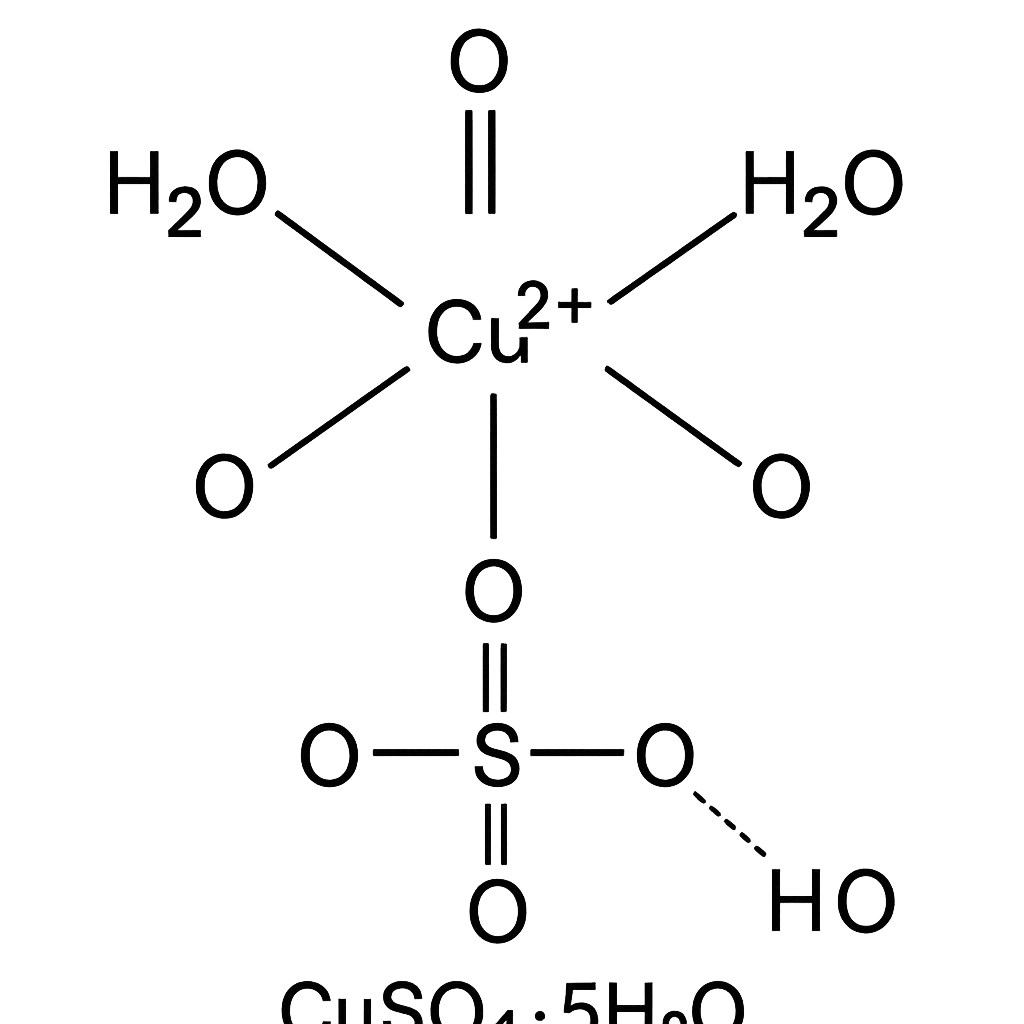
The diagram shows the crystal structure of copper(II) sulfate pentahydrate, CuSO₄·5H₂O.
Question Parts
(a)
Write the balanced chemical equation for the complete loss of water of crystallisation when the hydrate is heated strongly to give anhydrous copper(II) sulfate.
(b)
A sample weighing 10.0 g of the hydrate is heated until all water is removed. Calculate the number of moles of water vapour released.
(c)
From the same 10.0‑g sample, determine the mass of anhydrous CuSO₄ obtained after heating.
(d)
The anhydrous CuSO₄ obtained is dissolved in water to prepare a solution of concentration 0.250 mol dm⁻³. Calculate the volume of solution (in mL) required to contain all the copper originally present in the 10.0‑g sample.
Detailed Essay Solution & Marking Scheme Available

Get the step-by-step mathematical proofs, key points required by examiners, and a comprehensive breakdown from our AI Tutor.

Question 5 View Details
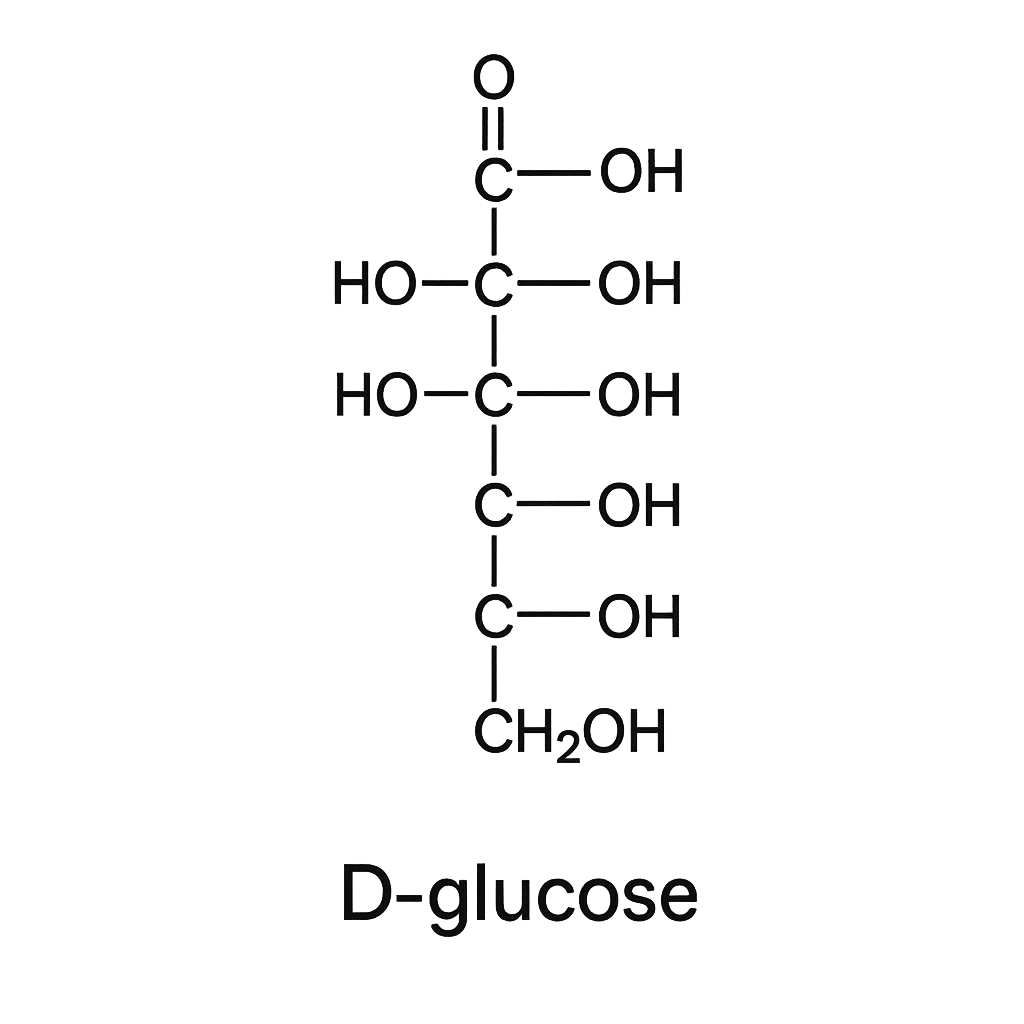
The diagram shows the structural formula of a carbohydrate molecule commonly found in fruits.
Question Parts
(a)
Write the molecular formula of the compound shown.
(b)
When 180 g of this compound is completely combusted according to the equation: C6H12O6 + 6 O2 → 6 CO2 + 6 H2O, calculate:
() The mass of O₂ required.
() The mass of CO₂ produced.
(c)
A sample containing 2.00 g of the compound is mixed with excess O₂ and the combustion is carried out. The volume of CO₂ collected at 25 °C and 1.00 atm is 0.92 L. Determine the percent yield of CO₂ based on the theoretical yield.
Detailed Essay Solution & Marking Scheme Available

Get the step-by-step mathematical proofs, key points required by examiners, and a comprehensive breakdown from our AI Tutor.

Question 6 View Details
A solution is prepared by dissolving 2.00 g of a non‑volatile solute (molar mass = 58.44 g mol⁻¹) in 100 g of water at 25 °C.
Question Parts
(a)
Calculate the molality of the solution.
(b)
Using the molality found in part (a), determine the elevation in the boiling point of the solution. (K_b for water = 0.512 °C kg mol⁻¹)
(c)
Determine the depression in the freezing point of the solution. (K_f for water = 1.86 °C kg mol⁻¹)
Detailed Essay Solution & Marking Scheme Available

Get the step-by-step mathematical proofs, key points required by examiners, and a comprehensive breakdown from our AI Tutor.

Question 7 View Details
A sample of an unknown element X is analysed and found to have an atomic mass of 39.10 u and an electronic configuration of 1s² 2s² 2p⁶ 3s² 3p⁶ 4s². Using this information:
Question Parts
(a)
Identify the element and write its symbol.
(b)
Explain why the first ionisation energy of potassium is lower than that of argon, even though argon is to the right of potassium in the same period.
(c)
Predict the most likely charge of the ion formed by potassium and justify your answer.
Detailed Essay Solution & Marking Scheme Available

Get the step-by-step mathematical proofs, key points required by examiners, and a comprehensive breakdown from our AI Tutor.

Question 8 View Details
Transition metals often exhibit variable oxidation states. Consider the element iron (Fe).
Question Parts
(a)
Write the electron configuration of Fe and indicate the electrons removed to form Fe²⁺ and Fe³⁺ ions.
(b)
Explain why Fe³⁺ is more stable in aqueous solution than Fe²⁺ despite the higher charge.
Detailed Essay Solution & Marking Scheme Available

Get the step-by-step mathematical proofs, key points required by examiners, and a comprehensive breakdown from our AI Tutor.

Master the Exam!

You've seen a preview, but there are thousands more questions plus AI tutor to break down complex solutions.

Unlock Full Access Available for Android & Windows
Help others prepare! Share this practice hub:
Chat with Support