neco model questions vol1 2024 biology | Objective

Prepare for your exams with neco model questions vol1 questions? Reviewing past/model questions is one of the most effective ways to guarantee a high score. This practice hub features authentic 2024 biology (Objective) questions designed to simulate the real exam environment.

Practice these randomly selected questions to test your readiness.

Question 1 View Details
In a test cross involving a plant heterozygous for two linked genes (genotype \(AB/ab\)), \(250\) offspring were observed with the following phenotypes: \(112\) showed the parental phenotype \(A\_B\_\), \(108\) showed the other parental phenotype \(a\_b\_\), \(15\) showed recombinant phenotype \(A\_b\_\), and \(15\) showed recombinant phenotype \(a\_B\_\).\n\n(a) Calculate the recombination frequency between the two genes.\n(b) Using this recombination frequency, determine how many recombinant offspring would be expected if the total number of offspring were increased to \(300\).
A. 30
B. 48
C. 24
Correct D. 36

Correct Answer: D

Want to see the full step-by-step solution? Unlock AI Explanation & Analytics
Question 2 View Details
A human somatic cell is diploid with a total of \(46\) chromosomes. During which stage of mitosis are the chromosomes aligned at the cell's equatorial plate, and how many chromosomes are present at that stage?
A. Metaphase, 23 chromosomes
Correct B. Metaphase, 46 chromosomes
C. Anaphase, 46 chromosomes
D. Prophase, 46 chromosomes

Correct Answer: B

Want to see the full step-by-step solution? Unlock AI Explanation & Analytics
Question 3 View Details
A population of a certain animal follows the logistic growth model \( \frac{dN}{dt}= rN\left(1-\frac{N}{K}\right) \) where \(r = 0.6\ \text{year}^{-1}\) and the carrying capacity \(K = 1200\) individuals.\n\n(a) Determine the maximum sustainable constant harvest rate \(H_{\max}\) (in individuals per year) that can be removed each year without causing the population to decline, assuming harvest is constant and the population remains at equilibrium.\n(b) If the current population size is \(800\) individuals, what is the maximum number of individuals that can be harvested annually without leading to a decline?
A. 200
B. 150
Correct C. 180
D. 120

Correct Answer: C

Want to see the full step-by-step solution? Unlock AI Explanation & Analytics
Question 4 View Details
Blood glucose concentration regulates the secretion of insulin and glucagon.\n\n- Insulin secretion (in \(\mu\text{U·mL}^{-1}\)) increases linearly with glucose above 5 mmol·L\(^{-1}\) according to \( I = 2\,(G-5) \) for \( G>5 \); otherwise \( I = 0 \).\n- Glucagon secretion (in \(\mu\text{U·mL}^{-1}\)) decreases linearly with glucose above 7 mmol·L\(^{-1}\) according to \( Gc = 1.5\,(7-G) \) for \( G<7 \); otherwise \( Gc = 0 \).\n\nCalculate the net hormonal effect defined as \( \text{Net}= I - Gc \) (\(\mu\text{U·mL}^{-1}\)) for:\n\n(a) a post‑prandial glucose level of \( G = 9 \) mmol·L\(^{-1}\),\n(b) a fasting glucose level of \( G = 4 \) mmol·L\(^{-1}\).\nProvide the net effect for each condition.
Correct A. 8 µU·mL^{-1} after a meal, -4.5 µU·mL^{-1} during fasting
B. 6 µU·mL^{-1} after a meal, -3 µU·mL^{-1} during fasting
C. 7 µU·mL^{-1} after a meal, -4 µU·mL^{-1} during fasting
D. 10 µU·mL^{-1} after a meal, -5 µU·mL^{-1} during fasting

Correct Answer: A

Want to see the full step-by-step solution? Unlock AI Explanation & Analytics
Question 5 View Details
A plant species has a diploid chromosome number of \(2n = 24\). After meiosis, how many chromosomes are present in each haploid gamete?
A. 6
B. 24
C. 13
Correct D. 12

Correct Answer: D

Want to see the full step-by-step solution? Unlock AI Explanation & Analytics
Question 6 View Details
A person's baseline blood glucose level is 90 mg/dL. After a carbohydrate‑rich meal, the level rises to 150 mg/dL. The pancreas secretes insulin at a rate of \(0.02\) units per minute for each mg/dL that the glucose exceeds the baseline, and each unit of insulin lowers the glucose concentration at a rate of \(1.5\) mg/dL per minute. Assuming the insulin‑mediated glucose removal follows first‑order kinetics, the rate of change of glucose can be expressed as \(\frac{dG}{dt}= -k\,(G-90)\) where \(k = 0.02 \times 1.5\). Calculate the time (in minutes) required for the glucose level to fall to within 2 mg/dL of the baseline.
A. 130
B. 120
Correct C. 113
D. 100

Correct Answer: C

Want to see the full step-by-step solution? Unlock AI Explanation & Analytics
Question 7 View Details
In a lake ecosystem, phytoplankton perform photosynthesis producing a gross primary productivity of 1200 kcal m\(^{-2}\) day\(^{-1}\). Ten percent of this energy is lost to phytoplankton respiration, and twenty percent of the remaining net primary production is not consumed and sinks to the sediment. Zooplankton consume seventy percent of the energy that remains after the sinking loss. Of the zooplankton biomass, fifteen percent is transferred to small fish and five percent is transferred directly to large fish. Large fish also obtain forty percent of the small‑fish biomass through predation. Determine the total amount of energy (in kcal m\(^{-2}\) day\(^{-1}\)) that becomes available to large fish.
A. 80
B. 55.2
C. 72
Correct D. 66.5

Correct Answer: D

Want to see the full step-by-step solution? Unlock AI Explanation & Analytics
Question 8 View Details
In a beetle population the recessive allele \(a\) (brown colour) has an initial frequency \(q = 0.20\). The fitnesses of the three genotypes are: \(w_{AA}=0.9\), \(w_{Aa}=0.8\), and \(w_{aa}=0.5\). Assuming Hardy-Weinberg proportions before selection, calculate the frequency of allele \(a\) after one generation of selection (before random mating).
A. 0.200
B. 0.182
C. 0.160
Correct D. 0.174

Correct Answer: D

Want to see the full step-by-step solution? Unlock AI Explanation & Analytics
Question 9 View Details
Which cellular organelle is primarily responsible for the synthesis of proteins that are destined for secretion or for insertion into the plasma membrane?
A. Golgi apparatus
B. Smooth endoplasmic reticulum
Correct C. Rough endoplasmic reticulum
D. Mitochondrion

Correct Answer: C

Want to see the full step-by-step solution? Unlock AI Explanation & Analytics
Question 10 View Details
In a plant, two genes are linked on the same chromosome: gene \(A\) (alleles \(A\) and \(a\)) determines flower colour and gene \(B\) (alleles \(B\) and \(b\)) determines seed shape. The parental genotype is heterozygous in coupling phase (\(AB/ab\)). The recombination frequency between the two genes is 10 %. This plant is crossed with a homozygous recessive individual (\(ab/ab\)). What proportion of the progeny will possess the recombinant genotype \(Ab/ab\)?
A. 0.15
Correct B. 0.05
C. 0.025
D. 0.1

Correct Answer: B

Want to see the full step-by-step solution? Unlock AI Explanation & Analytics
Question 11 View Details
A mitochondrion has an outer membrane and an inner membrane, each covering essentially the same surface area. If a fluorescent dye binds only to the outer membrane, what fraction of the total mitochondrial membrane area will be stained?
A. 1\/4
Correct B. 1/2
C. 1\/3
D. 2\/3

Correct Answer: B

Want to see the full step-by-step solution? Unlock AI Explanation & Analytics
Question 12 View Details
Two desert plants, A and B, have different adaptations to reduce water loss. Plant A has a thick waxy cuticle that reduces its transpiration rate by \(40\%\) relative to a non‑adapted plant. Plant B reduces its leaf surface area, decreasing its transpiration rate by \(30\%\) relative to the same non‑adapted plant. The baseline transpiration rate of a non‑adapted plant under the current climate is \(12\ \text{mL day}^{-1}\). During an extreme drought, Plant A can also close its stomata, halving the transpiration that remains after the cuticle effect, whereas Plant B cannot close its stomata. Calculate the final daily water loss for each plant during the drought and state which adaptation results in the lower water loss.
A. Plant A loses 3.6 mL day^{-1}; Plant B loses 9.6 mL day^{-1}. Plant A's adaptation results in the lower water loss.
B. Plant A loses 4.8 mL day^{-1}; Plant B loses 9.6 mL day^{-1}. Plant B's adaptation results in the lower water loss.
C. Plant A loses 4.8 mL day^{-1}; Plant B loses 8.4 mL day^{-1}. Plant A's adaptation results in the lower water loss.
Correct D. Plant A loses 3.6 mL day^{-1}; Plant B loses 8.4 mL day^{-1}. Plant A's adaptation results in the lower water loss.

Correct Answer: D

Want to see the full step-by-step solution? Unlock AI Explanation & Analytics
Question 13 View Details
A simplified phylogenetic tree shows three species X, Y and Z. The branch length from the common ancestor to species X is \(4\ \text{My}\). Species Y and Z share a more recent common ancestor that lived \(2\ \text{My}\) ago; from that node each lineage extends another \(4\ \text{My}\) to reach Y and Z respectively. Assuming branch lengths are proportional to time, which pair of species are most closely related, and what is the total divergence time between that pair?
A. X and Y; 6 My
B. X and Z; 8 My
C. Y and Z; 6 My
Correct D. Y and Z; 8 My

Correct Answer: D

Want to see the full step-by-step solution? Unlock AI Explanation & Analytics
Question 14 View Details
The metabolic rate of a cold‑water fish follows the Q10 rule: for every \(10^{\circ}\text{C}\) rise in temperature, the rate roughly doubles (Q10 = 2) up to its optimum temperature of \(25^{\circ}\text{C}\), after which the rate declines by \(20\%\) for each additional \(5^{\circ}\text{C}\) increase.\n\nFish A lives in a river where the temperature rises from \(10^{\circ}\text{C}\) to \(30^{\circ}\text{C}\) during summer. Fish B, a related species, has a lower Q10 of 1.5 and its optimum temperature is \(20^{\circ}\text{C}\); beyond \(20^{\circ}\text{C}\) its metabolic rate declines by \(15\%\) for each additional \(5^{\circ}\text{C}\) increase.\n\nAssuming both fish start with a metabolic rate of 1.0 (arbitrary units) at \(10^{\circ}\text{C}\), calculate the metabolic rate of each fish at \(30^{\circ}\text{C}\) and indicate which fish maintains a higher metabolic rate at that temperature.
A. Fish A ≈ 2.26 units; Fish B ≈ 0.90 units. Fish A has the higher rate at 30 °C.
B. Fish A ≈ 2.00 units; Fish B ≈ 1.20 units. Fish A has the higher rate at 30 °C.
Correct C. Fish A ≈ 2.26 units; Fish B ≈ 1.08 units. Fish A has the higher rate at 30 °C.
D. Fish A ≈ 1.80 units; Fish B ≈ 1.08 units. Fish B has the higher rate at 30 °C.

Correct Answer: C

Want to see the full step-by-step solution? Unlock AI Explanation & Analytics
Question 15 View Details
During mitosis, the durations of the phases are: prophase \(30\) min, metaphase \(10\) min, anaphase \(5\) min, and telophase \(15\) min. If a cell enters prophase at \(09{:}00\) h, at what time will it complete telophase and finish mitosis?
A. 10:05 h
Correct B. 10:00 h
C. 09:45 h
D. 09:55 h

Correct Answer: B

Want to see the full step-by-step solution? Unlock AI Explanation & Analytics
Question 16 View Details
Data from a bacterial culture grown at 30 °C show the following cell numbers: at time 0 h the culture contains \(1.0 \times 10^{3}\) cells, at 2 h it contains \(8.0 \times 10^{4}\) cells, and at 4 h it contains \(6.4 \times 10^{6}\) cells. Assuming exponential growth, (a) determine the generation time (the time required for the population to double) under these conditions, and (b) if the temperature is raised so that the generation time decreases by 20 %, calculate the expected number of cells after 6 h at the higher temperature, starting from the same initial inoculum.
Correct A. Generation time ≈ 0.32 h; population after 6 h ≈ 1.4 × 10^{10} cells
B. Generation time ≈ 0.45 h; population after 6 h ≈ 9.2 × 10^{9} cells
C. Generation time ≈ 0.40 h; population after 6 h ≈ 6.0 × 10^{9} cells
D. Generation time ≈ 0.25 h; population after 6 h ≈ 2.5 × 10^{10} cells

Correct Answer: A

Want to see the full step-by-step solution? Unlock AI Explanation & Analytics
Question 17 View Details
Two genes, A/a and B/b, are located on the same chromosome and are linked with a recombination frequency of 12 %. A plant heterozygous in coupling phase (genotype AB/ab) is crossed with a homozygous recessive plant (ab/ab). (a) What proportion of the offspring are expected to display recombinant phenotypes (Ab or aB)? (b) If 250 offspring are produced, what is the expected number of recombinant offspring? (c) In an actual experiment 40 recombinant offspring are observed. Using a chi‑square test with 1 degree of freedom, calculate the chi‑square value and state whether the deviation from the expected number is significant at the 5 % level.
A. Proportion 0.10; expected number 25; chi‑square ≈ 5.33; significant at 5 % level
B. Proportion 0.12; expected number 30; chi‑square ≈ 6.00; significant at 5 % level
C. Proportion 0.15; expected number 38; chi‑square ≈ 2.10; not significant at 5 % level
Correct D. Proportion 0.12; expected number 30; chi‑square ≈ 3.79; not significant at 5 % level

Correct Answer: D

Want to see the full step-by-step solution? Unlock AI Explanation & Analytics
Question 18 View Details
An animal cell is approximately spherical with a diameter of 12 µm. Using the formulas \(V = \frac{4}{3}\pi r^{3}\) for volume and \(A = 4\pi r^{2}\) for surface area, calculate the surface‑area‑to‑volume ratio (A/V) of the cell, expressing your answer in µm\(^{-1}\).
Correct A. 0.5 µm⁻¹
B. 0.4 µm⁻¹
C. 0.6 µm⁻¹
D. 0.33 µm⁻¹

Correct Answer: A

Want to see the full step-by-step solution? Unlock AI Explanation & Analytics
Question 19 View Details
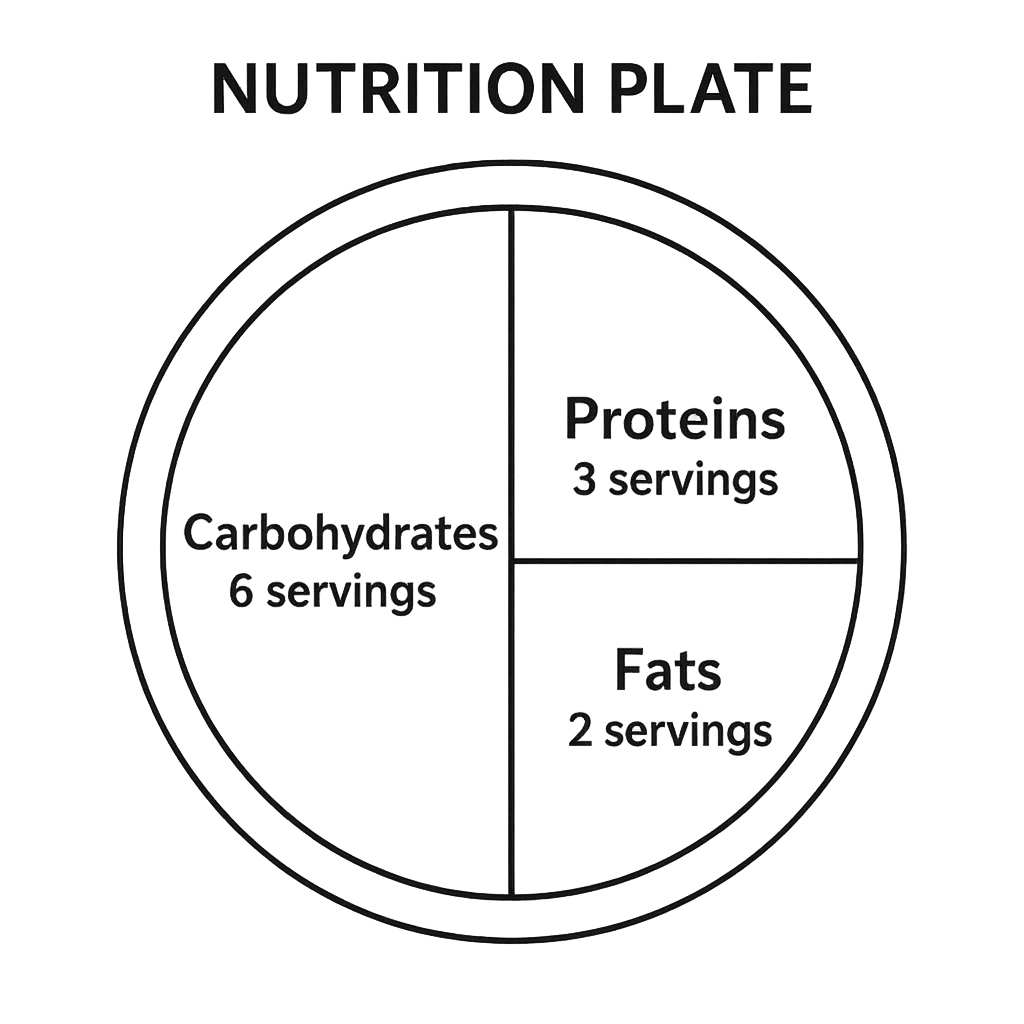
The diagram shows a plate model of the recommended daily food portions for an adult. The plate is divided into three labelled sections indicating the number of servings for each macronutrient: Carbohydrates - 6 servings, Proteins - 3 servings, Fats - 2 servings. Each carbohydrate serving provides 15 g of carbohydrate (4 kcal g\(^{-1}\)), each protein serving provides 10 g of protein (4 kcal g\(^{-1}\)), and each fat serving provides 5 g of fat (9 kcal g\(^{-1}\)). (a) Calculate the total caloric contribution of each macronutrient and the overall daily caloric intake. (b) What percentage of the total calories is supplied by fat?
A. Total calories 560 kcal; fat supplies ≈16.1 % of the calories
B. Total calories 580 kcal; fat supplies ≈15.5 % of the calories
C. Total calories 590 kcal; fat supplies ≈14.9 % of the calories
Correct D. Total calories 570 kcal; fat supplies ≈15.8 % of the calories

Correct Answer: D

Want to see the full step-by-step solution? Unlock AI Explanation & Analytics
Question 20 View Details
An ecosystem receives a primary productivity of 2000 kcal m\(^{-2}\) yr\(^{-1}\). Only 10 % of this energy is incorporated into herbivore biomass, 15 % of the herbivore biomass is transferred to primary carnivores, and 20 % of the primary carnivore biomass is transferred to secondary carnivores. If the ecosystem covers an area of 5 km\(^2\): (a) calculate the total energy available to secondary carnivores per year. (b) If a disease reduces the primary productivity by 25 %, what is the new amount of energy available to secondary carnivores per year?
Correct A. Original: 3.0 × 10⁷ kcal yr⁻¹; after disease: 2.25 × 10⁷ kcal yr⁻¹
B. Original: 3.0 × 10⁸ kcal yr⁻¹; after disease: 2.25 × 10⁸ kcal yr⁻¹
C. Original: 2.4 × 10⁷ kcal yr⁻¹; after disease: 1.8 × 10⁷ kcal yr⁻¹
D. Original: 3.0 × 10⁷ kcal yr⁻¹; after disease: 2.0 × 10⁷ kcal yr⁻¹

Correct Answer: A

Want to see the full step-by-step solution? Unlock AI Explanation & Analytics
Question 21 View Details
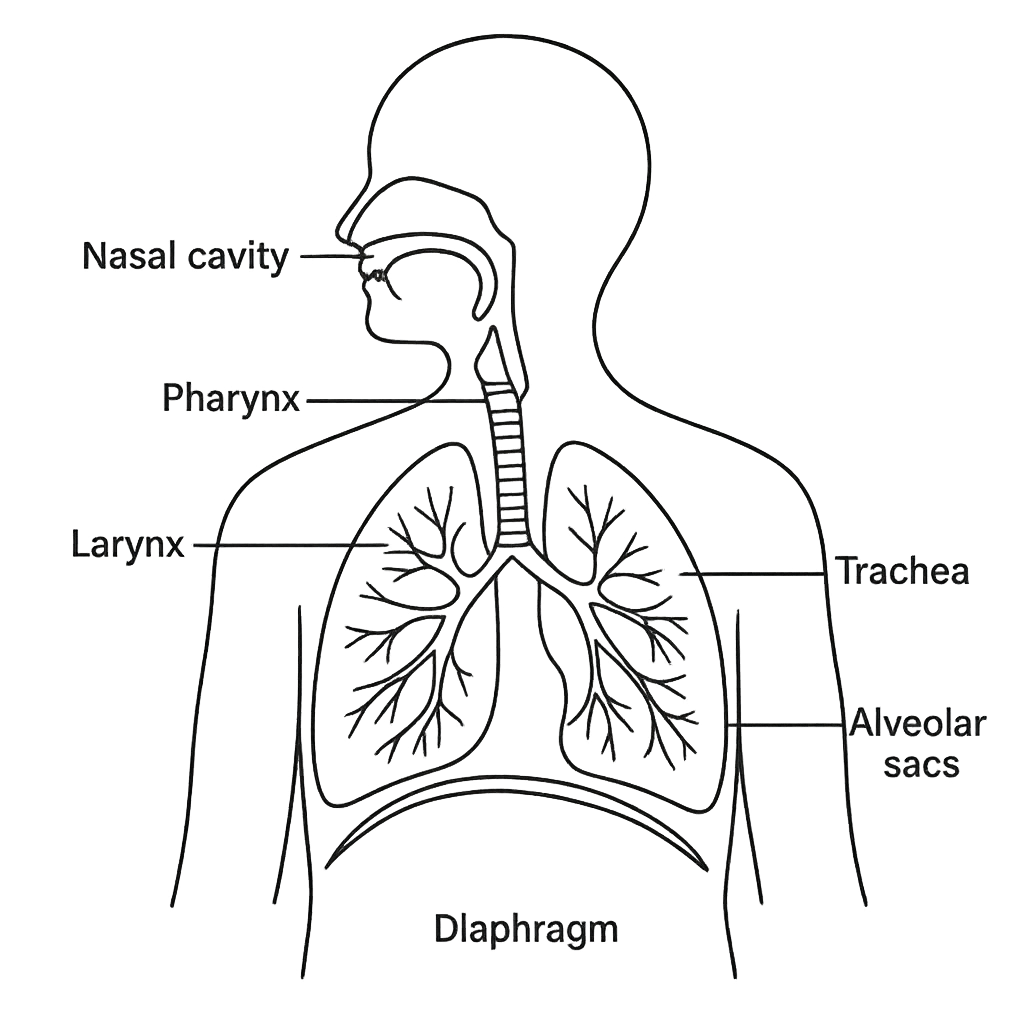
The diagram shows the major parts of the human respiratory system. If the tidal volume at rest is \(500\) mL and the respiratory rate is \(12\) breaths per minute, calculate the minute ventilation. During moderate exercise the tidal volume rises to \(1500\) mL and the respiratory rate to \(20\) breaths per minute. What is the percentage increase in minute ventilation compared with rest?
Correct A. 400
B. 500
C. 300
D. 600

Correct Answer: A

Want to see the full step-by-step solution? Unlock AI Explanation & Analytics
Question 22 View Details
A 25‑year‑old male weighing \(70\) kg and standing \(175\) cm tall has a basal metabolic rate (BMR) given by the Harris‑Benedict equation: \(BMR = 66 + 13.7W + 5H - 6.8A\), where \(W\) is weight in kg, \(H\) height in cm and \(A\) age in years. If his activity factor is 1.55, calculate his total daily energy expenditure (TEE). Assuming 15% of the TEE should come from protein (4 kcal per gram), how many grams of protein should he consume each day?
A. 130
B. 115
Correct C. 101
D. 85

Correct Answer: C

Want to see the full step-by-step solution? Unlock AI Explanation & Analytics
Question 23 View Details
In a simple reflex arc, the distance from a fingertip receptor to the spinal cord is \(0.5\) m and the sensory nerve conduction velocity is \(50\) m·s\(^{-1}\). The synaptic delay at the spinal cord is \(0.5\) ms. The motor pathway from the spinal cord to the finger muscle is \(0.4\) m with a conduction velocity of \(60\) m·s\(^{-1}\). Calculate the total reaction time in milliseconds for the reflex.
A. 16
B. 18
Correct C. 17
D. 20

Correct Answer: C

Want to see the full step-by-step solution? Unlock AI Explanation & Analytics
Question 24 View Details
A desert plant reduces its leaf surface area by 30% and its stomatal density by 40% relative to a closely related mesic species. Transpiration rate is proportional to leaf area × stomatal density × vapor pressure deficit (VPD). If VPD is the same for both species and the mesic species loses \(1200\) mL of water per day, what is the expected daily water loss of the desert plant? Additionally, the desert plant opens its stomata only 60% of the time that the mesic species does. What is the final daily water loss after accounting for this behavioural adjustment?
A. 240
Correct B. 302
C. 300
D. 350

Correct Answer: B

Want to see the full step-by-step solution? Unlock AI Explanation & Analytics
Question 25 View Details
Two genes, \(A\) and \(B\), are linked on the same chromosome with a recombination frequency of 10%. An individual heterozygous \(AaBb\) is test‑crossed with a homozygous recessive \(aabb\). What phenotypic ratio (in simplest whole‑number form) is expected among the offspring?
A. 9:9:2:2
B. 9:1:9:1
Correct C. 9:9:1:1
D. 8:8:1:1

Correct Answer: C

Want to see the full step-by-step solution? Unlock AI Explanation & Analytics

Master the Exam!

You've seen a preview, but there are thousands more questions plus AI tutor to break down complex solutions.

Unlock Full Access Available for Android & Windows
Help others prepare! Share this practice hub:
Chat with Support