neco model questions vol1 2024 agricultural_science | Essay

Prepare for your exams with neco model questions vol1 questions? Reviewing past/model questions is one of the most effective ways to guarantee a high score. This practice hub features authentic 2024 agricultural_science (Essay) questions designed to simulate the real exam environment.

Practice these randomly selected questions to test your readiness.

Question 1 View Details
A farmer wishes to make his farm more sustainable by improving the natural functions of the ecosystem.
Question Parts
(a)
Explain why biodiversity is important in agricultural ecosystems. Mention at least three ecosystem services provided by a diverse biota.
(b)
Suggest two practical ways a farmer can enhance biodiversity on his farm and briefly state how each method contributes to the services identified in part (a).
Detailed Essay Solution & Marking Scheme Available

Get the step-by-step mathematical proofs, key points required by examiners, and a comprehensive breakdown from our AI Tutor.
Question 2 View Details
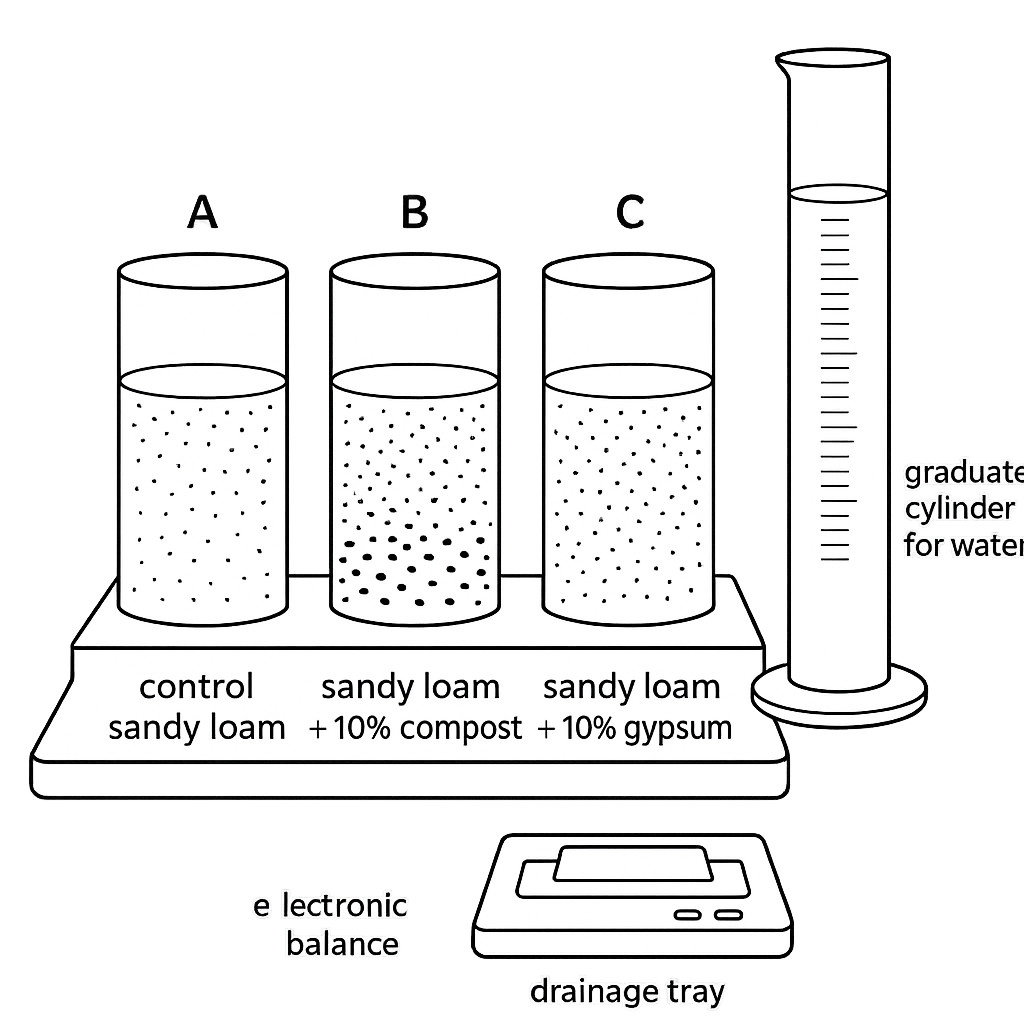
A soil scientist conducts an experiment to compare the water‑holding capacity of three soil samples: (i) a control sandy loam, (ii) sandy loam mixed with 10 % compost by weight, and (iii) sandy loam mixed with 10 % gypsum by weight. The experimental set‑up is shown in the diagram.
Question Parts
(a)
Describe the step‑by‑step procedure for determining the water‑holding capacity of each sample using the set‑up.
(b)
After saturation and drainage, the masses recorded were: control 520 g, compost‑amended 540 g, gypsum‑amended 530 g. The dry mass of each sample before the experiment was 500 g. Calculate the water‑holding capacity (percentage by weight) for each sample.
(c)
Interpret the results and recommend which amendment is most effective for improving water retention in this soil type.
Detailed Essay Solution & Marking Scheme Available

Get the step-by-step mathematical proofs, key points required by examiners, and a comprehensive breakdown from our AI Tutor.
Question 3 View Details
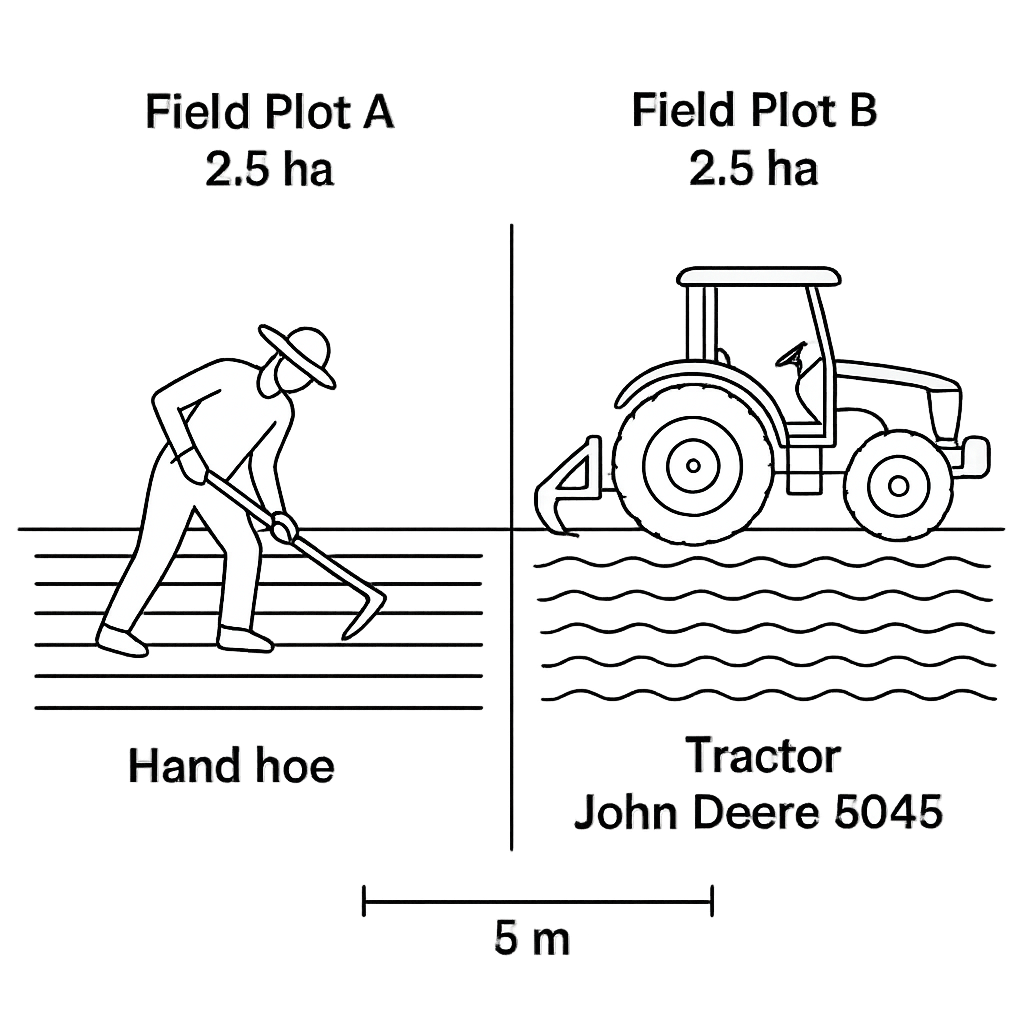
A farmer intends to cultivate a total area of 5 hectares. Two different tools are available: a hand hoe and a tractor‑drawn plough (John Deere 5045). The farmer can cultivate 0.4 ha per hour with the hand hoe and 1.2 ha per hour with the tractor plough. The cost of hiring labour is ₦150 per hour. The tractor consumes fuel at a cost of ₦250 per hour of operation and its depreciation is estimated at ₦500 per hour of use. Using the information provided, answer the following questions.
Question Parts
(a)
Calculate the total labour time required to cultivate the 5 ha with (i) the hand hoe and (ii) the tractor‑drawn plough. Show all working.
(b)
Using the times obtained in part (a), compute the total cost of cultivating the 5 ha with each tool. Include labour cost for both tools, and for the tractor also add fuel and depreciation costs. State which tool is cheaper.
(c)
Propose a practical experimental setup to compare the two tools in terms of soil disturbance and seed germination rate.
Detailed Essay Solution & Marking Scheme Available

Get the step-by-step mathematical proofs, key points required by examiners, and a comprehensive breakdown from our AI Tutor.

Question 4 View Details
A modern combine harvester is to be used on a large wheat farm. The machine has a grain‑tank capacity of 12,000 kg and an unloading rate of 3,000 kg per minute. During operation the harvester can intake grain at a rate of 2,500 kg per minute. Answer the following questions.
Question Parts
(a)
Identify the main components of a combine harvester and briefly describe the function of each component.
Detailed Essay Solution & Marking Scheme Available

Get the step-by-step mathematical proofs, key points required by examiners, and a comprehensive breakdown from our AI Tutor.

Question 5 View Details
A farmer intends to cultivate maize on a 1‑hectare field and is considering three fertilizer options. The details are: - **Fertilizer A (Urea)**: Cost ₦30 per kg, recommended application rate 100 kg ha⁻¹, average yield 5.2 t ha⁻¹. - **Fertilizer B (NPK 15‑15‑15)**: Cost ₦45 per kg, recommended application rate 80 kg ha⁻¹, average yield 5.8 t ha⁻¹. - **Fertilizer C (Organic compost)**: Cost ₦20 per kg, recommended application rate 150 kg ha⁻¹, average yield 4.6 t ha⁻¹. The current market price of maize is ₦30 per kg. Answer the following:
Question Parts
(a)
Calculate the net monetary return per hectare for each fertilizer option (revenue minus fertilizer cost).
(b)
Based on the net returns obtained, recommend the most economical fertilizer and justify your choice.
(c)
Discuss two agronomic advantages of incorporating a crop‑rotation system that includes a legume (e.g., cowpea) with the maize crop.
Detailed Essay Solution & Marking Scheme Available

Get the step-by-step mathematical proofs, key points required by examiners, and a comprehensive breakdown from our AI Tutor.

Question 6 View Details
A dairy farmer is evaluating two feeding regimes for her lactating cows. The data are: **Regime X** - Concentrate (30 % CP) costing ₦45 kg⁻¹, fed 5 kg cow⁻¹ day⁻¹. - Roughage (grass) costing ₦10 kg⁻¹, fed 8 kg cow⁻¹ day⁻¹. - Average milk yield = 20 L cow⁻¹ day⁻¹. **Regime Y** - Concentrate (35 % CP) costing ₦55 kg⁻¹, fed 4 kg cow⁻¹ day⁻¹. - Roughage (silage) costing ₦12 kg⁻¹, fed 9 kg cow⁻¹ day⁻¹. - Average milk yield = 22 L cow⁻¹ day⁻¹. The market price of milk is ₦120 per litre. Answer the following:
Question Parts
(a)
Calculate the total daily feed cost per cow for each regime.
(b)
Determine the feed cost per litre of milk for each regime and state which regime is more cost‑effective in terms of feed cost per litre.
(c)
If the farmer wishes to increase the herd’s total milk production by 10 % without raising the overall feed expenditure, suggest one management or breeding strategy that could achieve this and briefly explain how it works.
Detailed Essay Solution & Marking Scheme Available

Get the step-by-step mathematical proofs, key points required by examiners, and a comprehensive breakdown from our AI Tutor.

Question 7 View Details
A farmer in northern Nigeria cultivates maize on a 5‑hectare field. During the early rainy season he observes a sudden increase of small, greenish‑brown insects feeding on the leaf whorls, causing the leaves to turn yellow and the plants to become stunted. The larvae are white, soft‑bodied and feed inside the whorl. The farmer wishes to control the pest and asks for advice on identification, the most damaging life‑stage, the correct pesticide dosage and an integrated pest‑management (IPM) plan.
Question Parts
(a)
Identify the pest described and justify your identification with two key morphological or behavioural features.
(b)
Outline the complete life cycle of the identified pest and indicate which stage causes the greatest economic damage to maize.
(c)
The recommended spray rate for a 25 % EC (emulsifiable concentrate) insecticide is 0.5 L per hectare. The farmer has a 5 L container of the 25 % EC formulation. Calculate the volume (in litres) of the container that must be used to treat the entire 5‑hectare field.
(d)
Propose an integrated pest‑management (IPM) strategy for this pest, incorporating at least one cultural, one biological and one chemical control measure. Explain briefly how each component reduces reliance on chemical pesticides.
Detailed Essay Solution & Marking Scheme Available

Get the step-by-step mathematical proofs, key points required by examiners, and a comprehensive breakdown from our AI Tutor.

Question 8 View Details
A cassava farmer in southwestern Nigeria observes brown necrotic lesions on the lower stems of several plants and wilting of the leaves. Laboratory analysis confirms the presence of a fungal pathogen. The farmer wants to understand the disease, its impact on yield and how to manage it effectively.
Question Parts
(a)
Identify the disease based on the symptoms and the laboratory finding, and give two distinguishing characteristics that support your identification.
(b)
Describe the disease cycle of the identified pathogen, highlighting the primary source of inoculum and the main mode of spread within a cassava field.
(c)
In a 1‑hectare field containing 2 000 cassava plants, 150 plants show typical disease symptoms. Calculate the disease incidence as a percentage. Assuming each diseased plant would have produced 25 kg of tuber under healthy conditions but now loses 30 % of its potential yield, estimate the total yield loss in kilograms for the whole field.
Detailed Essay Solution & Marking Scheme Available

Get the step-by-step mathematical proofs, key points required by examiners, and a comprehensive breakdown from our AI Tutor.

Master the Exam!

You've seen a preview, but there are thousands more questions plus AI tutor to break down complex solutions.

Unlock Full Access Available for Android & Windows
Help others prepare! Share this practice hub:
Chat with Support