neco model questions vol1 2023 physics | Objective

Prepare for your exams with neco model questions vol1 questions? Reviewing past/model questions is one of the most effective ways to guarantee a high score. This practice hub features authentic 2023 physics (Objective) questions designed to simulate the real exam environment.

Practice these randomly selected questions to test your readiness.

Question 1 View Details
A sealed container holds a gas at \(27^{\circ}\text{C}\) and \(1.00\) atm. At this temperature, \(20\%\) of the gas is removed, after which the remaining gas is heated until the pressure reaches \(1.20\) atm. Assuming the volume of the container is constant, determine the final temperature of the gas in \(^{\circ}\text{C}\).
Correct A. 177
B. 165
C. 150
D. 200

Correct Answer: A

Want to see the full step-by-step solution? Unlock AI Explanation & Analytics
Question 2 View Details
A converging lens is used to form a real image of an object on a screen. The distance between the object and the screen is fixed at \(120\) cm. The lens can be placed anywhere between them. Determine the greatest focal length (in cm) that will allow the image to be at least three times larger than the object.
A. 20
B. 30
C. 25
Correct D. 22.5

Correct Answer: D

Want to see the full step-by-step solution? Unlock AI Explanation & Analytics
Question 3 View Details
Convert a speed of \(5.6\) km h\(^{-1}\) to metres per second (m s\(^{-1}\)). Give your answer correct to two decimal places.
A. 1.45
B. 1.50
Correct C. 1.56
D. 1.60

Correct Answer: C

Want to see the full step-by-step solution? Unlock AI Explanation & Analytics
Question 4 View Details
A battery of emf \(E\) V and internal resistance \(r\) Ω is first connected to a single resistor \(R_{1}=4\) Ω. The current measured is \(2\) A. When a second resistor \(R_{2}=6\) Ω is connected in parallel with \(R_{1}\), the current supplied by the battery becomes \(3\) A. Determine the emf \(E\) (in volts) and the internal resistance \(r\) (in ohms) of the battery.
A. E = 9.6 V, r = 1.2 Ω
B. E = 10.4 V, r = 0.8 Ω
C. E = 8.8 V, r = 0.6 Ω
Correct D. E = 9.6 V, r = 0.8 Ω

Correct Answer: D

Want to see the full step-by-step solution? Unlock AI Explanation & Analytics
Question 5 View Details
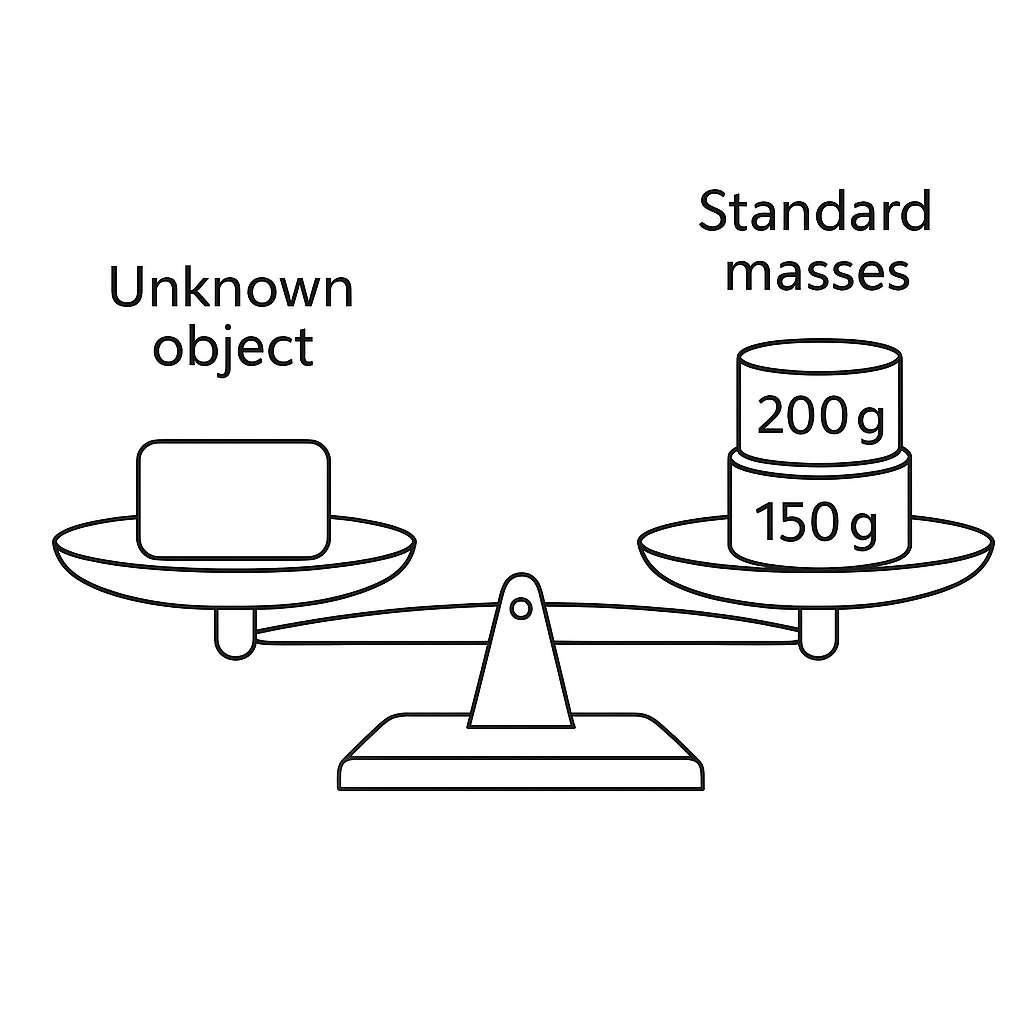
In a balance, an unknown object is placed on the left pan. On the right pan, a 200 g mass and a 150 g mass are placed together, and the balance is in equilibrium. Determine the mass of the unknown object in kilograms.
A. 0.20
Correct B. 0.35
C. 0.15
D. 0.55

Correct Answer: B

Want to see the full step-by-step solution? Unlock AI Explanation & Analytics
Question 6 View Details
A compound pulley system has a mechanical advantage of 2 (the effort rope moves twice the distance moved by the load). When a load of 500 N is lifted, the effort required is measured to be 300 N. (i) Determine the efficiency of the system. (ii) If the load is increased to 800 N, what effort force is required to lift it with the same system?
A. Efficiency = 90.00 %; Effort for 800 N load = 444 N
B. Efficiency = 66.67 %; Effort for 800 N load = 600 N
Correct C. Efficiency = 83.33 %; Effort for 800 N load = 480 N
D. Efficiency = 75.00 %; Effort for 800 N load = 533 N

Correct Answer: C

Want to see the full step-by-step solution? Unlock AI Explanation & Analytics
Question 7 View Details
A stretched string of length 0.60 m is fixed at both ends. It vibrates in a standing‑wave pattern that shows three complete loops (three antinodes). The frequency of the source is 150 Hz and the linear mass density of the string is 0.020 kg m⁻¹. (i) Determine the wavelength of the wave on the string. (ii) Find the speed of the wave. (iii) Calculate the tension in the string.
A. λ = 0.50 m; v = 75 m s⁻¹; T = 112.5 N
Correct B. λ = 0.40 m; v = 60 m s⁻¹; T = 72 N
C. λ = 0.30 m; v = 45 m s⁻¹; T = 54 N
D. λ = 0.20 m; v = 30 m s⁻¹; T = 18 N

Correct Answer: B

Want to see the full step-by-step solution? Unlock AI Explanation & Analytics
Question 8 View Details
A police car moving directly towards a stationary observer emits a siren of frequency 800 Hz. The speed of sound in air is 340 m s⁻¹. (i) If the observer hears a frequency of 880 Hz, determine the speed of the police car. (ii) After the car passes the observer and moves away with the same speed, what frequency does the observer hear? (iii) Suppose instead that while the car moves towards the observer at that speed, the observer is on a train moving towards the car at 20 m s⁻¹. What frequency is now heard by the observer?
A. vs ≈ 28 m s⁻¹; receding frequency ≈ 750 Hz; moving observer frequency ≈ 910 Hz
B. vs ≈ 35 m s⁻¹; receding frequency ≈ 720 Hz; moving observer frequency ≈ 950 Hz
C. vs ≈ 40 m s⁻¹; receding frequency ≈ 700 Hz; moving observer frequency ≈ 970 Hz
Correct D. vs ≈ 31 m s⁻¹; receding frequency ≈ 733 Hz; moving observer frequency ≈ 931 Hz

Correct Answer: D

Want to see the full step-by-step solution? Unlock AI Explanation & Analytics
Question 9 View Details
Two point charges are placed in air: q₁ = +5 µC at the origin O, and q₂ = -3 µC at the point (0, 0.04 m) on the y‑axis. (i) Determine the magnitude and direction of the net electric field at point P (0.03 m, 0). (ii) A test charge q = +2 µC is moved from P to point Q (0, 0.05 m) along the straight line joining them. Calculate the work done by the electric field on the test charge. (iii) Find the potential difference V_P - V_Q between the two points.
Correct A. E ≈ 4.44×10⁷ N C⁻¹ at 11.3° above +x; Work = 5.52 J; V_P‑V_Q = 2.76×10⁶ V
B. E ≈ 4.44×10⁷ N C⁻¹ at 15.0° above +x; Work = 5.52 J; V_P‑V_Q = 3.00×10⁶ V
C. E ≈ 3.90×10⁷ N C⁻¹ at 9.5° above +x; Work = 4.80 J; V_P‑V_Q = 2.30×10⁶ V
D. E ≈ 5.10×10⁷ N C⁻¹ at 13.0° above +x; Work = 6.20 J; V_P‑V_Q = 3.10×10⁶ V

Correct Answer: A

Want to see the full step-by-step solution? Unlock AI Explanation & Analytics
Question 10 View Details
A 10 kg block rests on a rough inclined plane that makes an angle of 30° with the horizontal. The block is held in equilibrium by a horizontal push of magnitude 40 N applied to the block. Determine the coefficient of static friction μ_s between the block and the plane required to keep the block at rest.
A. μ_s ≈ 0.09
B. μ_s ≈ 0.20
Correct C. μ_s ≈ 0.14
D. μ_s ≈ 0.05

Correct Answer: C

Want to see the full step-by-step solution? Unlock AI Explanation & Analytics
Question 11 View Details
A 200 g block of aluminum (specific heat \(0.900\ \text{J g}^{-1}\text{°C}^{-1}\)) at \(150^{\circ}\text{C}\) is placed into a calorimeter containing 300 g of water at \(20^{\circ}\text{C}\). The calorimeter has a heat capacity of \(100\ \text{J °C}^{-1}\). After the system reaches equilibrium the temperature is \(30^{\circ}\text{C}\) and 20 g of water has evaporated. Assuming all the heat for evaporation comes from the system, determine the latent heat of vaporisation of water in \(\text{J g}^{-1}\).
A. 350
B. 520
Correct C. 403
D. 460

Correct Answer: C

Want to see the full step-by-step solution? Unlock AI Explanation & Analytics
Question 12 View Details
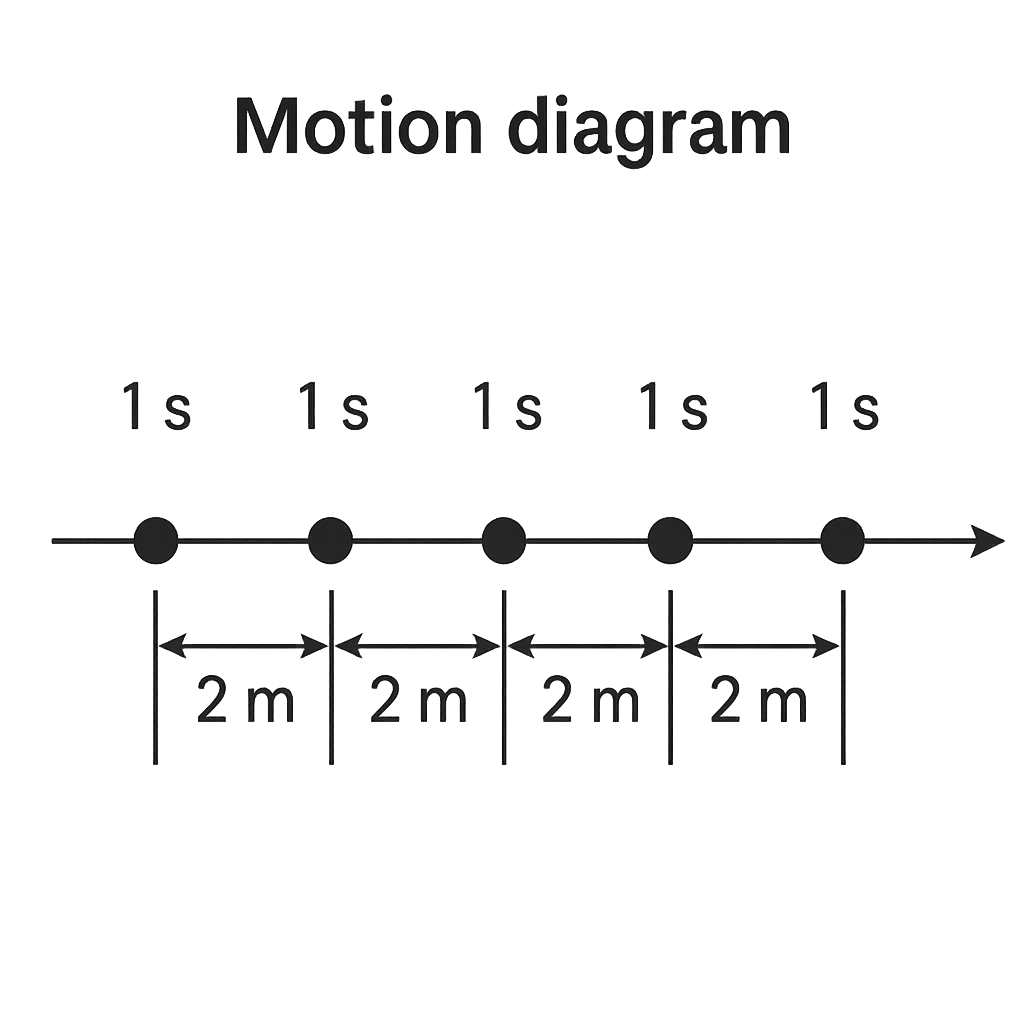
The motion diagram shows a particle at five successive equal time intervals of 1 s. The successive positions are equally spaced 2 m apart along a straight line. Determine the average speed of the particle in \(\text{m s}^{-1}\).
A. 4
Correct B. 2
C. 1
D. 3

Correct Answer: B

Want to see the full step-by-step solution? Unlock AI Explanation & Analytics
Question 13 View Details
A sample of gas occupies \(3.0\ \text{L}\) at \(27^{\circ}\text{C}\) and a pressure of \(100\ \text{kPa}\). It is compressed isothermally to a pressure of \(250\ \text{kPa}\). Then, while kept at the new volume, the gas is heated until its pressure reaches \(400\ \text{kPa}\). What is the final temperature of the gas in kelvin?
A. 560
B. 420
C. 300
Correct D. 480

Correct Answer: D

Want to see the full step-by-step solution? Unlock AI Explanation & Analytics
Question 14 View Details
A block‑and‑tackle system has four supporting rope segments (ideal mechanical advantage 4). A load of \(500\ \text{N}\) is lifted by applying an input force of \(150\ \text{N}\). (a) Calculate the efficiency of the system as a percentage. (b) If the input force moves at a constant speed of \(0.20\ \text{m s}^{-1}\), find the power output in watts.
A. 90.0% , 20 W
Correct B. 83.3% , 25 W
C. 66.7% , 40 W
D. 75.0% , 30 W

Correct Answer: B

Want to see the full step-by-step solution? Unlock AI Explanation & Analytics
Question 15 View Details
A rectangular coil of \(50\) turns, each side \(0.10\ \text{m}\), rotates in a uniform magnetic field of \(0.20\ \text{T}\). The axis of rotation is perpendicular to the field. The coil's resistance is \(5\ \Omega\). The maximum induced emf measured is \(12\ \text{V}\). (a) Determine the angular speed \(\omega\) in rad s\(^{-1}\). (b) Calculate the average electrical power dissipated in the coil. (c) If the coil is instead connected to an external resistor of \(15\ \Omega\) (the coil's own resistance being negligible), find the new average power.
A. 110 rad\/s , 13.5 W , 6.0 W
Correct B. 120 rad/s , 14.4 W , 4.8 W
C. 100 rad\/s , 12.0 W , 5.0 W
D. 130 rad\/s , 16.0 W , 3.2 W

Correct Answer: B

Want to see the full step-by-step solution? Unlock AI Explanation & Analytics
Question 16 View Details
An unknown battery is tested with two different external resistors. - With a resistor \(R\) the terminal voltage across the resistor is \(6\ \text{V}\) and the current measured is \(2\ \text{A}\). - When the external resistance is changed to \(2R\) the terminal voltage becomes \(8\ \text{V}\). Assuming the battery has an emf \(E\) and an internal resistance \(r\), determine: 1. The emf \(E\) (in volts) and the internal resistance \(r\) (in ohms) of the battery. 2. The value of external resistance that will draw maximum power from the battery, and the maximum power (in watts) delivered to that load.
Correct A. E = 12 V, r = 3 Ω, maximum power = 12 W
B. E = 10 V, r = 2 Ω, maximum power = 10 W
C. E = 12 V, r = 4 Ω, maximum power = 9 W
D. E = 14 V, r = 4 Ω, maximum power = 14 W

Correct Answer: A

Want to see the full step-by-step solution? Unlock AI Explanation & Analytics
Question 17 View Details
A source emits sound of frequency \(f_s = 500\ \text{Hz}\) and moves directly towards a stationary observer with a speed of \(30\ \text{m s}^{-1}\). At the same time the observer walks directly away from the source with a speed of \(10\ \text{m s}^{-1}\). The speed of sound in air is \(v = 340\ \text{m s}^{-1}\). (a) Calculate the frequency heard by the observer. (b) A second stationary source emits a sound of frequency \(520\ \text{Hz}\). Determine the beat frequency heard by the observer due to the interference of the two sounds.
A. Observed frequency ≈ 540 Hz, beat frequency = 20 Hz
B. Observed frequency ≈ 500 Hz, beat frequency = 8 Hz
C. Observed frequency ≈ 520 Hz, beat frequency = 0 Hz
Correct D. Observed frequency ≈ 532 Hz, beat frequency = 12 Hz

Correct Answer: D

Want to see the full step-by-step solution? Unlock AI Explanation & Analytics
Question 18 View Details
Refer to the diagram of an inclined plane of angle \(20^{\circ}\) with a block \(A\) of mass \(4\ \text{kg}\) attached by a light string over a frictionless pulley to a hanging mass \(B\) of \(2\ \text{kg}\). The plane is smooth. The system is released from rest. (a) Determine the acceleration of the system and the tension in the string. (b) After the system has moved \(2.0\ \text{m}\) up the incline, a constant external force of \(10\ \text{N}\) is applied parallel to the plane down the incline (opposing the motion). Assuming the force acts until the block comes to rest, find the additional distance the block travels up the incline and the total work done by the external force.
A. a = 0.95 m s⁻², T = 16.0 N, extra distance ≈ 3.00 m, work by external force = -30 J
Correct B. a = 1.03 m s⁻², T = 17.5 N, extra distance ≈ 3.26 m, work by external force = -33 J
C. a = 0.85 m s⁻², T = 15.2 N, extra distance ≈ 2.80 m, work by external force = -28 J
D. a = 1.20 m s⁻², T = 19.0 N, extra distance ≈ 3.80 m, work by external force = -40 J

Correct Answer: B

Want to see the full step-by-step solution? Unlock AI Explanation & Analytics
Question 19 View Details
A car starts from rest, accelerates uniformly for \(5\ \text{s}\) reaching a speed of \(20\ \text{m s}^{-1}\). It then travels at this constant speed for \(30\ \text{s}\) and finally decelerates uniformly to rest in \(4\ \text{s}\). Calculate: 1. The total distance travelled by the car during the whole motion. 2. The average speed of the car over the entire journey.
A. Total distance = 750 m, average speed = 18.8 m s⁻¹
Correct B. Total distance = 690 m, average speed = 17.7 m s⁻¹
C. Total distance = 620 m, average speed = 16.5 m s⁻¹
D. Total distance = 680 m, average speed = 17.2 m s⁻¹

Correct Answer: B

Want to see the full step-by-step solution? Unlock AI Explanation & Analytics
Question 20 View Details
200 g of water at \(80^{\circ}\text{C}\) is mixed with 100 g of ice at \(-10^{\circ}\text{C}\). The specific heat capacities are \(c_{\text{water}} = 4.18\ \text{J g}^{-1}\text{K}^{-1}\) and \(c_{\text{ice}} = 2.09\ \text{J g}^{-1}\text{K}^{-1}\). The latent heat of fusion of ice is \(L_f = 334\ \text{J g}^{-1}\). Assuming no heat loss to the surroundings, determine the final temperature of the mixture and state whether any ice remains.
A. Final temperature ≈ 0 °C, some ice remains
Correct B. Final temperature ≈ 25 °C, all ice melted
C. Final temperature ≈ 10 °C, all ice melted
D. Final temperature ≈ 30 °C, all ice melted

Correct Answer: B

Want to see the full step-by-step solution? Unlock AI Explanation & Analytics
Question 21 View Details
Two forces act on a point. Force \(\vec{F}_1\) has magnitude 8 N and points east. Force \(\vec{F}_2\) has magnitude 6 N and makes an angle of 60° north of east with \(\vec{F}_1\). Find the magnitude of the resultant force.
A. 2\sqrt{33} N
B. 4\sqrt{37} N
C. 10 N
Correct D. 2\sqrt{37} N

Correct Answer: D

Want to see the full step-by-step solution? Unlock AI Explanation & Analytics
Question 22 View Details
A mass is measured as \(2.35\ \text{kg}\) with an absolute uncertainty of \(\pm 0.02\ \text{kg}\). Express the mass in grams together with its absolute and relative uncertainties.
Correct A. 2350 g \pm 20 g (relative uncertainty 0.85%)
B. 2350 g \pm 15 g (relative uncertainty 0.64%)
C. 2350 g \pm 25 g (relative uncertainty 1.06%)
D. 2360 g \pm 20 g (relative uncertainty 0.85%)

Correct Answer: A

Want to see the full step-by-step solution? Unlock AI Explanation & Analytics
Question 23 View Details
A hydrogen atom in the \(n=3\) energy level absorbs a photon of wavelength \(410\ \text{nm}\) and becomes ionized. (a) Calculate the excess kinetic energy of the ejected electron in electron‑volts and joules. (b) Determine the speed of the electron after ionization.
Correct A. Excess kinetic energy = 1.52 eV (2.44×10⁻¹⁹ J); speed ≈ 7.3×10⁵ m/s
B. Excess kinetic energy = 2.10 eV (3.36×10⁻¹⁹ J); speed ≈ 8.5×10⁵ m\/s
C. Excess kinetic energy = 0.85 eV (1.36×10⁻¹⁹ J); speed ≈ 5.9×10⁵ m\/s
D. Excess kinetic energy = 1.52 eV (2.44×10⁻¹⁹ J); speed ≈ 6.2×10⁵ m\/s

Correct Answer: A

Want to see the full step-by-step solution? Unlock AI Explanation & Analytics
Question 24 View Details
A system consists of two masses, \(m_1 = 4\ \text{kg}\) and \(m_2 = 6\ \text{kg}\), connected by a light inextensible string that passes over a uniform solid cylinder of mass \(M = 2\ \text{kg}\) and radius \(R = 0.20\ \text{m}\). The string is wound around the cylinder so that when the masses move the cylinder rotates without slipping. Assuming the pulleys are frictionless, find (a) the magnitude of the common acceleration of the masses, and (b) the tension in the string on each side of the cylinder.
A. a = 1.78 m\/s²; T₁ = 48.1 N, T₂ = 46.3 N
B. a = 2.05 m\/s²; T₁ = 44.0 N, T₂ = 50.2 N
Correct C. a = 1.78 m/s²; T₁ = 46.3 N, T₂ = 48.1 N
D. a = 1.20 m\/s²; T₁ = 42.5 N, T₂ = 45.0 N

Correct Answer: C

Want to see the full step-by-step solution? Unlock AI Explanation & Analytics
Question 25 View Details
A string of length \(L = 1.20\ \text{m}\) fixed at both ends has a linear mass density \(\mu = 0.005\ \text{kg m}^{-1}\). Two harmonic waves travelling in opposite directions on the string have frequencies \(f_1 = 120\ \text{Hz}\) and \(f_2 = 124\ \text{Hz}\), producing a standing‑wave pattern. Assuming the two frequencies correspond to successive normal modes of the string, determine the tension \(T\) in the string.
A. 0.381 N
Correct B. 0.461 N
C. 0.511 N
D. 0.421 N

Correct Answer: B

Want to see the full step-by-step solution? Unlock AI Explanation & Analytics

Master the Exam!

You've seen a preview, but there are thousands more questions plus AI tutor to break down complex solutions.

Unlock Full Access Available for Android & Windows
Help others prepare! Share this practice hub:
Chat with Support