neco model questions vol1 2023 physics | Essay

Prepare for your exams with neco model questions vol1 questions? Reviewing past/model questions is one of the most effective ways to guarantee a high score. This practice hub features authentic 2023 physics (Essay) questions designed to simulate the real exam environment.

Practice these randomly selected questions to test your readiness.
Question 1 View Details
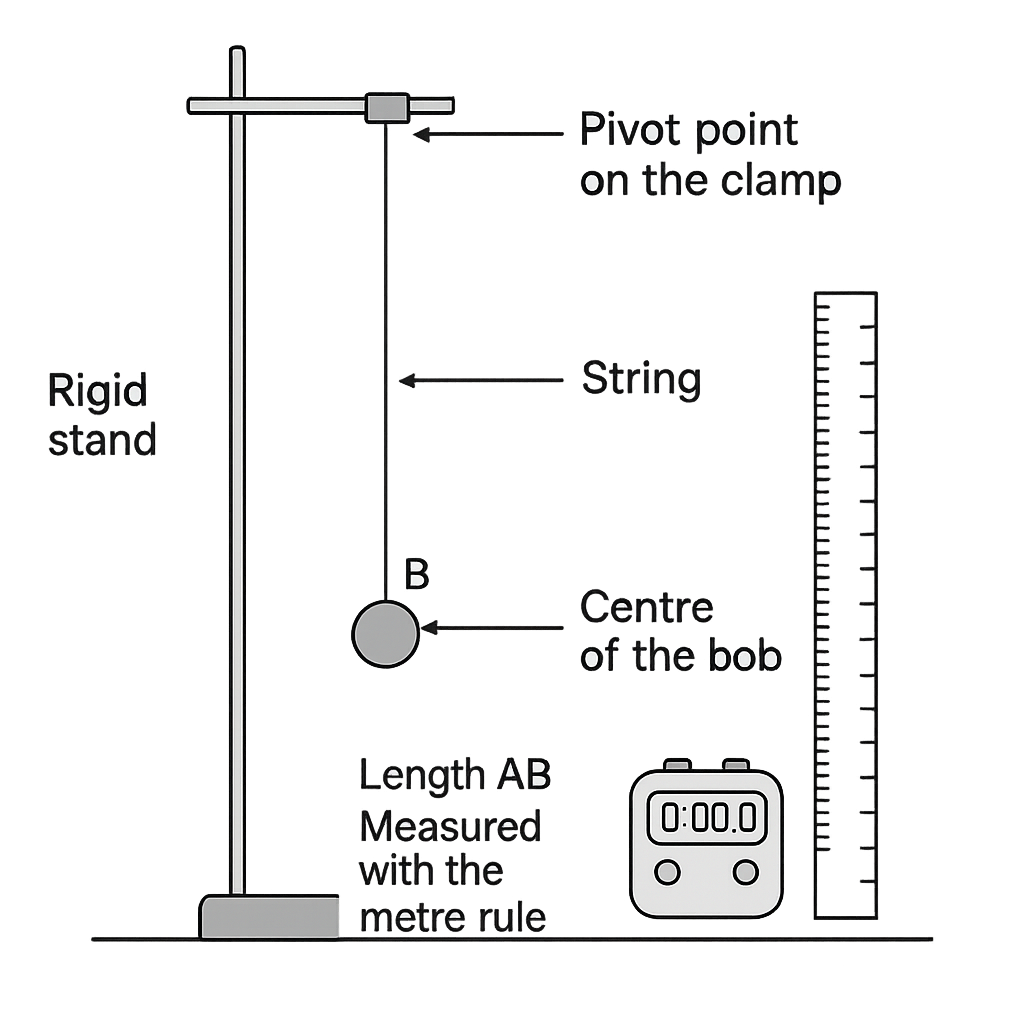
A simple pendulum is set up as shown in the diagram. The string is attached to a rigid stand at point A and a spherical bob hangs from the other end at point B. The length of the pendulum is measured with a metre rule and the period is measured with a digital stopwatch. The following data are obtained:
Question Parts
(a)
Three independent measurements of the length AB are recorded as 0.980 m, 0.985 m and 0.982 m. Determine the best estimate of the length and its absolute uncertainty (express the result in the form L ± ΔL).
(b)
The time for 20 complete oscillations is measured three times giving 40.2 s, 40.5 s and 40.3 s. Calculate the experimental period of the pendulum (T) and its absolute uncertainty, expressing the result as T ± ΔT.
(c)
Using g = 9.8 m s⁻², calculate the theoretical period of the pendulum from the length obtained in part (a). State the formula used and give the numerical value to two decimal places.
(d)
Determine the percentage error between the experimental period (part b) and the theoretical period (part c). Also discuss at least two possible sources of error that could affect the experimental result.
Detailed Essay Solution & Marking Scheme Available

Get the step-by-step mathematical proofs, key points required by examiners, and a comprehensive breakdown from our AI Tutor.
Question 2 View Details
A particle moves in a plane as follows: from the origin O it travels 5.0 m due east to point A. From A it then travels 3.0 m at 60° north of east to point B. During the whole motion a constant horizontal force of magnitude 10 N acts eastwards on the particle.
Question Parts
(a)
Determine the magnitude and direction (north of east) of the resultant displacement vector Ω from O to B.
(b)
Calculate the total work done by the 10 N eastward force during the complete displacement from O to B.
Detailed Essay Solution & Marking Scheme Available

Get the step-by-step mathematical proofs, key points required by examiners, and a comprehensive breakdown from our AI Tutor.
Question 3 View Details
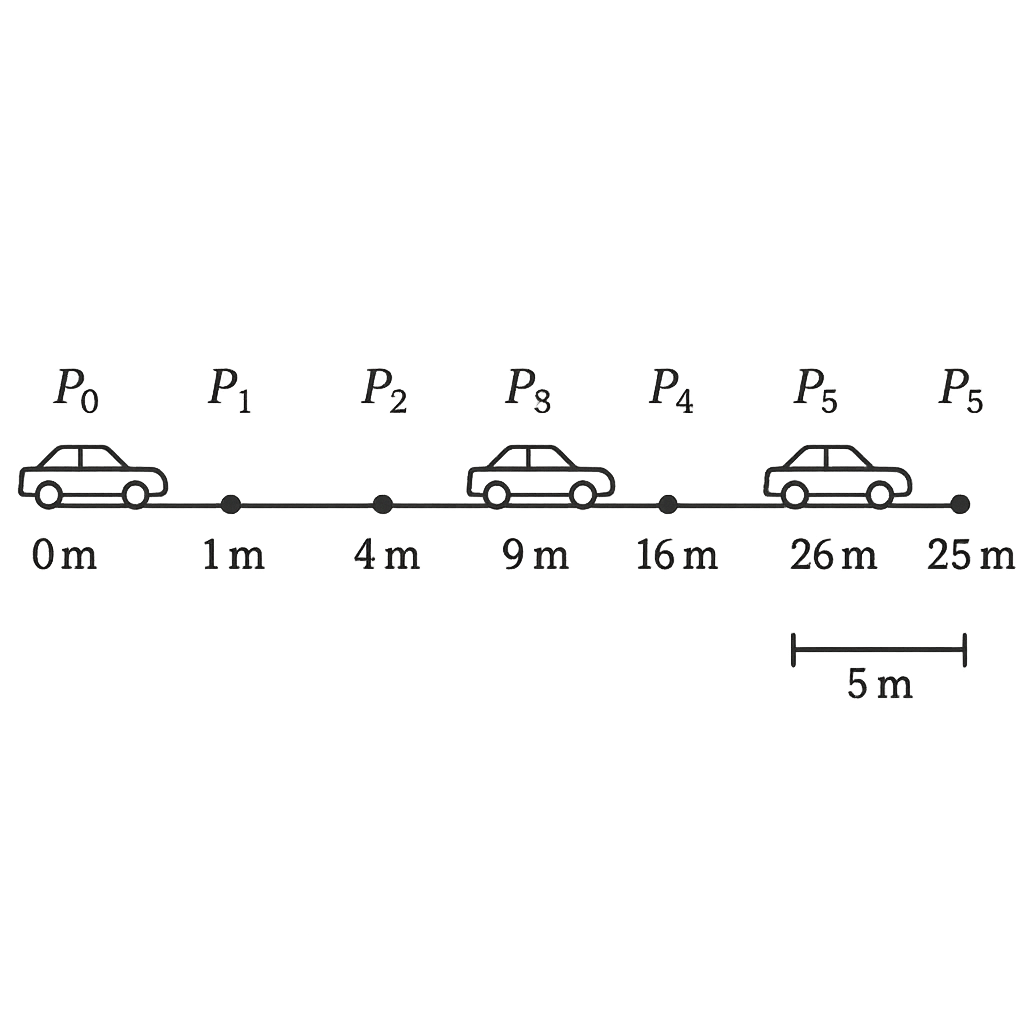
A motion diagram is provided showing the successive positions of a car moving in a straight line at equal time intervals of 1 s. The positions are marked as P0 (origin), P1 at 1 m, P2 at 4 m, P3 at 9 m, P4 at 16 m and P5 at 25 m from the origin.
Question Parts
(a)
Determine the magnitude of the car’s constant acceleration.
(b)
Find the speed of the car after 4 s from the start.
(c)
Calculate the distance travelled by the car between the 2nd and 4th seconds (i.e., from t = 2 s to t = 4 s).
Detailed Essay Solution & Marking Scheme Available

Get the step-by-step mathematical proofs, key points required by examiners, and a comprehensive breakdown from our AI Tutor.

Question 4 View Details
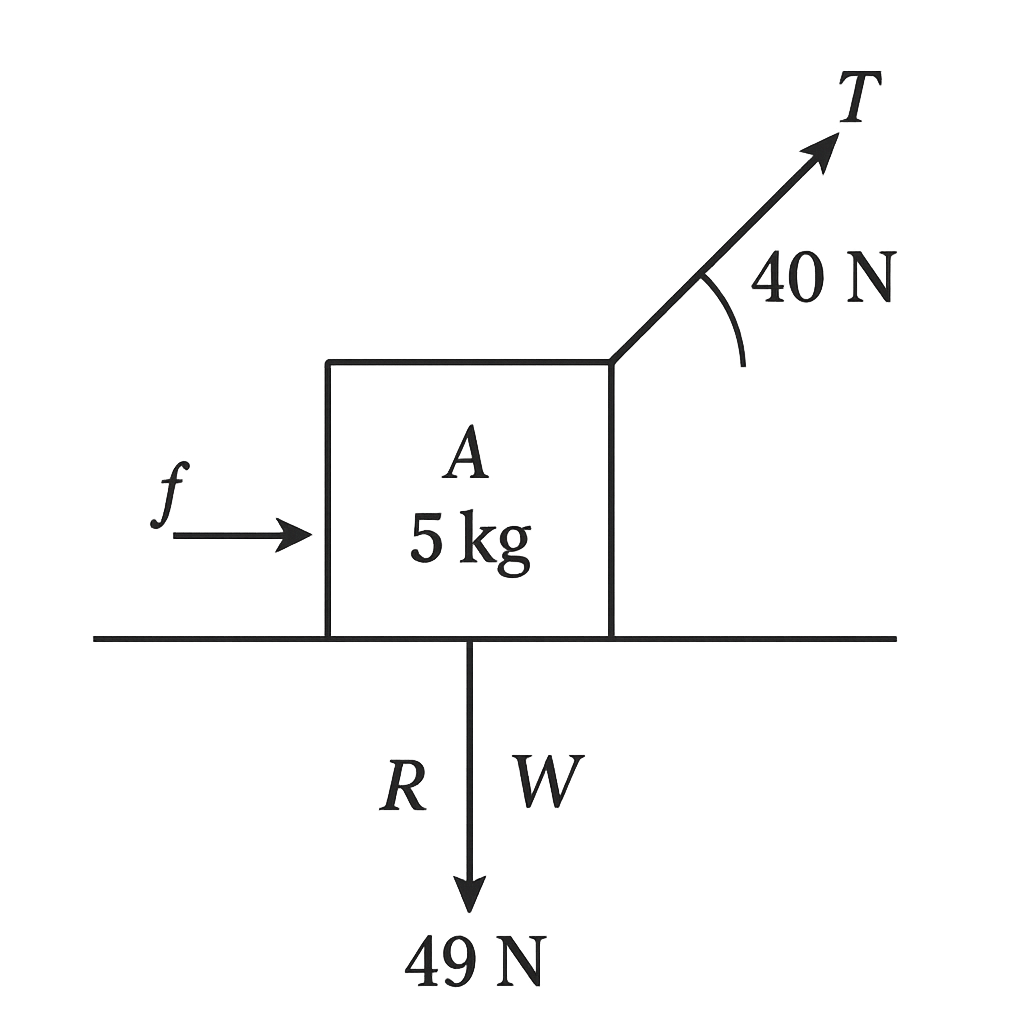
A 5.0 kg block rests on a rough horizontal floor. It is pulled to the right by a rope that makes an angle of 30° above the horizontal. The tension in the rope is 40 N and the block accelerates at 2.0 m s⁻².
Question Parts
(a)
Calculate the magnitude of the normal reaction exerted by the floor on the block.
(b)
Determine the coefficient of kinetic friction between the block and the floor.
(c)
Find the magnitude of the kinetic frictional force acting on the block and state its direction relative to the motion.
Detailed Essay Solution & Marking Scheme Available

Get the step-by-step mathematical proofs, key points required by examiners, and a comprehensive breakdown from our AI Tutor.

Question 5 View Details
A 50 kg crate is pulled up a rough inclined plane that is 10 m long and makes an angle of 30° with the horizontal. The pulling force is a constant horizontal force of 400 N. The coefficient of kinetic friction between the crate and the plane is 0.20. The crate starts from rest at the bottom of the plane and moves to the top.
Question Parts
(a)
Calculate the work done by the horizontal pulling force during the ascent.
(b)
Determine the work done by the kinetic friction force during the ascent.
(c)
Find the net work done on the crate and its speed when it reaches the top of the plane.
(d)
Calculate the magnitude of the constant acceleration of the crate while it moves up the plane.
(e)
If the crate reaches the top in the time found from the acceleration, determine the average power supplied by the horizontal pulling force during the ascent.
Detailed Essay Solution & Marking Scheme Available

Get the step-by-step mathematical proofs, key points required by examiners, and a comprehensive breakdown from our AI Tutor.

Question 6 View Details
A compound simple machine is shown in the diagram. It consists of a class‑I lever AB with a fulcrum at O. The distance OA (effort arm) is 0.25 m and OB (load arm) is 0.75 m. A rope is attached to point B, runs horizontally to a movable pulley P (radius 0.05 m) and then vertically down to a load W of 200 N. An effort force Ft is applied vertically upward at point C, which is 0.50 m above point B. The rope is massless and frictionless. The effort Fe is applied vertically downward at point A. The system is in static equilibrium.
Question Parts
(a)
Determine the tension T in the rope.
(b)
Find the magnitude of the effort Ft applied at C.
(c)
The lever is in equilibrium under the forces Fe (downward at A) and the rope tension T (upward at B).
Detailed Essay Solution & Marking Scheme Available

Get the step-by-step mathematical proofs, key points required by examiners, and a comprehensive breakdown from our AI Tutor.

Question 7 View Details
A vertical cylindrical container of cross‑sectional area 0.020 m² is closed at the bottom and fitted with a frictionless movable piston at the top. Initially the piston is held so that the gas inside occupies a volume of 0.040 m³ at a temperature of 300 K and a pressure equal to atmospheric pressure (1.00×10⁵ Pa). The surrounding air temperature remains constant at 300 K and the external atmospheric pressure is 1.00×10⁵ Pa. The piston is then released and the gas expands until the pressure inside again equals the external atmospheric pressure. Afterwards the temperature of the gas is raised while the piston is kept fixed, and finally the whole apparatus is placed underwater.
Question Parts
(a)
Assuming the expansion is isothermal, calculate the final volume of the gas when the internal pressure again equals the external atmospheric pressure.
(b)
During the expansion the piston rises a distance h. Determine h.
(c)
After the piston has risen to its new position, the temperature of the gas is increased uniformly to 450 K while the piston is kept fixed at that position. Calculate the new absolute pressure of the gas.
(d)
The container is now placed vertically in a lake so that a column of water 5.0 m high rests above the piston. The water exerts hydrostatic pressure on the piston. Assuming the temperature remains 450 K and the piston is free to move until the gas pressure balances the sum of atmospheric pressure and the water pressure, determine the new absolute pressure inside the gas and the corresponding volume of the gas.
Detailed Essay Solution & Marking Scheme Available

Get the step-by-step mathematical proofs, key points required by examiners, and a comprehensive breakdown from our AI Tutor.

Question 8 View Details
A 0.500 kg block of copper at 150°C is placed into a calorimeter containing 0.200 kg of water at 25°C. The calorimeter (including its lid) has a heat capacity of 0.050 kJ·°C⁻¹. The specific heat capacities are: copper 0.385 kJ·kg⁻¹·K⁻¹, water 4.18 kJ·kg⁻¹·K⁻¹. Assume no heat is lost to the surroundings. The same calorimeter is later used in a series of thermodynamic investigations.
Question Parts
(a)
Determine the final equilibrium temperature of the copper–water–calorimeter system.
(b)
If after reaching the equilibrium temperature the copper block is allowed to melt completely, calculate the amount of heat required for the phase change. State whether the calorimeter can supply this heat without the temperature of the water falling below 0°C. (Latent heat of fusion of copper = 205 kJ·kg⁻¹.)
Detailed Essay Solution & Marking Scheme Available

Get the step-by-step mathematical proofs, key points required by examiners, and a comprehensive breakdown from our AI Tutor.

Master the Exam!

You've seen a preview, but there are thousands more questions plus AI tutor to break down complex solutions.

Unlock Full Access Available for Android & Windows
Help others prepare! Share this practice hub:
Chat with Support