neco model questions vol1 2023 geography | Objective

Prepare for your exams with neco model questions vol1 questions? Reviewing past/model questions is one of the most effective ways to guarantee a high score. This practice hub features authentic 2023 geography (Objective) questions designed to simulate the real exam environment.

Practice these randomly selected questions to test your readiness.

Question 1 View Details
In 2015 the town of Umuogwu covered an area of \(120\ \text{km}^2\) and had a population of \(P\) persons. Each year the population increased by \(3\%\) due to natural growth, and after this increase \(1.5\%\) of the population at the start of the year migrated out. At the end of 2020 the town annexed additional land, increasing its total area by \(8\%\). The recorded population density in 2020 was \(400\ \text{persons per km}^2\). Determine the original population \(P\) (to the nearest person) and the original area (to one decimal place).
A. Population ≈ 11 800 persons; Area ≈ 44.0 km²
B. Population ≈ 13 200 persons; Area ≈ 38.5 km²
C. Population ≈ 12 900 persons; Area ≈ 40.2 km²
Correct D. Population ≈ 12 511 persons; Area ≈ 41.7 km²

Correct Answer: D

Want to see the full step-by-step solution? Unlock AI Explanation & Analytics
Question 2 View Details
The annual probability of a flood in Region A is \(p_f\) and that of a landslide is \(p_l\). The average economic loss per flood is \(\text{₦}2.5\) million and per landslide is \(\text{₦}1.8\) million. The expected annual loss is \(\text{₦}1.5\) million and the ratio of the probabilities is \(p_f:p_l = 3:2\). A mitigation programme reduces the flood probability by \(20\%\) and the landslide probability by \(10\%\) (relative reductions). After implementation, what is the new expected annual loss (in million naira) and does it achieve at least a \(40\%\) reduction from the original expected loss? Answer with the new loss rounded to two decimal places and "Yes" or "No".
Correct A. 1.25, No
B. 1.15, Yes
C. 1.20, Yes
D. 1.30, No

Correct Answer: A

Want to see the full step-by-step solution? Unlock AI Explanation & Analytics
Question 3 View Details
A cargo train travels from station A to B (300 km) at a constant speed \(v_1\) km/h, stops at B for 30 minutes, then proceeds from B to C (200 km) at a speed \(v_2\) that is 20 % higher than \(v_1\). The total journey time from A to C is 7 hours.\n\n(a) Determine \(v_1\) (in km/h) to one decimal place.\n(b) The train's fuel consumption per kilometre is given by \(c = \frac{k}{v}\) litres/km, where \(k\) is a constant. If the whole journey consumes exactly 500 litres of fuel, find the value of \(k\) (in litre·km).
A. v1 ≈ 65.3 km/h; k ≈ 85.0 litre·km
B. v1 ≈ 75.0 km/h; k ≈ 70.1 litre·km
C. v1 ≈ 68.5 km/h; k ≈ 80.2 litre·km
Correct D. v1 ≈ 71.8 km/h; k ≈ 76.9 litre·km

Correct Answer: D

Want to see the full step-by-step solution? Unlock AI Explanation & Analytics
Question 4 View Details
The following table shows the average monthly rainfall (in millimetres) for City X:\n\n| Month | Jan | Feb | Mar | Apr | May | Jun | Jul | Aug | Sep | Oct | Nov | Dec | |-------|-----|-----|-----|-----|-----|-----|-----|-----|-----|-----|-----|-----| | Rainfall (mm) | 120 | 80 | 60 | 40 | 20 | 10 | 5 | 5 | 15 | 30 | 70 | 110 | \nCalculate the coefficient of variation (CV) of the monthly rainfall, expressed as a percentage and rounded to one decimal place. The national average CV for rainfall is 45 %. State whether City X's rainfall distribution is more uniform than the national average (answer "Yes" or "No").
Correct A. 82.5%, No
B. 45.0%, Yes
C. 78.3%, Yes
D. 90.2%, No

Correct Answer: A

Want to see the full step-by-step solution? Unlock AI Explanation & Analytics
Question 5 View Details
Four geopolitical zones of Nigeria have the following average annual rainfall (mm) and populations (million):\n\n- North: 200 mm, 30 million\n- South‑West: 1500 mm, 20 million\n- South‑East: 1800 mm, 15 million\n- Central: unknown rainfall \(Y\) mm, population 10 million\n\nThe population‑weighted national average rainfall is 900 mm. Determine the average annual rainfall in the Central zone (\(Y\)) and state whether it meets the minimum 1000 mm rainfall required for the new irrigation project (answer "Yes" or "No").
A. 600 mm, No
B. 1200 mm, No
C. 450 mm, Yes
Correct D. 450 mm, No

Correct Answer: D

Want to see the full step-by-step solution? Unlock AI Explanation & Analytics
Question 6 View Details
On the map, the distance between Town A and Town B is measured as \(7\) cm. The map scale is \(1\) cm : \(10\) km. A car travels from A to B in \(1\) hour \(40\) minutes. (i) What is the car's average speed in km/h? (ii) If the distance on the map between Town A and Town C is \(9.5\) cm, how long will the same car take to travel from A to C at the same speed? Give your answer in hours and minutes.
A. 1 h 55 min (≈ 1.92 h)
Correct B. 2 h 16 min (≈ 2.26 h)
C. 2 h 30 min (≈ 2.50 h)
D. 2 h 10 min (≈ 2.17 h)

Correct Answer: B

Want to see the full step-by-step solution? Unlock AI Explanation & Analytics
Question 7 View Details
A map shows that Town P is located \(30\) km north‑east of Town Q. A hiker starts at P and walks directly south for \(12\) km. What is the straight‑line distance from the hiker's final position to Town Q? Give your answer to one decimal place (km).
A. 26.0 km
B. 21.8 km
C. 24.5 km
Correct D. 23.1 km

Correct Answer: D

Want to see the full step-by-step solution? Unlock AI Explanation & Analytics
Question 8 View Details
The following climatic data (average monthly maximum temperature, minimum temperature and rainfall) are recorded for a location: \( \begin{array}{lccc}\text{Month}&T_{\max} (\!^\circ\!\text{C})&T_{\min} (\!^\circ\!\text{C})&\text{Rainfall (mm)}\\\hline\text{Jan}&30&20&120\\\text{Feb}&31&21&110\\\text{Mar}&32&22&80\\\text{Apr}&33&23&60\\\text{May}&34&24&40\\\text{Jun}&33&23&30\\\text{Jul}&32&22&20\\\text{Aug}&31&21&25\\\text{Sep}&30&20&35\\\text{Oct}&29&19&70\\\text{Nov}&28&18&100\\\text{Dec}&27&17&130\end{array} \) Using the Köppen climate classification, determine the climate type of the location (choose among Aw, Am, Af).
A. Cw
B. Af
C. Am
Correct D. Aw

Correct Answer: D

Want to see the full step-by-step solution? Unlock AI Explanation & Analytics
Question 9 View Details
A farmer has 5 ha of land. The recommended nitrogen application is \(120\) kg N ha\(^{-1}\). The soil also requires \(80\) kg of phosphorus in total. Two fertilizers are available:\n\n- Fertilizer X: 30 % N, 10 kg P per ton, cost ₦12 000 per ton.\n- Fertilizer Y: 20 % N, 30 kg P per ton, cost ₦9 000 per ton.\n\nLet \(x\) be the tons of Fertilizer X and \(y\) the tons of Fertilizer Y to be purchased. Determine the values of \(x\) and \(y\) (to two decimal places) that satisfy both nutrient requirements at minimum total cost.
A. Fertilizer X: 0.35 t, Fertilizer Y: 2.40 t (approx.)
B. Fertilizer X: 0.50 t, Fertilizer Y: 2.00 t (approx.)
Correct C. Fertilizer X: 0.29 t, Fertilizer Y: 2.57 t (approx.)
D. Fertilizer X: 0.20 t, Fertilizer Y: 2.80 t (approx.)

Correct Answer: C

Want to see the full step-by-step solution? Unlock AI Explanation & Analytics
Question 10 View Details
The population of Town Z was \(150\,000\) in the year 2010. From 2010 to 2015 the annual natural growth rate was \(2.5\%\). Beginning in 2015, the natural growth rate fell to \(1.8\%\) per year and the town experienced a net out‑migration of \(1\,200\) people each year. Assuming the rates apply at the end of each year, calculate the estimated population of Town Z in 2020. Round your answer to the nearest whole number.
A. 178900
B. 180800
Correct C. 179322
D. 176500

Correct Answer: C

Want to see the full step-by-step solution? Unlock AI Explanation & Analytics
Question 11 View Details
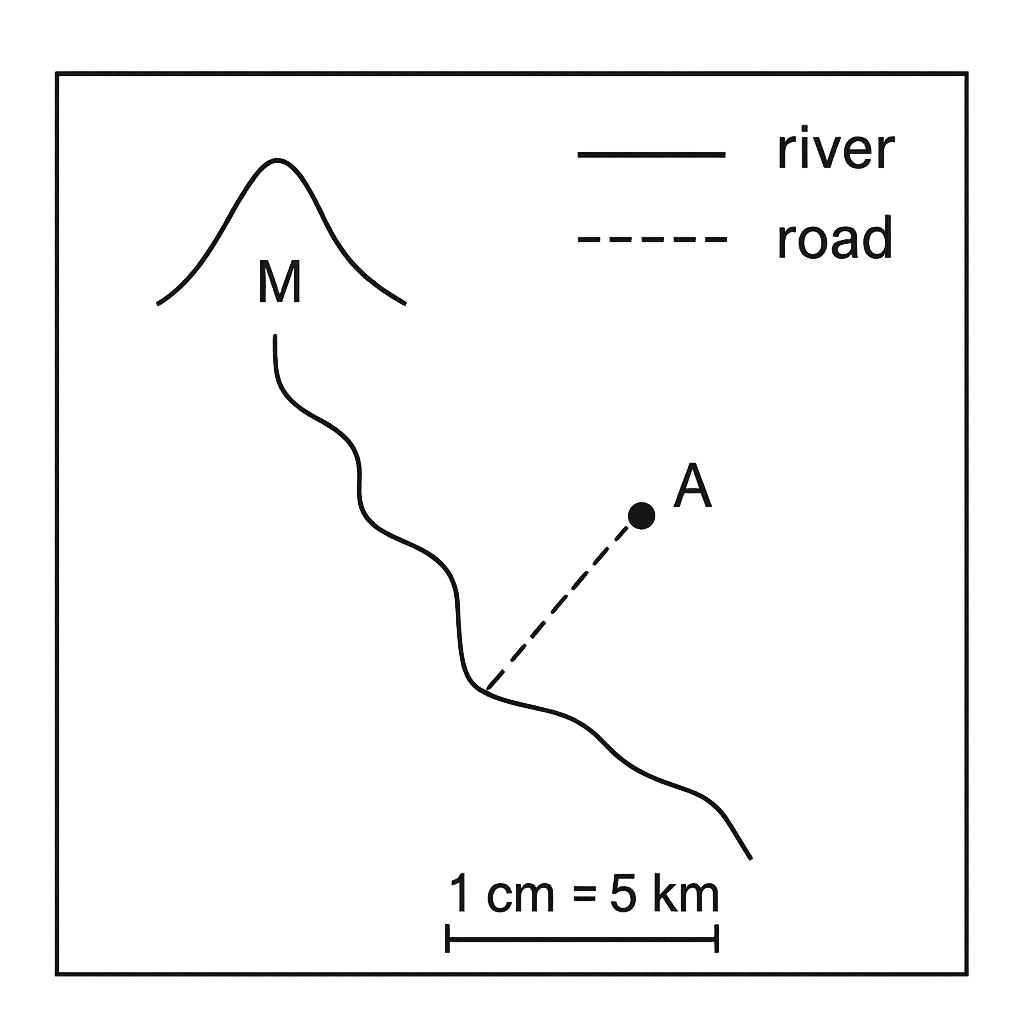
On the map, the scale is \(1\text{ cm}=5\text{ km}\). The mountain peak M is at the centre. Town A is \(3\) cm east of M, and the confluence point C is \(4\) cm south of M. What is the straight‑line distance between A and C in kilometres?
A. 30 km
B. 35 km
C. 20 km
Correct D. 25 km

Correct Answer: D

Want to see the full step-by-step solution? Unlock AI Explanation & Analytics
Question 12 View Details
A plateau covers an area of \(120\) km\(^2\). Each year it loses \(0.8\%\) of its area uniformly due to erosion. A neighbouring hill has an area of \(90\) km\(^2\). After how many whole years will the plateau's remaining area become less than that of the hill?
A. 30 years
B. 45 years
C. 40 years
Correct D. 36 years

Correct Answer: D

Want to see the full step-by-step solution? Unlock AI Explanation & Analytics
Question 13 View Details
A coastal town experiences two independent hazards each year: a severe flood (probability \(0.12\)) and a cyclone (probability \(0.08\)). A flood causes an average loss of \(\text{₦}15\) million, a cyclone \(\text{₦}20\) million. If both occur in the same year, an extra synergistic loss equal to \(25\%\) of the sum of the two individual losses is incurred. What is the expected annual monetary loss (in millions of naira) for the town?
A. 5.12 million
B. 2.76 million
C. 4.20 million
Correct D. 3.48 million

Correct Answer: D

Want to see the full step-by-step solution? Unlock AI Explanation & Analytics
Question 14 View Details
City X is located at latitude \(6^{\circ}30'\) N, longitude \(3^{\circ}20'\) E. City Y is at latitude \(5^{\circ}15'\) N, longitude \(7^{\circ}45'\) E. Assuming the Earth's radius is \(6371\) km, calculate the great‑circle distance between the two cities using the spherical law of cosines. Give your answer in kilometres, rounded to the nearest kilometre.
A. 450 km
B. 610 km
Correct C. 503 km
D. 560 km

Correct Answer: C

Want to see the full step-by-step solution? Unlock AI Explanation & Analytics
Question 15 View Details
A soil sample has a field capacity of \(0.35\) cm\(^3\)/cm\(^3\) and a wilting point of \(0.15\) cm\(^3\)/cm\(^3\). The bulk density is \(1.4\) g/cm\(^3\) and the root‑zone depth is \(0.6\) m. Calculate (a) the amount of water that can be stored between field capacity and wilting point in the root zone, expressed in millimetres of water depth, and (b) the corresponding mass of water in kilograms per hectare.
A. 100 mm, 10,000 kg
B. 130 mm, 13,500 kg
C. 90 mm, 9,000 kg
Correct D. 120 mm, 12,000 kg

Correct Answer: D

Want to see the full step-by-step solution? Unlock AI Explanation & Analytics
Question 16 View Details
A factory produces two products, P and Q, using two machines, M1 and M2. Each unit of P requires (2) hours on M1 and (1) hour on M2, while each unit of Q requires (1) hour on M1 and (2) hours on M2. Machine M1 is available for at most (100) hours per week and M2 for at most (80) hours per week. The profit earned per unit is \(\text{₦}500\) for P and \(\text{₦}400\) for Q. Determine the number of units of P and Q that should be produced each week to maximise profit, and state the maximum profit.
A. Produce 30 units of P and 30 units of Q; maximum profit = ₦27,000
B. Produce 45 units of P and 10 units of Q; maximum profit = ₦26,500
Correct C. Produce 40 units of P and 20 units of Q; maximum profit = ₦28,000
D. Produce 20 units of P and 40 units of Q; maximum profit = ₦26,000

Correct Answer: C

Want to see the full step-by-step solution? Unlock AI Explanation & Analytics
Question 17 View Details
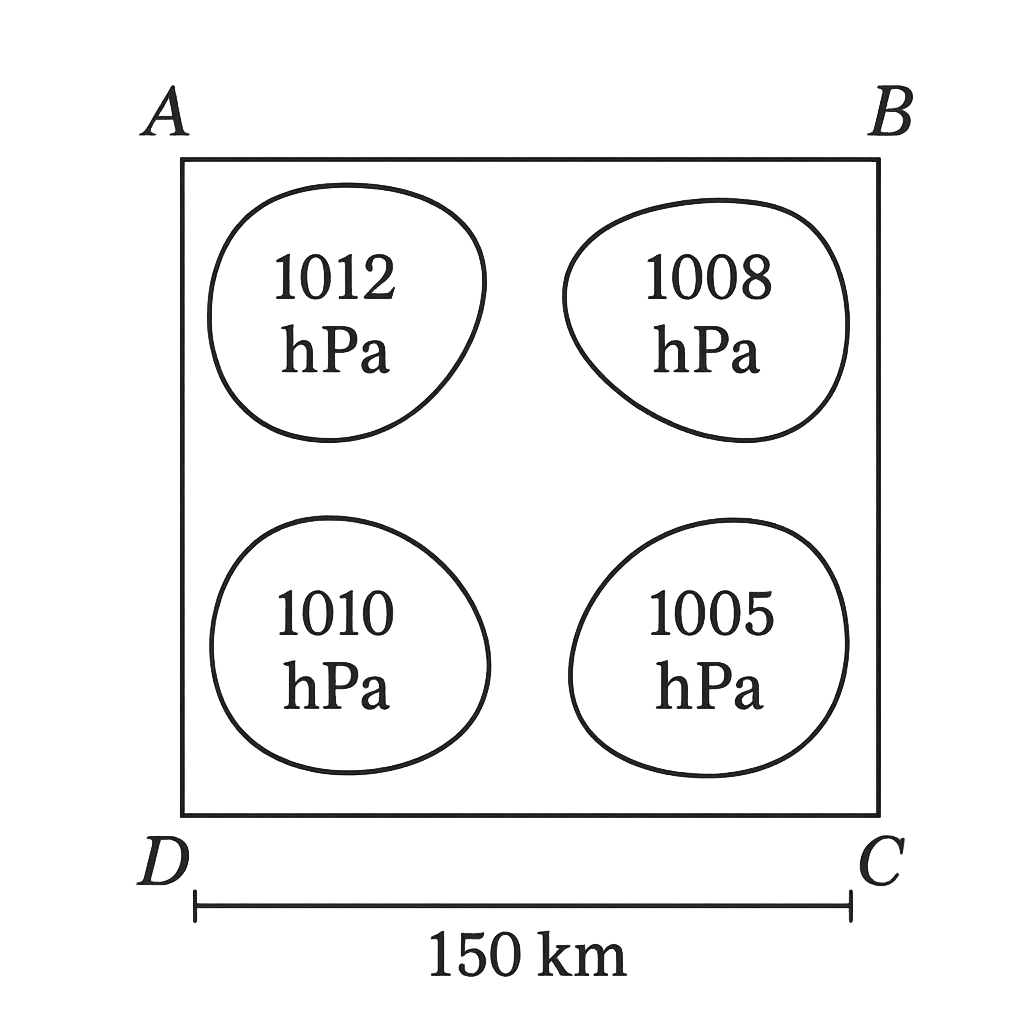
The diagram shows four weather stations A, B, C and D forming a rectangle, each side 150 km long. The sea‑level pressures recorded are: A = 1012 hPa, B = 1008 hPa, C = 1005 hPa, D = 1010 hPa. In the Northern Hemisphere wind blows from high to low pressure and is deflected to the right of the pressure gradient. (a) Identify the station with the lowest pressure. (b) State the approximate wind direction at station B. (c) Calculate the pressure gradient between stations B and C in hPa per kilometre.
A. Station D; Southeast; 0.01 hPa\/km
Correct B. Station C; Southwest; 0.02 hPa/km
C. Station B; South; 0.02 hPa\/km
D. Station C; Northwest; 0.03 hPa\/km

Correct Answer: B

Want to see the full step-by-step solution? Unlock AI Explanation & Analytics
Question 18 View Details
A metamorphic rock sample contains the minerals quartz, muscovite, garnet and sillimanite. Based on this mineral assemblage, (a) identify the metamorphic facies, and (b) estimate the approximate pressure (in kbar) and temperature (in °C) conditions under which the rock formed.
Correct A. Upper amphibolite (granulite) facies; pressure ≈ 6-8 kbar; temperature ≈ 650-750 °C
B. Lower amphibolite facies; pressure ≈ 4-5 kbar; temperature ≈ 500-600 °C
C. Greenschist facies; pressure ≈ 2-3 kbar; temperature ≈ 350-450 °C
D. Blueschist facies; pressure ≈ 10-12 kbar; temperature ≈ 300-400 °C

Correct Answer: A

Want to see the full step-by-step solution? Unlock AI Explanation & Analytics
Question 19 View Details
A vegetation map of a tropical region divides the area into three zones: Zone A (elevation 0-200 m, annual rainfall 1500 mm), Zone B (elevation 200-800 m, rainfall 1200 mm), and Zone C (elevation >800 m, rainfall 800 mm). Cocoa cultivation requires an annual rainfall between 1000 mm and 2000 mm and an average temperature between 21 °C and 27 °C. Assuming temperature decreases by 0.6 °C for every 100 m increase in elevation, which zone is most suitable for cocoa farming? Justify your choice.
Correct A. Zone B; it provides rainfall of 1200 mm and a temperature range of about 22-26 °C, both within the cocoa requirements.
B. Zone A; it provides rainfall of 1500 mm but a temperature range of about 18-22 °C, which is below the cocoa requirement.
C. Zone B; it provides rainfall of 1200 mm but a temperature range of about 28-32 °C, exceeding the cocoa temperature limit.
D. Zone C; it provides rainfall of 800 mm and a temperature range of about 16-20 °C, both outside the cocoa requirements.

Correct Answer: A

Want to see the full step-by-step solution? Unlock AI Explanation & Analytics
Question 20 View Details
A soil sample has the following texture percentages: 30 % sand, 45 % silt and 25 % clay. (a) Classify the soil texture according to the USDA soil‑texture triangle. (b) Estimate the soil's water‑holding capacity (WHC) using the approximation WHC ≈ 0.2 × (clay %) + 0.1 × (silt %) (expressed in cm³ cm⁻³).
A. Clay loam; 9.5 cm³ cm⁻³
B. Loam; 0.050 cm³ cm⁻³
Correct C. Silt loam; 0.095 cm³ cm⁻³
D. Sandy loam; 0.115 cm³ cm⁻³

Correct Answer: C

Want to see the full step-by-step solution? Unlock AI Explanation & Analytics
Question 21 View Details
City A is located at \(5^{\circ}\)N, \(7^{\circ}\)E and City B at \(8^{\circ}\)S, \(3^{\circ}\)W. Assuming each degree of latitude corresponds to 111 km, calculate the approximate north‑south distance between the two cities, ignoring any east‑west component.
A. 1332
B. 1554
C. 1456
Correct D. 1443

Correct Answer: D

Want to see the full step-by-step solution? Unlock AI Explanation & Analytics
Question 22 View Details
Four regions have the following annual rainfall and population density:\n\n- Region A: rainfall \(1400\) mm, density \(120\) persons/km\(^2\)\n- Region B: rainfall \(1100\) mm, density \(80\) persons/km\(^2\)\n- Region C: rainfall \(1600\) mm, density \(200\) persons/km\(^2\)\n- Region D: rainfall \(1300\) mm, density \(140\) persons/km\(^2\)\n\nA crop requires at least \(1200\) mm rainfall and an optimum population density below \(150\) persons/km\(^2\). For each region that meets both criteria, compute the suitability index defined as \(\frac{\text{rainfall (mm)}}{\text{population density (persons/km}^2)}\). Which region has the highest suitability index?
A. Region D
Correct B. Region A
C. Region B
D. Region C

Correct Answer: B

Want to see the full step-by-step solution? Unlock AI Explanation & Analytics
Question 23 View Details
Farm X cultivates maize on \(5\) ha. Expected yield is \(3.2\) t/ha and market price is ₦\(120\) per kg. Variable cost is ₦\(150{,}000\) per ha and fixed cost is ₦\(200{,}000\). Fertilizer constitutes \(10\%\) of the variable cost and the government subsidises \(20\%\) of the fertilizer cost.\n\nFarm Y cultivates sorghum on \(4\) ha. Expected yield is \(2.5\) t/ha and market price is ₦\(100\) per kg. Variable cost is ₦\(130{,}000\) per ha and fixed cost is ₦\(180{,}000\). Fertilizer is also \(10\%\) of the variable cost and the subsidy is \(15\%\) of the fertilizer cost.\n\nCalculate the net profit per hectare for each farm after accounting for the subsidy, and state which farm has the higher profit per hectare.
Correct A. Farm X
B. Both farms have equal profit per hectare
C. Farm Y
D. Neither farm makes a profit

Correct Answer: A

Want to see the full step-by-step solution? Unlock AI Explanation & Analytics
Question 24 View Details
A map has a scale of \(1\) cm : \(5\) km. The measured distance between Town C and Town D on the map is \(7.8\) cm. What is the actual distance in kilometres between the two towns?
A. 42
B. 38
C. 35
Correct D. 39

Correct Answer: D

Want to see the full step-by-step solution? Unlock AI Explanation & Analytics
Question 25 View Details
Three environmental hazards have the following estimated annual probability of occurrence and impact scores (on a scale of 1-10):\n\n- Flood: probability \(0.30\), impact \(9\)\n- Drought: probability \(0.15\), impact \(8\)\n- Landslide: probability \(0.05\), impact \(10\)\n\nRisk is defined as the product of probability and impact. Identify which hazard has a risk value exceeding \(2.5\) and therefore requires immediate mitigation.
A. Earthquake
B. Landslide
C. Drought
Correct D. Flood

Correct Answer: D

Want to see the full step-by-step solution? Unlock AI Explanation & Analytics

Master the Exam!

You've seen a preview, but there are thousands more questions plus AI tutor to break down complex solutions.

Unlock Full Access Available for Android & Windows
Help others prepare! Share this practice hub:
Chat with Support