neco model questions vol1 2023 chemistry | Objective

Prepare for your exams with neco model questions vol1 questions? Reviewing past/model questions is one of the most effective ways to guarantee a high score. This practice hub features authentic 2023 chemistry (Objective) questions designed to simulate the real exam environment.

Practice these randomly selected questions to test your readiness.

Question 1 View Details
A solution contains 0.025 mol of \(\mathrm{Fe^{2+}}\) ions in acidic medium. It is titrated with a 0.020 M solution of \(\mathrm{KMnO_4}\) until the solution just turns colourless. Write the balanced overall redox equation and calculate the volume (in mL) of \(\mathrm{KMnO_4}\) solution required.
A. 225
B. 300
Correct C. 250
D. 200

Correct Answer: C

Want to see the full step-by-step solution? Unlock AI Explanation & Analytics
Question 2 View Details
The Henry's law constant for carbon dioxide at 25°C is \(3.3\times10^{-2}\) mol·L^{-1}·atm^{-1}. The enthalpy of solution of CO_2 is \(-19\) kJ·mol^{-1}. Calculate the concentration of dissolved CO_2 (in mol·L^{-1}) in water at 35°C when the partial pressure of CO_2 above the water is \(4.0\times10^{-4}\) atm. (Assume the van't Hoff equation applies and use \(R = 8.314\) J·mol^{-1}·K^{-1}).
A. 5.0×10^{-6}
B. 1.5×10^{-5}
Correct C. 1.0×10^{-5}
D. 2.0×10^{-5}

Correct Answer: C

Want to see the full step-by-step solution? Unlock AI Explanation & Analytics
Question 3 View Details
Cyclohexanone (\(C_6H_{10}O\)) is first reduced with NaBH_4 to give the corresponding alcohol, which is then dehydrated using concentrated \(H_2SO_4\). (a) Write the molecular formula of the final product. (b) If 5.00 g of cyclohexanone were used and the isolated mass of the final product was 3.50 g, calculate the percentage yield.
Correct A. C6H10; 85.4%
B. C6H10; 92.1%
C. C6H8; 85.4%
D. C6H12; 70.0%

Correct Answer: A

Want to see the full step-by-step solution? Unlock AI Explanation & Analytics
Question 4 View Details
A 0.500 g sample of ammonium chloride (\(NH_4Cl\)) is dissolved in 250.0 mL of water at 25°C. Assuming complete dissociation, calculate the pH of the solution. (Ka of \(NH_4^+\) = 5.6×10^{-10}).
A. 4.96
Correct B. 5.34
C. 5.12
D. 5.78

Correct Answer: B

Want to see the full step-by-step solution? Unlock AI Explanation & Analytics
Question 5 View Details
The vapour pressure of a liquid is 0.40 atm at 298 K and 0.55 atm at 308 K. Assuming the enthalpy of vapourisation remains constant over this temperature range, calculate \(\Delta H_{vap}\) in kJ·mol^{-1} using the Clausius-Clapeyron equation.
A. 22.5
B. 30.1
C. 27.8
Correct D. 24.3

Correct Answer: D

Want to see the full step-by-step solution? Unlock AI Explanation & Analytics
Question 6 View Details
An element is located in period 4 and group 13 of the periodic table. It commonly forms a +3 cation and has an atomic mass of about 69 u. Identify the element symbol.
Correct A. Ga
B. Tl
C. In
D. Al

Correct Answer: A

Want to see the full step-by-step solution? Unlock AI Explanation & Analytics
Question 7 View Details
A metal M reacts with dilute hydrochloric acid according to \( \mathrm{M + 2HCl \rightarrow MCl_2 + H_2} \). When 5.00 g of the metal reacts with excess HCl, 2.01 L of hydrogen gas are collected at STP. Identify the metal and give its molar mass in g·mol\(^{-1}\).
A. Ni (≈58.7)
Correct B. Fe (≈55.8)
C. Cu (≈63.5)
D. Zn (≈65.4)

Correct Answer: B

Want to see the full step-by-step solution? Unlock AI Explanation & Analytics
Question 8 View Details
A 10.0 g mixture of two hydrocarbons is completely combusted in excess oxygen. The mixture contains an alkane of formula \( \mathrm{C_nH_{2n+2}} \) and an alkene of formula \( \mathrm{C_mH_{2m}} \) in a mass ratio of 3:2 (alkane : alkene). The combustion produces 30.6 g of \( \mathrm{CO_2} \) and 15.0 g of \( \mathrm{H_2O} \). Determine the molecular formulas of the alkane and the alkene.
Correct A. Alkane: C₃H₈; Alkene: C₂H₄
B. Alkane: C₄H₁₀; Alkene: C₃H₆
C. Alkane: C₂H₆; Alkene: C₁H₂
D. Alkane: C₅H₁₂; Alkene: C₄H₈

Correct Answer: A

Want to see the full step-by-step solution? Unlock AI Explanation & Analytics
Question 9 View Details
A 0.250 M solution of the weak acid HA ( \(K_a = 1.8 \times 10^{-5}\) ) is titrated with 0.200 M NaOH. If 12.5 mL of NaOH is added to 25.0 mL of the acid solution, calculate the pH of the resulting solution.
A. 5.03
B. 4.12
C. 3.89
Correct D. 4.57

Correct Answer: D

Want to see the full step-by-step solution? Unlock AI Explanation & Analytics
Question 10 View Details
In acidic solution the redox reaction \(\mathrm{MnO_4^- + C_2O_4^{2-} \rightarrow Mn^{2+} + CO_2}\) occurs. Balance the equation and then determine the volume (in mL) of 0.100 M \(\mathrm{H_2SO_4}\) required to completely react with 0.0500 mol of \(\mathrm{C_2O_4^{2-}}\) when excess \(\mathrm{KMnO_4}\) (0.200 M) is present. Assume that the \(\mathrm{H^+}\) ions are supplied solely by the sulfuric acid.
Correct A. 800
B. 600
C. 400
D. 1000

Correct Answer: A

Want to see the full step-by-step solution? Unlock AI Explanation & Analytics
Question 11 View Details
A 1.00 L aqueous solution contains 0.20 mol of the weak acid HA ( \(K_a = 1.8 \times 10^{-5}\) ) and 0.15 mol of its sodium salt NaA. After adding 0.05 mol of HCl, what is the pH of the solution? Give your answer to two decimal places.
Correct A. 4.35
B. 4.15
C. 5.05
D. 4.55

Correct Answer: A

Want to see the full step-by-step solution? Unlock AI Explanation & Analytics
Question 12 View Details
In the Fischer esterification of acetic acid with ethanol, 5.00 g of acetic acid ( \(M = 60.05\ \text{g mol}^{-1}\) ) is mixed with 4.60 g of ethanol ( \(M = 46.07\ \text{g mol}^{-1}\) ) and excess sulfuric acid. After reflux, 4.20 g of ethyl acetate ( \(M = 88.11\ \text{g mol}^{-1}\) ) is obtained, but 0.50 g of product is lost during washing. Calculate the percent yield based on the limiting reagent, using the final mass of product.
A. 45%
Correct B. 50%
C. 55%
D. 60%

Correct Answer: B

Want to see the full step-by-step solution? Unlock AI Explanation & Analytics
Question 13 View Details
Boron trifluoride (BF₃) is a planar molecule. Determine the hybridisation of the central boron atom and the expected bond angle between the B-F bonds. State your answer in the form ‘hybridisation; angle (°)'.
A. sp³; 109.5°
B. sp²; 90°
Correct C. sp²; 120°
D. sp; 180°

Correct Answer: C

Want to see the full step-by-step solution? Unlock AI Explanation & Analytics
Question 14 View Details
30.0 mL of 0.500 M hydrochloric acid is mixed with 2.50 g of calcium carbonate (CaCO₃). The reaction is: CaCO₃ + 2 HCl → CaCl₂ + CO₂ + H₂O. Identify the limiting reagent and calculate (i) the volume of CO₂ produced at STP and (ii) the mass of CaCl₂ formed. Give the volume in litres (three significant figures) and the mass in grams (three significant figures).
A. CaCO₃ is limiting; CO₂ = 0.250 L; CaCl₂ = 1.25 g
B. HCl is limiting; CO₂ = 0.150 L; CaCl₂ = 0.750 g
C. HCl is limiting; CO₂ = 0.200 L; CaCl₂ = 1.00 g
Correct D. HCl is limiting; CO₂ = 0.168 L; CaCl₂ = 0.832 g

Correct Answer: D

Want to see the full step-by-step solution? Unlock AI Explanation & Analytics
Question 15 View Details
A piece of copper metal weighing 5.00 g is placed in 0.10 mol of aqueous silver nitrate (AgNO₃). The reaction is: Cu(s) + 2 AgNO₃(aq) → Cu(NO₃)₂(aq) + 2 Ag(s). After completion, the silver precipitate is filtered, dried and weighed. (a) Calculate the mass of silver obtained. (b) Using the same amount of copper that actually reacted, determine the volume of hydrogen gas that would be liberated at STP if the copper instead reacted with excess dilute hydrochloric acid according to Cu + 2 HCl → CuCl₂ + H₂. Assume 100 % yield. Give the volume in litres to three significant figures.
A. Ag mass = 9.65 g; H₂ volume = 1.00 L
Correct B. Ag mass = 10.8 g; H₂ volume = 1.12 L
C. Ag mass = 10.8 g; H₂ volume = 0.95 L
D. Ag mass = 12.3 g; H₂ volume = 1.25 L

Correct Answer: B

Want to see the full step-by-step solution? Unlock AI Explanation & Analytics
Question 16 View Details
A 5.00 g sample of benzoic acid (\(C_{6}H_{5}COOH\)) is refluxed with excess ethanol under Fischer esterification conditions. At equilibrium the concentration of ethyl benzoate in the 250 mL reaction mixture is found to be \(0.080\ \text{mol\,L}^{-1}\). Calculate the percentage yield of ethyl benzoate based on the initial benzoic acid.
Correct A. 48.9 %
B. 41.7 %
C. 55.0 %
D. 52.3 %

Correct Answer: A

Want to see the full step-by-step solution? Unlock AI Explanation & Analytics
Question 17 View Details
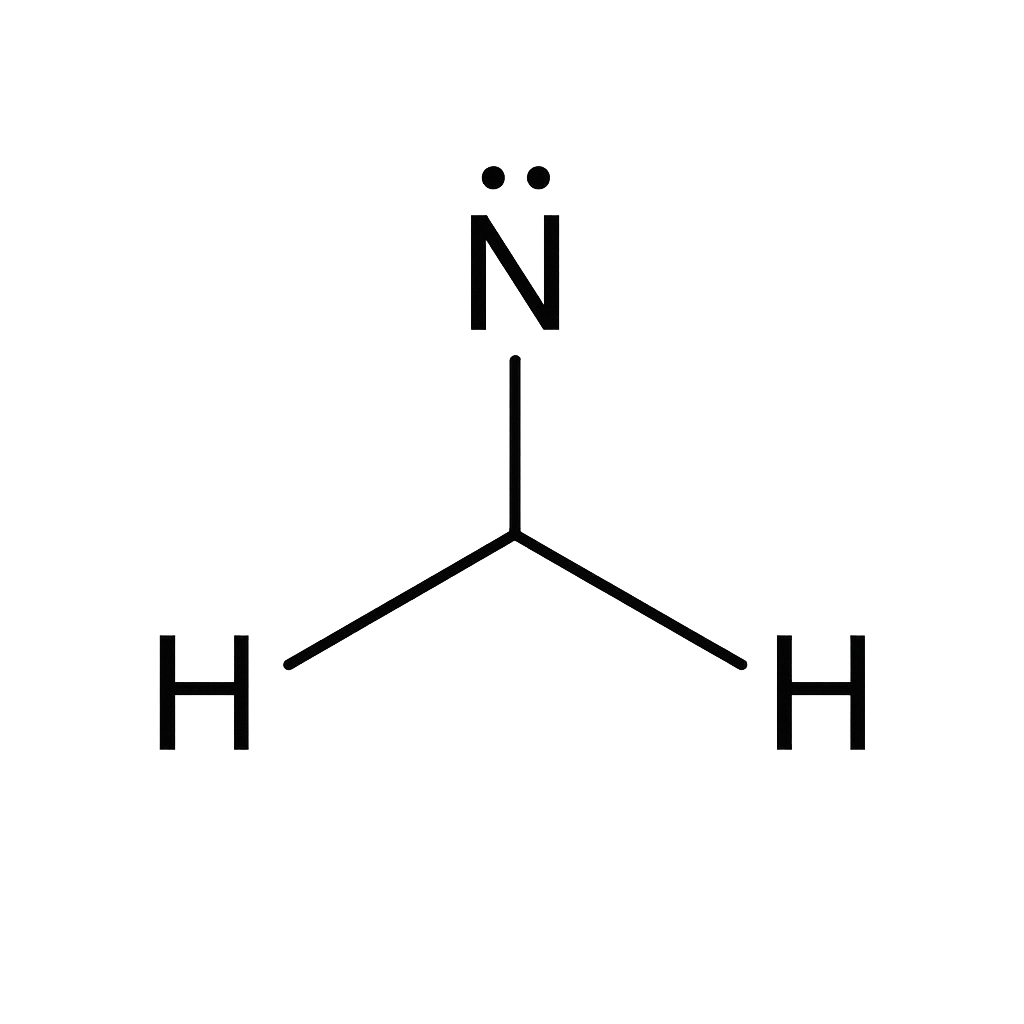
The diagram shows a molecule of ammonia. Identify the hybridisation of the nitrogen atom and state the molecular geometry.
Correct A. sp³ hybridisation; trigonal pyramidal
B. sp hybridisation; linear
C. sp² hybridisation; trigonal planar
D. sp³ hybridisation; tetrahedral

Correct Answer: A

Want to see the full step-by-step solution? Unlock AI Explanation & Analytics
Question 18 View Details
Aluminium metal reacts with chlorine gas according to \(2\text{Al} + 3\text{Cl}_{2} \rightarrow 2\text{AlCl}_{3}\). If \(2.0\ \text{g}\) of Al are mixed with \(4.0\ \text{L}\) of \(\text{Cl}_{2}\) at \(25^{\circ}\text{C}\) and \(1.00\ \text{atm}\), calculate (a) the mass of \(\text{AlCl}_{3}\) formed and (b) the volume of excess \(\text{Cl}_{2}\) remaining at the same temperature and pressure.
Correct A. 9.9 g of AlCl₃ and 1.28 L of excess Cl₂
B. 10.7 g of AlCl₃ and 0.62 L of excess Cl₂
C. 9.2 g of AlCl₃ and 1.55 L of excess Cl₂
D. 8.3 g of AlCl₃ and 0.97 L of excess Cl₂

Correct Answer: A

Want to see the full step-by-step solution? Unlock AI Explanation & Analytics
Question 19 View Details
A hydrocarbon containing only C, H and O is combusted. From the combustion of a \(0.850\ \text{g}\) sample, \(2.17\ \text{g}\) of \(\text{CO}_{2}\) and \(0.89\ \text{g}\) of \(\text{H}_{2}\text{O}\) are obtained. The molar mass of the compound is \(86\ \text{g\,mol}^{-1}\). Determine its molecular formula.
Correct A. C₅H₁₀O
B. C₅H₁₂O
C. C₆H₁₂O
D. C₄H₈O₂

Correct Answer: A

Want to see the full step-by-step solution? Unlock AI Explanation & Analytics
Question 20 View Details
The solubility product of silver chloride at \(25^{\circ}\text{C}\) is \(K_{sp}=1.8\times10^{-10}\). A solution is prepared by mixing \(100\ \text{mL}\) of \(0.010\ \text{M}\) NaCl with \(50\ \text{mL}\) of \(0.020\ \text{M}\) AgNO₃. Calculate the mass of AgCl that precipitates.
Correct A. 0.143 g
B. 0.120 g
C. 0.283 g
D. 0.014 g

Correct Answer: A

Want to see the full step-by-step solution? Unlock AI Explanation & Analytics
Question 21 View Details
In a laboratory oxidation, 10.0 g of 2‑butanol (\(C_4H_{10}O\)) is treated with 5.0 g of potassium dichromate (\(K_2Cr_2O_7\)) in acidic medium to give butan‑2‑one. (a) Identify the limiting reagent. (b) Calculate the theoretical mass of butan‑2‑one that can be formed. (c) If 3.00 g of butan‑2‑one is actually obtained, determine the percent yield.
A. Limiting reagent: K₂Cr₂O₇; theoretical mass of butan‑2‑one = 3.68 g; percent yield = 75.0 %
B. Limiting reagent: K₂Cr₂O₇; theoretical mass of butan‑2‑one = 3.20 g; percent yield = 93.8 %
C. Limiting reagent: C₄H₁₀O; theoretical mass of butan‑2‑one = 4.12 g; percent yield = 72.8 %
Correct D. Limiting reagent: K₂Cr₂O₇; theoretical mass of butan‑2‑one = 3.68 g; percent yield = 81.6 %

Correct Answer: D

Want to see the full step-by-step solution? Unlock AI Explanation & Analytics
Question 22 View Details
A buffer solution is prepared by dissolving 0.250 mol of acetic acid (\(CH_3COOH\), \(K_a = 1.8\times10^{-5}\)) and 0.150 mol of sodium acetate (\(CH_3COONa\)) in 1.00 L of water. Then 0.050 mol of hydrochloric acid (\(HCl\)) is added. (a) Calculate the pH of the solution before the addition of \(HCl\). (b) Calculate the pH after the addition. (c) How many moles of sodium hydroxide (\(NaOH\)) must be added to restore the original pH?
A. Initial pH = 4.30; pH after HCl = 4.27; NaOH needed = 0.060 mol
Correct B. Initial pH = 4.52; pH after HCl = 4.27; NaOH needed = 0.050 mol
C. Initial pH = 4.52; pH after HCl = 4.40; NaOH needed = 0.055 mol
D. Initial pH = 4.74; pH after HCl = 4.10; NaOH needed = 0.045 mol

Correct Answer: B

Want to see the full step-by-step solution? Unlock AI Explanation & Analytics
Question 23 View Details
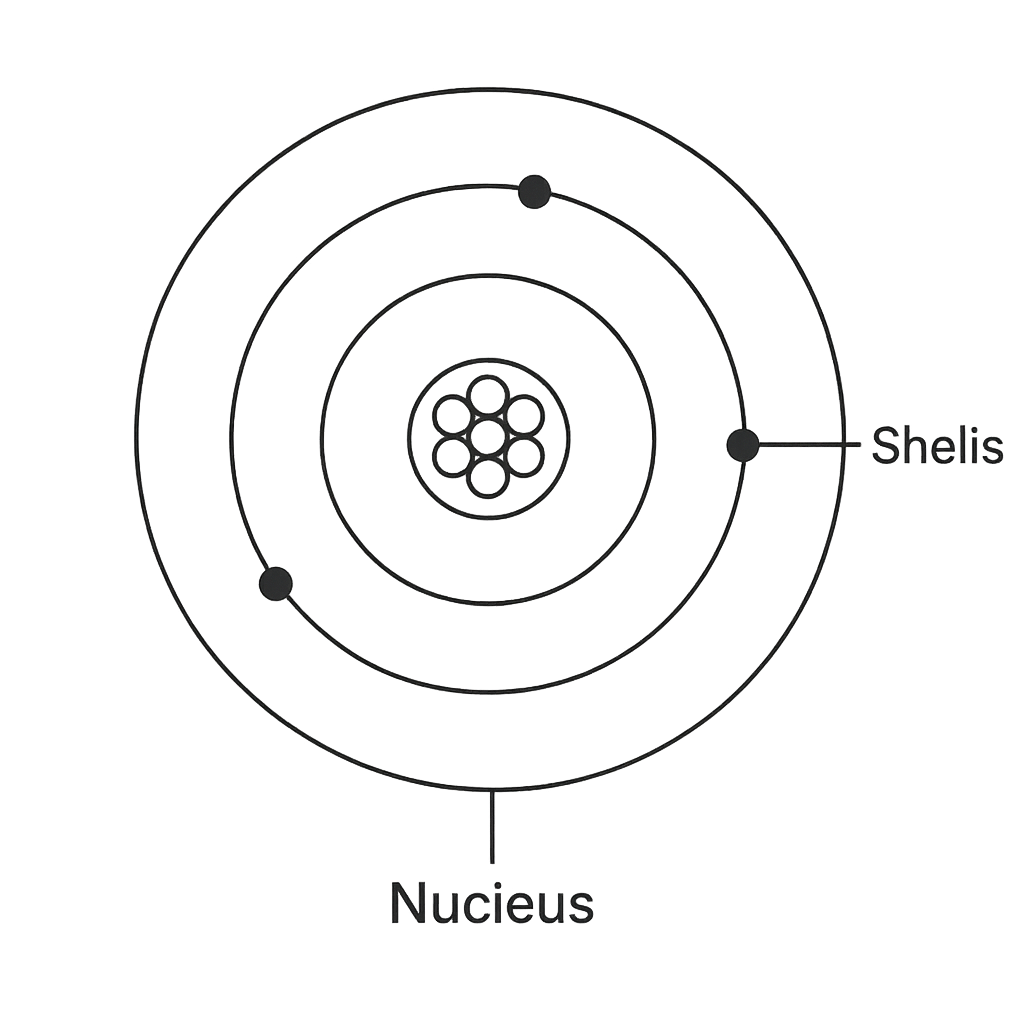
The Bohr‑model diagram shows an element with two electrons in the first shell, eight electrons in the second shell and five electrons in the third shell. (a) Identify the element and write its ground‑state electron configuration in spectroscopic notation. (b) State the most common oxidation state of this element. (c) Write the ionic symbol of the element in that oxidation state.
A. Element: S; configuration: 1s²2s²2p⁶3s²3p⁴; common oxidation state: -2; ion: S²⁻
B. Element: Si; configuration: 1s²2s²2p⁶3s²3p²; common oxidation state: +4; ion: Si⁴⁺
C. Element: Cl; configuration: 1s²2s²2p⁶3s²3p⁵; common oxidation state: -1; ion: Cl⁻
Correct D. Element: P; configuration: 1s²2s²2p⁶3s²3p³; common oxidation state: -3; ion: P³⁻

Correct Answer: D

Want to see the full step-by-step solution? Unlock AI Explanation & Analytics
Question 24 View Details
Consider the galvanic cell: \(\text{Zn(s)}\,|\,\text{Zn}^{2+}(0.010\ \text{M})\,||\,\text{Cu}^{2+}(0.10\ \text{M})\,|\,\text{Cu(s)}\). Standard reduction potentials are \(E^{\circ}_{\text{Zn}^{2+}/\text{Zn}} = -0.76\ \text{V}\) and \(E^{\circ}_{\text{Cu}^{2+}/\text{Cu}} = +0.34\ \text{V}\). (a) Calculate the standard cell potential \(E^{\circ}_{\text{cell}}\). (b) Determine the cell potential at 25 °C using the Nernst equation. (c) If the cell is operated as an electrolytic cell, what minimum external voltage is required to drive the non‑spontaneous reaction?
A. E°cell = 0.58 V; E (25 °C) ≈ 0.60 V; minimum external voltage ≈ 0.60 V
B. E°cell = 1.10 V; E (25 °C) ≈ 1.07 V; minimum external voltage ≈ 1.07 V
Correct C. E°cell = 1.10 V; E (25 °C) ≈ 1.13 V; minimum external voltage ≈ 1.13 V
D. E°cell = 1.10 V; E (25 °C) ≈ 1.13 V; minimum external voltage ≈ 1.15 V

Correct Answer: C

Want to see the full step-by-step solution? Unlock AI Explanation & Analytics
Question 25 View Details
In a Fischer esterification, 0.050 mol of benzoic acid (\(C_6H_5COOH\), \(M = 122.12\ \text{g mol}^{-1}\)) is mixed with 0.040 mol of ethanol (\(C_2H_5OH\), \(M = 46.07\ \text{g mol}^{-1}\)) in the presence of excess \(H_2SO_4\). The equilibrium constant at reflux is \(K = 4.0\). After equilibrium is reached, the ester is isolated and 4.00 g of ethyl benzoate is obtained. (a) Identify the limiting reagent. (b) Calculate the theoretical maximum mass of ethyl benzoate. (c) Using the equilibrium constant, determine the mass of ester that would be present at equilibrium. (d) Compute the percent recovery based on the isolated mass. (e) If the isolated ester is dissolved in 250 mL of water and assumed to hydrolyse completely back to benzoic acid (\(K_a = 6.3\times10^{-5}\)), estimate the pH of the solution.
Correct A. Limiting reagent: ethanol; theoretical mass = 6.01 g; equilibrium mass = 4.43 g; percent recovery = 90.3 %; estimated pH = 2.59
B. Limiting reagent: benzoic acid; theoretical mass = 5.45 g; equilibrium mass = 3.87 g; percent recovery = 71.0 %; estimated pH = 3.12
C. Limiting reagent: ethanol; theoretical mass = 5.80 g; equilibrium mass = 4.43 g; percent recovery = 76.4 %; estimated pH = 2.85
D. Limiting reagent: ethanol; theoretical mass = 6.01 g; equilibrium mass = 5.20 g; percent recovery = 86.7 %; estimated pH = 2.30

Correct Answer: A

Want to see the full step-by-step solution? Unlock AI Explanation & Analytics

Master the Exam!

You've seen a preview, but there are thousands more questions plus AI tutor to break down complex solutions.

Unlock Full Access Available for Android & Windows
Help others prepare! Share this practice hub:
Chat with Support