neco model questions vol1 2023 biology | Essay

Prepare for your exams with neco model questions vol1 questions? Reviewing past/model questions is one of the most effective ways to guarantee a high score. This practice hub features authentic 2023 biology (Essay) questions designed to simulate the real exam environment.

Practice these randomly selected questions to test your readiness.
Question 1 View Details
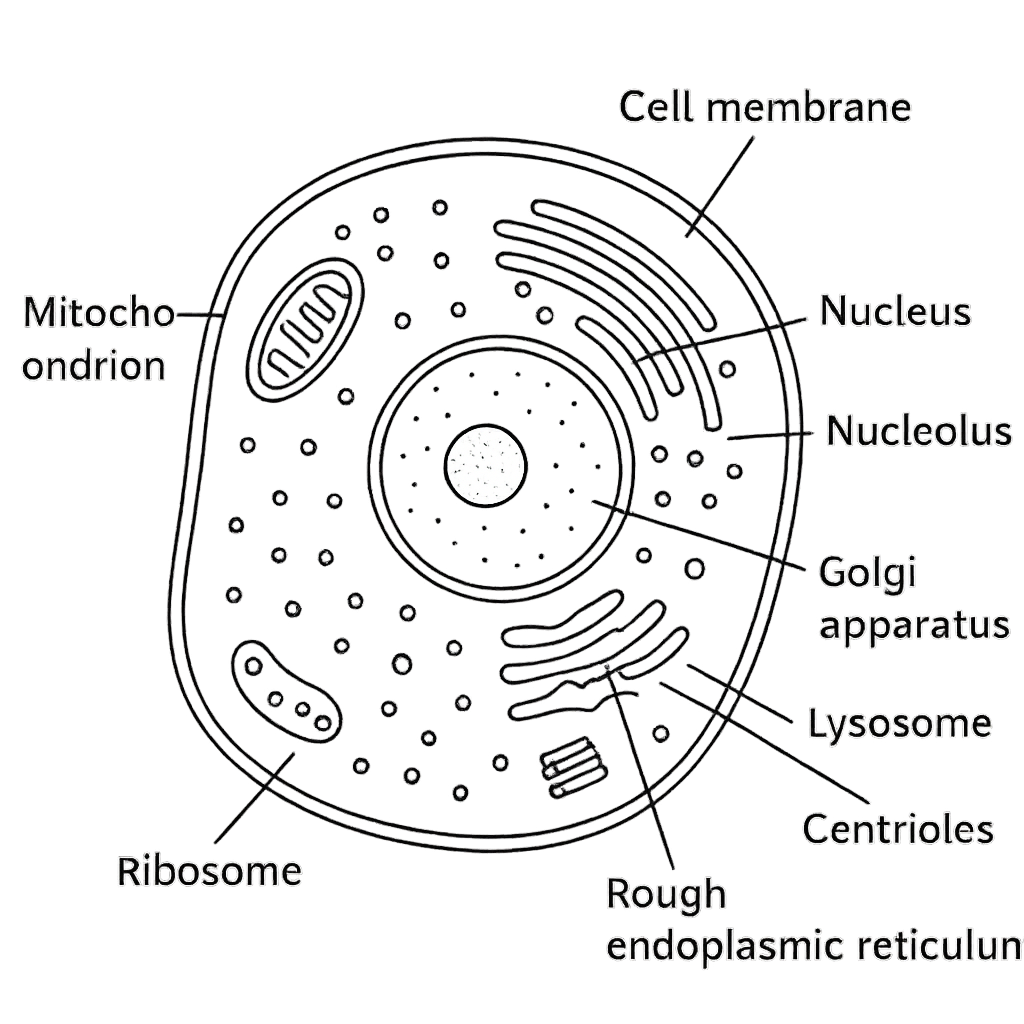
The labelled diagram shows a typical animal cell.
Question Parts
(a)
List eight major organelles that are visible in the diagram.
(b)
State the main function of each of the following organelles:
() Nucleus
() Mitochondrion
() Ribosome
(c)
Explain two key differences between animal and plant cells based on the presence or absence of specific organelles.
Detailed Essay Solution & Marking Scheme Available

Get the step-by-step mathematical proofs, key points required by examiners, and a comprehensive breakdown from our AI Tutor.
Question 2 View Details
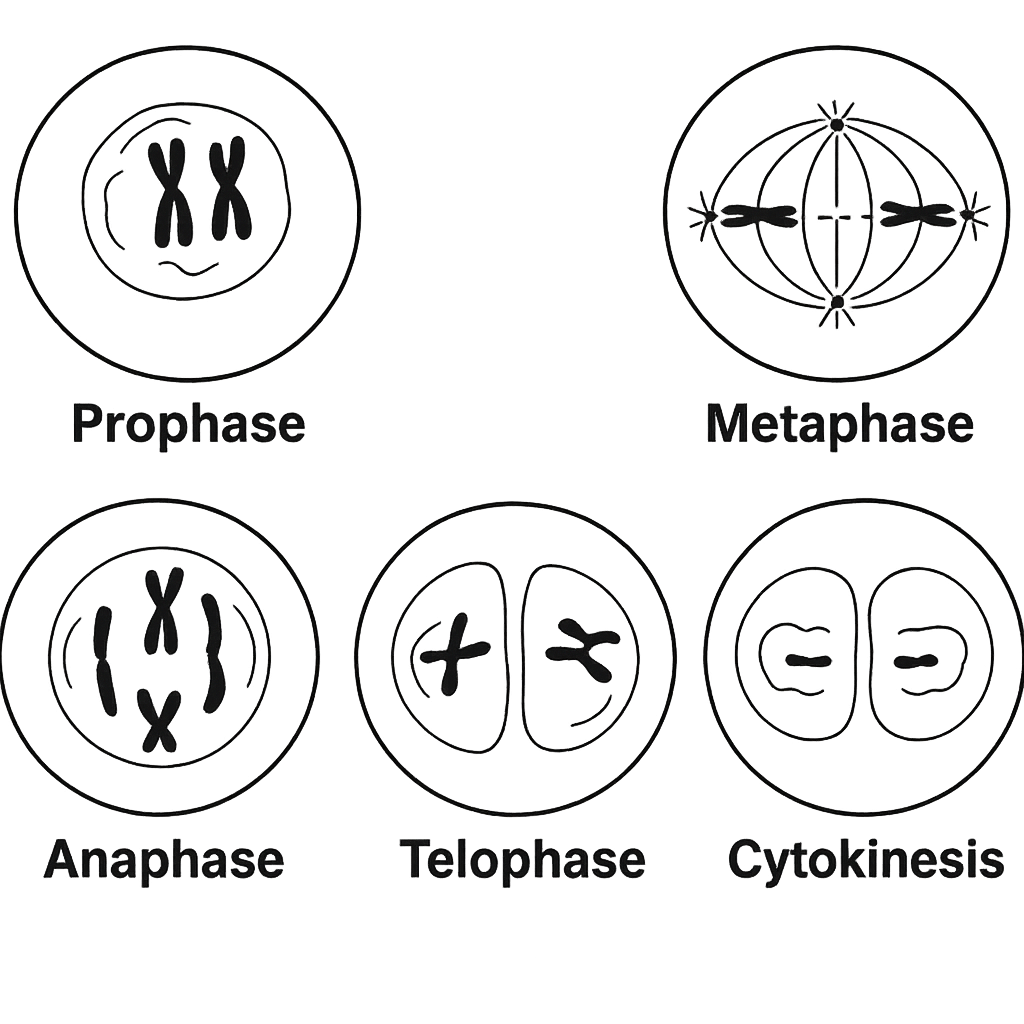
The labelled diagram depicts the stages of mitosis in a somatic cell.
Question Parts
(a)
Write the four phases of mitosis in the order they occur.
(b)
State one characteristic event that occurs in each phase:
() Prophase
() Metaphase
() Anaphase
() Telophase
(c)
Explain why cytokinesis is essential after mitosis in animal cells.
Detailed Essay Solution & Marking Scheme Available

Get the step-by-step mathematical proofs, key points required by examiners, and a comprehensive breakdown from our AI Tutor.
Question 3 View Details
A secondary school student prepares a simple daily diet consisting of the following foods: - 250 g of boiled white rice (carbohydrate content 80% of its dry weight) - 100 g of boiled beans (protein content 20% of its dry weight) - 30 g of vegetable oil (fat content 100%). The energy values of the macronutrients are: carbohydrate 4 kcal g⁻¹, protein 4 kcal g⁻¹ and fat 9 kcal g⁻¹.
Question Parts
(a)
Calculate the amount (in grams) of carbohydrate, protein and fat supplied by the diet described.
(b)
Determine the percentage contribution of each macronutrient to the total energy intake of the diet.
(c)
Using the percentages obtained, evaluate whether the diet meets the recommended energy distribution for a balanced diet (carbohydrate 55‑75 %, protein 10‑15 %, fat 20‑30 %). State any deficiency or excess and suggest a brief corrective measure.
Detailed Essay Solution & Marking Scheme Available

Get the step-by-step mathematical proofs, key points required by examiners, and a comprehensive breakdown from our AI Tutor.
Question 4 View Details
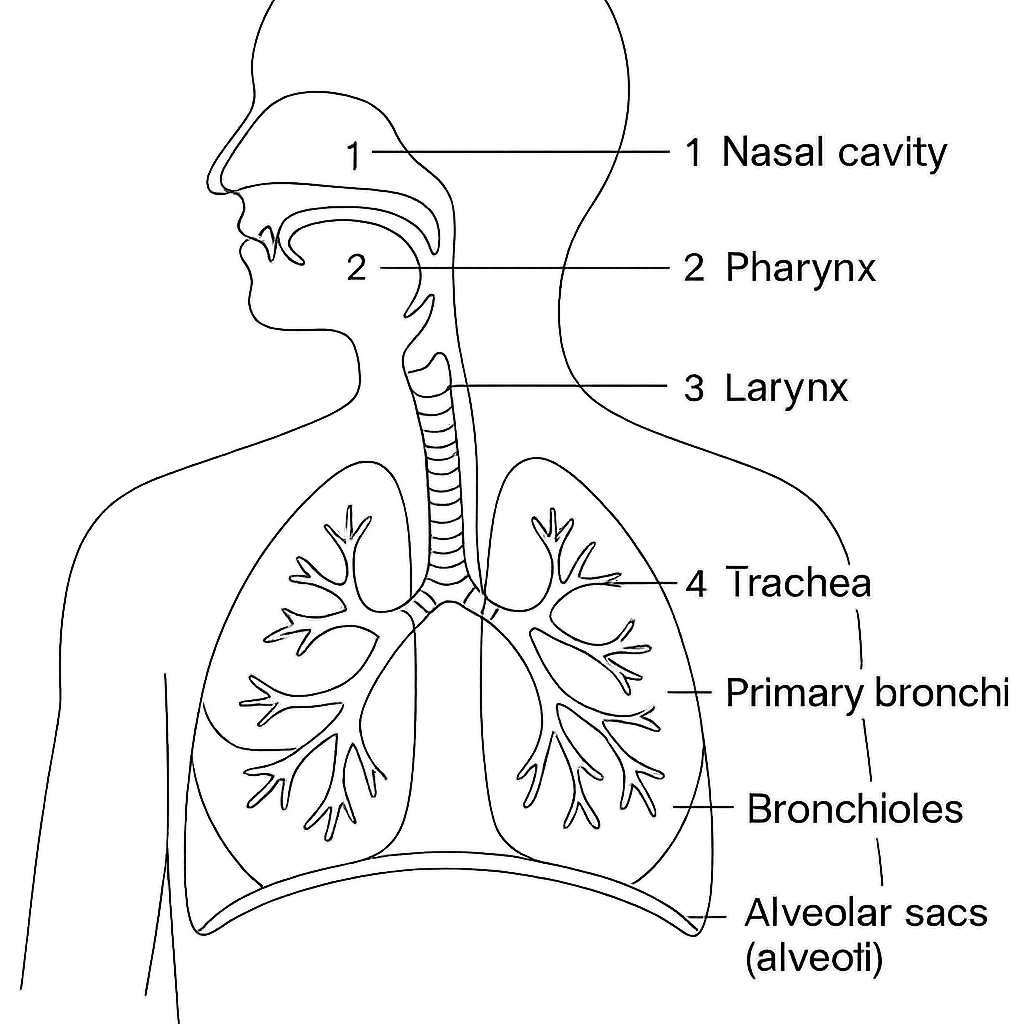
The diagram shows the major structures of the human respiratory system.
Question Parts
(a)
Identify the structure represented by each numbered part (1–8) in the diagram.
(b)
Describe the complete pathway that air follows from the external environment to the site where gas exchange occurs, naming each structure it passes through.
(c)
Explain the mechanism of gas exchange in the alveoli, including the role of partial pressure gradients and the structure of the respiratory membrane.
(d)
Discuss two physiological effects of chronic smoking on the respiratory system, relating each effect to structural changes that could be observed in the diagram.
Detailed Essay Solution & Marking Scheme Available

Get the step-by-step mathematical proofs, key points required by examiners, and a comprehensive breakdown from our AI Tutor.

Question 5 View Details
Plants and animals have evolved various mechanisms to transport substances that are essential for their survival and growth.
Question Parts
(a)
Explain in detail the three major mechanisms by which water moves from the soil to the leaves of a typical dicotyledonous plant.
(b)
A student places three equal-sized potato discs in 0 % (distilled water), 10 % and 20 % (w/v) sucrose solutions for 30 minutes. The initial mass of each disc is 5.00 g. After the experiment the masses are recorded as follows: 0 % – 5.80 g, 10 % – 5.10 g, 20 % – 4.55 g. (i) Calculate the percentage change in mass of each disc. (ii) Interpret the results in terms of the direction of water movement and the concept of osmotic potential.
(c)
Compare active transport and facilitated diffusion, giving one specific example of each that occurs in animal cells.
(d)
Discuss how temperature influences the rate of diffusion and active transport in living tissues.
Detailed Essay Solution & Marking Scheme Available

Get the step-by-step mathematical proofs, key points required by examiners, and a comprehensive breakdown from our AI Tutor.

Question 6 View Details
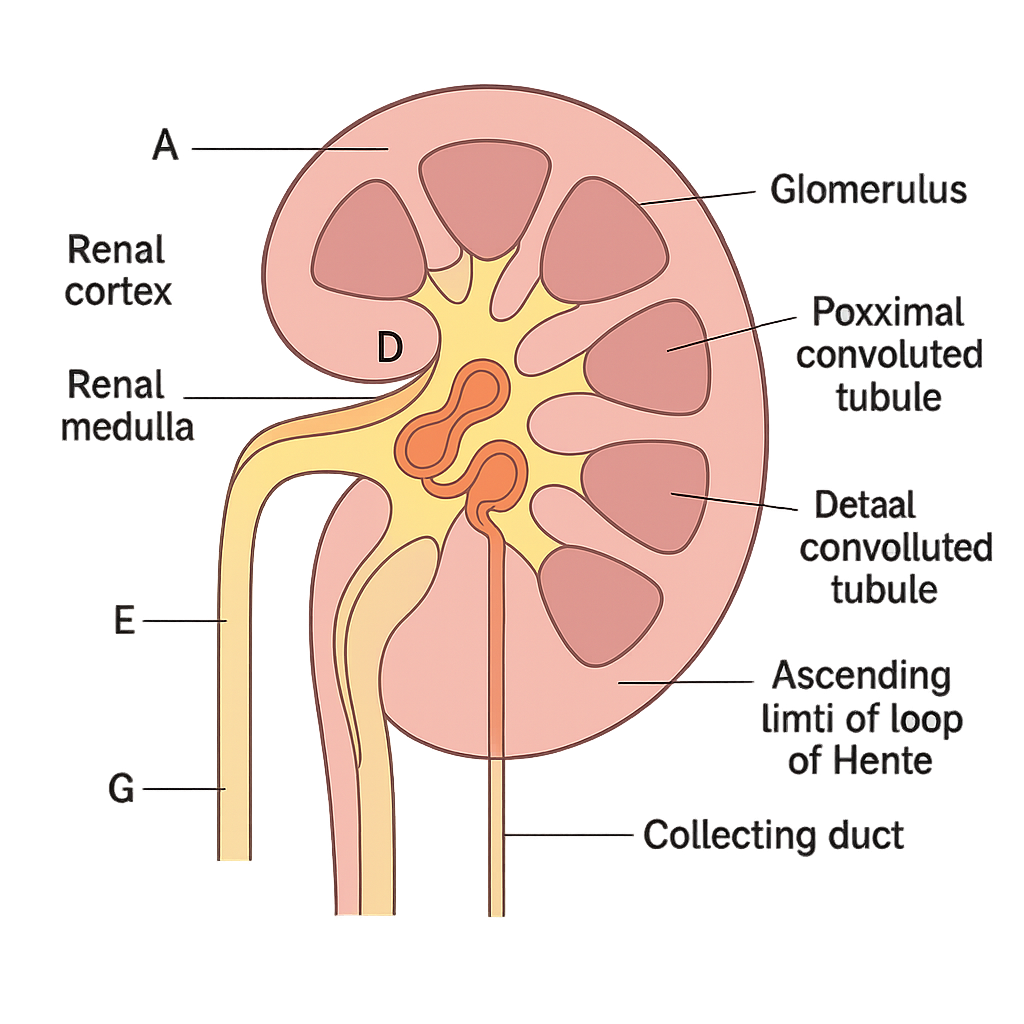
The diagram shows a cross‑section of a human kidney with a single nephron labelled as follows: A – Renal cortex, B – Renal medulla, C – Renal pelvis, D – Glomerulus, E – Bowman's capsule, F – Proximal convoluted tubule, G – Descending limb of loop of Henle, H – Ascending limb of loop of Henle, I – Distal convoluted tubule, J – Collecting duct.
Question Parts
(a)
Identify each labelled part in the diagram and state its primary role in urine formation.
(b)
Describe, in the correct order, the processes that occur from the filtration of blood to the formation of urine, referring to the labelled structures.
(c)
Explain how antidiuretic hormone (ADH) modifies water reabsorption in the nephron, indicating which labelled part(s) are directly affected and the physiological consequence for urine output.
(d)
A patient is administered a drug that blocks ADH receptors. Predict the changes in (i) urine volume, (ii) urine osmolality and (iii) the part of the nephron where the most noticeable effect will be observed. Justify your answer using the labelled diagram.
Detailed Essay Solution & Marking Scheme Available

Get the step-by-step mathematical proofs, key points required by examiners, and a comprehensive breakdown from our AI Tutor.

Question 7 View Details
The maintenance of internal stability (homeostasis) is vital for the survival of humans. Discuss the regulatory mechanisms that control blood glucose concentration.
Question Parts
(a)
Describe the role of insulin and glucagon in maintaining normal blood glucose levels. Include the source of each hormone, the target tissues and the principal metabolic effect.
(b)
Explain what would happen to blood glucose concentration and the associated symptoms if the pancreas failed to secrete insulin.
(c)
Compare the feedback mechanisms that regulate insulin secretion with those that regulate antidiuretic hormone (ADH) secretion.
(d)
Design a simple laboratory experiment to investigate the effect of a graded series of insulin concentrations on glucose uptake by isolated rat muscle tissue. State the hypothesis, the main steps, the variables to be measured and how you would analyse the data.
Detailed Essay Solution & Marking Scheme Available

Get the step-by-step mathematical proofs, key points required by examiners, and a comprehensive breakdown from our AI Tutor.

Question 8 View Details
The coordinated activity of the nervous system enables rapid responses to internal and external stimuli. Discuss the structure and function of the reflex arc and its importance in human survival.
Question Parts
(a)
Outline the five components of a typical monosynaptic stretch reflex, giving a brief description of the role of each component.
(b)
Explain how myelination of axons influences the speed of nerve impulse transmission and why this is crucial for coordinated movement.
(c)
A researcher wishes to compare reaction times between a simple visual stimulus and a simple auditory stimulus. Propose a suitable experimental procedure, indicating the variables to be measured, control measures and how the data would be interpreted.
Detailed Essay Solution & Marking Scheme Available

Get the step-by-step mathematical proofs, key points required by examiners, and a comprehensive breakdown from our AI Tutor.

Master the Exam!

You've seen a preview, but there are thousands more questions plus AI tutor to break down complex solutions.

Unlock Full Access Available for Android & Windows
Help others prepare! Share this practice hub:
Chat with Support