neco model questions vol1 2023 agricultural_science | Objective

Prepare for your exams with neco model questions vol1 questions? Reviewing past/model questions is one of the most effective ways to guarantee a high score. This practice hub features authentic 2023 agricultural_science (Objective) questions designed to simulate the real exam environment.

Practice these randomly selected questions to test your readiness.

Question 1 View Details
A farmer wants to plow a rectangular field of 2.5 ha. The plow requires a draft force of 1500 N and is operated at a speed of 5 km\,h\(^{-1}\). The tractor engine has a mechanical efficiency of 0.85 and the diesel fuel has an energy content of 42 MJ\,kg\(^{-1}\) with a density of 0.85 kg\,L\(^{-1}\). If the plow width is 0.5 m, determine the volume of diesel (in litres, to two decimal places) required to plow the whole field once.
Correct A. 2.47
B. 2.15
C. 3.02
D. 1.89

Correct Answer: A

Want to see the full step-by-step solution? Unlock AI Explanation & Analytics
Question 2 View Details
A soil test shows that a hectare of land contains 45 kg of nitrogen (N), 20 kg of phosphorus as P₂O₅ and 30 kg of potassium as K₂O. For a maize crop the target nutrient levels are 120 kg N, 60 kg P₂O₅ and 80 kg K₂O per hectare. Fertiliser A contains 30 % N, 20 % P₂O₅ and 10 % K₂O, while fertiliser B contains 15 % N, 30 % P₂O₅ and 20 % K₂O. Determine the least total amount (in kg) of fertilisers A and B that must be applied per hectare to meet or exceed each nutrient target. Then calculate the total cost if fertiliser A costs ₦12,000 per tonne and fertiliser B costs ₦10,000 per tonne. Give the cost rounded to the nearest hundred naira.
Correct A. ₦3,700
B. ₦2,900
C. ₦4,100
D. ₦3,200

Correct Answer: A

Want to see the full step-by-step solution? Unlock AI Explanation & Analytics
Question 3 View Details
A farmer converts 2 ha of degraded land into a mixed tree‑legume agro‑forestry system that sequesters on average 3.5 tonnes of CO₂ per hectare each year. How many tonnes of CO₂ will be sequestered in total after 5 years?
A. 25
B. 30
C. 40
Correct D. 35

Correct Answer: D

Want to see the full step-by-step solution? Unlock AI Explanation & Analytics
Question 4 View Details
A farmer harvests 1 tonne of fresh cassava roots with an initial moisture content of 60 % (wet basis). He wishes to produce dried cassava chips with a final moisture content of 10 % (wet basis). The drying kiln operates at a constant temperature of 60 °C and the inlet air has a relative humidity of 30 %. The saturation humidity ratio at 60 °C is 0.044 kg water per kg dry air, and the latent heat of vaporisation of water at this temperature is 2,430 kJ kg⁻¹. Air flows through the kiln at 2,000 m³ h⁻¹; the density of dry air at standard conditions is 1.2 kg m⁻³. Assuming the air leaves the kiln at 80 % relative humidity (same temperature) and that drying is limited by the amount of water that can be removed by the air stream, calculate the minimum drying time (in hours, to one decimal place) required to achieve the desired moisture reduction. Ignore heat losses.
A. 8.6
B. 12.3
C. 9.8
Correct D. 10.5

Correct Answer: D

Want to see the full step-by-step solution? Unlock AI Explanation & Analytics
Question 5 View Details
A farmer needs to control Helicoverpa armigera on cotton using a pesticide supplied as a 250 g L⁻¹ concentrate. The recommended field rate is 0.75 L of the spray solution per hectare, applied in two equal sprays 7 days apart. The spray solution is prepared by mixing 5 mL of concentrate per litre of water (i.e., a 1:200 dilution). The farmer has a 50 L drum and intends to treat 30 ha in the first spray. Determine (a) the volume of concentrate (in mL) that must be added to the drum for the first spray, (b) the total volume of water to be added so that the drum contains the correct amount of spray solution for the first application, and (c) the total amount of active ingredient (in grams) applied per hectare over the two sprays. Give the active ingredient rounded to one decimal place.
A. 125.0 mL concentrate, 22.5 L water, 2.1 g per ha
B. 112.5 mL concentrate, 25.0 L water, 2.0 g per ha
Correct C. 112.5 mL concentrate, 22.39 L water, 1.9 g per ha
D. 100.0 mL concentrate, 20.0 L water, 1.7 g per ha

Correct Answer: C

Want to see the full step-by-step solution? Unlock AI Explanation & Analytics
Question 6 View Details
A farmer prepares a field of 1 hectare (10,000 m\(^2\)) to a depth of 15 cm. If the soil bulk density is 1.3 g/cm\(^3\), calculate the total mass of soil in kilograms that will be tilled.
A. 2100000
Correct B. 1950000
C. 1950
D. 1800000

Correct Answer: B

Want to see the full step-by-step solution? Unlock AI Explanation & Analytics
Question 7 View Details
In a 5‑ha maize field the expected yield without disease is 4 t/ha. A fungal disease reduces yield by 30 % on the portion of the field it attacks. Initially the disease incidence is 12 %. After applying a fungicide the incidence falls to 4 %, and the fungicide costs \(\text{₦}50\) per ha. The market price of maize is \(\text{₦}600\) per ton. Should the farmer apply the fungicide, and what is the net change in profit per hectare (in \(\text{₦}\))?
Correct A. 7.6
B. 0.8
C. 56
D. -7.6

Correct Answer: A

Want to see the full step-by-step solution? Unlock AI Explanation & Analytics
Question 8 View Details
A poultry farm has 800 chickens. The basic reproduction number (R\(_0\)) of a certain viral disease is 4, and the vaccine available is 85 % effective. What is the minimum number of chickens that must be vaccinated to achieve herd immunity?
A. 650
B. 800
C. 750
Correct D. 707

Correct Answer: D

Want to see the full step-by-step solution? Unlock AI Explanation & Analytics
Question 9 View Details
A farmer monitors a maize field of 2 ha for stem‑borer larvae. The economic injury level (EIL) is 5 larvae per plant. Plant density is 45,000 plants per ha. The current count is 3 larvae per plant, but the pest population is expected to increase by 40 % before harvest. The pesticide costs \(\text{₦}12,000\) per ha, and if the EIL is exceeded the expected yield loss is 0.4 t/ha at a market price of \(\text{₦}800\) per ton. Should the farmer apply the pesticide? State "Apply" or "Do not apply".
A. Apply
B. Apply pesticide
Correct C. Do not apply
D. Do not apply pesticide

Correct Answer: C

Want to see the full step-by-step solution? Unlock AI Explanation & Analytics
Question 10 View Details
A rabbit farm aims to produce 500 kg of rabbit meat in 60 days. Each rabbit gains an average of 30 g per day and consumes 100 g of feed per day. The feed contains 18 % protein, but the rabbits require protein equal to 22 % of their total feed intake for optimal growth. How many kilograms of pure protein supplement are needed to meet the requirement?
Correct A. 66.8
B. 58.2
C. 73.5
D. 61

Correct Answer: A

Want to see the full step-by-step solution? Unlock AI Explanation & Analytics
Question 11 View Details
A tractor weighing \(1,800\) kg is to pull a plough weighing \(2,500\) kg across a field at a constant speed of \(5\) km h\(^{-1}\) up a \(3\)% slope. The coefficient of rolling resistance between the wheels and the soil is \(0.02\). Determine the minimum engine power (in kW) required to maintain this motion and state whether a tractor with a rated power of \(30\) kW is adequate.
A. No, the tractor is not adequate; required power ≈ 2.9 kW
B. Yes, the tractor is adequate; required power ≈ 5.3 kW
C. No, the tractor is not adequate; required power ≈ 4.1 kW
Correct D. Yes, the tractor is adequate; required power ≈ 2.9 kW

Correct Answer: D

Want to see the full step-by-step solution? Unlock AI Explanation & Analytics
Question 12 View Details
A doe rabbit is to be raised from a live weight of \(1.2\) kg to \(2.5\) kg over 8 weeks. Its daily protein requirement is 3 % of its live weight. The concentrate feed offered contains \(18\)% crude protein with a digestibility of 80 %. Assuming the rabbit's weight increases uniformly, calculate the minimum amount of this feed (in kg) that must be offered each day to meet its protein needs.
A. 0.45 kg per day
Correct B. 0.39 kg per day
C. 0.28 kg per day
D. 0.32 kg per day

Correct Answer: B

Want to see the full step-by-step solution? Unlock AI Explanation & Analytics
Question 13 View Details
A herd of 120 goats consists of 90 females and an unknown number of breeding males. To preserve genetic diversity, the effective population size must be at least 50 % of the total breeding population. Each male can mate with up to 10 females. Determine the minimum number of breeding males required.
A. 18
B. 20
C. 14
Correct D. 16

Correct Answer: D

Want to see the full step-by-step solution? Unlock AI Explanation & Analytics
Question 14 View Details
A farmer cultivates \(5\) ha of maize with an expected yield of \(4\) t ha\(^{-1}\). A leaf‑blight disease currently affects \(20\)% of the area, causing a \(35\)% yield loss on the affected portion. The market price of maize is ₦150 kg\(^{-1}\). A fungicide treatment costing ₦12,000 ha\(^{-1}\) reduces disease incidence to \(5\)% while the loss on the remaining affected area stays at \(35\)%. Should the farmer apply the fungicide? Compute the net profit (in ₦) for both scenarios and indicate the better option.
A. Apply fungicide; net profit = ₦2,950,000 (higher than ₦2,790,000 without treatment)
B. Apply fungicide; net profit = ₦2,800,000 (higher than ₦2,790,000 without treatment)
Correct C. Apply fungicide; net profit = ₦2,887,500 (higher than ₦2,790,000 without treatment)
D. Do not apply fungicide; net profit = ₦2,887,500 (higher than ₦2,790,000 without treatment)

Correct Answer: C

Want to see the full step-by-step solution? Unlock AI Explanation & Analytics
Question 15 View Details
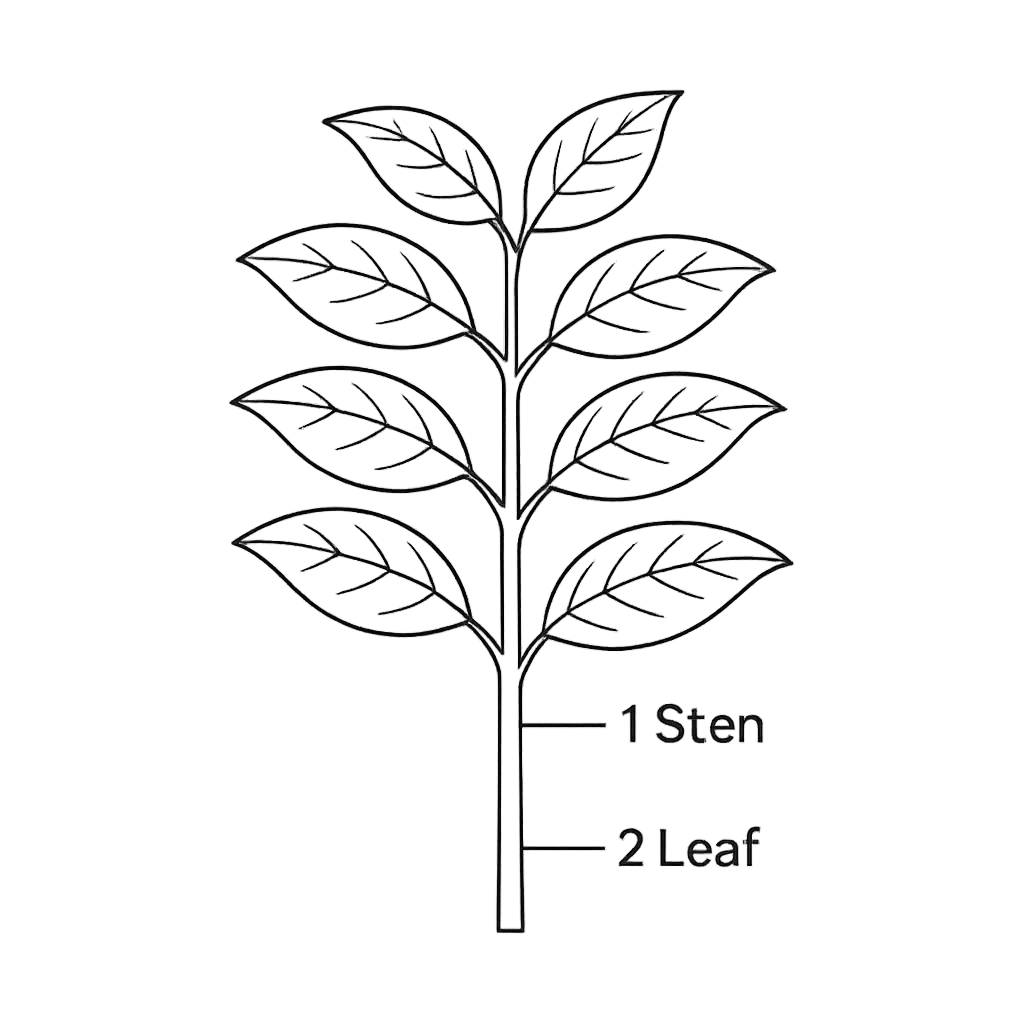
The diagram shows a bean plant with a stem of length \(30\) cm and diameter \(2\) cm, and ten rectangular leaves each \(12\) cm long and \(3\) cm wide. Assuming the leaves are flat rectangles, calculate (a) the total leaf area in cm\(^2\); (b) the lateral surface area of the stem (treated as a cylinder) in cm\(^2\); and (c) the ratio of total leaf area to stem surface area, expressed to two decimal places.
Correct A. 1.91
B. 1.68
C. 2.05
D. 2.13

Correct Answer: A

Want to see the full step-by-step solution? Unlock AI Explanation & Analytics
Question 16 View Details
Forestry: The volume of timber (in cubic metres per hectare) that a stand yields after \(t\) years of growth is approximated by \(V(t)=0.4\,t^{1.6}\). A forester plans to adopt a clear‑cut rotation system and wants to choose a rotation age among 25, 35 or 45 years that maximises the present value of the timber per hectare. Assume a constant annual discount rate of 10 % and that the present value of an infinite series of identical rotations is proportional to \(\frac{V(T)}{(1.10)^{T}}\). Which rotation age gives the highest present value?
A. 35
B. 45
C. 30
Correct D. 25

Correct Answer: D

Want to see the full step-by-step solution? Unlock AI Explanation & Analytics
Question 17 View Details
Farm Machinery: A plough has three bottom shares each 0.30 m wide, giving a total effective width of 0.90 m. The soil draft required is 3000 N per metre of plough width. The tractor pulls the plough at a speed of 5 km h\(^{-1}\). The overall mechanical efficiency of the power train is 85 %. Determine the minimum engine power required, expressed (a) in kilowatts (rounded to two decimal places) and (b) in horsepower (1 hp = 0.746 kW).
A. 3.95 kW; 5.30 hp
B. 4.80 kW; 6.44 hp
Correct C. 4.41 kW; 5.91 hp
D. 5.20 kW; 6.97 hp

Correct Answer: C

Want to see the full step-by-step solution? Unlock AI Explanation & Analytics
Question 18 View Details
Plant Diseases: A 10‑ha maize field has a potential yield of 5 t ha\(^{-1}\). If leaf blight is left uncontrolled, disease incidence reaches 40 % and reduces the yield by 30 % of the potential yield. A fungicide programme consisting of two applications (costing ₦12 000 per ha per application) reduces the incidence by 75 %. The market price of maize is ₦30 000 per tonne. Calculate the net economic benefit per hectare of applying the fungicide programme compared with doing nothing.
Correct A. ₦9 750 per hectare
B. ₦10 500 per hectare
C. ₦8 250 per hectare
D. ₦7 500 per hectare

Correct Answer: A

Want to see the full step-by-step solution? Unlock AI Explanation & Analytics
Question 19 View Details
Agricultural Extension: An extension officer wishes to estimate the proportion of farmers who have adopted a new technology with a margin of error of \(\pm5\)% at the 95 % confidence level. From a pilot survey the expected adoption proportion is \(p=0.40\). Using the formula \(n = \frac{Z^{2}p(1-p)}{d^{2}}\) (where \(Z=1.96\) for 95 % confidence, \(p\) is the expected proportion and \(d\) the desired margin of error), determine the minimum sample size required, rounding up to the next whole farmer.
A. 384
B. 350
C. 400
Correct D. 369

Correct Answer: D

Want to see the full step-by-step solution? Unlock AI Explanation & Analytics
Question 20 View Details
Animal Diseases: In a cattle herd, a contagious disease has a transmission coefficient \(\beta = 0.8\) week\(^{-1}\). The average infectious period is 2 weeks, giving a recovery rate \(\gamma = 0.5\) week\(^{-1}\). The disease also causes a mortality rate of \(\mu = 0.1\) week\(^{-1}\). The basic reproduction number is given by \(R_{0}= \frac{\beta}{\gamma + \mu}\). Compute \(R_{0}\) (to two decimal places) and state whether the disease is expected to spread in the herd.
A. R0 = 2.00; the disease will spread
Correct B. R0 = 1.33; the disease will spread
C. R0 = 0.80; the disease will not spread
D. R0 = 1.33; the disease will not spread

Correct Answer: B

Want to see the full step-by-step solution? Unlock AI Explanation & Analytics
Question 21 View Details
A farmer uses the economic injury level (EIL) formula \(EIL = \dfrac{C}{V \times I \times D}\) to decide when to spray a pest. The cost of control per hectare is ₦30, the market value of the crop is ₦200 per kg, each pest causes a loss of 0.02 kg yield per plant, and the damage coefficient is 0.5. If the current pest density is 12 pests per plant, should the farmer apply pesticide? Answer Yes or No.
A. Yes
B. Maybe
Correct C. No
D. Undecided

Correct Answer: C

Want to see the full step-by-step solution? Unlock AI Explanation & Analytics
Question 22 View Details
In the nitrogen cycle, which natural process converts fixed nitrogen back to atmospheric nitrogen (N₂)?
A. Ammonification
Correct B. Denitrification
C. Nitrification
D. Nitrogen fixation

Correct Answer: B

Want to see the full step-by-step solution? Unlock AI Explanation & Analytics
Question 23 View Details
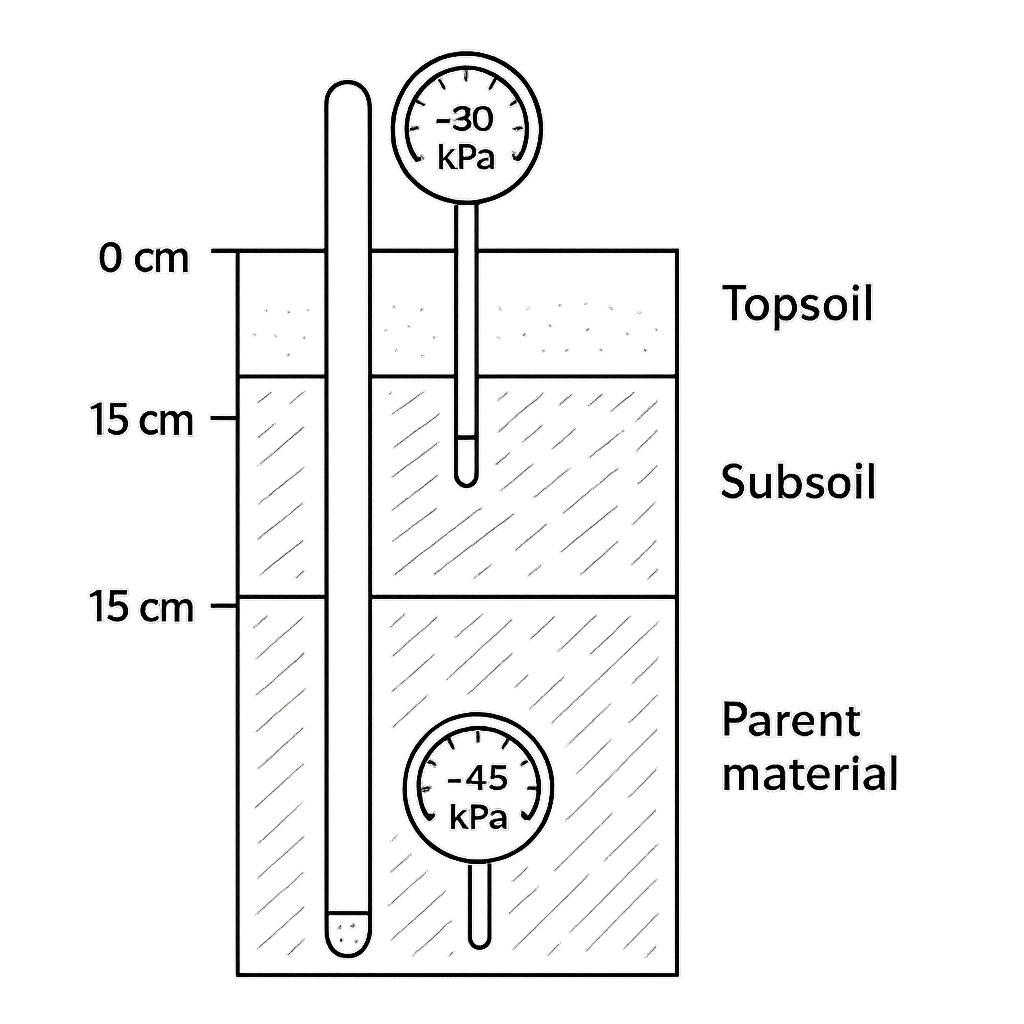
A soil moisture experiment uses two tensiometers placed at depths of 10 cm and 25 cm in a soil profile. The tensiometer at 10 cm reads -30 kPa and the one at 25 cm reads -45 kPa. What is the average soil water potential (in kPa) for the profile?
A. -35
B. -40
Correct C. -37.5
D. -42.5

Correct Answer: C

Want to see the full step-by-step solution? Unlock AI Explanation & Analytics
Question 24 View Details
A hand lever used to lift a load has an effort arm of 0.8 m and a load arm of 0.2 m. If a farmer applies an effort force of 200 N, what maximum load (in newtons) can be lifted? Based on this, can the lever lift a 1200 N sack? Answer Yes or No.
Correct A. No
B. Possibly
C. Yes
D. Maybe

Correct Answer: A

Want to see the full step-by-step solution? Unlock AI Explanation & Analytics
Question 25 View Details
A community emits 500 tonnes of CO₂ each year. A fast‑growing tree species sequesters 0.025 tonnes CO₂ per tree per year for the first 10 years and 0.015 tonnes per tree per year thereafter. The annual mortality rate of the trees is 2 % (survival factor \(0.98\) per year). How many trees must be planted now so that, after 10 years, the annual net sequestration equals or exceeds the community's emissions? Give the smallest whole number of trees.
A. 38500
B. 40000
Correct C. 40816
D. 42000

Correct Answer: C

Want to see the full step-by-step solution? Unlock AI Explanation & Analytics

Master the Exam!

You've seen a preview, but there are thousands more questions plus AI tutor to break down complex solutions.

Unlock Full Access Available for Android & Windows
Help others prepare! Share this practice hub:
Chat with Support