neco model questions vol1 2022 physics | Objective

Prepare for your exams with neco model questions vol1 questions? Reviewing past/model questions is one of the most effective ways to guarantee a high score. This practice hub features authentic 2022 physics (Objective) questions designed to simulate the real exam environment.

Practice these randomly selected questions to test your readiness.

Question 1 View Details
A 5.0 g mixture of two radioactive isotopes, A (half‑life 30 min, decays 100 % to daughter C) and B (half‑life 2 h, decays 80 % to C and 20 % to a stable nuclide D), is prepared. After exactly 3 h the activity of daughter C is measured as \(1.0\times10^{17}\) Bq. The atomic masses are 240 u for A and 238 u for B. Assuming each decay that produces C contributes one count to the activity, determine the initial mass of isotope A in the mixture (in grams, to two decimal places).
A. 3.12 g
Correct B. 4.55 g
C. 5.67 g
D. 2.98 g

Correct Answer: B

Want to see the full step-by-step solution? Unlock AI Explanation & Analytics
Question 2 View Details
An assembly of gears consists of two successive gear pairs. Gear A (20 teeth) drives Gear B (40 teeth); Gear B is rigidly attached to Gear C (30 teeth) which drives Gear D (60 teeth). The input shaft (Gear A) rotates at 1500 rpm and the power supplied to the gear train is 2.0 kW. The overall mechanical efficiency of the train is 80 %. Determine (a) the angular speed of the output shaft (Gear D) in rpm and (b) the torque transmitted by the output shaft in N·m (give the torque to two significant figures).
A. 300 rpm, 35 N·m
Correct B. 375 rpm, 41 N·m
C. 250 rpm, 30 N·m
D. 420 rpm, 48 N·m

Correct Answer: B

Want to see the full step-by-step solution? Unlock AI Explanation & Analytics
Question 3 View Details
A 5.0 kg block is released from rest at the top of a smooth 30° incline that is 4.0 m long. The coefficient of kinetic friction between the block and the incline is unknown. At the bottom of the incline the block compresses a horizontal spring of force constant \(k = 800\) N m\(^{-1}\) and comes to rest after compressing the spring by 0.10 m. (a) Determine the coefficient of kinetic friction \(\mu_k\) for the block‑incline contact. (b) Calculate the work done by the friction force during the motion (state its sign). Use \(g = 9.8\) m s\(^{-2}\).
Correct A. μ_k = 0.55, work by friction = -94 J
B. μ_k = 0.55, work by friction = -110 J
C. μ_k = 0.45, work by friction = -78 J
D. μ_k = 0.60, work by friction = -102 J

Correct Answer: A

Want to see the full step-by-step solution? Unlock AI Explanation & Analytics
Question 4 View Details
A hydrogen‑like ion of atomic number \(Z = 3\) (i.e., \(\mathrm{Li}^{2+}\)) has its single electron in the orbit \(n = 4\). (a) Calculate the radius of this orbit (in ångströms). (b) Find the wavelength of the photon emitted when the electron makes a transition from \(n = 4\) to \(n = 2\). Use the Bohr model with \(a_0 = 0.529\) Å and \(13.6\) eV as the hydrogen ground‑state energy. Give the wavelength in nanometres to two decimal places.
A. r = 2.12 Å, λ = 48.30 nm
Correct B. r = 2.82 Å, λ = 54.07 nm
C. r = 3.55 Å, λ = 62.10 nm
D. r = 2.82 Å, λ = 45.00 nm

Correct Answer: B

Want to see the full step-by-step solution? Unlock AI Explanation & Analytics
Question 5 View Details
Two masses, \(m_1 = 4.0\) kg and \(m_2 = 6.0\) kg, are connected by a light inextensible rope that passes over a frictionless, massless pulley. The system is released from rest. The heavier mass \(m_2\) descends a distance of 5.0 m in 3.0 s. During the motion a constant kinetic friction force of magnitude \(f = 8.5\) N acts on \(m_2\) opposite to its direction of motion. Determine the tension in the rope while the masses are moving (give the tension to two decimal places, in newtons). Take \(g = 9.8\) m s\(^{-2}\).
A. 44.6 N
B. 50.3 N
Correct C. 43.6 N
D. 47.0 N

Correct Answer: C

Want to see the full step-by-step solution? Unlock AI Explanation & Analytics
Question 6 View Details
An isotope X decays to Y with half‑life 20 s, and Y decays to a stable nuclide with half‑life 80 s. Initially only X is present, (N_0 = 2.0\times10^{6}\) nuclei. At what time after the start does the number of Y nuclei reach its maximum value? Give your answer in seconds (to two significant figures).
A. 60 s (approximately)
Correct B. 53 s (approximately)
C. 45 s (approximately)
D. 71 s (approximately)

Correct Answer: B

Want to see the full step-by-step solution? Unlock AI Explanation & Analytics
Question 7 View Details
A 5.0 kg block rests on a rough inclined plane that makes an unknown angle \(\theta\) with the horizontal. The coefficient of static friction \(\mu_s\) is also unknown. When a horizontal force of 30 N is applied, the block is on the point of moving up the plane. When a horizontal force of 20 N is applied, the block remains at rest. Determine the angle \(\theta\) (in degrees) and the coefficient of static friction \(\mu_s\).
Correct A. θ≈27° and μ≈0.081
B. θ≈22° and μ≈0.060
C. θ≈30° and μ≈0.090
D. θ≈25° and μ≈0.075

Correct Answer: A

Want to see the full step-by-step solution? Unlock AI Explanation & Analytics
Question 8 View Details
In a hydrogen discharge tube an electron is accelerated through a potential difference \(V\) and collides with a stationary hydrogen atom, exciting it from the ground state \(n=1\) to the first excited state \(n=3\). The collision is perfectly inelastic, so after the excitation the electron and the hydrogen atom move together. (a) Determine the minimum accelerating voltage \(V_{\min}\) required for this excitation. (b) After excitation the atom returns to the ground state by emitting two photons in a cascade: \(n=3\rightarrow2\) and \(2\rightarrow1\). Calculate the wavelengths of these two photons. (Use \(13.6\) eV for the hydrogen ionisation energy and \(hc=1240\) eV·nm.)
A. V_min≈15.0 V; λ_{3→2}≈640.0 nm, λ_{2→1}≈115.0 nm
B. V_min≈13.2 V; λ_{3→2}≈650.0 nm, λ_{2→1}≈119.0 nm
C. V_min≈10.5 V; λ_{3→2}≈660.0 nm, λ_{2→1}≈124.0 nm
Correct D. V_min≈12.10 V; λ_{3→2}≈656.5 nm, λ_{2→1}≈121.6 nm

Correct Answer: D

Want to see the full step-by-step solution? Unlock AI Explanation & Analytics
Question 9 View Details
A rectangular coil of \(N=50\) turns has dimensions \(0.10\) m by \(0.20\) m and rotates about its longer side in a uniform magnetic field \(B=0.5\) T. The plane of the coil is initially perpendicular to the field. (a) Find the angular speed \(\omega\) (in rad s⁻¹) required for the coil to produce a maximum induced emf of \(5\) V. (b) The coil has resistance \(R=2\) Ω and self‑inductance \(L=0.20\) H. Determine the average electrical power dissipated in the resistor and the torque that must be applied to keep the coil rotating at the constant speed found in part (a).
A. ω=15 rad\/s; average power≈5.6 W; torque≈0.56 N·m
Correct B. ω=10 rad/s; average power≈3.13 W; torque≈0.313 N·m
C. ω=12 rad\/s; average power≈4.0 W; torque≈0.40 N·m
D. ω=8 rad\/s; average power≈2.5 W; torque≈0.25 N·m

Correct Answer: B

Want to see the full step-by-step solution? Unlock AI Explanation & Analytics
Question 10 View Details
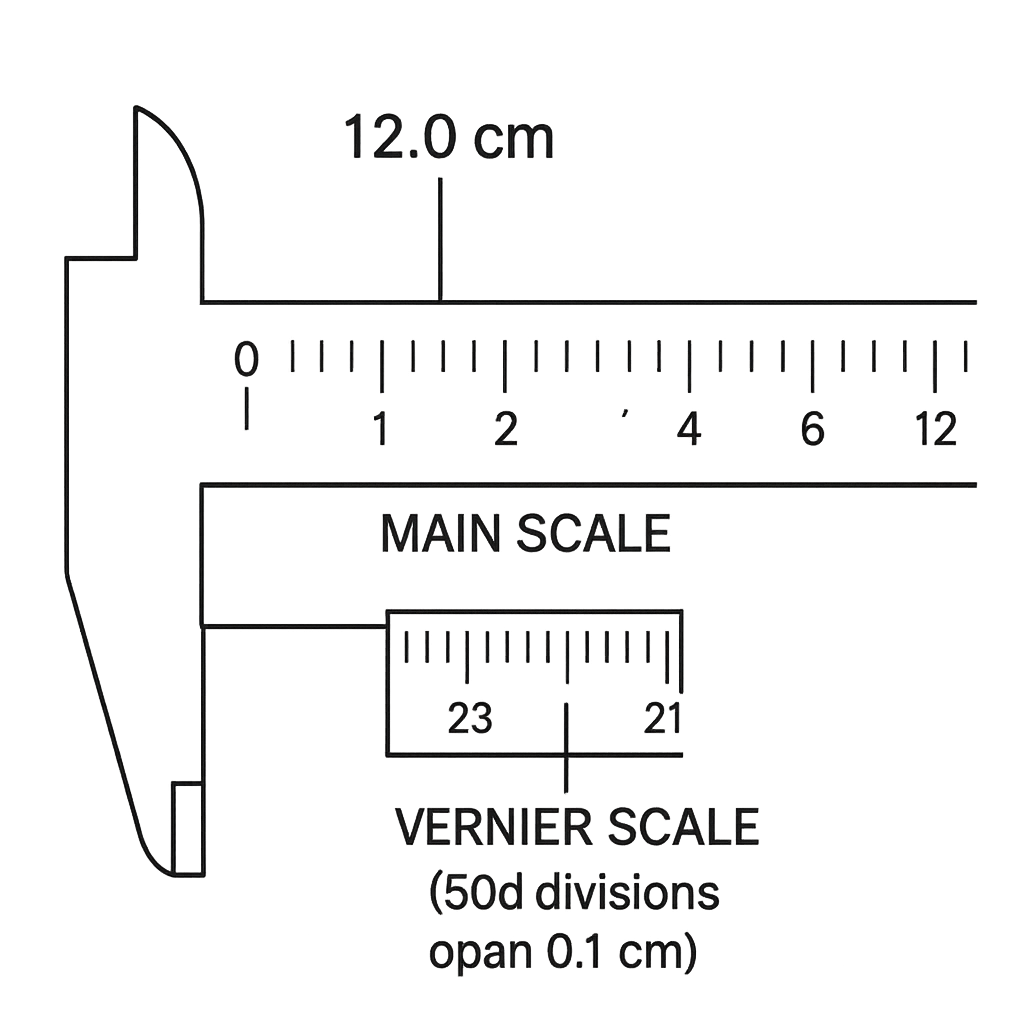
A vernier caliper is shown. The main scale reads 12.0 cm. The vernier scale has 50 divisions that together span 0.1 cm, giving a least count of 0.02 mm. The 23rd division on the vernier scale coincides with a division on the main scale. Determine the length measured by the caliper, expressed to the nearest 0.02 mm.
Correct A. 12.046 cm (or 120.46 mm)
B. 12.044 cm (or 120.44 mm)
C. 12.048 cm (or 120.48 mm)
D. 12.040 cm (or 120.40 mm)

Correct Answer: A

Want to see the full step-by-step solution? Unlock AI Explanation & Analytics
Question 11 View Details
A police siren emits a sound of frequency 800\,Hz. An observer moves directly towards the source at 20\,m\,s\(^{-1}\) and hears a frequency of 860\,Hz. Assuming the speed of sound in air is 340\,m\,s\(^{-1}\), determine the speed of the siren (in m\,s\(^{-1}\)) if it is moving directly towards the observer.
Correct A. 5.1 m/s
B. 6.0 m/s
C. 3.9 m/s
D. 4.3 m/s

Correct Answer: A

Want to see the full step-by-step solution? Unlock AI Explanation & Analytics
Question 12 View Details
A metal rod of length 1.20\,m at 20\,°C expands linearly with a coefficient of linear expansion \( \alpha_{r}=12\times10^{-6}\,^{\circ}\!\text{C}^{-1}\). The scale attached to the rod also expands, having a coefficient \( \alpha_{s}=5\times10^{-6}\,^{\circ}\!\text{C}^{-1}\). If the length indicated on the scale increases by 0.018\,mm, calculate the temperature change of the rod.
A. 3.4 °C
B. 1.7 °C
Correct C. 2.1 °C
D. 2.8 °C

Correct Answer: C

Want to see the full step-by-step solution? Unlock AI Explanation & Analytics
Question 13 View Details
The diagram shows a rough inclined plane of length 8.0\,m making an angle of \(30^{\circ}\) with the horizontal. A block of mass 5.0\,kg is released from rest at the top. The coefficient of kinetic friction between the block and the plane is 0.20. (Take \(g=10\;\text{m\,s}^{-2}\)). (a) Determine the speed of the block when it reaches the bottom. (b) Determine the time taken to travel down the plane.
Correct A. speed = 7.2 m/s, time = 2.2 s
B. speed = 8.0 m/s, time = 1.9 s
C. speed = 5.0 m/s, time = 3.0 s
D. speed = 6.5 m/s, time = 2.5 s

Correct Answer: A

Want to see the full step-by-step solution? Unlock AI Explanation & Analytics
Question 14 View Details
A sealed cylinder contains an ideal gas at an initial pressure of 2.0\,atm and temperature 27\,°C. The gas is heated to 127\,°C while the piston on top (area 0.05\,m\(^2\), mass 0.5\,kg) is free to move. Atmospheric pressure is 1.0\,atm. Assuming the piston remains in equilibrium during heating, find the distance the piston rises.
A. 0.45 m
B. 0.15 m
C. 0.25 m
Correct D. 0.33 m

Correct Answer: D

Want to see the full step-by-step solution? Unlock AI Explanation & Analytics
Question 15 View Details
In the diagram, a 10\,kg block rests on a horizontal rough surface (coefficient of kinetic friction \( \mu =0.30\)). Two forces act on the block: a horizontal force \(F_{1}=20\,\text{N}\) to the right, and a force \(F_{2}=40\,\text{N}\) directed \(30^{\circ}\) above the horizontal to the left. Determine the minimum magnitude of an additional horizontal force \(F_{3}\) (to the right) required to start moving the block to the right.
A. 48.6 N
Correct B. 38.6 N
C. 28.6 N
D. 33.6 N

Correct Answer: B

Want to see the full step-by-step solution? Unlock AI Explanation & Analytics
Question 16 View Details
A rectangular water tank has an internal length of \(2.5\ \text{m}\), width of \(150\ \text{cm}\) and height of \(0.8\ \text{m}\). Find the volume of water it can hold, expressed in litres. (1\ \text{m}^3 = 1000\ \text{L})
A. 3500 L
Correct B. 3000 L
C. 2400 L
D. 2500 L

Correct Answer: B

Want to see the full step-by-step solution? Unlock AI Explanation & Analytics
Question 17 View Details
A metal rod of mass \(2.0\ \text{kg}\) and specific heat capacity \(0.45\ \text{kJ\,kg}^{-1}\text{K}^{-1}\) is heated from \(20^{\circ}\text{C}\) to \(80^{\circ}\text{C}\). It is then placed into \(5.0\ \text{kg}\) of water initially at \(25^{\circ}\text{C}\) (specific heat \(4.18\ \text{kJ\,kg}^{-1}\text{K}^{-1}\)). Assuming no heat loss to the surroundings, determine the final equilibrium temperature of the system (to one decimal place).
A. 28.5 °C
B. 25.0 °C
Correct C. 27.3 °C
D. 30.0 °C

Correct Answer: C

Want to see the full step-by-step solution? Unlock AI Explanation & Analytics
Question 18 View Details
A car travels a distance of \(120\ \text{km}\) at a constant speed of \(60\ \text{km\,h}^{-1}\). It then travels another \(150\ \text{km}\) at a constant but unknown speed. If the total time for the whole journey is \(5\ \text{h}\), find the speed for the second part of the trip in km\,h\(^{-1}\).
A. 55 km\/h
Correct B. 50 km/h
C. 60 km\/h
D. 45 km\/h

Correct Answer: B

Want to see the full step-by-step solution? Unlock AI Explanation & Analytics
Question 19 View Details
A battery of emf \(12\ \text{V}\) has an internal resistance \(r\). When a load resistor of \(6\ \Omega\) is connected, the terminal voltage across the load is measured to be \(9\ \text{V}\). (a) Determine the internal resistance \(r\). (b) Find the maximum power that can be delivered to a load, and the value of the load resistance for which this occurs. (c) Calculate the efficiency of the circuit when it is delivering this maximum power.
A. r = 1 Ω, maximum power = 24 W, efficiency = 50 %
Correct B. r = 2 Ω, maximum power = 18 W, efficiency = 50 %
C. r = 4 Ω, maximum power = 9 W, efficiency = 50 %
D. r = 3 Ω, maximum power = 12 W, efficiency = 50 %

Correct Answer: B

Want to see the full step-by-step solution? Unlock AI Explanation & Analytics
Question 20 View Details
A calorimeter contains \(300\ \text{g}\) of water at \(40^{\circ}\text{C}\). Into it is placed \(200\ \text{g}\) of ice at \(0^{\circ}\text{C}\). The specific heat capacity of water is \(4.18\ \text{J\,g}^{-1}\text{K}^{-1}\) and the latent heat of fusion of ice is \(334\ \text{J\,g}^{-1}\). Assuming no heat loss to the surroundings, determine the final temperature of the mixture.
Correct A. 0 °C
B. 5 °C
C. 10 °C
D. -5 °C

Correct Answer: A

Want to see the full step-by-step solution? Unlock AI Explanation & Analytics
Question 21 View Details
A 150 g copper block is heated to an unknown temperature and then placed into a calorimeter containing 200 g of water initially at \(25^{\circ}\text{C}\). After the system reaches equilibrium the temperature rises to \(30^{\circ}\text{C}\) and \(5\) g of water has evaporated. The specific heat capacities are \(c_{\text{Cu}} = 0.385\ \text{J g}^{-1}\!^{\circ}\text{C}^{-1}\) and \(c_{\text{water}} = 4.18\ \text{J g}^{-1}\!^{\circ}\text{C}^{-1}\). The latent heat of vapourisation of water is \(L_{v}=2260\ \text{J g}^{-1}\). Assuming the calorimeter has negligible heat capacity, determine the initial temperature of the copper block (in \(^\circ\text{C}\)).
Correct A. 298
B. 260
C. 312
D. 285

Correct Answer: A

Want to see the full step-by-step solution? Unlock AI Explanation & Analytics
Question 22 View Details
Two point charges, \(q_{1}=+8\ \mu\text{C}\) at point A and \(q_{2}=-2\ \mu\text{C}\) at point B, are placed 0.12 m apart on a straight line. (a) Find the position on the line where the net electric field is zero. (b) Calculate the electric potential at that point due to both charges. Give the potential in volts.
A. 0.04 m from the +8 µC charge; 2.5×10^5 V
B. 0.06 m from the +8 µC charge; 3.2×10^5 V
Correct C. 0.08 m from the +8 µC charge; 4.5×10^5 V
D. 0.10 m from the +8 µC charge; 6.0×10^5 V

Correct Answer: C

Want to see the full step-by-step solution? Unlock AI Explanation & Analytics
Question 23 View Details
A battery of emf \(E\) and internal resistance \(r\) is connected to a circuit as shown: resistors \(R_{1}=6\ \Omega\) and \(R_{2}=12\ \Omega\) are in parallel, their equivalent resistance is in series with a resistor \(R_{3}=12\ \Omega\) and the internal resistance \(r\). When the circuit is complete the total current is \(2.0\ \text{A}\) and the power dissipated in \(R_{3}\) is \(48\ \text{W}\). If the resistor \(R_{3}\) is removed, the current becomes \(3.0\ \text{A}\). Determine the emf \(E\) of the battery and its internal resistance \(r\).
Correct A. E = 72 V; r = 20 Ω
B. E = 60 V; r = 25 Ω
C. E = 72 V; r = 15 Ω
D. E = 80 V; r = 15 Ω

Correct Answer: A

Want to see the full step-by-step solution? Unlock AI Explanation & Analytics
Question 24 View Details
Unpolarised light of initial intensity \(I_{0}\) passes through three ideal polarisers. The first polariser is oriented vertically, the third is oriented horizontally, and the second polariser is placed between them making an angle \(\theta\) with the vertical. (a) Find the value of \(\theta\) (in degrees) that maximises the transmitted intensity. (b) What is the maximum transmitted intensity expressed as a fraction of \(I_{0}\)?
Correct A. θ = 45°; I_max = I₀/8
B. θ = 45°; I_max = I₀/4
C. θ = 60°; I_max = I₀/16
D. θ = 30°; I_max = I₀/4

Correct Answer: A

Want to see the full step-by-step solution? Unlock AI Explanation & Analytics
Question 25 View Details
A car travels a distance of \(150\ \text{km}\) in \(2\ \text{h}\ 15\ \text{min}\). Express the average speed of the car (i) in metres per second, (ii) in kilometres per hour, and (iii) in centimetres per minute, each to three significant figures.
A. 20.0 m s⁻¹, 72.0 km h⁻¹, 1.20×10⁵ cm min⁻¹
B. 18.5 m s⁻¹, 66.7 km h⁻¹, 1.05×10⁵ cm min⁻¹
Correct C. 18.5 m s⁻¹, 66.7 km h⁻¹, 1.11×10⁵ cm min⁻¹
D. 17.0 m s⁻¹, 61.2 km h⁻¹, 1.03×10⁵ cm min⁻¹

Correct Answer: C

Want to see the full step-by-step solution? Unlock AI Explanation & Analytics

Master the Exam!

You've seen a preview, but there are thousands more questions plus AI tutor to break down complex solutions.

Unlock Full Access Available for Android & Windows
Help others prepare! Share this practice hub:
Chat with Support