neco model questions vol1 2022 physics | Essay

Prepare for your exams with neco model questions vol1 questions? Reviewing past/model questions is one of the most effective ways to guarantee a high score. This practice hub features authentic 2022 physics (Essay) questions designed to simulate the real exam environment.

Practice these randomly selected questions to test your readiness.
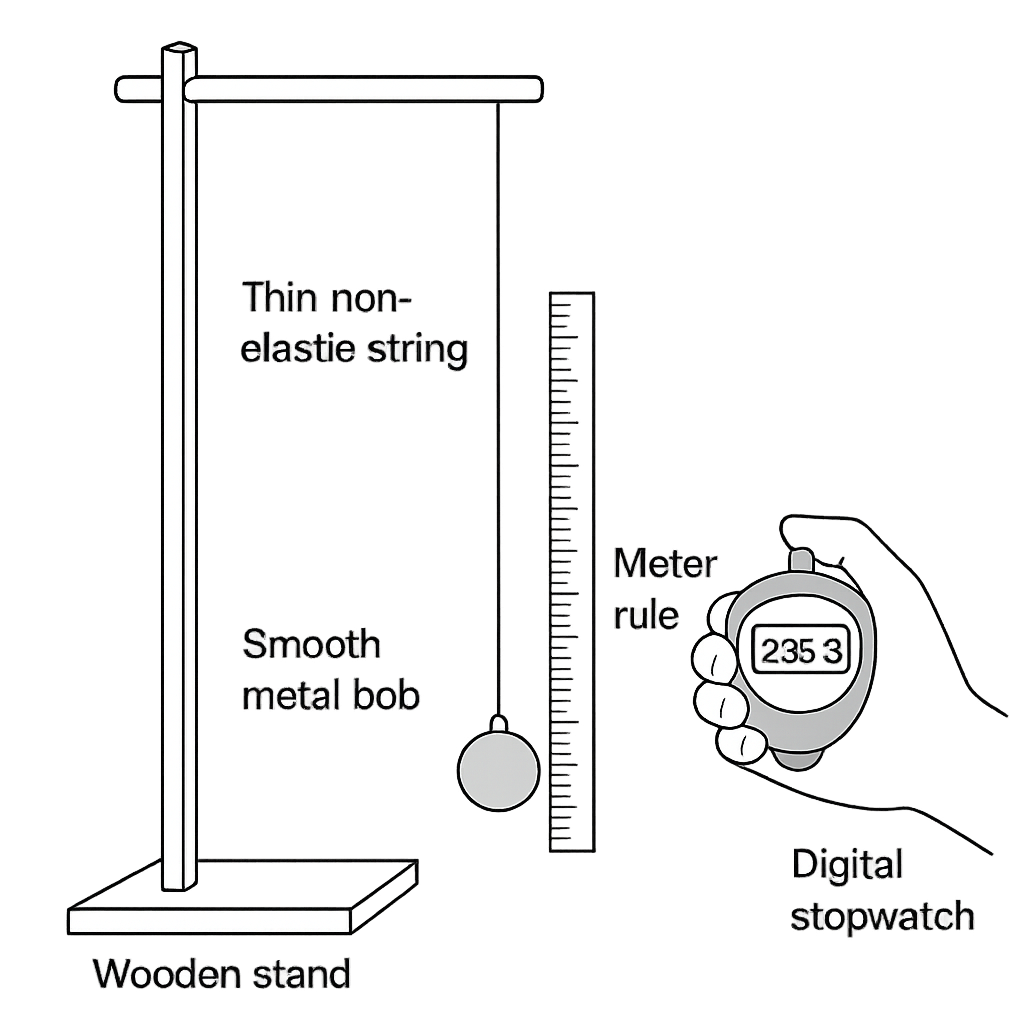
Question 1 View Details
A simple pendulum experiment is set up to determine the acceleration due to gravity (g). The apparatus consists of a sturdy wooden stand, a thin non‑elastic string attached to the stand, and a smooth metal spherical bob. The length of the pendulum is measured from the point of suspension to the centre of the bob using a metre rule. The time for 20 complete oscillations is recorded with a digital stopwatch. The measured length of the string is 0.500 m and the recorded time for 20 oscillations is 28.40 s.
Question Parts
(a)
State the formula that relates the period of a simple pendulum to its length and g, and show how the period (T) is obtained from the recorded time.
(b)
Using the period obtained in (a), calculate the experimental value of g. Show all steps and keep intermediate results to three significant figures.
(c)
Identify two possible sources of systematic error in this experiment and explain qualitatively how each would affect the calculated value of g (whether it would increase or decrease the result).
(d)
Express the obtained value of g in cm s⁻² and state the result with the appropriate number of significant figures.
Detailed Essay Solution & Marking Scheme Available

Get the step-by-step mathematical proofs, key points required by examiners, and a comprehensive breakdown from our AI Tutor.
Question 2 View Details
A car travels in three straight‑line segments as follows: 150 km due north, then 200 km due east, and finally 120 km due south. The total time taken for the whole journey is 5.0 h.
Question Parts
(a)
Express each leg of the journey as a vector in component form (i.e. using the unit vectors \(\hat i\) for east and \(\hat j\) for north).
(b)
Find the resultant displacement of the car.
(c)
Calculate (i) the total distance travelled, (ii) the average speed, and (iii) the average velocity vector (in component form). Then briefly explain why speed is a scalar whereas velocity is a vector.
Detailed Essay Solution & Marking Scheme Available

Get the step-by-step mathematical proofs, key points required by examiners, and a comprehensive breakdown from our AI Tutor.
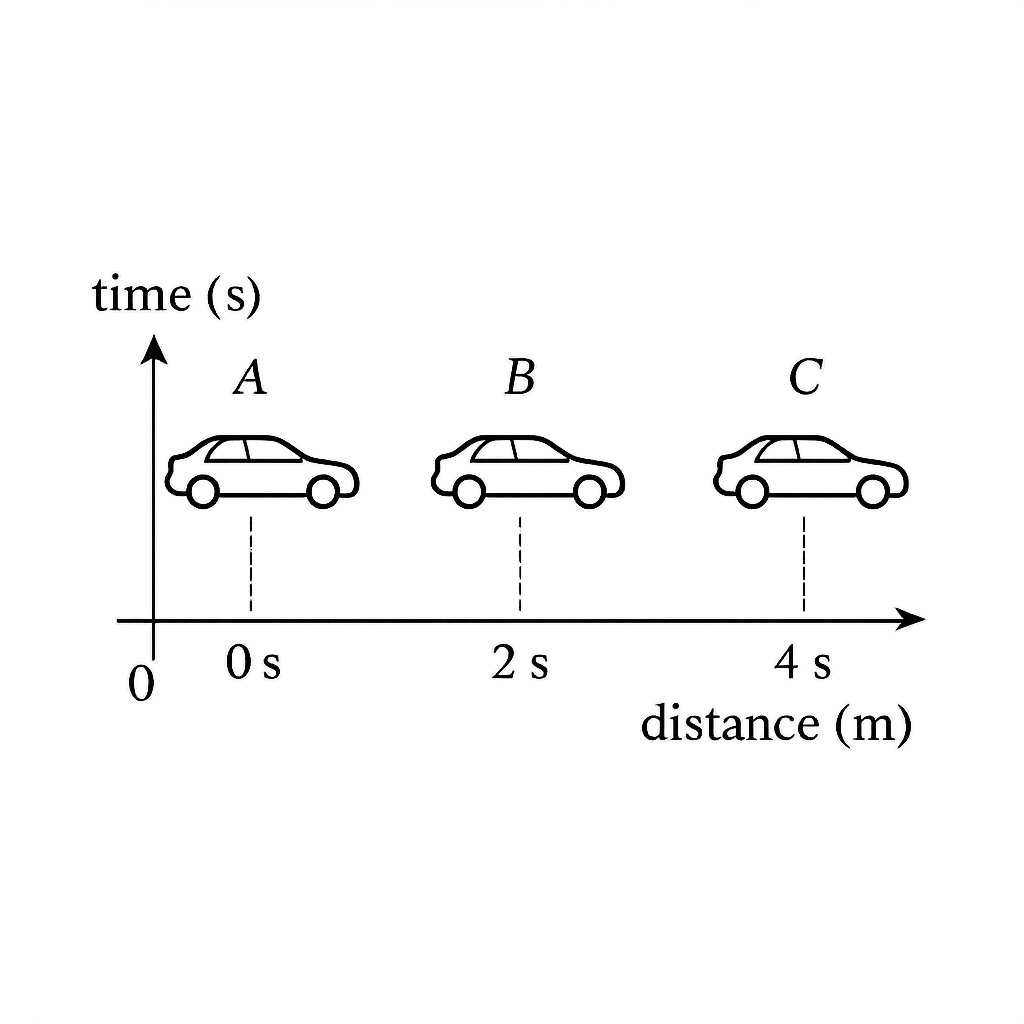
Question 3 View Details
A car moves in a straight line as shown in the motion diagram. The diagram records the car’s position at equal time intervals of 2 seconds:
Question Parts
(a)
Determine the car’s instantaneous speed at point B and at point C, assuming the motion has a constant acceleration.
(b)
Find the magnitude of the constant acceleration of the car.
(c)
Predict the car’s position relative to the starting point after another 2‑second interval (i.e., at t = 6 s).
Detailed Essay Solution & Marking Scheme Available

Get the step-by-step mathematical proofs, key points required by examiners, and a comprehensive breakdown from our AI Tutor.

Question 4 View Details
A block of mass 8 kg rests on a rough inclined plane that makes an angle of 25° with the horizontal. A rope pulls the block with a force of magnitude 50 N acting at 30° above the horizontal, as shown in the force diagram. The block is on the point of moving up the plane. Using the information given, answer the following:
Question Parts
(a)
State all the forces acting on the block and indicate their directions on the diagram.
(b)
Resolve the applied force of 50 N into components parallel and perpendicular to the plane. Show your working.
(c)
Write the equilibrium equation for forces parallel to the plane and use it to find the magnitude of the frictional force acting on the block.
(d)
Determine the coefficient of static friction between the block and the plane.
(e)
If the applied force is increased to 70 N (still at 30° above the horizontal), calculate the acceleration of the block up the plane.
Detailed Essay Solution & Marking Scheme Available

Get the step-by-step mathematical proofs, key points required by examiners, and a comprehensive breakdown from our AI Tutor.

Question 5 View Details
A 1500 kg car moves up a 5% incline (grade) with a constant speed of 20 m s⁻¹. The engine must overcome both the component of its weight along the slope and a rolling resistance whose coefficient is 0.02. The car travels 200 m along the incline.
Question Parts
(a)
Calculate the total work done by the engine in moving the car the 200 m distance.
(b)
Determine the average power output of the engine during this motion.
(c)
If the engine operates at an efficiency of 30 % and the calorific value of gasoline is 34 MJ per litre, estimate the volume of fuel consumed for the 200 m climb.
Detailed Essay Solution & Marking Scheme Available

Get the step-by-step mathematical proofs, key points required by examiners, and a comprehensive breakdown from our AI Tutor.

Question 6 View Details
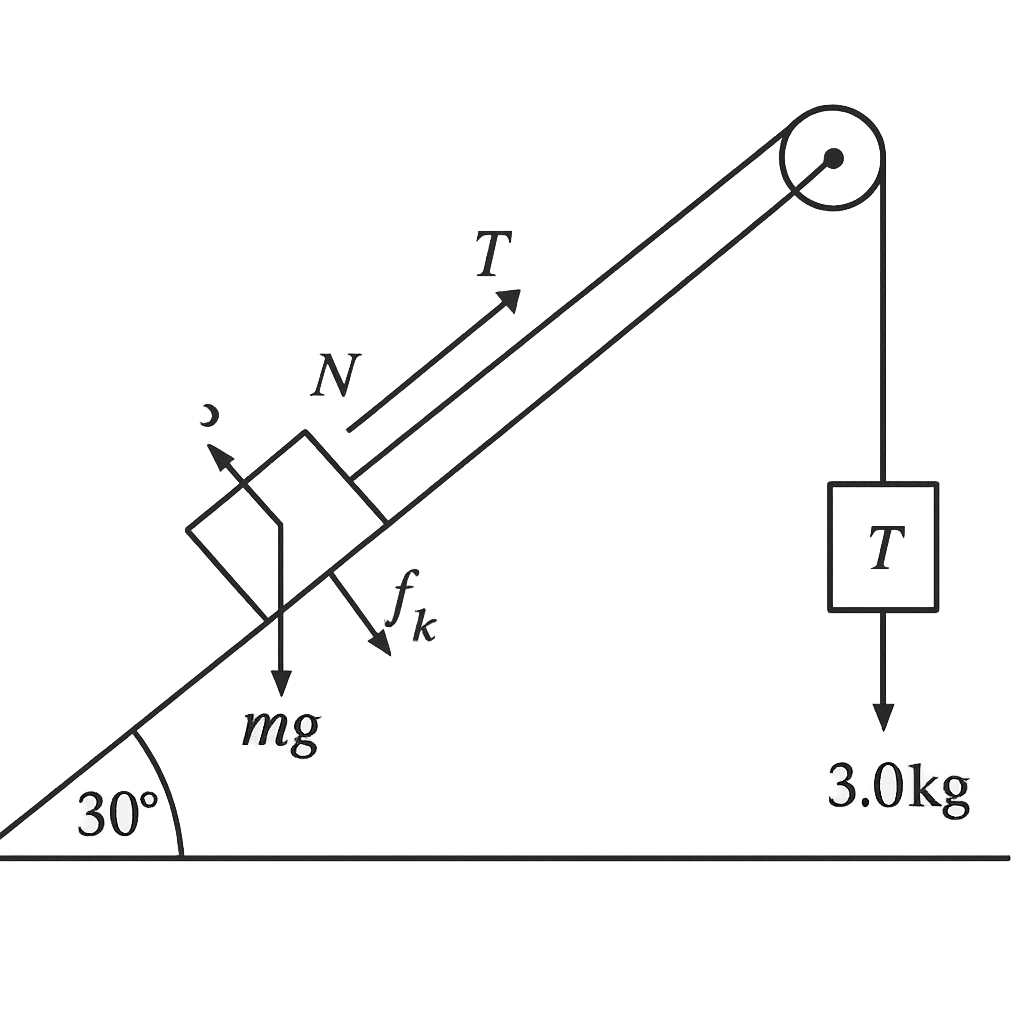
A 5.0 kg block rests on a rough inclined plane that makes an angle of 30° with the horizontal. The block is attached to a 3.0 kg hanging mass by a light inextensible string that passes over a smooth, frictionless pulley. The system is released from rest and the block moves 2.0 m up the plane in 4.0 s.
Question Parts
(a)
Determine the magnitude of the acceleration of the system.
(b)
Find the tension in the string.
(c)
Calculate the coefficient of kinetic friction between the block and the plane.
Detailed Essay Solution & Marking Scheme Available

Get the step-by-step mathematical proofs, key points required by examiners, and a comprehensive breakdown from our AI Tutor.

Question 7 View Details
A sealed vertical cylindrical container of cross‑sectional area 2.0×10⁻³ m² contains dry air at 300 K and a pressure of 1.0×10⁵ Pa. A frictionless piston of negligible mass rests on the air. The piston is slowly pushed down until the volume of the trapped air is reduced to one‑half of its original value.
Question Parts
(a)
Determine the new pressure of the air after the compression, assuming the temperature remains constant.
(b)
The piston is now heated uniformly until the temperature of the trapped air rises to 450 K. The piston is free to move and the external atmospheric pressure remains 1.0×10⁵ Pa. Determine (i) the final volume of the air and (ii) the work done by the gas during this heating process.
(c)
Discuss qualitatively how the reading on a manometer connected to the container would change during the two stages described above, and explain the difference between gauge pressure and absolute pressure in this context.
Detailed Essay Solution & Marking Scheme Available

Get the step-by-step mathematical proofs, key points required by examiners, and a comprehensive breakdown from our AI Tutor.

Question 8 View Details
A 0.5 kg block of copper (specific heat capacity 0.385 J g⁻¹ K⁻¹) at 120°C is placed in a well‑insulated calorimeter containing 200 g of water at 25°C. The calorimeter itself has a heat capacity of 50 J K⁻¹. The system is allowed to reach thermal equilibrium.
Question Parts
(a)
Calculate the final equilibrium temperature of the water‑copper‑calorimeter system, assuming no heat loss to the surroundings.
Detailed Essay Solution & Marking Scheme Available

Get the step-by-step mathematical proofs, key points required by examiners, and a comprehensive breakdown from our AI Tutor.

Master the Exam!

You've seen a preview, but there are thousands more questions plus AI tutor to break down complex solutions.

Unlock Full Access Available for Android & Windows
Help others prepare! Share this practice hub:
Chat with Support