neco model questions vol1 2022 geography | Objective

Prepare for your exams with neco model questions vol1 questions? Reviewing past/model questions is one of the most effective ways to guarantee a high score. This practice hub features authentic 2022 geography (Objective) questions designed to simulate the real exam environment.

Practice these randomly selected questions to test your readiness.

Question 1 View Details
A river drops 720 m over a horizontal distance of 120 km before reaching a plain. The region experiences a uniform tectonic uplift of 0.12 mm/yr. The river's erosion rate (mm/yr) can be approximated by \(E = 0.25 \times G\), where \(G\) is the river gradient expressed in percent. If the uplift rate exceeds the erosion rate, a gorge is formed; otherwise a V‑shaped valley develops. Determine the landform that will be produced by this river.
Correct A. V‑shaped valley
B. U‑shaped valley
C. Flat plain
D. Gorge

Correct Answer: A

Want to see the full step-by-step solution? Unlock AI Explanation & Analytics
Question 2 View Details
A farmer wants to maximise wheat yield per hectare. The yield (tons/ha) is modelled by \[Y = 2 + 0.04F - 0.0001F^{2} + 0.009R - 0.000005R^{2} + 0.5P,\] where \(F\) is fertilizer applied (kg/ha), \(R\) is average rainfall (mm) and \(P\) is a pest‑control index (0-5). The region's baseline figures are \(F=120\) kg/ha, \(R=800\) mm and \(P=2\).\n\nThe farmer can spend a total of \(30\,000\) Naira on improvements, choosing any combination of the following options (each option may be used up to its stated limit):\n- Increase fertilizer by up to 100 kg/ha at \(10\) Naira per kg.\n- Increase rainfall by up to 100 mm at \(5\) Naira per mm (through irrigation).\n- Increase the pest‑control index by 1 unit at \(2\,000\) Naira per unit (maximum increase of 2 units).\n\nDetermine the combination of improvements that gives the highest possible wheat yield and state that maximum yield (rounded to two decimal places).
A. 13.00
Correct B. 12.01
C. 12.45
D. 11.85

Correct Answer: B

Want to see the full step-by-step solution? Unlock AI Explanation & Analytics
Question 3 View Details
In 2020 a region had a population of 5 000 000. The annual natural increase rate is 2.5 % for the first five years and then falls by 0.1 % each subsequent year. Net migration adds 10 000 people per year for the first three years and 5 000 people per year thereafter. Assuming the rates change exactly as described, in which calendar year will the population first exceed 7 000 000?
A. 2038
Correct B. 2036
C. 2034
D. 2040

Correct Answer: B

Want to see the full step-by-step solution? Unlock AI Explanation & Analytics
Question 4 View Details
Three towns A, B and C form a triangle with side lengths AB = 120 km, BC = 150 km and AC = 180 km. The AB road is paved (average speed 80 km/h) and the BC road is unpaved (average speed 40 km/h). The AC road can be upgraded: paving costs \(500\,000\) Naira per kilometre and allows travel at 80 km/h; the unpaved portion remains at 40 km/h. The government has a budget of \(60\) million Naira for upgrading AC and may pave any length \(x\) (0 ≤ x ≤ 180) kilometres, starting from town A.\n\n(a) What is the maximum length of AC that can be paved within the budget?\n(b) Using that maximum length, calculate the travel time from A to C along the upgraded AC road.\n(c) Compare this time with the travel time via the route A‑B‑C (using the existing roads) and state which route is faster, giving the minimum travel time (rounded to two decimal places).
A. 3.20
B. 2.80
C. 3.50
Correct D. 3.00

Correct Answer: D

Want to see the full step-by-step solution? Unlock AI Explanation & Analytics
Question 5 View Details
In a tropical region the annual rainfall decreases linearly from north to south. At latitude 5° N the rainfall is 1300 mm and it falls by 80 mm for each degree of latitude moving northwards. The region extends from 5° N to 10° N, so rainfall at 10° N is 900 mm. The mean annual temperature is uniformly 25 °C, which satisfies the temperature requirements for both savanna (20‑30 °C) and woodland (22‑28 °C).\n\nSavanna vegetation occurs where rainfall is between 500 mm and 1000 mm, while woodland occurs where rainfall is between 1000 mm and 1500 mm. Assuming vegetation type follows the rainfall criterion, calculate the percentage of the region's latitudinal extent that would be classified as savanna. Round the answer to the nearest whole percent.
A. 20
B. 30
Correct C. 25
D. 40

Correct Answer: C

Want to see the full step-by-step solution? Unlock AI Explanation & Analytics
Question 6 View Details
Three regions are being evaluated for a new agricultural project. The suitability index \(S\) for a region is calculated as follows: start with 100 points, add 0.1 point for each millimetre of annual rainfall above 800 mm, subtract 2 points for each degree Celsius the average temperature deviates from the optimum 25 °C, add 10 points for each unit of soil‑fertility rating (scale 1-5), and finally subtract 0.5 point for each kilometre of distance to the nearest major market. The data are: - Region A: rainfall 950 mm, average temperature 27 °C, soil‑fertility rating 3, distance to market 120 km. - Region B: rainfall 1300 mm, average temperature 23 °C, soil‑fertility rating 4, distance to market 200 km. - Region C: rainfall 1100 mm, average temperature 25 °C, soil‑fertility rating 2, distance to market 80 km. Which region has the highest suitability index and should be selected for the project?
Correct A. Region C
B. Region D
C. Region A
D. Region B

Correct Answer: A

Want to see the full step-by-step solution? Unlock AI Explanation & Analytics
Question 7 View Details
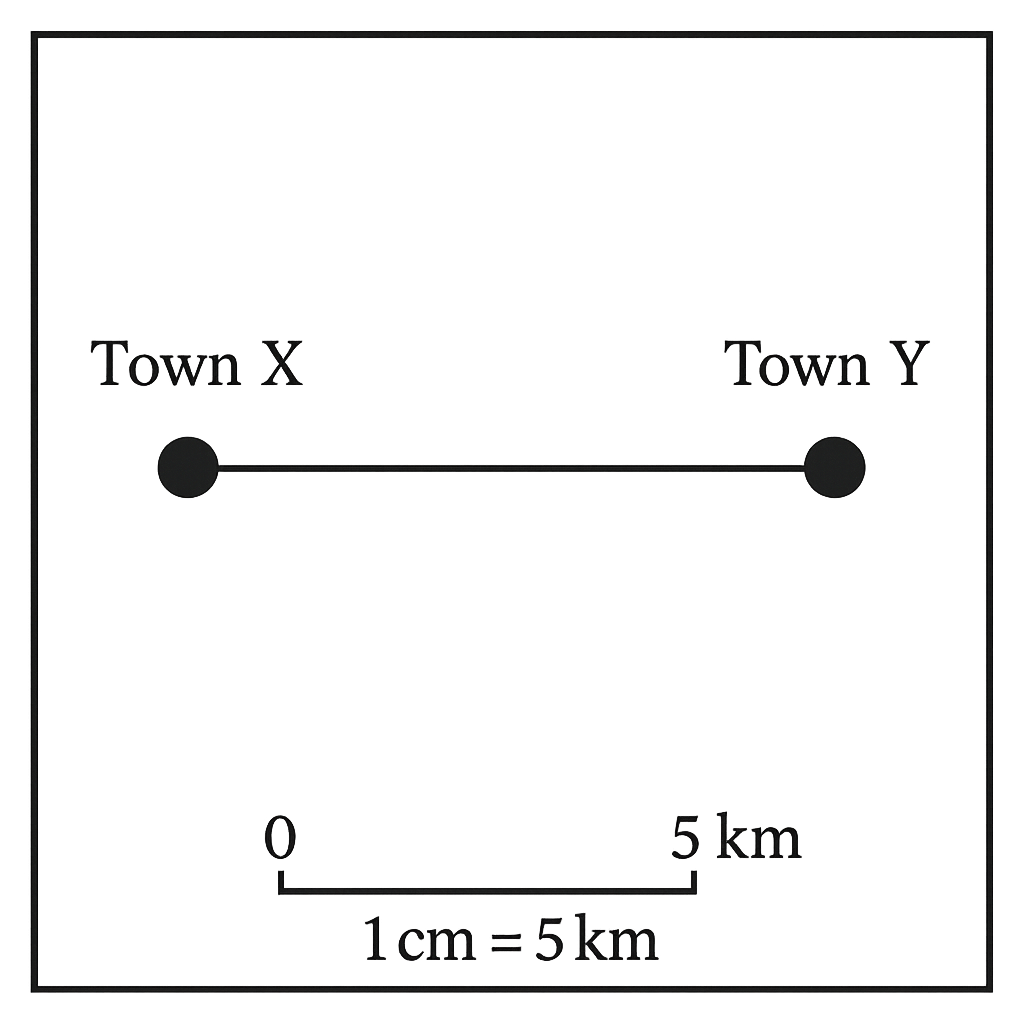
On the map, the straight‑line distance between Town X and Town Y measures 3.2 cm. If the map scale is 1 cm : 5 km, what is the actual distance between the towns in kilometres?
A. 20
Correct B. 16
C. 15
D. 12

Correct Answer: B

Want to see the full step-by-step solution? Unlock AI Explanation & Analytics
Question 8 View Details
A settlement has a population of 12 000 people. Its main economic activity is agriculture, it possesses a secondary school and a weekly market, and it lies 30 km from the nearest city. According to the Nigerian settlement hierarchy, which category best describes this settlement: village, town or city?
A. City
Correct B. Town
C. Hamlet
D. Village

Correct Answer: B

Want to see the full step-by-step solution? Unlock AI Explanation & Analytics
Question 9 View Details
Three possible routes connect City A to City D. **Route 1:** A-B by road, 120 km at 60 km h\(^{-1}\); B-C by rail, 80 km at 80 km h\(^{-1}\); C-D by road, 150 km at 50 km h\(^{-1}\). No waiting times. **Route 2:** A-E by air, 300 km at 300 km h\(^{-1}\); layover at E of 45 minutes; E-D by road, 100 km at 70 km h\(^{-1}\). **Route 3:** A-F by road, 200 km at 55 km h\(^{-1}\); transfer at F of 30 minutes; F-D by rail, 180 km at 90 km h\(^{-1}\). Which route yields the shortest total travel time? State the route number and the total time in hours and minutes.
Correct A. Route 2, 3 hours 11 minutes
B. Route 3, 6 hours 8 minutes
C. Route 2, 3 hours 10 minutes
D. Route 1, 6 hours 0 minutes

Correct Answer: A

Want to see the full step-by-step solution? Unlock AI Explanation & Analytics
Question 10 View Details
A map shows a river flowing from point A at the lower‑left corner to point B at the upper‑right corner. The map's north arrow points to the top of the page. In which cardinal direction does the river flow in reality?
A. Southeast
B. Northwest
Correct C. Northeast
D. Southwest

Correct Answer: C

Want to see the full step-by-step solution? Unlock AI Explanation & Analytics
Question 11 View Details
In 2020 a factory produced two products, A and B, with a total output of 10\,000 units. In 2021 the output of product A increased by \(25\%\) while the output of product B decreased by \(10\%\). The total output in 2021 was \(4\%\) higher than in 2020. Find the number of units of product A produced in 2020.
A. 5000
B. 3500
Correct C. 4000
D. 4500

Correct Answer: C

Want to see the full step-by-step solution? Unlock AI Explanation & Analytics
Question 12 View Details
A bus travels from City X to City Y, a distance of 150\,km, at a constant speed of \(v\) km\,h\(^{-1}\). On the return journey the distance is increased by \(10\%\) because of a detour and the average speed is reduced by \(20\%\) due to traffic. If the total time for the round trip is 5\,hours, determine \(v\) (in km\,h\(^{-1}\)).
Correct A. 71.25
B. 68.00
C. 72.00
D. 80.00

Correct Answer: A

Want to see the full step-by-step solution? Unlock AI Explanation & Analytics
Question 13 View Details
Two types of rock are weathering. Initially rock A weighs 6\,000\,kg and loses mass at a constant rate of \(2\%\) per year. Rock B initially weighs 5\,000\,kg and loses mass at a constant rate of \(1.5\%\) per year. After how many whole years will the two rocks have the same mass? Give the answer rounded to the nearest year.
A. 38
Correct B. 36
C. 34
D. 42

Correct Answer: B

Want to see the full step-by-step solution? Unlock AI Explanation & Analytics
Question 14 View Details
The average monthly temperature (in \(^{\circ}\)C) of a region is modelled by \(T(m)=25+10\sin\!\left(\frac{\pi}{6}(m-3)\right)\), where \(m\) is the month number (January = 1). (i) List the month(s) in which the temperature exceeds \(30^{\circ}\)C. (ii) Compute the average temperature of those month(s), giving your answer to one decimal place.
Correct A. May, June, July; 34.1°C
B. June, July, August; 33.5°C
C. May, June, July; 35.0°C
D. April, May, June; 32.8°C

Correct Answer: A

Want to see the full step-by-step solution? Unlock AI Explanation & Analytics
Question 15 View Details
A town had a population of 20\,000 in 2010. Each year the natural increase (births minus deaths) adds \(2\%\) of the current population, and net migration adds a constant 150 persons. Assuming these changes occur each year, after how many whole years will the population reach at least 30\,000? Give the smallest integer number of years.
A. 15
B. 18
C. 17
Correct D. 16

Correct Answer: D

Want to see the full step-by-step solution? Unlock AI Explanation & Analytics
Question 16 View Details
A location receives an annual rainfall of \(1800\) mm. The driest month records \(45\) mm of rain and has an average temperature of \(22^{\circ}\text{C}\). Using the Köppen climate classification, determine the climate type of the location.
A. Tropical rainforest (Af)
Correct B. Tropical savanna (Aw)
C. Humid subtropical (Cfa)
D. Tropical monsoon (Am)

Correct Answer: B

Want to see the full step-by-step solution? Unlock AI Explanation & Analytics
Question 17 View Details
At sea level the mean annual temperature is \(28^{\circ}\text{C}\). The environmental lapse rate is \(6.5^{\circ}\text{C}\) per 1000 m. Determine the vegetation zone (lowland forest, montane forest, or sub‑alpine) that would be expected at an altitude of \(1500\) m, given that lowland forest occurs where temperature exceeds \(24^{\circ}\text{C}\), montane forest where temperature is between \(16^{\circ}\text{C}\) and \(24^{\circ}\text{C}\), and sub‑alpine where temperature is between \(8^{\circ}\text{C}\) and \(16^{\circ}\text{C}\).
A. Alpine tundra
B. Lowland forest
C. Sub‑alpine
Correct D. Montane forest

Correct Answer: D

Want to see the full step-by-step solution? Unlock AI Explanation & Analytics
Question 18 View Details
To assess the suitability of a proposed settlement site, the following data are given:\n- Annual rainfall: \(1800\) mm.\n- Average river discharge: \(1.5\) m³ s\(^{-1}\).\n- Soil fertility index (out of 100): \(80\).\n- Flood risk rating (1 = low, 5 = high): \(2\).\n- Distance to the nearest market: \(20\) km.\n\nA suitability score \(S\) is calculated as\n\[\nS = R_f + W_f + S_f + (5 - F) + \frac{50 - D}{10},\n\]\nwhere\n\(R_f = \min\left(\frac{\text{rainfall}}{200},\,10\right)\),\n\(W_f = \min\left(5 \times \text{river discharge},\,10\right)\),\n\(S_f = \frac{\text{soil index}}{10}\),\n\(F\) is the flood risk rating, and \(D\) is the distance (km).\nIf \(S \ge 30\) the site is considered suitable. Compute \(S\) and state whether the site is suitable.
A. Inadequate
B. Not suitable
C. Unsuitable
Correct D. Suitable

Correct Answer: D

Want to see the full step-by-step solution? Unlock AI Explanation & Analytics
Question 19 View Details
The percentages of sand and silt in a soil sample are \(40\%\) and \(35\%\) respectively. The remaining fraction is clay. Using the USDA soil texture triangle, identify the soil texture class of the sample.
A. Clay
B. Silt
C. Sand
Correct D. Loam

Correct Answer: D

Want to see the full step-by-step solution? Unlock AI Explanation & Analytics
Question 20 View Details
An agricultural enterprise cultivates maize on 5 ha and cassava on 3 ha.\n\n- Maize yield: \(2.8\) t ha\(^{-1}\); market price: ₦\(150\) per kg; variable cost: ₦\(30{,}000\) per ha.\n- Cassava yield: \(15\) t ha\(^{-1}\); market price: ₦\(45\) per kg; variable cost: ₦\(25{,}000\) per ha.\n- Fixed costs for the whole farm: ₦\(20{,}000\).\n\nA government subsidy of 10 % is paid on the amount by which total gross revenue exceeds ₦\(2{,}000{,}000\).\n\nProfit after costs and subsidy is taxed at 15 % if it exceeds ₦\(500{,}000\); otherwise the tax rate is 10 %.\n\nCalculate the net farm income (in Naira) after applying the subsidy and tax.
A. 3683250
B. 3495625
C. 3457800
Correct D. 3478625

Correct Answer: D

Want to see the full step-by-step solution? Unlock AI Explanation & Analytics
Question 21 View Details
An area of 12 km\(^2\) receives a uniform rainfall of 80 mm in 24 hours. The catchment consists of 30 % urban land with a runoff coefficient of 0.9 and 70 % agricultural land with a coefficient of 0.3. Calculate the total volume of runoff (in cubic metres) that reaches the river.
Correct A. 460800
B. 960000
C. 384000
D. 768000

Correct Answer: A

Want to see the full step-by-step solution? Unlock AI Explanation & Analytics
Question 22 View Details
Nigeria is divided into three geopolitical zones with the following data:\n\n- North: area 400,000 km\(^2\), population 20 million, per‑capita GDP $2,500.\n- South: area 250,000 km\(^2\), population 15 million, per‑capita GDP $4,200.\n- Central: area 150,000 km\(^2\), population 10 million, per‑capita GDP $3,300.\n\nIdentify the zone that contributes the greatest amount to the national GDP and state its contribution as a percentage of total national GDP, rounded to one decimal place.
A. Central, 22.6%
B. North, 34.2%
Correct C. South, 43.2%
D. South, 38.5%

Correct Answer: C

Want to see the full step-by-step solution? Unlock AI Explanation & Analytics
Question 23 View Details
A farmer intends to cultivate maize on 5 ha. The expected yield without fertilizer is 2.5 t ha\(^{-1}\). Applying nitrogen fertilizer at a rate of R kg ha\(^{-1}\) increases yield by 0.02 t for each kilogram of N applied. Each kilogram of N costs ₦120 and each tonne of maize sells for ₦45,000. The farmer has a maximum fertilizer budget of ₦300,000. Determine the amount of fertilizer (kg ha\(^{-1}\)) that maximises profit without exceeding the budget, and compute the maximum profit (in ₦). Assume fertilizer is spread uniformly over the whole area.
A. 550 kg/ha; ₦2,730,000
Correct B. 500 kg/ha; ₦2,512,500
C. 450 kg/ha; ₦2,340,000
D. 500 kg/ha; ₦2,600,000

Correct Answer: B

Want to see the full step-by-step solution? Unlock AI Explanation & Analytics
Question 24 View Details
Daily rainfall (in mm) recorded over a 5‑day period is: 12, 0, 5, 20, 8. Calculate the coefficient of variation (CV) of the series and state whether the rainfall is highly variable (CV > 30 %). Express the CV to one decimal place.
Correct A. 75.1% (highly variable)
B. 82.0% (highly variable)
C. 55.0% (low variability)
D. 68.4% (moderately variable)

Correct Answer: A

Want to see the full step-by-step solution? Unlock AI Explanation & Analytics
Question 25 View Details
A location has an annual precipitation of 1,200 mm and an average annual temperature of 24 °C. The driest month receives 20 mm of rain, while the wettest month receives 180 mm. More than 70 % of the total precipitation falls in the summer months, giving the area a distinct dry winter. Using the Köppen climate classification criteria, determine the climate type of the location (choose from Aw, Cw, Cwa, BSh).
A. BSh
Correct B. Aw
C. Cw
D. Cwa

Correct Answer: B

Want to see the full step-by-step solution? Unlock AI Explanation & Analytics

Master the Exam!

You've seen a preview, but there are thousands more questions plus AI tutor to break down complex solutions.

Unlock Full Access Available for Android & Windows
Help others prepare! Share this practice hub:
Chat with Support