neco model questions vol1 2022 chemistry | Objective

Prepare for your exams with neco model questions vol1 questions? Reviewing past/model questions is one of the most effective ways to guarantee a high score. This practice hub features authentic 2022 chemistry (Objective) questions designed to simulate the real exam environment.

Practice these randomly selected questions to test your readiness.

Question 1 View Details
Given a compound with molecular formula \(C_7H_8O_2\) that contains a carboxylic acid group attached directly to a benzene ring and a \(\mathrm{CH_2CH_2OCH_3}\) substituent positioned para to the carboxyl group, write the IUPAC name of the compound.
A. 4-(2-ethoxyethyl)benzoic acid
B. 3-(2-methoxyethyl)benzoic acid
Correct C. 4-(2-methoxyethyl)benzoic acid
D. 4-(2-methoxyethyl)phenylacetic acid

Correct Answer: C

Want to see the full step-by-step solution? Unlock AI Explanation & Analytics
Question 2 View Details
A 0.10 M solution of a weak monoprotic acid HA ( \(K_a = 1.2 \times 10^{-5}\) ) has a volume of 50.0 mL. It is titrated with 0.10 M NaOH. After adding 75.0 mL of the base, calculate the pH of the solution.
A. 11.30
Correct B. 12.30
C. 9.75
D. 10.85

Correct Answer: B

Want to see the full step-by-step solution? Unlock AI Explanation & Analytics
Question 3 View Details
The standard enthalpy of formation of carbon dioxide is \(\Delta_f H^\circ(\mathrm{CO_2(g)}) = -393.5\ \text{kJ mol}^{-1}\) and that of carbon monoxide is \(\Delta_f H^\circ(\mathrm{CO(g)}) = -110.5\ \text{kJ mol}^{-1}\). The O=O bond dissociation energy is 498 kJ mol\(^{-1}\). Using Hess's law, determine the average bond energy of a C=O bond in \(\mathrm{CO_2}\).
A. 470 kJ mol^{-1}
B. 420 kJ mol^{-1}
C. 398 kJ mol^{-1}
Correct D. 446 kJ mol^{-1}

Correct Answer: D

Want to see the full step-by-step solution? Unlock AI Explanation & Analytics
Question 4 View Details
Balance the redox reaction between permanganate ion and ferrous ion in acidic medium, then determine the volume (in mL) of 0.200 M \(\mathrm{KMnO_4}\) solution required to completely oxidise 25.0 mL of 0.150 M \(\mathrm{FeSO_4}\) solution.
Correct A. 3.75 mL
B. 3.25 mL
C. 4.20 mL
D. 2.85 mL

Correct Answer: A

Want to see the full step-by-step solution? Unlock AI Explanation & Analytics
Question 5 View Details
A 12.0 g sample of a mixture of 1‑butanol (\(\mathrm{C_4H_{10}O}\)) and 2‑butanol (\(\mathrm{C_4H_{10}O}\)) is oxidised with excess potassium dichromate in acidic medium. The oxidation converts 1‑butanol to butanoic acid (\(\mathrm{C_4H_8O_2}\)) and 2‑butanol to butan‑2‑one (\(\mathrm{C_4H_8O}\)). After the reaction, the combined mass of the two products obtained is 13.2 g. Assuming quantitative conversion, calculate the mass of 1‑butanol and the mass of 2‑butanol originally present in the mixture.
A. 1‑butanol: 6.5 g; 2‑butanol: 5.5 g
B. 1‑butanol: 7.5 g; 2‑butanol: 4.5 g
Correct C. 1‑butanol: 7.1 g; 2‑butanol: 4.9 g
D. 1‑butanol: 8.0 g; 2‑butanol: 4.0 g

Correct Answer: C

Want to see the full step-by-step solution? Unlock AI Explanation & Analytics
Question 6 View Details
A 2.00 g mixture of ethene (\(C_2H_4\)) and propane (\(C_3H_8\)) is burnt completely in excess oxygen. The combustion produces \(6.10\) g of carbon dioxide and \(3.03\) g of water. Determine the mass of propane present in the original mixture (in grams).
A. 1.75
B. 0.85
Correct C. 1.30
D. 2.10

Correct Answer: C

Want to see the full step-by-step solution? Unlock AI Explanation & Analytics
Question 7 View Details
Which element is located in period 4 and group 7 of the periodic table?
A. Iron (Fe)
Correct B. Copper (Cu)
C. Nickel (Ni)
D. Zinc (Zn)

Correct Answer: B

Want to see the full step-by-step solution? Unlock AI Explanation & Analytics
Question 8 View Details
What is the maximum number of electrons that can occupy the third electron shell (\(n = 3\)) of an atom?
A. 8
B. 24
Correct C. 18
D. 12

Correct Answer: C

Want to see the full step-by-step solution? Unlock AI Explanation & Analytics
Question 9 View Details
A sample of \(5.00\) g calcium carbonate (\(CaCO_3\)) is reacted with excess hydrochloric acid. The reaction is: \(CaCO_3 + 2HCl \rightarrow CaCl_2 + CO_2 + H_2O\). Only \(80\%\) of the theoretical amount of calcium chloride (\(CaCl_2\)) is obtained. The obtained \(CaCl_2\) is then reacted with excess sodium sulfate (\(Na_2SO_4\)) according to: \(CaCl_2 + Na_2SO_4 \rightarrow CaSO_4\downarrow + 2NaCl\). Calculate the mass of calcium sulfate (\(CaSO_4\)) produced (in grams).
A. 4.32
Correct B. 5.44
C. 5.00
D. 6.88

Correct Answer: B

Want to see the full step-by-step solution? Unlock AI Explanation & Analytics
Question 10 View Details
A sample of a non‑metal oxide containing only phosphorus, hydrogen and oxygen is heated. The products are \(0.180\) g of water and \(0.500\) g of diphosphorus pentoxide (\(P_2O_5\)). Determine the empirical formula of the oxide.
A. H3PO3
Correct B. H3PO4
C. H4PO5
D. H2PO4

Correct Answer: B

Want to see the full step-by-step solution? Unlock AI Explanation & Analytics
Question 11 View Details
A lake has a volume of \(2.0 \times 10^{6}\) L and an initial pH of 7.5. Acid rain adds a total of \(5.0 \times 10^{4}\) mol of \(\mathrm{H^{+}}\) uniformly to the lake water. To restore the lake to its original pH, limestone (\(\mathrm{CaCO_{3}}\)) is added, which reacts according to \(\mathrm{CaCO_{3} + 2H^{+} \rightarrow Ca^{2+} + CO_{2} + H_{2}O}\). Calculate the mass of limestone required (in kilograms) to bring the pH back to 7.5.
A. 5.0 \\times 10^{3} kg
B. 3.8 \\times 10^{3} kg
C. 1.2 \\times 10^{3} kg
Correct D. 2.5 \times 10^{3} kg

Correct Answer: D

Want to see the full step-by-step solution? Unlock AI Explanation & Analytics
Question 12 View Details
An impure sample of ferrous sulfate heptahydrate (\(\mathrm{FeSO_{4}\cdot7H_{2}O}\)) weighing \(5.00\) g is dissolved in water and diluted to a final volume of \(250.0\) mL. A \(25.00\) mL aliquot of this solution is titrated with \(0.0200\) M potassium permanganate (\(\mathrm{KMnO_{4}}\)) in acidic medium. The reaction is \(\mathrm{MnO_{4}^{-} + 5Fe^{2+} + 8H^{+} \rightarrow Mn^{2+} + 5Fe^{3+} + 4H_{2}O}\). The volume of \(\mathrm{KMnO_{4}}\) required is \(12.5\) mL. Determine the percent purity of the original sample, assuming only \(\mathrm{FeSO_{4}\cdot7H_{2}O}\) contributes ferrous ions.
Correct A. 69.5 %
B. 55.2 %
C. 82.1 %
D. 73.8 %

Correct Answer: A

Want to see the full step-by-step solution? Unlock AI Explanation & Analytics
Question 13 View Details
A galvanic cell is constructed as \(\mathrm{Zn(s) | Zn^{2+}(0.010\;M) || Cu^{2+}(0.10\;M) | Cu(s)}\) at \(25^{\circ}\mathrm{C}\). Standard reduction potentials are \(E^{\circ}_{\mathrm{Zn^{2+}/Zn}} = -0.76\) V and \(E^{\circ}_{\mathrm{Cu^{2+}/Cu}} = +0.34\) V. (a) Calculate the cell potential under the given conditions using the Nernst equation. (b) If the same cell is used to electrolyze water, what minimum external voltage must be applied, given that the thermodynamic voltage for water electrolysis is \(1.23\) V and the oxygen‑evolution overpotential is \(0.50\) V?
A. 1.02 V; 1.78 V
B. 1.20 V; 1.65 V
Correct C. 1.13 V; 1.73 V
D. 0.94 V; 1.68 V

Correct Answer: C

Want to see the full step-by-step solution? Unlock AI Explanation & Analytics
Question 14 View Details
Equal volumes of \(0.010\) M \(\mathrm{Pb(NO_{3})_{2}}\) solution and \(0.020\) M potassium iodide (\(\mathrm{KI}\)) solution are mixed at \(25^{\circ}\mathrm{C}\). Lead(II) iodide (\(\mathrm{PbI_{2}}\)) precipitates according to \(\mathrm{Pb^{2+} + 2I^{-} \rightarrow PbI_{2}(s)}\). The solubility product of \(\mathrm{PbI_{2}}\) is \(K_{sp}=8.5 \times 10^{-9}\). (a) Calculate the mass of \(\mathrm{PbI_{2}}\) that precipitates per litre of the resulting mixture. (b) Determine the concentration of iodide ions remaining in solution after precipitation.
A. 2.10 g; 1.8 \times 10^{-3} M
B. 2.75 g; 2.0 \times 10^{-3} M
Correct C. 2.31 g; 2.6 \times 10^{-3} M
D. 1.85 g; 3.2 \times 10^{-3} M

Correct Answer: C

Want to see the full step-by-step solution? Unlock AI Explanation & Analytics
Question 15 View Details
The vapor pressure of water can be estimated by the Antoine equation \(\log_{10} P = A - \frac{B}{C+T}\), where \(P\) is the pressure in mm Hg and \(T\) is the temperature in °C. For water in the range \(1^{\circ}\mathrm{C}\) to \(100^{\circ}\mathrm{C}\), the constants are \(A = 8.07131\), \(B = 1730.63\), and \(C = 233.426\). At a mountain station the atmospheric pressure is \(630\) mm Hg. Calculate the boiling point of water at this pressure (in °C).
A. 100.0 \(^\circ\)C
B. 85.6 \(^\circ\)C
Correct C. 94.8 \(^\circ\)C
D. 90.2 \(^\circ\)C

Correct Answer: C

Want to see the full step-by-step solution? Unlock AI Explanation & Analytics
Question 16 View Details
Calcium carbonate reacts with hydrochloric acid according to \(\mathrm{CaCO_3(s) + 2 HCl(aq) \rightarrow CaCl_2(aq) + CO_2(g) + H_2O(l)}\). If 12.0 g of \(\mathrm{CaCO_3}\) are mixed with 25.0 mL of 0.500 M \(\mathrm{HCl}\), calculate (i) the theoretical mass of \(\mathrm{CaCl_2}\) formed, (ii) the volume of \(\mathrm{CO_2}\) gas produced at STP, and (iii) the percent yield of \(\mathrm{CaCl_2}\) when the actual mass obtained after purification is 0.55 g.
A. 0.694 g; 0.150 L; 85.0 %
B. 1.33 g; 0.280 L; 41.3 %
Correct C. 0.694 g; 0.140 L; 79.3 %
D. 0.600 g; 0.140 L; 73.5 %

Correct Answer: C

Want to see the full step-by-step solution? Unlock AI Explanation & Analytics
Question 17 View Details
A buffer is prepared by mixing 50.0 mL of 0.200 M acetic acid \(\mathrm{CH_3COOH}\) with 30.0 mL of 0.150 M sodium acetate \(\mathrm{CH_3COONa}\). Then 5.00 mL of 0.100 M \(\mathrm{HCl}\) is added. Given \(K_a\) of acetic acid = \(1.8\times10^{-5}\), calculate the pH of the resulting solution.
A. 5.02
Correct B. 4.33
C. 4.55
D. 4.10

Correct Answer: B

Want to see the full step-by-step solution? Unlock AI Explanation & Analytics
Question 18 View Details
The solubility product of silver chloride is \(K_{sp}=1.8\times10^{-10}\).\n(a) Calculate the molar solubility of \(\mathrm{AgCl}\) in pure water.\n(b) Determine its solubility when 0.010 M \(\mathrm{NaCl}\) is present (common‑ion effect).\n(c) If 0.010 M ammonia is added, forming the complex \(\mathrm{[Ag(NH_3)_2]^+}\) with overall formation constant \(\beta_2=1.6\times10^{7}\), calculate the new molar solubility of \(\mathrm{AgCl}\). Assume the ammonia concentration remains essentially 0.010 M.
A. 1.0×10⁻⁴ M; 2.5×10⁻⁸ M; 3.0×10⁻³ M
B. 9.5×10⁻⁶ M; 9.0×10⁻⁹ M; 2.5×10⁻³ M
C. 2.12×10⁻⁵ M; 3.6×10⁻⁸ M; 8.5×10⁻⁴ M
Correct D. 1.34×10⁻⁵ M; 1.8×10⁻⁸ M; 1.70×10⁻³ M

Correct Answer: D

Want to see the full step-by-step solution? Unlock AI Explanation & Analytics
Question 19 View Details
A 2.00 g sample of an unknown compound containing only carbon, hydrogen and oxygen is completely combusted, producing 4.00 g of \(\mathrm{CO_2}\) and 1.64 g of \(\mathrm{H_2O}\). (a) Determine the empirical formula of the compound. (b) If its molar mass is approximately 176 g·mol⁻¹, find its molecular formula.
A. Empirical formula C₃H₆O; Molecular formula C₉H₁₈O₃
B. Empirical formula C₄H₈O₂; Molecular formula C₁₆H₃₂O₈
C. Empirical formula C₂H₆O; Molecular formula C₁₀H₂₄O₅
Correct D. Empirical formula C₂H₄O; Molecular formula C₈H₁₆O₄

Correct Answer: D

Want to see the full step-by-step solution? Unlock AI Explanation & Analytics
Question 20 View Details
A 10.0 g sample of an unknown hydrocarbon‑oxygen compound is burned completely in excess oxygen, producing 5.6 L of \(\mathrm{CO_2}\) and 4.5 L of \(\mathrm{H_2O}\) vapour at STP (22.4 L mol⁻¹). Determine the mass percent of carbon in the original sample.
A. 25.0 %
B. 40.0 %
Correct C. 30.0 %
D. 35.0 %

Correct Answer: C

Want to see the full step-by-step solution? Unlock AI Explanation & Analytics
Question 21 View Details
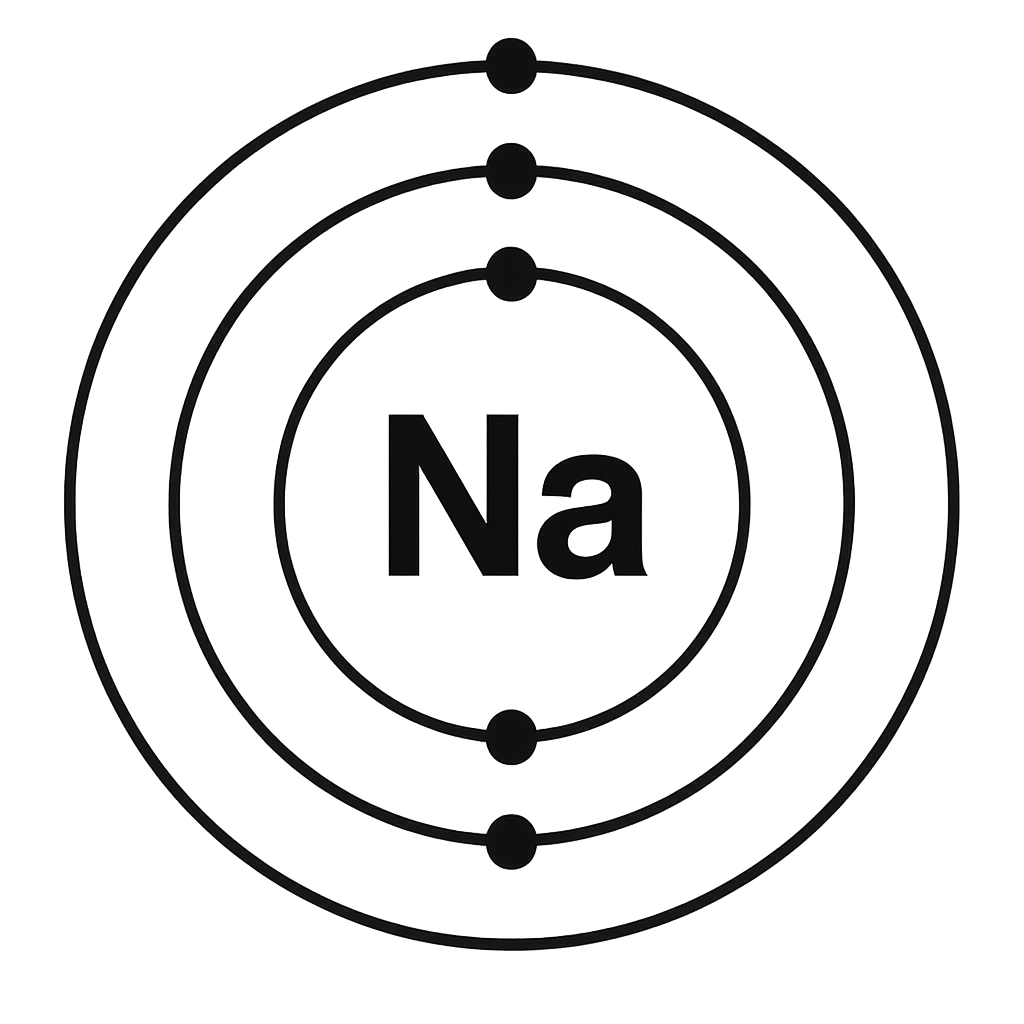
The diagram shows a Bohr model of an atom with three electron shells. The innermost shell contains 2 electrons, the second shell contains 8 electrons and the outermost shell contains 1 electron. How many electrons are present in the outermost shell?
Correct A. 1
B. 2
C. 0
D. 3

Correct Answer: A

Want to see the full step-by-step solution? Unlock AI Explanation & Analytics
Question 22 View Details
Standard reduction potentials at 25 °C are: \(\mathrm{Cu^{2+}+2e^- \rightarrow Cu(s)}\) \(E^{\circ}=+0.34\ \text{V}\) and \(\mathrm{Zn^{2+}+2e^- \rightarrow Zn(s)}\) \(E^{\circ}=-0.76\ \text{V}\). A galvanic cell is set up with a Zn(s) electrode immersed in 1.0 M ZnSO\(_4\) and a Cu(s) electrode immersed in 0.10 M CuSO\(_4\).\n(a) Write the overall cell reaction.\n(b) Calculate the cell EMF at 25 °C.\n(c) Determine the equilibrium constant \(K\) for the cell reaction.
A. E = 0.85 V; K ≈ 5.0×10^30
B. E = 1.12 V; K ≈ 3.0×10^38
C. E = 0.98 V; K ≈ 2.0×10^34
Correct D. E = 1.07 V; K ≈ 1.5×10^37

Correct Answer: D

Want to see the full step-by-step solution? Unlock AI Explanation & Analytics
Question 23 View Details
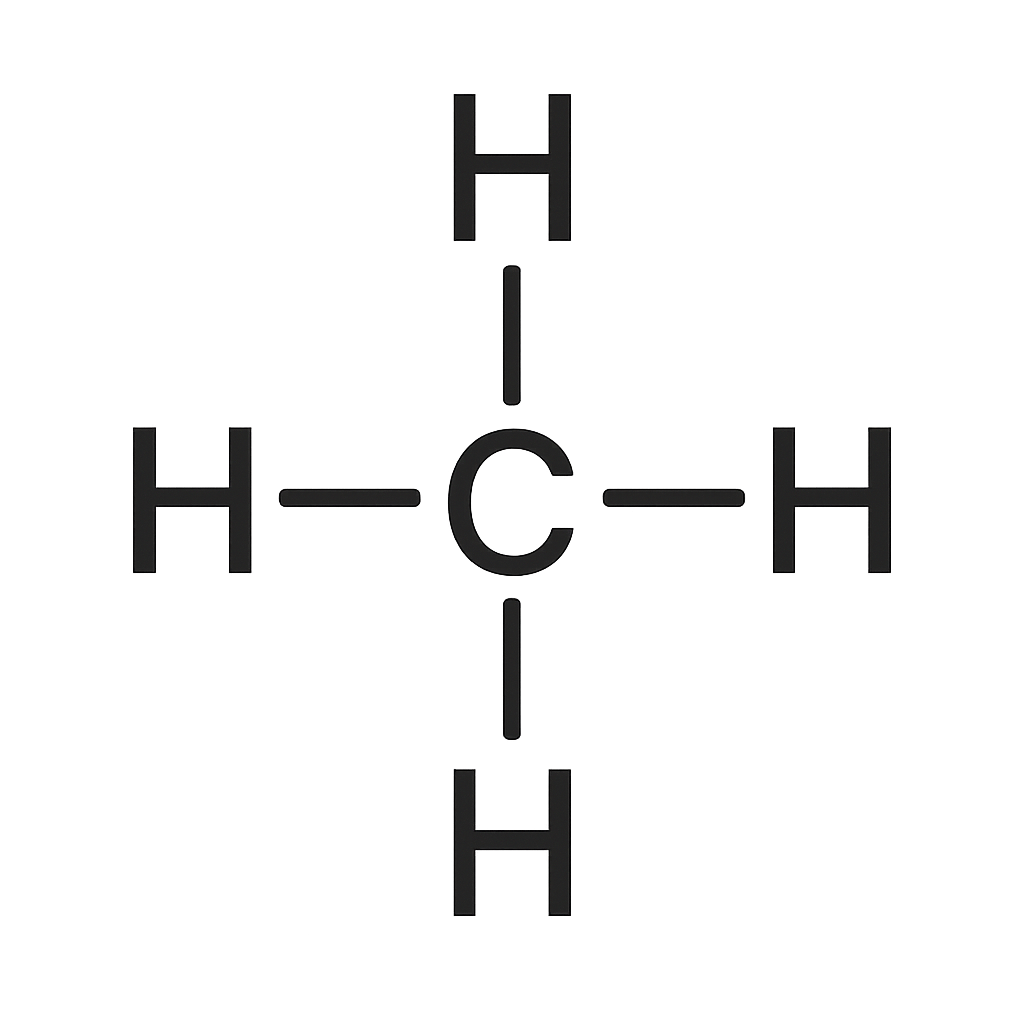
The diagram shows the Lewis structure of methane (CH\(_4\)). What is the hybridisation of the central carbon atom?
A. sp
B. sp²
C. sp³d
Correct D. sp³

Correct Answer: D

Want to see the full step-by-step solution? Unlock AI Explanation & Analytics
Question 24 View Details
1‑Phenylpropene (\(\mathrm{C_6H_5CH=CHCH_3}\)) is treated with excess HBr in the presence of peroxides, and the resulting alkyl bromide is subsequently hydrolysed with aqueous NaOH. Write the structural formula of the final product and give its IUPAC name.
A. Structural formula: C₆H₅CH₂CH(Br)CH₃; IUPAC name: 2‑bromo‑1‑phenylpropane (1‑phenyl‑2‑bromopropane)
B. Structural formula: C₆H₅CH₂CH(OH)CH₂Cl; IUPAC name: 2‑hydroxy‑1‑phenyl‑2‑chloropropane (1‑phenyl‑2‑chloropropan‑2‑ol)
C. Structural formula: C₆H₅CH₂CH₂CH₂OH; IUPAC name: 3‑hydroxy‑1‑phenylpropane (1‑phenyl‑3‑propanol)
Correct D. Structural formula: C₆H₅CH₂CH(OH)CH₃; IUPAC name: 2‑hydroxy‑1‑phenylpropane (1‑phenyl‑2‑propanol)

Correct Answer: D

Want to see the full step-by-step solution? Unlock AI Explanation & Analytics
Question 25 View Details
A compound contains 40.0 % C, 6.7 % H and 53.3 % O by mass. Its molar mass is 180 g·mol\(^{-1}\). Determine its empirical formula and its molecular formula.
A. Empirical formula: CHO; Molecular formula: C₆H₆O₆
B. Empirical formula: C₂H₄O; Molecular formula: C₁₂H₂₄O₁₂
C. Empirical formula: C₃H₆O₃; Molecular formula: C₉H₁₈O₉
Correct D. Empirical formula: CH₂O; Molecular formula: C₆H₁₂O₆

Correct Answer: D

Want to see the full step-by-step solution? Unlock AI Explanation & Analytics

Master the Exam!

You've seen a preview, but there are thousands more questions plus AI tutor to break down complex solutions.

Unlock Full Access Available for Android & Windows
Help others prepare! Share this practice hub:
Chat with Support