neco model questions vol1 2022 chemistry | Essay

Prepare for your exams with neco model questions vol1 questions? Reviewing past/model questions is one of the most effective ways to guarantee a high score. This practice hub features authentic 2022 chemistry (Essay) questions designed to simulate the real exam environment.

Practice these randomly selected questions to test your readiness.
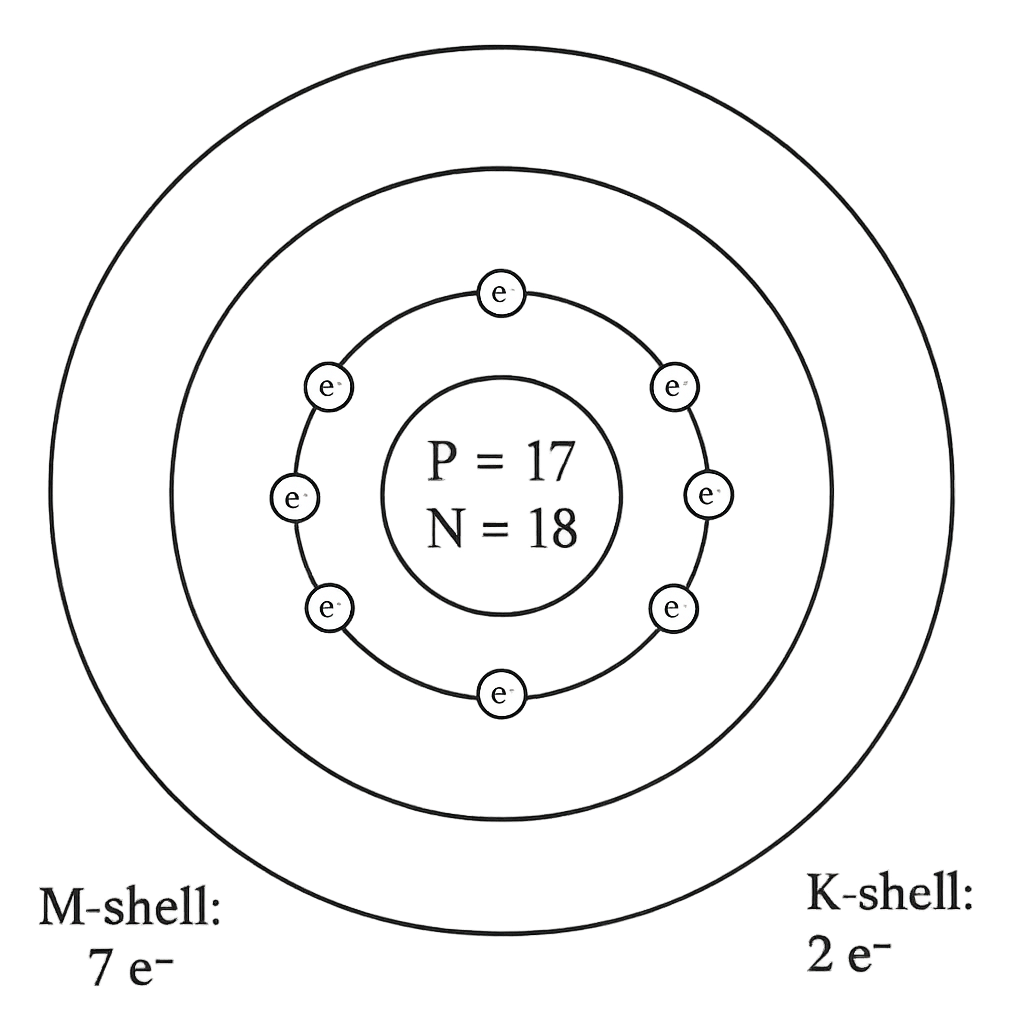
Question 1 View Details
The diagram shows a neutral atom of an element X. The nucleus contains 17 protons and 18 neutrons. The electrons are distributed in three shells: 2 electrons in the first shell, 8 electrons in the second shell and 7 electrons in the third shell.
Question Parts
(a)
State the atomic number, mass number and the total number of electrons of element X.
(b)
Write the electron configuration of element X in the energy‑level (K‑L‑M) notation.
(c)
Explain why element X readily gains one electron to form the X⁻ ion, referring to its position in the periodic table and its electron configuration.
(d)
Calculate the percentage by mass of element X in sodium chloride (NaCl) using the atomic masses: Na = 23 g mol⁻¹, Cl (element X) = 35.5 g mol⁻¹, Cl = 35.5 g mol⁻¹ (same as X).
Detailed Essay Solution & Marking Scheme Available

Get the step-by-step mathematical proofs, key points required by examiners, and a comprehensive breakdown from our AI Tutor.
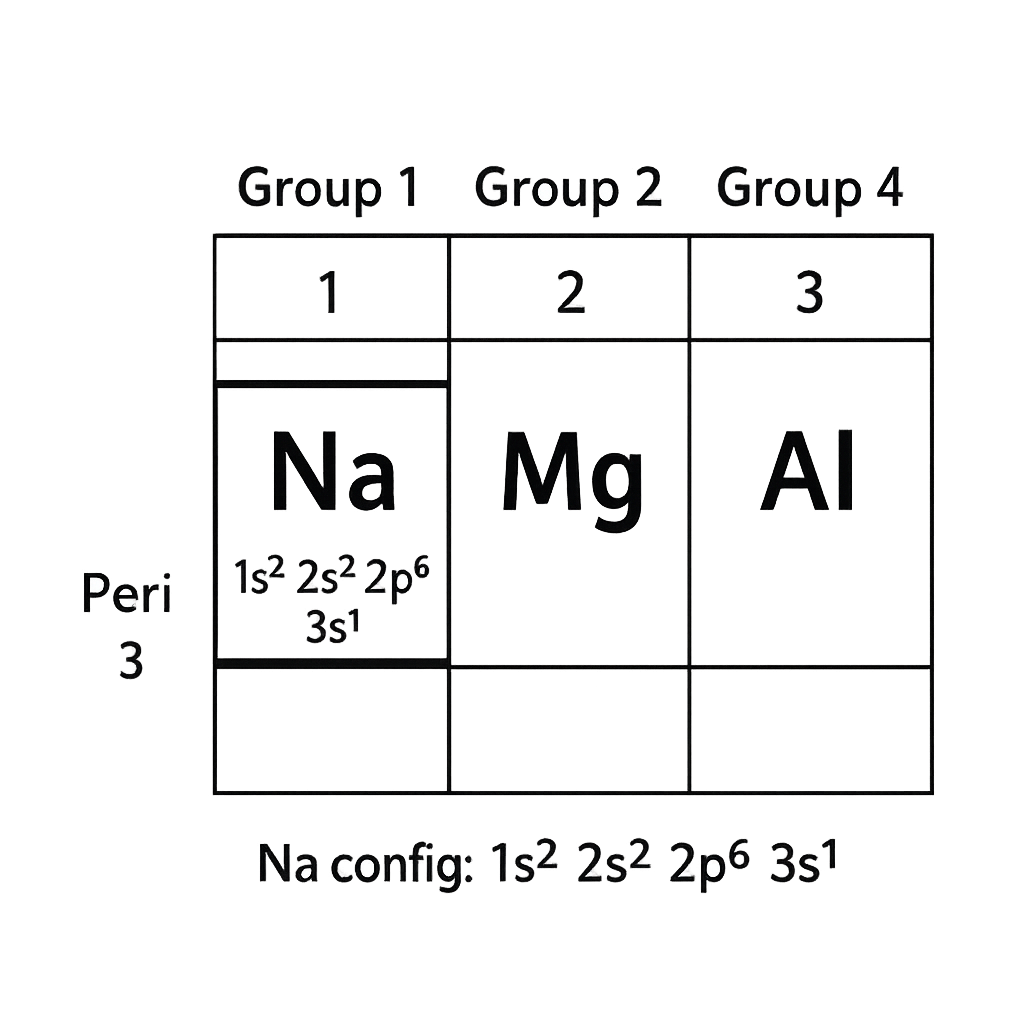
Question 2 View Details
The diagram presents a portion of the periodic table highlighting the elements Na, Mg, Al and Si. The groups are numbered 1 to 4 from left to right and the periods are numbered 3 from top to bottom. The electronic configuration of Na is shown as 1s² 2s² 2p⁶ 3s¹.
Question Parts
(a)
State the block (s, p or d) to which each of the four highlighted elements belongs.
(b)
Write the general electronic configuration for any element belonging to Group 1 (the alkali metals).
(c)
Predict the most common oxidation states of Al and Si and justify each prediction using their position in the periodic table.
(d)
Describe the trend in atomic radius across Period 3 from Na to Si and give a brief explanation for this trend.
Detailed Essay Solution & Marking Scheme Available

Get the step-by-step mathematical proofs, key points required by examiners, and a comprehensive breakdown from our AI Tutor.
Question 3 View Details
A solid compound X is formed between a metal M and a non‑metal N. The metal M forms a +3 ion and the non‑metal N forms a –2 ion. In the crystal each M ion is surrounded by six N ions in an octahedral arrangement, while each N ion is tetrahedrally coordinated to four M ions. The crystal adopts the rock‑salt structure in which each cubic unit cell of edge length 0.5 nm contains four formula units of X.
Question Parts
(a)
Write the empirical formula of X based on the charges of the ions.
(b)
Explain why X has a high melting point, referring to the type of bonding and the crystal structure.
(c)
Using the given coordination numbers, determine the ratio of M to N ions in the lattice and show that it is consistent with the formula obtained in part (a).
(d)
If 1.00 g of X contains 0.025 mol of M ions, calculate the total number of N ions present in that gram of X. Assume the rock‑salt structure described above (four formula units per unit cell). Express your answer in scientific notation to two significant figures.
Detailed Essay Solution & Marking Scheme Available

Get the step-by-step mathematical proofs, key points required by examiners, and a comprehensive breakdown from our AI Tutor.

Question 4 View Details
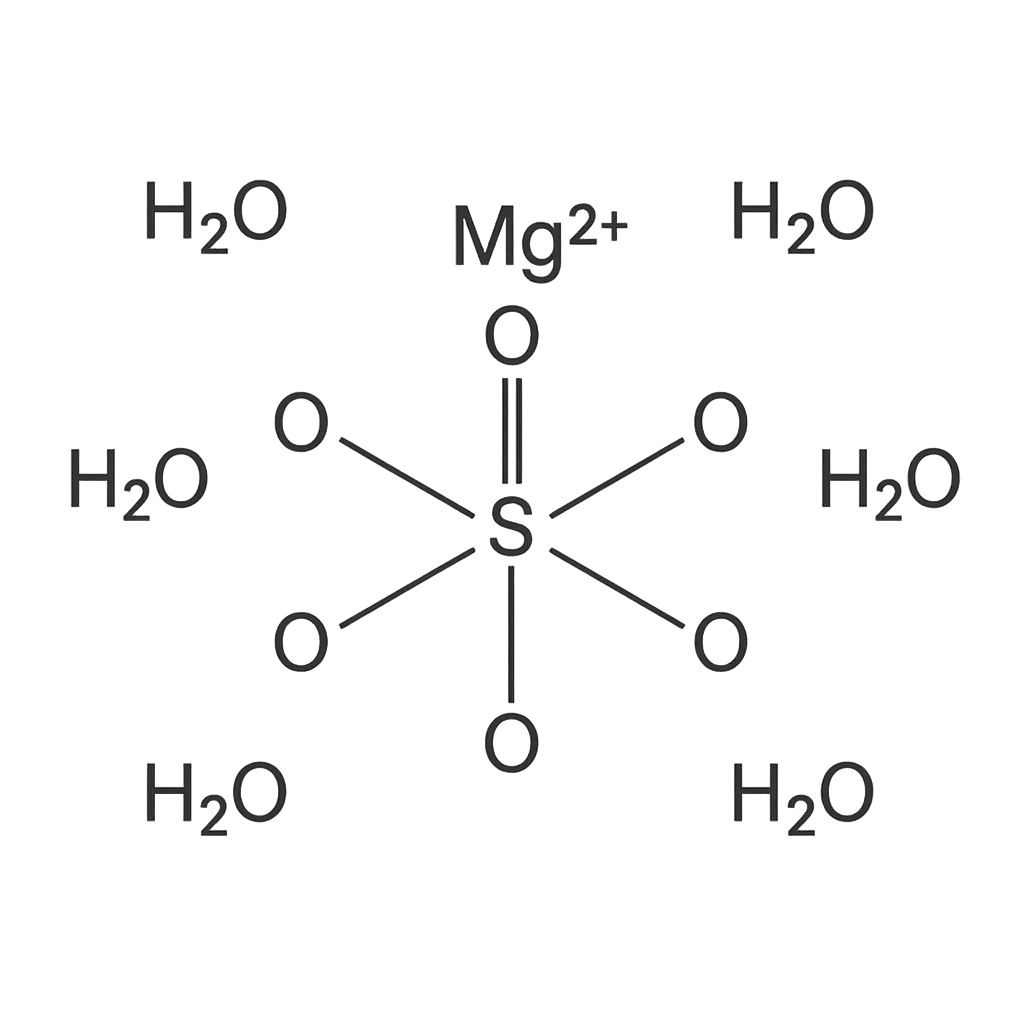
A white crystalline solid shown in the labelled diagram is a hydrate of magnesium sulphate. The diagram represents the composition of the compound as magnesium ion (Mg²⁺) coordinated to a tetrahedral sulphate ion (SO₄²⁻) together with seven water molecules of crystallisation. A 2.50 g sample of this solid is taken for analysis.
Question Parts
(a)
Calculate the number of moles of the hydrate present in the 2.50 g sample. Show all steps, including the determination of the molar mass from the formula shown in the diagram.
(b)
From the result in (a), determine the number of moles of water of crystallisation present in the sample.
(c)
If the sample is heated strongly to remove all water of crystallisation, calculate the mass of the anhydrous MgSO4 that would remain.
(d)
Determine the percentage by mass of magnesium (Mg) in the original 2.50 g sample.
Detailed Essay Solution & Marking Scheme Available

Get the step-by-step mathematical proofs, key points required by examiners, and a comprehensive breakdown from our AI Tutor.

Question 5 View Details
A sample of 12.0 g of calcium carbonate (CaCO₃) is mixed with excess hydrochloric acid (HCl) according to the reaction: CaCO₃ + 2 HCl → CaCl₂ + CO₂ + H₂O The carbon dioxide gas produced is collected over water at 25 °C and a total pressure of 760 mmHg. The volume of gas collected is 2.50 L. The vapour pressure of water at 25 °C is 23.8 mmHg.
Question Parts
(a)
Calculate the theoretical volume of CO₂ (in litres) that should be obtained at the given conditions if all of the CaCO₃ reacts completely.
(b)
Determine the percent yield of CO₂ based on the experimental volume collected.
(c)
If the experiment were repeated with 15.0 g of CaCO₃ but the same volume of CO₂ (2.50 L) was collected, discuss two plausible reasons for the lower percent yield, linking your discussion to concepts of reaction completeness and gas handling.
Detailed Essay Solution & Marking Scheme Available

Get the step-by-step mathematical proofs, key points required by examiners, and a comprehensive breakdown from our AI Tutor.

Question 6 View Details
A 250 g sample of a pure substance X has a melting point of 120 °C and a boiling point of 350 °C. Its specific heat capacities are: solid 0.80 J g⁻¹ K⁻¹, liquid 0.95 J g⁻¹ K⁻¹, gas 0.70 J g⁻¹ K⁻¹. The molar heat of fusion is 6.0 kJ mol⁻¹ and the molar heat of vaporisation is 35 kJ mol⁻¹. The molar mass of X is 50.0 g mol⁻¹.
Question Parts
(a)
Calculate the total amount of heat (in kJ) required to raise the sample from 25 °C to the gaseous state at 360 °C, assuming heating at constant pressure and no heat losses.
Detailed Essay Solution & Marking Scheme Available

Get the step-by-step mathematical proofs, key points required by examiners, and a comprehensive breakdown from our AI Tutor.

Question 7 View Details
A solution is prepared by dissolving 0.250 mol of acetic acid (CH₃COOH, Ka = 1.8 × 10⁻⁵) and 0.150 mol of sodium acetate (CH₃COONa) in enough water to make exactly 1.00 L of solution at 25 °C.
Question Parts
(a)
Calculate the initial pH of the solution.
(b)
If 0.050 mol of 0.100 M HCl is added to the solution (volume remains 1.00 L), calculate the new pH of the mixture.
(c)
After the addition of HCl, a 0.200 M NaOH solution is added to restore the original pH. Calculate the minimum volume (in mL) of NaOH required.
Detailed Essay Solution & Marking Scheme Available

Get the step-by-step mathematical proofs, key points required by examiners, and a comprehensive breakdown from our AI Tutor.

Question 8 View Details
A student carries out a solubility experiment to determine the solubility of calcium hydroxide, Ca(OH)₂, in water at two temperatures using the apparatus shown. The apparatus consists of a 250 mL beaker placed on a thermostatically controlled water bath, a thermometer, a magnetic stirrer, a filter funnel with filter paper, a pre‑weighed evaporating dish placed on an analytical balance, and a drying oven. The procedure is: 1. Measure 100.0 mL of distilled water into the beaker and adjust the water bath to the required temperature. 2. Add excess solid Ca(OH)₂ and stir until no further solid dissolves (saturation). 3. Filter the hot mixture through the funnel into a clean flask. 4. Transfer the filtrate to the evaporating dish, evaporate to dryness in the oven and cool in a desiccator. 5. Weigh the evaporating dish with the dried solute. The mass of the empty evaporating dish is 15.000 g. After the 25 °C experiment the mass of the dish plus dried solute is 15.300 g. After the 60 °C experiment the mass of the dish plus dried solute is 15.420 g. Answer the following questions:
Question Parts
(a)
Calculate the solubility of Ca(OH)₂ in grams per 100 mL of water at 25 °C and at 60 °C.
(b)
Using the solubility values obtained, calculate the solubility product (Ksp) of Ca(OH)₂ at each temperature. Show all steps, assuming complete dissociation: Ca(OH)₂ ⇌ Ca²⁺ + 2 OH⁻.
(c)
Discuss, with reference to Le Chatelier’s principle, why the solubility of Ca(OH)₂ changes with temperature as observed.
(d)
A solution prepared at 60 °C (100 mL) is allowed to cool slowly to 25 °C. Estimate the mass of Ca(OH)₂ that will precipitate on cooling, assuming no loss of water.
Detailed Essay Solution & Marking Scheme Available

Get the step-by-step mathematical proofs, key points required by examiners, and a comprehensive breakdown from our AI Tutor.

Master the Exam!

You've seen a preview, but there are thousands more questions plus AI tutor to break down complex solutions.

Unlock Full Access Available for Android & Windows
Help others prepare! Share this practice hub:
Chat with Support