neco model questions vol1 2022 biology | Objective

Prepare for your exams with neco model questions vol1 questions? Reviewing past/model questions is one of the most effective ways to guarantee a high score. This practice hub features authentic 2022 biology (Objective) questions designed to simulate the real exam environment.

Practice these randomly selected questions to test your readiness.

Question 1 View Details
An adult female has a regular menstrual cycle of \(28\) days. The luteal phase (the period after ovulation) is known to be constant at \(14\) days. Her basal body temperature rises by \(0.4^{\circ}\text{C}\) on the day of ovulation. Progesterone peaks at \(150\ \text{ng\,mL}^{-1}\) exactly \(7\) days after ovulation and then declines linearly to \(30\ \text{ng\,mL}^{-1}\) on day \(28\) of the cycle. On which day of the cycle does the progesterone level fall to \(90\ \text{ng\,mL}^{-1}\)?
A. Day 28 of the cycle
Correct B. Day 24.5 of the cycle
C. Day 26 of the cycle
D. Day 22 of the cycle

Correct Answer: B

Want to see the full step-by-step solution? Unlock AI Explanation & Analytics
Question 2 View Details
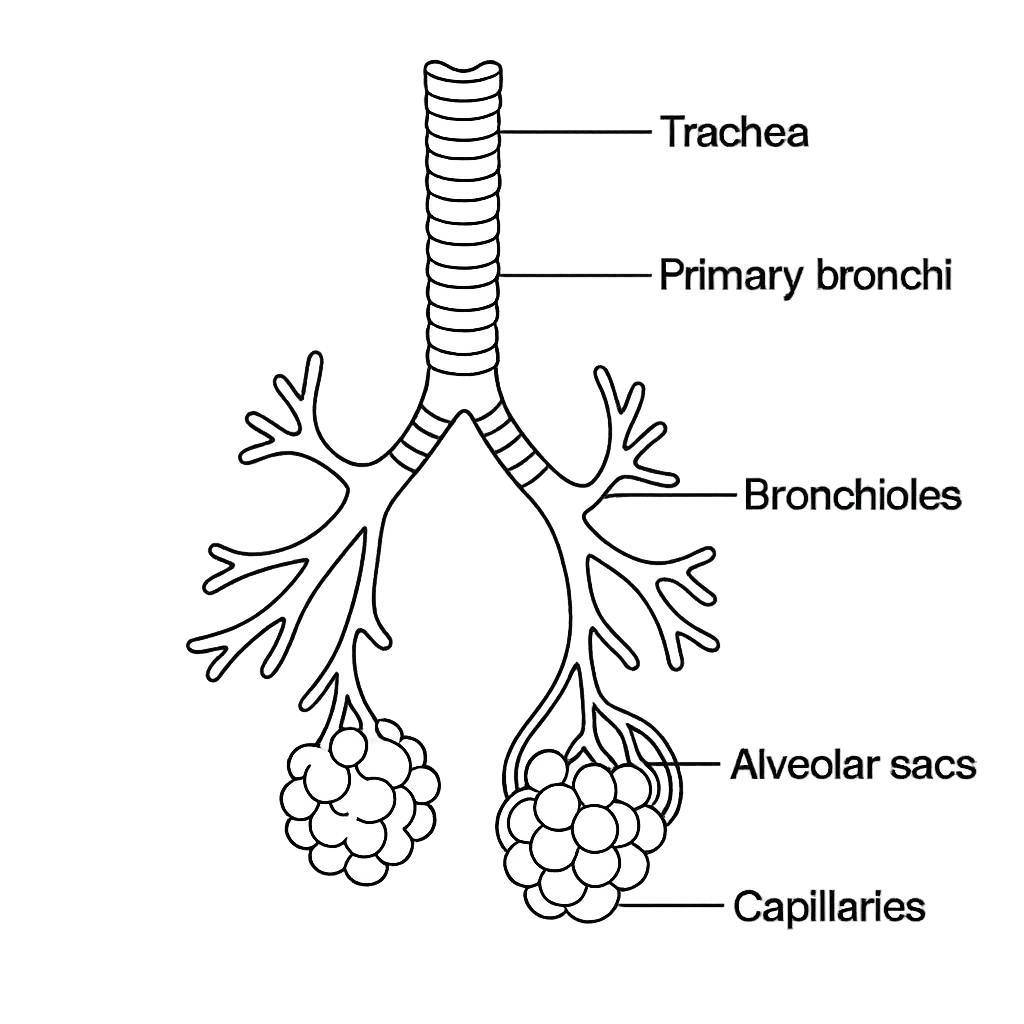
Refer to the labelled diagram of the human respiratory system. The alveolar wall thickness is \(0.5\ \mu\text{m}\), the capillary wall thickness is \(0.3\ \mu\text{m}\) and the interstitial space between them is \(0.2\ \mu\text{m}\). The effective diffusion area for oxygen is \(70\ \text{m}^{2}\). Using Fick's law, compare the rate of oxygen diffusion when the partial pressure difference between alveolar air and capillary blood is \(100\ \text{mmHg}\) versus when it is \(80\ \text{mmHg}\). Express the ratio of the two rates.
A. 0.80
B. 1.00
Correct C. 1.25
D. 1.50

Correct Answer: C

Want to see the full step-by-step solution? Unlock AI Explanation & Analytics
Question 3 View Details
Two species of mammals differ in a 16 000‑base‑pair mitochondrial gene at 150 nucleotide positions. The average mutation rate for mitochondrial DNA is \(2\times10^{-8}\) substitutions per site per year. Assuming a molecular clock and that mutations accumulate independently in each lineage, estimate the time (in years) since the two species diverged.
A. 250 000 years
Correct B. 234 375 years
C. 300 000 years
D. 210 000 years

Correct Answer: B

Want to see the full step-by-step solution? Unlock AI Explanation & Analytics
Question 4 View Details
Plant A and Plant B are desert shrubs. Plant A has a leaf area of \(0.8\ \text{m}^{2}\) and a stomatal density of \(200\) stomata mm\(^{-2}\). Each stomata of Plant A contributes a conductance of \(0.05\ \text{mol\,s}^{-1}\). Plant B has a leaf area of \(0.5\ \text{m}^{2}\) and a stomatal density of \(300\) stomata mm\(^{-2}\), each contributing \(0.03\ \text{mol\,s}^{-1}\). Assuming total water‑loss rate is proportional to the product (leaf area × stomatal density × conductance per stomata), determine which plant loses water faster and calculate the factor by which its loss exceeds the other.
A. Plant B; about 0.56 times faster
B. Plant B; about 1.5 times faster
Correct C. Plant A; about 1.78 times faster
D. Plant A; about 2.0 times faster

Correct Answer: C

Want to see the full step-by-step solution? Unlock AI Explanation & Analytics
Question 5 View Details
In a forest, light‑barked trees constitute \(60\%\) of the trunks and dark‑barked trees \(40\%\). A moth species occurs as two colour morphs: a light morph (\(30\%\) of the population) and a dark morph (\(70\%\)). Predators detect a moth with probability \(0.2\) when its colour matches the bark and \(0.8\) when it mismatches. Assuming moths settle randomly on tree trunks in proportion to bark type, calculate:\n\na) the survival probability of an individual of each morph;\nb) the overall survival probability of the moth population.
A. Light morph survival = 0.60; dark morph survival = 0.40; overall survival ≈ 0.500
B. Light morph survival = 0.48; dark morph survival = 0.52; overall survival ≈ 0.500
C. Light morph survival = 0.44; dark morph survival = 0.56; overall survival ≈ 0.524
Correct D. Light morph survival = 0.56; dark morph survival = 0.44; overall survival ≈ 0.476

Correct Answer: D

Want to see the full step-by-step solution? Unlock AI Explanation & Analytics
Question 6 View Details
A person in a cold environment loses heat at a rate of \(150\ \text{kJ h}^{-1}\). Shivering generates heat at \(200\ \text{kJ h}^{-1}\) and basal metabolism adds another \(50\ \text{kJ h}^{-1}\). After two hours vasoconstriction reduces the heat‑loss rate by 30 %. Assuming the rates remain constant in each period, calculate the net heat balance (in kJ) after four hours.
A. 340
B. 200
Correct C. 490
D. 610

Correct Answer: C

Want to see the full step-by-step solution? Unlock AI Explanation & Analytics
Question 7 View Details
An unknown aquatic organism shows the following characteristics: it is eukaryotic, possesses a nucleus, its cells are flagellated, it contains chloroplasts with chlorophyll\,a,\,c and fucoxanthin, stores starch as a reserve, its cell wall is composed of cellulose, it reproduces by motile zoospores, and its life cycle is dominated by a diploid sporophyte. Using these traits, determine the organism's classification at the kingdom, phylum and class levels.
A. Kingdom Protista; Phylum Phaeophyta; Class Phaeophyceae
Correct B. Kingdom Plantae; Phylum Phaeophyta; Class Phaeophyceae
C. Kingdom Plantae; Phylum Chlorophyta; Class Ulvophyceae
D. Kingdom Plantae; Phylum Rhodophyta; Class Florideophyceae

Correct Answer: B

Want to see the full step-by-step solution? Unlock AI Explanation & Analytics
Question 8 View Details
A forest ecosystem receives \(2000\ \text{MJ m}^{-2}\) of solar radiation annually. Only 2 % of this energy is captured as gross primary productivity (GPP). Plant respiration uses 60 % of GPP, the remainder is net primary productivity (NPP). Herbivores consume 45 % of NPP, and decomposers return 30 % of the remaining NPP to the soil as mineral nutrients. The rest is stored as biomass, but each year 10 % of the stored biomass is lost by fire. Calculate the amount of energy (in MJ m\(^{-2}\)) stored as biomass after one year.
A. 6.21
B. 4.97
C. 5.08
Correct D. 5.54

Correct Answer: D

Want to see the full step-by-step solution? Unlock AI Explanation & Analytics
Question 9 View Details
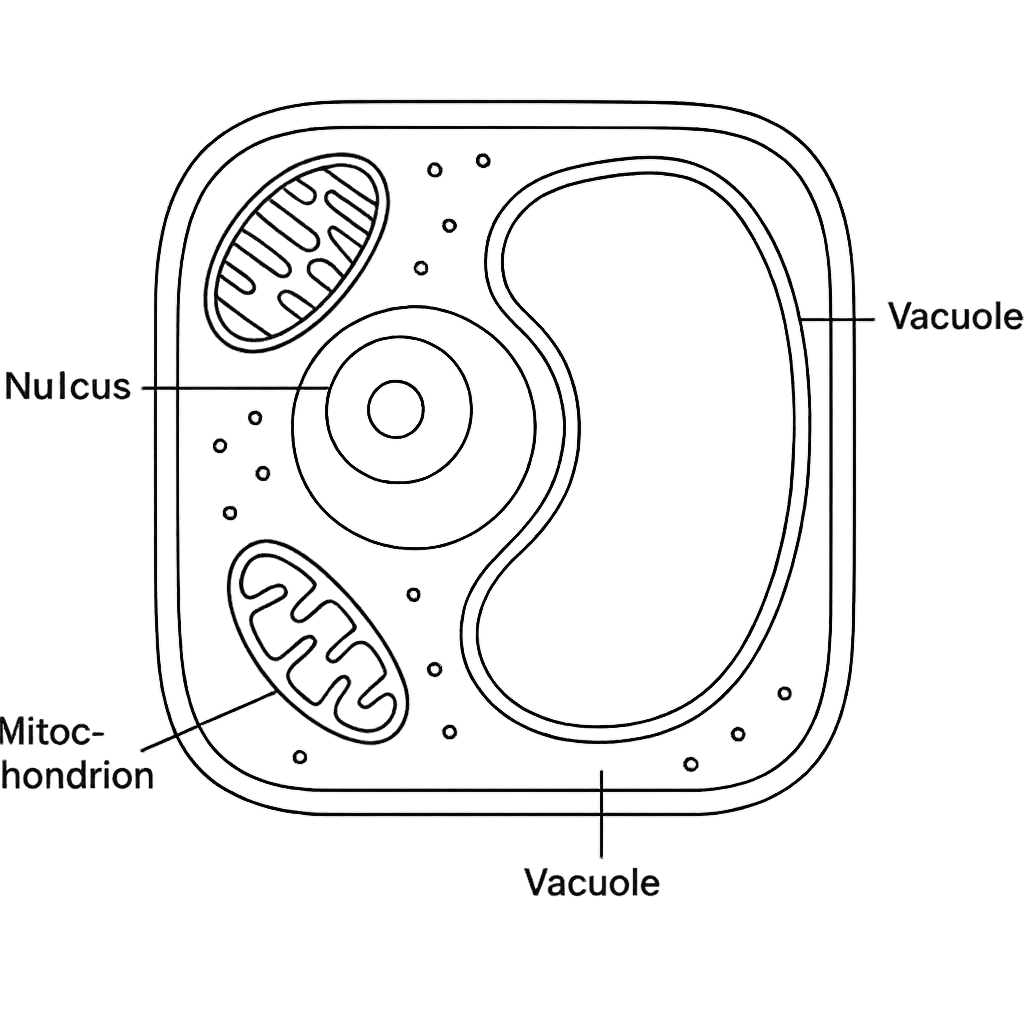
The diagram shows a typical plant cell with its major organelles labelled. Identify the organelle that carries out photosynthesis and explain, in two sentences, why its structure is suited to this function.
Correct A. Chloroplast; its stacked thylakoid membranes increase surface area for light absorption and the stroma houses the Calvin‑cycle enzymes, enabling efficient photosynthesis.
B. Nucleus; its double membrane encloses genetic material and regulates cellular activities. The nucleoplasm is believed to host photosynthetic pigments, making it suitable for photosynthesis.
C. Vacuole; its large central space stores water and nutrients, providing a reservoir for photosynthetic substrates. The tonoplast membrane is thought to contain chlorophyll, allowing light absorption.
D. Mitochondrion; its inner membrane folds called cristae increase surface area for ATP synthesis. The matrix contains enzymes for the citric acid cycle, which are mistakenly thought to capture light energy.

Correct Answer: A

Want to see the full step-by-step solution? Unlock AI Explanation & Analytics
Question 10 View Details
A cell metabolises two molecules of glucose under aerobic conditions. For each glucose the following yields are obtained: glycolysis produces 2 ATP (substrate‑level) and 2 cytosolic NADH; each cytosolic NADH yields 3 ATP via the malate‑aspartate shuttle. Pyruvate oxidation generates 2 mitochondrial NADH, but transporting each pyruvate into the mitochondrion costs 2 ATP. The citric‑acid cycle yields per glucose 6 mitochondrial NADH, 2 FADH\(_2\) and 2 GTP (equivalent to ATP). Each mitochondrial NADH yields 3 ATP and each FADH\(_2\) yields 2 ATP. Determine the total net ATP produced from the two glucose molecules.
A. 64
B. 68
Correct C. 72
D. 76

Correct Answer: C

Want to see the full step-by-step solution? Unlock AI Explanation & Analytics
Question 11 View Details
Substance X is present in the blood at a concentration of \(0.5\ \text{mg mL}^{-1}\). The glomerular filtration rate (GFR) of the kidneys is \(120\ \text{mL min}^{-1}\). Of the filtered load, \(80\%\) is reabsorbed, and \(10\%\) of the reabsorbed amount is subsequently secreted back into the tubular fluid. Calculate the amount of X excreted in the urine per minute (in mg).
A. 4.8 mg/min
B. 48 mg/min
Correct C. 16.8 mg/min
D. 12 mg/min

Correct Answer: C

Want to see the full step-by-step solution? Unlock AI Explanation & Analytics
Question 12 View Details
In a plant, genes A and B are linked on the same chromosome with a recombination frequency of \(20\%\). Allele \(A\) (dominant) gives tall plants, \(a\) (recessive) short; allele \(B\) (dominant) gives purple flowers, \(b\) (recessive) white. A heterozygous plant (\(AaBb\)) is crossed with a homozygous recessive plant (\(aabb\)). Determine the expected phenotypic ratio of the progeny in the order tall‑purple : tall‑white : short‑purple : short‑white.
A. 2:1:1:2
B. 5:1:1:5
C. 3:1:1:3
Correct D. 4:1:1:4

Correct Answer: D

Want to see the full step-by-step solution? Unlock AI Explanation & Analytics
Question 13 View Details
In a population the frequencies of the blood‑group alleles are \(p = 0.30\) for \(I^{A}\), \(q = 0.20\) for \(I^{B}\) and \(r = 0.50\) for \(i\) (\(p+q+r = 1\)). Both parents have blood type A. Assuming random mating and Hardy-Weinberg equilibrium, calculate the probability that their child will have blood type O. Give your answer as a decimal to three significant figures.
Correct A. 0.148
B. 0.200
C. 0.075
D. 0.125

Correct Answer: A

Want to see the full step-by-step solution? Unlock AI Explanation & Analytics
Question 14 View Details
A plant cell has an internal potassium concentration of \(100\ \text{mM}\) and an external concentration of \(10\ \text{mM}\). The membrane potential is \(-70\ \text{mV}\) (inside negative). Using the Nernst equation at \(25^{\circ}\text{C}\) (\(RT/F \approx 25.7\ \text{mV}\)), determine the direction of net movement of \(K^{+}\) ions through a potassium channel (into or out of the cell).
A. no net movement
B. equilibrium (no net flux)
Correct C. out of the cell
D. into the cell

Correct Answer: C

Want to see the full step-by-step solution? Unlock AI Explanation & Analytics
Question 15 View Details
In a batch culture of bacteria, the optical density at 600 nm (OD\(_{600}\)) is measured as follows: at \(0\ \text{h}\) the OD is \(0.05\); at \(2\ \text{h}\) the OD is \(0.20\); at \(4\ \text{h}\) the OD is \(0.80\). Assuming exponential growth during this interval:\n\na) Determine the generation (doubling) time in minutes.\n\nb) An antibiotic is added at \(5\ \text{h}\) that reduces the specific growth rate by \(40\%\). Predict the OD\(_{600}\) at \(8\ \text{h}\). Give your answer to two decimal places.
A. generation time = 45 min; OD at 8 h ≈ 4.23
B. generation time = 90 min; OD at 8 h ≈ 3.12
Correct C. generation time = 60 min; OD at 8 h ≈ 5.57
D. generation time = 75 min; OD at 8 h ≈ 6.78

Correct Answer: C

Want to see the full step-by-step solution? Unlock AI Explanation & Analytics
Question 16 View Details
State the main function of the mitochondrion in eukaryotic cells.
A. Site of lipid synthesis; stores fatty acids.
B. Site of photosynthesis; generates glucose.
C. Site of DNA replication; synthesizes nucleotides.
Correct D. Site of cellular respiration; produces ATP.

Correct Answer: D

Want to see the full step-by-step solution? Unlock AI Explanation & Analytics
Question 17 View Details
The diagram shows a balanced meal consisting of three macronutrient portions. The carbohydrate portion weighs 150 g, the protein portion 80 g, and the fat portion 30 g. Carbohydrate and protein each provide 4 kcal per gram, while fat provides 9 kcal per gram. Calculate the percentage of the total caloric intake contributed by each macronutrient, giving your answers to one decimal place.
A. Carbohydrate 45.0%, Protein 30.0%, Fat 25.0%
B. Carbohydrate 48.0%, Protein 28.0%, Fat 24.0%
Correct C. Carbohydrate 50.4%, Protein 26.9%, Fat 22.7%
D. Carbohydrate 52.5%, Protein 25.0%, Fat 22.5%

Correct Answer: C

Want to see the full step-by-step solution? Unlock AI Explanation & Analytics
Question 18 View Details
A bacterial culture is incubated at 30°C. At the optimal temperature of 37°C the bacterium has a generation time of 20 minutes. When the temperature is lowered to 30°C the generation time increases by 50%. Starting with 10³ cells, how many cells will be present after 5 hours at 30°C? Also, determine how many cells would be present after the same period at 37°C and state the factor by which the 37°C culture exceeds the 30°C culture.
Correct A. 30°C: 1.024×10⁶ cells; 37°C: 3.277×10⁷ cells; factor ≈ 32
B. 30°C: 8.00×10⁵ cells; 37°C: 2.90×10⁷ cells; factor ≈ 36
C. 30°C: 1.5×10⁶ cells; 37°C: 3.0×10⁷ cells; factor ≈ 20
D. 30°C: 9.5×10⁵ cells; 37°C: 2.5×10⁷ cells; factor ≈ 26

Correct Answer: A

Want to see the full step-by-step solution? Unlock AI Explanation & Analytics
Question 19 View Details
A 30‑year‑old female weighs 65 kg and is 165 cm tall. Using the Harris‑Benedict equation for females, calculate her basal metabolic rate (BMR). Then, assuming a moderate activity level with an activity factor of 1.55, find her total daily energy expenditure (TDEE). Finally, determine the amount of protein she should consume each day if the recommendation is 0.8 g per kilogram of body weight.
A. BMR = 1,350 kcal\/day; TDEE ≈ 2,093 kcal\/day; protein = 52 g\/day
Correct B. BMR = 1,435 kcal/day; TDEE ≈ 2,224 kcal/day; protein = 52 g/day
C. BMR = 1,420 kcal\/day; TDEE ≈ 2,200 kcal\/day; protein = 60 g\/day
D. BMR = 1,500 kcal\/day; TDEE ≈ 2,325 kcal\/day; protein = 48 g\/day

Correct Answer: B

Want to see the full step-by-step solution? Unlock AI Explanation & Analytics
Question 20 View Details
A semi‑permeable membrane has a permeability coefficient (P = 1.2\times10^{-5}\,\text{cm/s}\), an area (A = 2\,\text{cm}^2\), a thickness (L = 0.01\,\text{cm}\), and a concentration difference across it of \(\Delta C = 0.05\,\text{mol/cm}^3\). Using Fick's law \(J = \frac{P A \Delta C}{L}\), calculate the rate of diffusion (J\) in mol/s. An active transport pump in the same membrane can move (2\times10^{-6}\,\text{mol/s}\). State which mechanism transports solute faster and by what factor.
A. Diffusion rate = 6.0×10⁻⁵ mol\/s; diffusion is ~30 times faster than active transport
Correct B. Diffusion rate = 1.2×10⁻⁴ mol/s; diffusion is ~60 times faster than active transport
C. Diffusion rate = 2.4×10⁻⁴ mol\/s; diffusion is ~120 times faster than active transport
D. Diffusion rate = 1.2×10⁻⁵ mol\/s; diffusion is ~6 times faster than active transport

Correct Answer: B

Want to see the full step-by-step solution? Unlock AI Explanation & Analytics
Question 21 View Details
A cell population triples every 12 hours. Starting with \(120\) cells, how many cells will be present after \(24\) hours?
A. 360
B. 960
Correct C. 1080
D. 1440

Correct Answer: C

Want to see the full step-by-step solution? Unlock AI Explanation & Analytics
Question 22 View Details
A muscle cell during intense exercise metabolises \(0.5\) mol of glucose. Seventy percent of the glucose is oxidised aerobically (yielding \(38\) ATP per mol) while the remaining thirty percent undergoes anaerobic glycolysis (yielding \(2\) ATP per mol). How many moles of ATP are produced in total?
Correct A. 13.6
B. 13.3
C. 12.8
D. 19.0

Correct Answer: A

Want to see the full step-by-step solution? Unlock AI Explanation & Analytics
Question 23 View Details
In a lake ecosystem primary producers fix \(10{,}000\) MJ of energy per year. An invasive plant reduces this primary production by \(20\)\%. Energy transfer efficiency to the second trophic level is \(10\)\% and to the third level is \(5\)\% of the energy received by the second level. A fish species at the third trophic level requires \(2{,}000\) MJ per year to sustain its population. After the invasion, will the fish population be able to meet its energy requirement? State Yes or No.
A. Uncertain
B. Maybe
C. Yes
Correct D. No

Correct Answer: D

Want to see the full step-by-step solution? Unlock AI Explanation & Analytics
Question 24 View Details
A diet plan provides \(2500\) kcal per day. It includes \(60\) g of protein and \(80\) g of fat. Protein supplies \(4\) kcal per gram and fat supplies \(9\) kcal per gram. The remaining calories come from carbohydrates. What percentage of the total calories is supplied by carbohydrates? Round to the nearest whole percent.
A. 58
Correct B. 62
C. 66
D. 64

Correct Answer: B

Want to see the full step-by-step solution? Unlock AI Explanation & Analytics
Question 25 View Details
A diploid organism has a chromosome number of \(2n = 30\). After meiosis, how many chromosomes are present in the four haploid gametes combined?
Correct A. 60
B. 45
C. 30
D. 120

Correct Answer: A

Want to see the full step-by-step solution? Unlock AI Explanation & Analytics

Master the Exam!

You've seen a preview, but there are thousands more questions plus AI tutor to break down complex solutions.

Unlock Full Access Available for Android & Windows
Help others prepare! Share this practice hub:
Chat with Support