neco model questions vol1 2022 agricultural_science | Essay

Prepare for your exams with neco model questions vol1 questions? Reviewing past/model questions is one of the most effective ways to guarantee a high score. This practice hub features authentic 2022 agricultural_science (Essay) questions designed to simulate the real exam environment.

Practice these randomly selected questions to test your readiness.

Question 1 View Details
A mixed‑crop farm in the middle belt of Nigeria maintains a variety of crops, livestock and a small orchard. The farm is situated on a gently sloping terrain and experiences a distinct rainy and dry season.
Question Parts
(a)
Identify and explain three major ecological factors that influence the diversity of plant and animal species on the farm.
(b)
Discuss two management practices that could be adopted to enhance biodiversity while maintaining farm productivity.
(c)
Explain how the chosen practices in part (b) can mitigate a specific environmental problem commonly faced by farms in the region.
Detailed Essay Solution & Marking Scheme Available

Get the step-by-step mathematical proofs, key points required by examiners, and a comprehensive breakdown from our AI Tutor.
Question 2 View Details
A soil‑water retention experiment is to be carried out in the school laboratory to determine the gravimetric water content of a loamy soil at field capacity and at permanent wilting point.
Question Parts
(a)
Using the diagram of the experimental setup, describe the step‑by‑step procedure for obtaining the masses required to calculate water content at field capacity and wilting point.
(b)
The following masses were recorded: - Mass of empty container: 50 g - Mass of container + air‑dry soil: 200 g - Mass of container + soil at field capacity (after 24 h drainage): 260 g - Mass of container + soil at permanent wilting point: 210 g Calculate the gravimetric water content (expressed as % of dry soil mass) at field capacity and at wilting point.
(c)
Interpret the results obtained in part (b) and recommend an irrigation schedule for the crop season, assuming the crop requires a minimum soil moisture of 15 % (gravimetric) for optimal growth.
Detailed Essay Solution & Marking Scheme Available

Get the step-by-step mathematical proofs, key points required by examiners, and a comprehensive breakdown from our AI Tutor.

Question 3 View Details
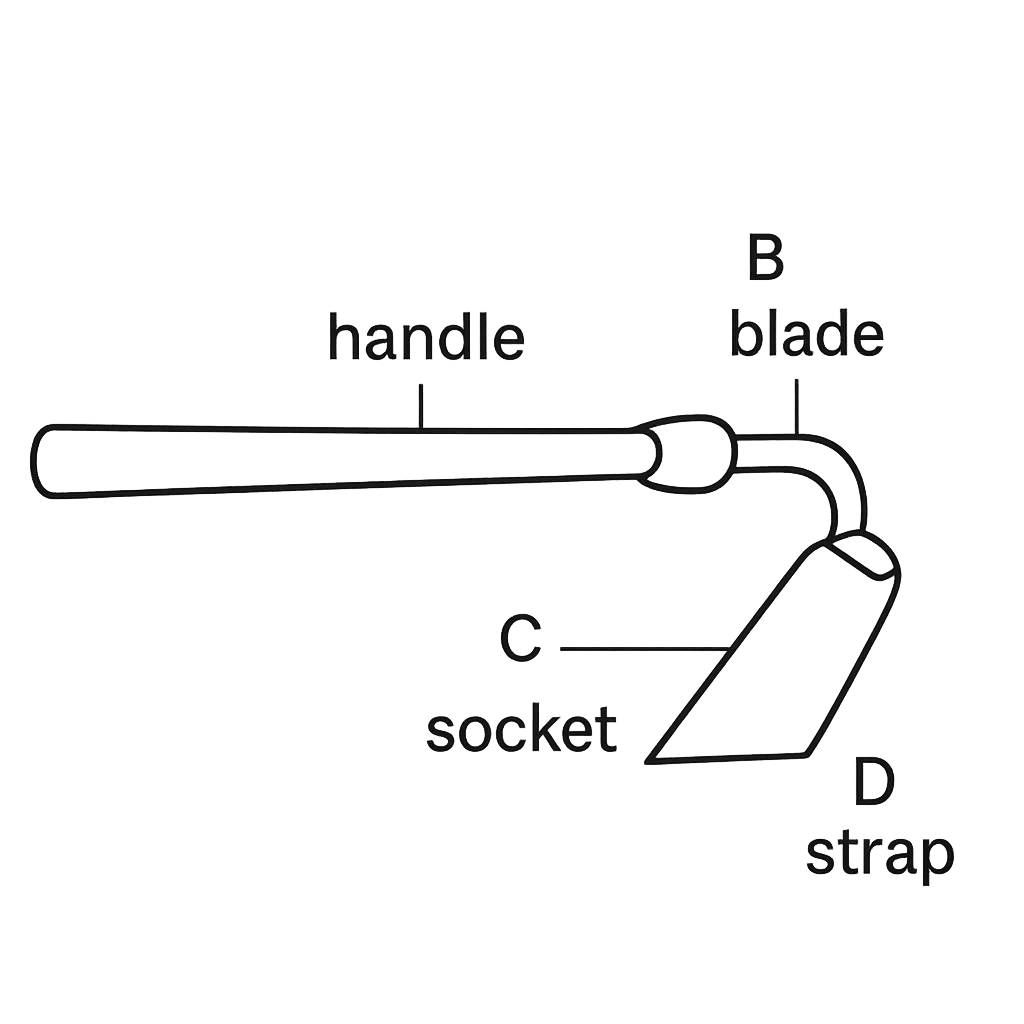
The illustration shows a hand hoe with its parts labelled A, B, C and D. A. Identify the part represented by each label. B. State the function of each identified part. C. Discuss two safety precautions that should be observed when using a hand hoe and two maintenance practices that will extend its service life.
Question Parts
(a)
Identify the part represented by each label.
(b)
State the function of each identified part.
(c)
Discuss two safety precautions that should be observed when using a hand hoe and two maintenance practices that will extend its service life.
Detailed Essay Solution & Marking Scheme Available

Get the step-by-step mathematical proofs, key points required by examiners, and a comprehensive breakdown from our AI Tutor.

Question 4 View Details
A farmer intends to plough a rectangular field that measures 200 m in length and 250 m in width. The field will be ploughed in rows spaced 0.75 m apart. A 30‑horsepower (hp) diesel tractor is to be used. The tractor’s fuel consumption rate is 0.30 L per hp per hour when operating at full load. During ploughing the tractor works at 70 % of its rated power. The average speed of the tractor while ploughing is 5 km h⁻¹. Diesel costs ₦180 per litre. a) Calculate the total time (in hours) required to plough the whole field. b) Estimate the total volume of diesel fuel that will be consumed. c) Determine the monetary cost of the diesel for the operation. d) Briefly discuss two advantages of using a tractor for ploughing this field compared with animal‑drawn ploughing.
Question Parts
(a)
Calculate the total time (in hours) required to plough the whole field.
(b)
Estimate the total volume of diesel fuel that will be consumed.
(c)
Determine the monetary cost of the diesel for the operation.
(d)
Briefly discuss two advantages of using a tractor for ploughing this field compared with animal‑drawn ploughing.
Detailed Essay Solution & Marking Scheme Available

Get the step-by-step mathematical proofs, key points required by examiners, and a comprehensive breakdown from our AI Tutor.

Question 5 View Details
A farmer intends to establish a 2‑hectare field for the production of maize and soybean in a mixed cropping system. Soil analysis shows pH 5.2, organic matter 1.5 %, available P 8 mg kg⁻¹ and K 120 mg kg⁻¹. The farmer targets yields of 5 t ha⁻¹ for maize and 2.5 t ha⁻¹ for soybean. Recommended fertilizer rates are: for maize – N 120 kg ha⁻¹, P₂O₅ 60 kg ha⁻¹, K₂O 40 kg ha⁻¹; for soybean – N 20 kg ha⁻¹, P₂O₅ 30 kg ha⁻¹, K₂O 20 kg ha⁻¹. To raise the soil pH to 6.5, the lime requirement is 2 t ha⁻¹ for each 0.5 unit increase in pH. Maize will occupy 60 % of the field and soybean 40 %.
Question Parts
(a)
Calculate the total amount of lime required for the whole 2‑hectare field.
(b)
Determine the total quantity of each fertilizer nutrient (N, P₂O₅, K₂O) required for the whole field, applying the given rates proportionally to the cultivated area of each crop.
(c)
Discuss two agronomic advantages of integrating soybean as a legume component in the maize field.
Detailed Essay Solution & Marking Scheme Available

Get the step-by-step mathematical proofs, key points required by examiners, and a comprehensive breakdown from our AI Tutor.

Question 6 View Details
A smallholder dairy farm keeps 25 lactating Friesian cows. The average daily milk yield per cow is 22 L. Each cow is fed 2.5 kg of a concentrate (20 % crude protein) and 10 kg of grass silage (8 % crude protein) per day. The concentrate costs ₦120 kg⁻¹ and the silage ₦30 kg⁻¹. Milk contains 3.2 % fat and is sold at ₦150 per litre. The farmer plans to introduce a breeding programme that will raise the average daily yield by 10 % over the next two years.
Question Parts
(a)
Calculate the total daily feed cost for the herd.
(b)
Determine the gross daily income from milk sales before the breeding programme.
Detailed Essay Solution & Marking Scheme Available

Get the step-by-step mathematical proofs, key points required by examiners, and a comprehensive breakdown from our AI Tutor.

Question 7 View Details
A farmer in the Sudan Savanna zone of Nigeria cultivates maize and has been experiencing damage caused by an insect pest.
Question Parts
(a)
Identify the major insect pest of maize in this region and describe its complete life cycle, including all developmental stages and their approximate durations.
(b)
Explain three cultural control methods that can be employed against this pest and the scientific rationale for each method.
(c)
Discuss the advantages and disadvantages of using a synthetic insecticide compared with a biological control agent for managing this pest, considering environmental impact, resistance development and cost.
(d)
The farmer observes that at 30 days after planting, 15 % of the maize leaves show feeding damage. The economic injury level (EIL) for this pest is 10 % leaf damage. Based on this information, decide whether control action is justified and recommend the most appropriate control measure, justifying your choice.
Detailed Essay Solution & Marking Scheme Available

Get the step-by-step mathematical proofs, key points required by examiners, and a comprehensive breakdown from our AI Tutor.

Question 8 View Details
A commercial tomato farmer in the humid forest zone of Nigeria has been suffering from a foliar disease that reduces marketable yield.
Question Parts
(a)
Identify the most likely causal organism of early blight on tomato and outline its disease cycle, emphasizing the role of spores and environmental conditions.
(b)
Explain two environmental factors that favour the development and spread of early blight in tomato crops.
(c)
Propose an integrated disease management plan for early blight that incorporates cultural, chemical and host‑resistance strategies.
(d)
The farmer’s field covers 5 ha. The planting density is 10 000 plants ha⁻¹. Current disease incidence is 20 % and each infected plant loses 0.5 kg of marketable fruit. The market price of tomato is ₦150 kg⁻¹. A fungicide costing ₦2 000 ha⁻¹ can reduce incidence to 5 %. Calculate the net monetary benefit (in ₦) of applying the fungicide, showing all steps.
Detailed Essay Solution & Marking Scheme Available

Get the step-by-step mathematical proofs, key points required by examiners, and a comprehensive breakdown from our AI Tutor.

Master the Exam!

You've seen a preview, but there are thousands more questions plus AI tutor to break down complex solutions.

Unlock Full Access Available for Android & Windows
Help others prepare! Share this practice hub:
Chat with Support