neco model questions vol1 2021 physics | Objective

Prepare for your exams with neco model questions vol1 questions? Reviewing past/model questions is one of the most effective ways to guarantee a high score. This practice hub features authentic 2021 physics (Objective) questions designed to simulate the real exam environment.

Practice these randomly selected questions to test your readiness.

Question 1 View Details
In a circuit, a 12 V ideal battery has an internal resistance of 0.5 Ω. Two external resistors, \(R_{1}=4\ \Omega\) and an unknown resistor \(R_{2}\), are connected in parallel. Their equivalent resistance is in series with another unknown resistor \(R_{3}\). The total current supplied by the battery is 2 A, and the power dissipated in \(R_{3}\) is twice the power dissipated in \(R_{1}\). Determine the resistance of \(R_{3}\) (in ohms, correct to two decimal places).
Correct A. 3.04
B. 5.00
C. 2.56
D. 4.12

Correct Answer: A

Want to see the full step-by-step solution? Unlock AI Explanation & Analytics
Question 2 View Details
A converging lens of focal length \(f_{1}=10\ \text{cm}\) is placed a distance \(d\) to the left of a second converging lens of focal length \(f_{2}=20\ \text{cm}\). An object 30 cm in front of the first lens produces a final real image on a screen 50 cm to the right of the second lens. Find the separation \(d\) between the lenses (in centimetres, correct to one decimal place).
A. 36.9
B. 55.1
Correct C. 48.3
D. 42.7

Correct Answer: C

Want to see the full step-by-step solution? Unlock AI Explanation & Analytics
Question 3 View Details
A sample of an ideal gas is contained in a cylinder fitted with a movable piston. The gas is kept at constant pressure. Initially the gas occupies a volume of \(2.0\ \text{L}\) at a temperature of \(300\ \text{K}\). After heating, the volume expands to \(3.5\ \text{L}\) and the gas absorbs \(5.0\times10^{5}\ \text{J}\) of heat. The molar heat capacity at constant pressure for the gas is \(C_{p}=29\ \text{J\,mol}^{-1}\text{K}^{-1}\). Determine the number of moles of gas present (to two significant figures).
Correct A. 77
B. 85
C. 92
D. 70

Correct Answer: A

Want to see the full step-by-step solution? Unlock AI Explanation & Analytics
Question 4 View Details
An engine operates in two successive Carnot cycles. The first cycle works between a hot reservoir at \(T_{H}=800\ \text{K}\) and an intermediate reservoir at temperature \(T_{M}\). The second cycle works between the intermediate reservoir at \(T_{M}\) and a cold reservoir at \(T_{C}=300\ \text{K}\). The total work produced per overall cycle is \(2000\ \text{J}\) and the heat rejected to the cold reservoir is \(1200\ \text{J}\). If the work done by the first Carnot engine equals the work done by the second Carnot engine, find the temperature \(T_{M}\) of the intermediate reservoir (in kelvin, to the nearest kelvin).
A. 600
Correct B. 550
C. 450
D. 500

Correct Answer: B

Want to see the full step-by-step solution? Unlock AI Explanation & Analytics
Question 5 View Details
A block of mass \(2\ \text{kg}\) is released from rest at the top of a smooth incline that is \(5\ \text{m}\) long and makes an angle of \(30^{\circ}\) with the horizontal. The coefficient of kinetic friction between the block and the incline is the same as that on the horizontal surface at the bottom. After reaching the bottom, the block moves onto a horizontal surface where it compresses a spring of spring constant \(k=800\ \text{N\,m}^{-1}\) by \(0.10\ \text{m}\) and momentarily comes to rest. Determine the coefficient of kinetic friction \(\mu_{k}\) (to two decimal places).
A. 0.68
Correct B. 0.52
C. 0.45
D. 0.60

Correct Answer: B

Want to see the full step-by-step solution? Unlock AI Explanation & Analytics
Question 6 View Details
A block of mass \(5.0\ \text{kg}\) rests on a plane inclined at \(30^{\circ}\) to the horizontal. The coefficient of static friction between the block and the plane is \(0.25\). A horizontal force \(F\) is applied to the block, pushing it into the plane. Determine the minimum magnitude of \(F\) (in newtons) required to keep the block from sliding down the plane.
A. 12.0 N
Correct B. 14.0 N
C. 9.8 N
D. 16.5 N

Correct Answer: B

Want to see the full step-by-step solution? Unlock AI Explanation & Analytics
Question 7 View Details
A \(10\ \text{kg}\) crate is pulled across a horizontal floor by a constant force of \(80\ \text{N}\) applied at \(30^{\circ}\) above the horizontal. The coefficient of kinetic friction between the crate and the floor is \(0.20\). The crate starts from rest and moves \(5.0\ \text{m}\) in \(4.0\ \text{s}\). (i) Calculate the work done by the pulling force. (ii) Determine the work done against friction. (iii) Find the increase in the crate's kinetic energy. (iv) Compute the average power delivered by the pulling force during the motion.
Correct A. Work by pull = 3.46×10^2 J; work against friction = -5.8×10^1 J; ΔK = 2.88×10^2 J; average power = 7.2×10^1 W
B. Work by pull = 3.80×10^2 J; work against friction = -4.8×10^1 J; ΔK = 3.30×10^2 J; average power = 8.0×10^1 W
C. Work by pull = 3.20×10^2 J; work against friction = -6.5×10^1 J; ΔK = 2.55×10^2 J; average power = 6.5×10^1 W
D. Work by pull = 2.90×10^2 J; work against friction = -7.2×10^1 J; ΔK = 2.20×10^2 J; average power = 5.5×10^1 W

Correct Answer: A

Want to see the full step-by-step solution? Unlock AI Explanation & Analytics
Question 8 View Details
A ball is thrown vertically upward with an initial speed of \(20\ \text{m s}^{-1}\). Ignoring air resistance, (a) calculate the maximum height reached, and (b) determine the total time taken for the ball to return to the thrower's hand. Take \(g = 9.8\ \text{m s}^{-2}\).
A. Maximum height = 19.6 m; total time = 4.08 s
B. Maximum height = 20.0 m; total time = 4.00 s
Correct C. Maximum height = 20.4 m; total time = 4.08 s
D. Maximum height = 20.4 m; total time = 3.92 s

Correct Answer: C

Want to see the full step-by-step solution? Unlock AI Explanation & Analytics
Question 9 View Details
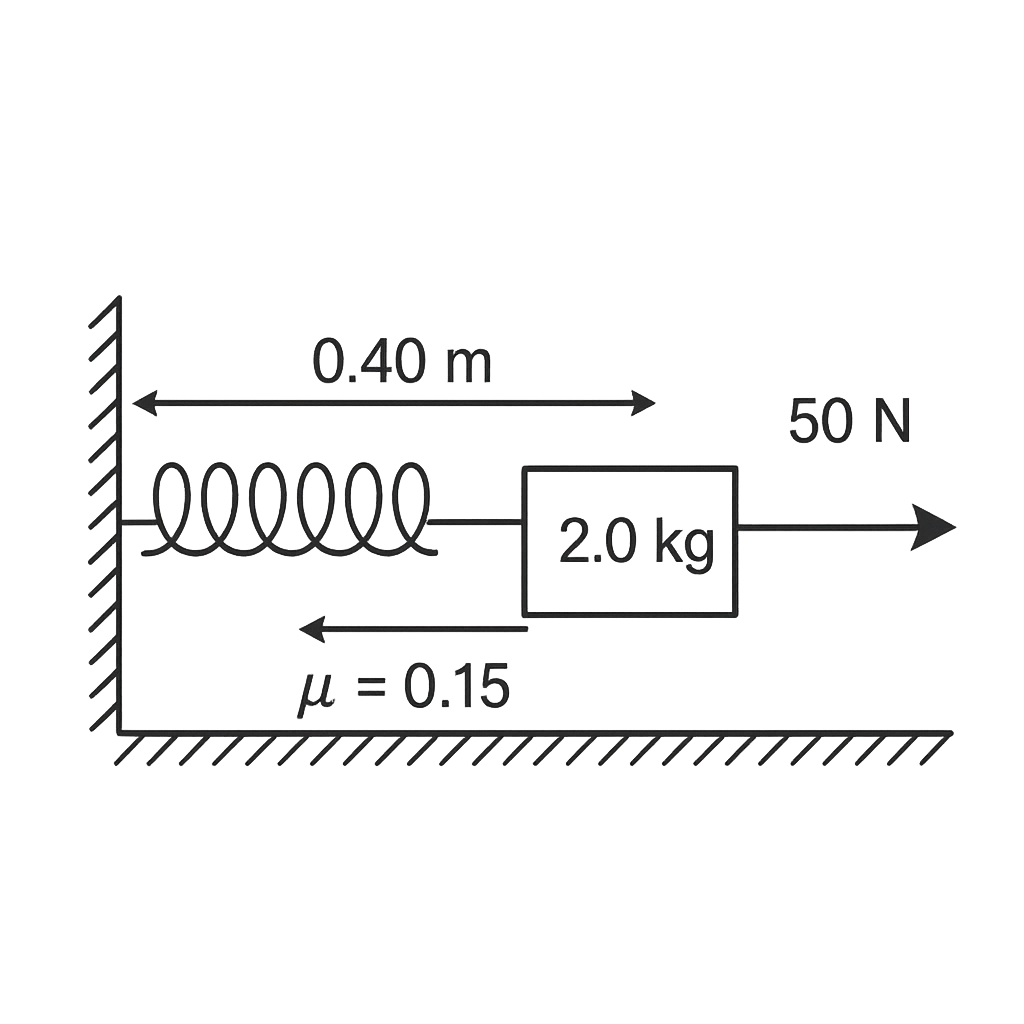
In the diagram, a \(2.0\ \text{kg}\) block rests on a horizontal surface. It is attached to a spring of force constant \(k = 150\ \text{N m}^{-1}\) fixed to a wall on its left. A constant horizontal pulling force of \(50\ \text{N}\) acts to the right on the block. The coefficient of kinetic friction between the block and the surface is \(0.15\). The block is pulled so that the spring is stretched by \(0.40\ \text{m}\) from its unstretched length. (i) Find the work done by the pulling force. (ii) Determine the increase in the block's kinetic energy after the displacement.
Correct A. Work by pull = 20 J; increase in kinetic energy ≈ 6.8 J
B. Work by pull = 30 J; increase in kinetic energy ≈ 8.5 J
C. Work by pull = 10 J; increase in kinetic energy ≈ 5.0 J
D. Work by pull = 25 J; increase in kinetic energy ≈ 12.0 J

Correct Answer: A

Want to see the full step-by-step solution? Unlock AI Explanation & Analytics
Question 10 View Details
A rectangular plate of area \(0.20\ \text{m}^{2}\) is placed at the bottom of a tank that contains two immiscible liquids. The top layer is oil of density \(800\ \text{kg m}^{-3}\) and thickness \(0.50\ \text{m}\). Beneath it lies water of density \(1000\ \text{kg m}^{-3}\) and thickness \(1.20\ \text{m}\). Atmospheric pressure is \(1.01\times10^{5}\ \text{Pa}\). Calculate the total force exerted on the plate by the fluids.
A. 2.80×10^4 N
B. 2.10×10^4 N
C. 2.55×10^4 N
Correct D. 2.33×10^4 N

Correct Answer: D

Want to see the full step-by-step solution? Unlock AI Explanation & Analytics
Question 11 View Details
A metal block of unknown mass \(m\) (in kg) has a specific heat capacity of \(0.385\ \text{kJ·kg}^{-1}\text{K}^{-1}\). The block is heated to \(150^{\circ}\text{C}\) and then placed into \(0.5\ \text{kg}\) of water at \(20^{\circ}\text{C}\) (specific heat capacity \(4.18\ \text{kJ·kg}^{-1}\text{K}^{-1}\)) in an insulated container. After thermal equilibrium the temperature of the system is \(30^{\circ}\text{C}\). Assuming no heat loss to the surroundings, determine the mass \(m\) of the metal block (to two decimal places).
A. 0.35 kg
B. 0.65 kg
Correct C. 0.45 kg
D. 0.55 kg

Correct Answer: C

Want to see the full step-by-step solution? Unlock AI Explanation & Analytics
Question 12 View Details
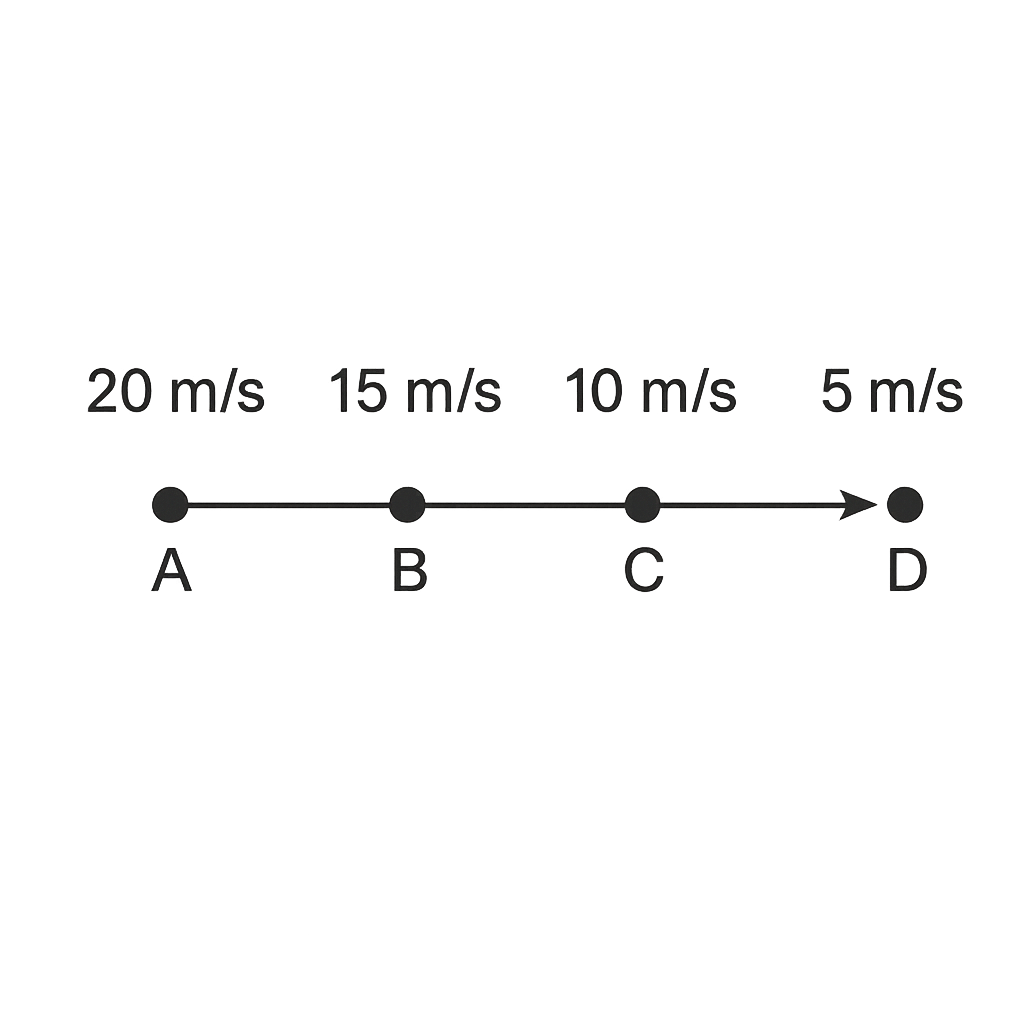
The diagram shows a particle moving in a straight line. At successive one‑second intervals the particle's velocities are \(20\ \text{m·s}^{-1}\), \(15\ \text{m·s}^{-1}\), \(10\ \text{m·s}^{-1}\) and \(5\ \text{m·s}^{-1}\) to the right. Using this motion diagram, calculate the magnitude of the particle's constant acceleration.
A. 4 m·s⁻²
B. 6 m·s⁻²
Correct C. 5 m·s⁻²
D. 10 m·s⁻²

Correct Answer: C

Want to see the full step-by-step solution? Unlock AI Explanation & Analytics
Question 13 View Details
When a resistor \(R\) is connected to a battery, the current measured is \(2\ \text{A}\) when \(R = 4\ \Omega\) and \(1\ \text{A}\) when \(R = 9\ \Omega\). Assuming the battery has an emf \(E\) and an internal resistance \(r\), (a) find the values of \(E\) and \(r\); (b) what external resistance would give the maximum power delivered to the external circuit, and what is that maximum power?
A. E = 10 V; r = 2 Ω; external resistance for maximum power = 2 Ω; maximum power = 20 W
B. E = 12 V; r = 2 Ω; external resistance for maximum power = 2 Ω; maximum power = 18 W
C. E = 8 V; r = 0.5 Ω; external resistance for maximum power = 0.5 Ω; maximum power = 16 W
Correct D. E = 10 V; r = 1 Ω; external resistance for maximum power = 1 Ω; maximum power = 25 W

Correct Answer: D

Want to see the full step-by-step solution? Unlock AI Explanation & Analytics
Question 14 View Details
A 12 V battery has an internal resistance of \(0.5\ \Omega\). It is connected to a network where a \(2\ \Omega\) resistor \(R_1\) is in series with a parallel combination of a \(6\ \Omega\) resistor \(R_2\) and a \(3\ \Omega\) resistor \(R_3\). (a) Determine the total current supplied by the battery and the potential difference across \(R_2\). (b) If \(R_3\) is removed, what is the new total current supplied by the battery?
Correct A. Total current = 8/3 A (≈2.67 A); V_R2 = 16/3 V (≈5.33 V); New total current = 24/17 A (≈1.41 A)
B. Total current = 7/3 A (≈2.33 A); V_R2 = 14/3 V (≈4.67 V); New total current = 20/17 A (≈1.18 A)
C. Total current = 8/3 A (≈2.67 A); V_R2 = 15/3 V (≈5.00 V); New total current = 24/15 A (≈1.60 A)
D. Total current = 3 A (≈3.00 A); V_R2 = 5 V (≈5.00 V); New total current = 2 A (≈2.00 A)

Correct Answer: A

Want to see the full step-by-step solution? Unlock AI Explanation & Analytics
Question 15 View Details
A metal rod of length \(1.00\ \text{m}\) at \(20^{\circ}\text{C}\) expands to \(1.0025\ \text{m}\) when heated to \(120^{\circ}\text{C}\). The rod forms the capillary of a liquid‑in‑glass thermometer, and the rise of the liquid column is directly proportional to the change in length of the capillary. The thermometer shows a rise of \(5.0\ \text{cm}\) for the temperature change from \(20^{\circ}\text{C}\) to \(120^{\circ}\text{C}\). (a) Calculate the coefficient of linear expansion \(\alpha\) of the metal (in \(\text{°C}^{-1}\)). (b) Predict the rise of the liquid column when the temperature is increased from \(20^{\circ}\text{C}\) to \(200^{\circ}\text{C}\).
Correct A. α = 2.5×10⁻⁵ °C⁻¹; rise = 9.0 cm
B. α = 2.0×10⁻⁵ °C⁻¹; rise = 7.5 cm
C. α = 3.0×10⁻⁵ °C⁻¹; rise = 10.5 cm
D. α = 2.5×10⁻⁴ °C⁻¹; rise = 9.0 cm

Correct Answer: A

Want to see the full step-by-step solution? Unlock AI Explanation & Analytics
Question 16 View Details
A sealed rigid container initially holds \(0.500\ \text{mol}\) of an ideal gas at a pressure of \(2.00\ \text{atm}\) and a temperature of \(300\ \text{K}\). The container is heated to \(450\ \text{K}\). To keep the pressure from exceeding \(2.00\ \text{atm}\), a valve is opened and gas escapes until the pressure stabilises at exactly \(2.00\ \text{atm}\) while the temperature remains at \(450\ \text{K}\). Assuming the volume of the container does not change, how many moles of gas escaped?
A. 0.250 mol
Correct B. 0.167 mol
C. 0.333 mol
D. 0.083 mol

Correct Answer: B

Want to see the full step-by-step solution? Unlock AI Explanation & Analytics
Question 17 View Details
A glass tube of uniform cross‑section is closed at one end and open at the other. The open end is exposed to atmospheric pressure of \(101.3\ \text{kPa}\). The tube contains a column of mercury of height \(0.80\ \text{m}\) supporting a trapped air pocket of volume \(2.0\times10^{-4}\ \text{m}^{3}\) at \(20^{\circ}\text{C}\). The trapped air is heated to \(80^{\circ}\text{C}\), causing the mercury level to fall by \(0.12\ \text{m}\). Assuming the density of mercury is \(13\,600\ \text{kg m}^{-3}\) and neglecting the volume change of the mercury, determine the final pressure of the trapped air (in kPa).
A. 210 kPa
Correct B. 192 kPa
C. 200 kPa
D. 180 kPa

Correct Answer: B

Want to see the full step-by-step solution? Unlock AI Explanation & Analytics
Question 18 View Details
A hydrogen atom in its first excited state (\(n=2\)) absorbs a photon and is promoted to the \(n=4\) level. It then returns to the ground state (\(n=1\)) by either (i) a direct transition \(4\rightarrow1\) or (ii) a cascade of three transitions \(4\rightarrow3\), \(3\rightarrow2\), and \(2\rightarrow1\). Assuming the atom is initially at rest, calculate the difference in recoil kinetic energy of the atom between the two decay routes. Use the hydrogen energy formula \(E_n = -\dfrac{13.6\ \text{eV}}{n^{2}}\) and the atomic mass of hydrogen \(m_{\text{H}} = 1.6735\times10^{-27}\ \text{kg}\). Give your answer in joules (expressed in scientific notation to two significant figures).
A. 4.6×10⁻²⁶ J
B. 3.2×10⁻²⁷ J
C. 5.1×10⁻²⁶ J
Correct D. 4.6×10⁻²⁷ J

Correct Answer: D

Want to see the full step-by-step solution? Unlock AI Explanation & Analytics
Question 19 View Details
A car travels at a constant speed of \(72\ \text{km h}^{-1}\) for \(2\ \text{min}\ 30\ \text{s}\). Calculate the distance covered in metres.
Correct A. 3000 m
B. 7200 m
C. 2500 m
D. 3600 m

Correct Answer: A

Want to see the full step-by-step solution? Unlock AI Explanation & Analytics
Question 20 View Details
\(150\ \text{g}\) of water at \(80^{\circ}\text{C}\) is mixed with a \(200\ \text{g}\) aluminum block at \(25^{\circ}\text{C}\). The specific heat capacities are \(c_{\text{water}} = 4.18\ \text{J g}^{-1}\text{K}^{-1}\) and \(c_{\text{Al}} = 0.900\ \text{J g}^{-1}\text{K}^{-1}\). Assuming no heat loss to the surroundings, determine the final equilibrium temperature of the mixture (in \(^\circ\text{C}\)).
Correct A. 68 °C
B. 60 °C
C. 70 °C
D. 65 °C

Correct Answer: A

Want to see the full step-by-step solution? Unlock AI Explanation & Analytics
Question 21 View Details
A rectangular coil of 50 turns has dimensions 0.20 m by 0.10 m and is placed in a uniform magnetic field of 0.5 T perpendicular to the plane of the coil. The coil is pulled out of the field so that the area within the field decreases uniformly to zero in 0.40 s. The coil has an internal resistance of 2 Ω and is connected across an external resistor of 10 Ω. (a) Determine the average induced emf in the coil during the motion. (b) Find the current flowing in the circuit and the power dissipated in the external resistor. (c) Calculate the total electrical energy converted into heat and the mechanical work that must be done against the magnetic drag.
Correct A. Average emf = 1.25 V; I = 0.104 A; Power in external resistor = 0.109 W (energy 0.043 J); Total electrical energy = 0.052 J, which equals the mechanical work required.
B. Average emf = 0.90 V; I = 0.075 A; Power in external resistor = 0.056 W (energy 0.022 J); Total electrical energy = 0.030 J, which equals the mechanical work required.
C. Average emf = 1.50 V; I = 0.125 A; Power in external resistor = 0.156 W (energy 0.062 J); Total electrical energy = 0.070 J, which equals the mechanical work required.
D. Average emf = 1.00 V; I = 0.083 A; Power in external resistor = 0.083 W (energy 0.033 J); Total electrical energy = 0.040 J, which equals the mechanical work required.

Correct Answer: A

Want to see the full step-by-step solution? Unlock AI Explanation & Analytics
Question 22 View Details
A block of mass 20 kg is lifted vertically by a rope that passes over a fixed solid‑cylinder pulley of radius 0.15 m and mass 2 kg. The axle of the pulley has a constant friction torque of 0.5 N·m. The rope is attached to a motor that exerts a constant tension \(T\) on the rope. The block starts from rest and reaches a speed of 2.0 m s⁻¹ in 4.0 s. Assuming the rope does not slip, determine the minimum tension \(T\) that the motor must supply.
A. Approximately 1.5×10² N (≈150 N).
B. Approximately 2.5×10² N (≈250 N).
C. Approximately 1.8×10² N (≈180 N).
Correct D. Approximately 2.0×10² N (≈199.8 N).

Correct Answer: D

Want to see the full step-by-step solution? Unlock AI Explanation & Analytics
Question 23 View Details
Two loudspeakers \(S_{1}\) and \(S_{2}\) emit sound of frequencies 512 Hz and 520 Hz respectively. They are 3.0 m apart and the speed of sound in air is 340 m s⁻¹. A listener stands at a point \(P\) on the line joining the speakers such that the path difference between the waves from \(S_{1}\) and \(S_{2}\) at \(P\) equals half the wavelength of the 512 Hz sound. (a) Find the beat frequency heard at \(P\). (b) State whether the 512 Hz component at \(P\) is at a maximum or a minimum of intensity.
A. Beat frequency = 4 Hz; the 512 Hz component is at a minimum of intensity.
Correct B. Beat frequency = 8 Hz; the 512 Hz component is at a minimum of intensity.
C. Beat frequency = 12 Hz; the 512 Hz component is at a minimum of intensity.
D. Beat frequency = 8 Hz; the 512 Hz component is at a maximum of intensity.

Correct Answer: B

Want to see the full step-by-step solution? Unlock AI Explanation & Analytics
Question 24 View Details
A point charge +8 µC is fixed at the origin O. A second point charge -2 µC is fixed on the positive y‑axis at \(y = 0.12\) m. (a) Find the position on the y‑axis where the net electric field is zero. (b) Determine the electric potential at that point, taking the potential to be zero at infinity. (c) Calculate the work required to bring a test charge +1 µC from infinity to that point.
A. Zero‑field point at y = 0.24 m; potential = 1.5×10⁵ V; work required = 0.20 J.
B. Zero‑field point at y = 0.12 m; potential = 1.5×10⁵ V; work required = 0.15 J.
C. Zero‑field point at y = 0.24 m; potential = 2.0×10⁵ V; work required = 0.15 J.
Correct D. Zero‑field point at y = 0.24 m; potential = 1.5×10⁵ V; work required = 0.15 J.

Correct Answer: D

Want to see the full step-by-step solution? Unlock AI Explanation & Analytics
Question 25 View Details
A train moving towards a stationary observer at 30 m s⁻¹ sounds its horn at a frequency of 500 Hz. The observer is 200 m from the point where the train will pass directly in front of him. At the instant when the train is 100 m away (still approaching), a vertical wall located 150 m beyond the observer reflects the sound back toward the observer. Taking the speed of sound as 340 m s⁻¹, determine the frequency of the reflected sound heard by the observer at that instant.
A. Approximately 658 Hz.
B. Approximately 540 Hz.
C. Approximately 720 Hz.
Correct D. Approximately 602 Hz.

Correct Answer: D

Want to see the full step-by-step solution? Unlock AI Explanation & Analytics

Master the Exam!

You've seen a preview, but there are thousands more questions plus AI tutor to break down complex solutions.

Unlock Full Access Available for Android & Windows
Help others prepare! Share this practice hub:
Chat with Support