neco model questions vol1 2021 geography | Objective

Prepare for your exams with neco model questions vol1 questions? Reviewing past/model questions is one of the most effective ways to guarantee a high score. This practice hub features authentic 2021 geography (Objective) questions designed to simulate the real exam environment.

Practice these randomly selected questions to test your readiness.

Question 1 View Details
An electronics manufacturing firm is evaluating three possible sites for a new plant. The plant will produce 10,000 units per year, each unit requiring 2 kWh of electricity. The annual electricity consumption is therefore 20,000 kWh. Transport cost is ₦0.05 per unit per kilometre. The firm needs 5 ha of land. The data for each site are: - Site X: land cost ₦1,200,000 per ha; distance to raw‑material source 80 km; distance to main market 150 km; electricity cost ₦15 per kWh. - Site Y: land cost ₦1,000,000 per ha; distance to raw‑material source 120 km; distance to main market 100 km; electricity cost ₦13 per kWh. - Site Z: land cost ₦1,100,000 per ha; distance to raw‑material source 60 km; distance to main market 200 km; electricity cost ₦14 per kWh. Assuming all costs are incurred annually, calculate the total annual cost for each site and state which site the firm should choose to minimise cost.
Correct A. Site Y
B. Site X
C. Site Z
D. Site W

Correct Answer: A

Want to see the full step-by-step solution? Unlock AI Explanation & Analytics
Question 2 View Details
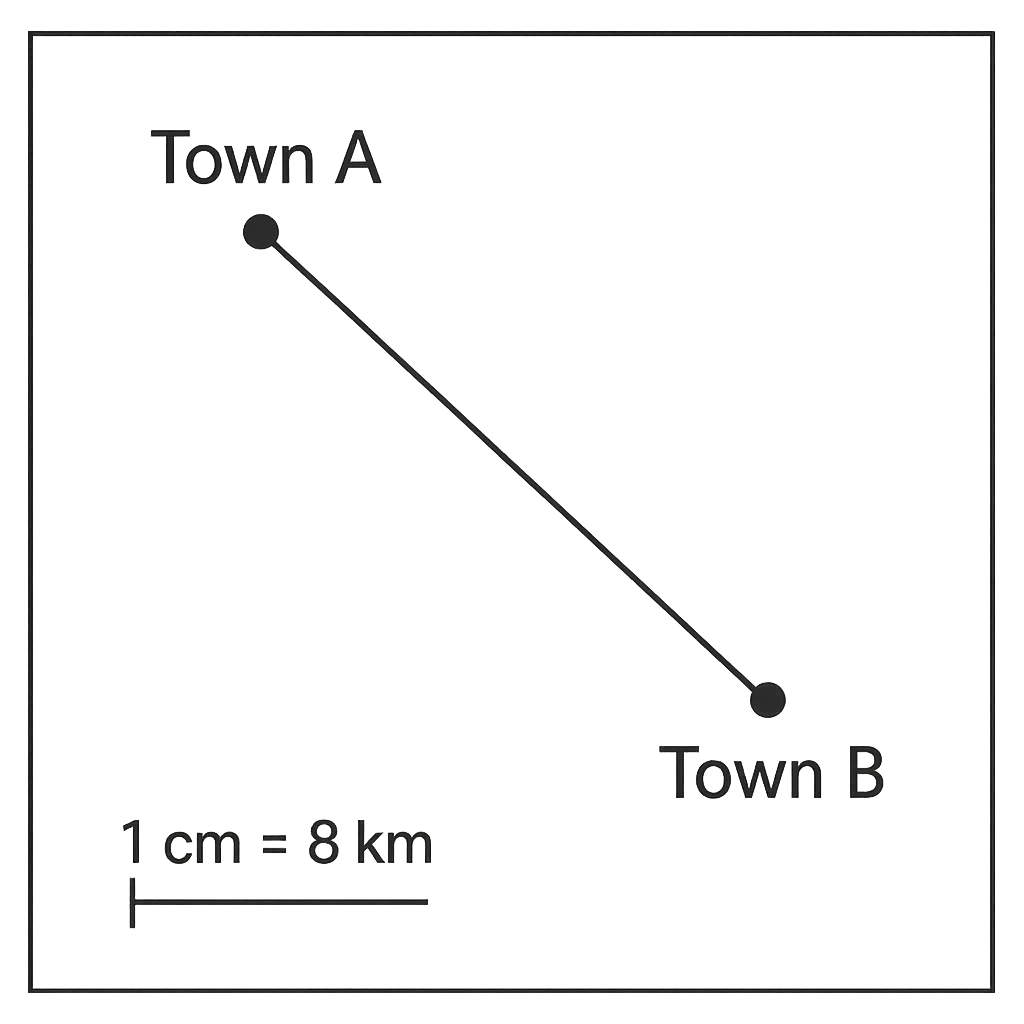
On a map the distance between Town A and Town B is measured as 4.5 cm. The map scale is 1 cm : 8 km. What is the actual distance between the two towns in kilometres?
A. 40
B. 30
Correct C. 36
D. 45

Correct Answer: C

Want to see the full step-by-step solution? Unlock AI Explanation & Analytics
Question 3 View Details
Town L had a population of 120,000 in 2010. The natural increase (births minus deaths) rate was constant at 2.5 % per year. By 2015 the population was recorded as 138,000. (a) Assuming the natural increase rate remained unchanged, determine the average annual net migration rate (as a percentage of the 2010 population) over the 2010‑2015 period. (b) If the same natural increase rate and the derived net migration rate continue, estimate the population of Town L in 2020.
A. a) 0.25% per year; b) 155,000 (approx)
Correct B. a) 0.37% per year; b) 159,000 (approx)
C. a) 0.45% per year; b) 162,000 (approx)
D. a) 0.60% per year; b) 170,000 (approx)

Correct Answer: B

Want to see the full step-by-step solution? Unlock AI Explanation & Analytics
Question 4 View Details
The settlement of X is roughly square with a measured perimeter of 20 km and a current population of 1,200. A new housing development will add 30,000 people but will not change the settlement's area. (a) Calculate the settlement's area and its population density (people per km²). Classify the settlement as a village, town or city using the criteria: village < 500 people/km², town 500-2,500 people/km², city > 2,500 people/km². (b) After the housing development, recalculate the population density and give the new classification.
A. a) Area = 25 km², density = 48 people/km² → village; b) New density = 1,248 people/km² → city
B. a) Area = 20 km², density = 60 people/km² → village; b) New density = 1,500 people/km² → city
Correct C. a) Area = 25 km², density = 48 people/km² → village; b) New density = 1,248 people/km² → town
D. a) Area = 25 km², density = 48 people/km² → village; b) New density = 1,200 people/km² → town

Correct Answer: C

Want to see the full step-by-step solution? Unlock AI Explanation & Analytics
Question 5 View Details
The region of Kogi lies at latitude \(7^{\circ}\) N and an altitude of 1,200 m. Its average annual rainfall is 1,200 mm and the mean temperature is \(22^{\circ}\)C. The dominant soil type is lateritic. Using the following agro‑ecological zone criteria, identify the zone in which Kogi belongs: - Lowland forest: altitude < 500 m, rainfall > 1,500 mm. - Montane forest: altitude > 1,500 m, rainfall > 1,200 mm. - Savannah: rainfall 800-1,200 mm, temperature 20-30 °C, altitude ≤ 1,500 m. - Sahel: rainfall < 800 mm, temperature > 30 °C. (For additional insight, the effective moisture index is defined as \(\text{EMI}=\text{rainfall}-10\times\text{temperature}\). An EMI > 800 mm supports savannah, while EMI > 1,200 mm supports forest.) State the agro‑ecological zone and justify your choice.
A. Sahel
B. Montane forest
Correct C. Savannah
D. Lowland forest

Correct Answer: C

Want to see the full step-by-step solution? Unlock AI Explanation & Analytics
Question 6 View Details
Town X has a population of \(78{,}000\) and covers an area of \(12\ \text{km}^2\). Town Y has a population of \(62{,}000\) and covers an area of \(8\ \text{km}^2\). The distance from Town X to the nearest river is \(4\) km, while Town Y is \(3\) km from the nearest river. Town X possesses a hospital and a market; Town Y possesses a secondary school only. A primary settlement is defined as meeting at least three of the following four criteria: (i) population > \(70{,}000\), (ii) population density > \(5{,}000\) persons per \(\text{km}^2\), (iii) distance to river ≤ \(5\) km, (iv) at least two of the three services: hospital, secondary school, market. Which town qualifies as a primary settlement?
A. Town Z
B. Town Y
Correct C. Town X
D. Town W

Correct Answer: C

Want to see the full step-by-step solution? Unlock AI Explanation & Analytics
Question 7 View Details
Town A is located at \(5^{\circ}30'\) N, \(7^{\circ}45'\) E. Town B is located at \(2^{\circ}15'\) S, \(8^{\circ}20'\) E. A north‑south river follows the meridian \(8^{\circ}00'\) E. Using the Earth's radius \(R = 6371\) km, calculate the shortest ground distance from each town to the river (assume the Earth is a sphere) and state which town is nearer to the river.
A. Town C
B. Town B
Correct C. Town A
D. Town D

Correct Answer: C

Want to see the full step-by-step solution? Unlock AI Explanation & Analytics
Question 8 View Details
Station X at latitude \(5^{\circ}00'\) N, longitude \(5^{\circ}00'\) E records an atmospheric pressure of \(1012\) hPa. Station Y at the same latitude \(5^{\circ}00'\) N but longitude \(6^{\circ}00'\) E records \(1004\) hPa. Assuming wind blows from higher to lower pressure and using the empirical relation \(V = 20\sqrt{\dfrac{\Delta P}{\Delta d}}\) where \(V\) is wind speed in km h\(^{-1}\), \(\Delta P\) is the pressure difference in hPa and \(\Delta d\) is the straight‑line distance between the stations in km, determine the wind speed and its direction.
Correct A. Approximately 5.4 km h^{-1} towards the east
B. Approximately 5.4 km h^{-1} towards the west
C. Approximately 4.2 km h^{-1} towards the east
D. Approximately 6.1 km h^{-1} towards the east

Correct Answer: A

Want to see the full step-by-step solution? Unlock AI Explanation & Analytics
Question 9 View Details
On a map the scale is \(1\text{ cm} : 5\text{ km}\). The distance between Town M and Town N measures \(7.2\) cm on a map that has been enlarged by a factor of \(1.5\). What is the actual ground distance between the two towns in kilometres?
Correct A. 24
B. 21
C. 27
D. 30

Correct Answer: A

Want to see the full step-by-step solution? Unlock AI Explanation & Analytics
Question 10 View Details
Three settlements are being evaluated for classification as a regional centre. - Settlement A: population \(115{,}000\); area \(30\ \text{km}^2\); services - university, regional hospital, market; located \(25\) km from the nearest major highway; hosts the district headquarters. - Settlement B: population \(98{,}000\); area \(20\ \text{km}^2\); services - airport, secondary school, market; located \(10\) km from the nearest major highway; no administrative office. - Settlement C: population \(130{,}000\); area \(45\ \text{km}^2\); services - university, airport, market, industrial zone; located \(15\) km from the nearest major highway; hosts a regional administrative office. A settlement qualifies as a regional centre if it satisfies all of the following: (i) population ≥ \(120{,}000\), (ii) possesses at least two of the three key services (university, airport, major market), (iii) lies within \(20\) km of a major highway, and (iv) contains a regional administrative office. Which settlement meets the criteria?
Correct A. Settlement C
B. Settlement A
C. Settlement D
D. Settlement B

Correct Answer: A

Want to see the full step-by-step solution? Unlock AI Explanation & Analytics
Question 11 View Details
A farmer wants to increase his crop yield by exactly 12 % over the baseline. He can use Fertilizer A, which costs ₦200 per bag and raises yield by 15 % per bag, and Fertilizer B, which costs ₦150 per bag and raises yield by 10 % per bag. If the total amount spent on fertilizer is ₦850, how many bags of each type must he purchase? Give your answer as "(a) bags of A and (b) bags of B".
Correct A. 2 bags of A and 3 bags of B
B. 4 bags of A and 1 bag of B
C. 1 bags of A and 4 bags of B
D. 3 bags of A and 2 bags of B

Correct Answer: A

Want to see the full step-by-step solution? Unlock AI Explanation & Analytics
Question 12 View Details
A bus travels a total distance of 240 km from City X to City Y. It covers the first 120 km at a constant speed of \(v\) km h\(^{-1}\), then stops for 30 minutes, and covers the remaining 120 km at a speed of \(v+20\) km h\(^{-1}\). The scheduled travel time, assuming a constant speed of 80 km h\(^{-1}\) with no stop, is 3 hours. In reality the bus arrives 10 minutes earlier than the scheduled time. Determine the value of \(v\) (in km h\(^{-1}\)), rounded to the nearest whole number.
A. 78
B. 88
Correct C. 94
D. 100

Correct Answer: C

Want to see the full step-by-step solution? Unlock AI Explanation & Analytics
Question 13 View Details
In a forest plot the measured basal area is 30 m\(^2\) per hectare. If the average diameter at breast height (DBH) of the trees in the plot is 30 cm, estimate the number of trees per hectare. Use the formula \(BA = \frac{\pi}{4} N d^{2}\), where \(d\) is in metres. Give your answer rounded to the nearest whole tree.
A. 460
B. 500
Correct C. 424
D. 380

Correct Answer: C

Want to see the full step-by-step solution? Unlock AI Explanation & Analytics
Question 14 View Details
The air temperature at 2 pm is 30 °C and the dew‑point temperature is 20 °C. Using the approximation \(e_{s}=6.11\times10^{\frac{7.5T}{237.3+T}}\) (hPa) for saturation vapour pressure, calculate the relative humidity (RH) to the nearest percent. Express your answer as a whole number percentage.
A. 65
B. 45
C. 75
Correct D. 55

Correct Answer: D

Want to see the full step-by-step solution? Unlock AI Explanation & Analytics
Question 15 View Details
A two‑lane road has a free‑flow speed of 80 km h\(^{-1}\) and a lane capacity of 1800 passenger cars per hour under free‑flow conditions. During the peak hour the observed flow is 2600 cars per hour and the average speed drops to 45 km h\(^{-1}\). Assuming the linear speed‑flow relationship \(v = v_{f}\bigl(1 - q/q_{\max}\bigr)\), where \(v_{f}\) is the free‑flow speed and \(q_{\max}\) is the theoretical maximum flow, determine \(q_{\max}\) (rounded to the nearest whole car per hour) and state the level of service (LOS) using the following criteria: LOS A if the observed flow / \(q_{\max}\) ≤ 0.6, LOS B if > 0.6 and ≤ 0.8, LOS C if > 0.8 and ≤ 1.0, LOS D if > 1.0.
A. approximately 5200 cars per hour; LOS B
Correct B. approximately 5940 cars per hour; LOS A
C. approximately 4800 cars per hour; LOS A
D. approximately 6600 cars per hour; LOS C

Correct Answer: B

Want to see the full step-by-step solution? Unlock AI Explanation & Analytics
Question 16 View Details
A soil sample is analysed and the ratio of sand to silt is \(3:2\). The combined percentage of sand and clay in the sample is \(70\%\). Assuming the three components (sand, silt, clay) sum to \(100\%\), determine the percentage of clay in the sample and state whether the soil would be classified as loam (loam requires sand \(40\%-60\%\) and clay \(20\%-30\%\)).
A. Clay = 25 % and the soil is not classified as loam.
B. Clay = 20 % and the soil is classified as loam.
C. Clay = 30 % and the soil is classified as loam.
Correct D. Clay = 25 % and the soil is classified as loam.

Correct Answer: D

Want to see the full step-by-step solution? Unlock AI Explanation & Analytics
Question 17 View Details
A chemical plant stores a hazardous material. The probability of an accidental release in a year is \(0.02\). If a release occurs, the expected number of persons affected is given by \(E = k d^{2}\) where \(k = 0.5\) persons km\(^{-2}\) and \(d\) is the distance (km) from the plant to the nearest settlement. The nearest settlement is \(4\) km away. The plant installs a mitigation system that reduces the probability of release by \(30\%\) but increases the effective distance to the settlement by \(20\%\) because of enhanced dispersion. Calculate the new expected annual number of affected persons after mitigation and state whether the annual risk (expected persons) has increased or decreased compared with the original situation.
A. New annual expected persons ≈ 0.180 (persons per year), which is slightly higher than the original 0.160; therefore the risk has increased.
B. New annual expected persons ≈ 0.150 (persons per year), which is slightly lower than the original 0.160; therefore the risk has decreased.
Correct C. New annual expected persons ≈ 0.161 (persons per year), which is slightly higher than the original 0.160; therefore the risk has increased.
D. New annual expected persons ≈ 0.161 (persons per year), which is the same as the original 0.160; therefore the risk has not changed.

Correct Answer: C

Want to see the full step-by-step solution? Unlock AI Explanation & Analytics
Question 18 View Details
A tile factory has the production function \(Q = 20 L^{0.5} K^{0.5}\), where \(Q\) is the number of tiles produced per week, \(L\) is labour hours per week and \(K\) is the number of capital units (machines). Labour costs ₦150 per hour and each capital unit costs ₦2000 per week (depreciated). Tiles sell for ₦500 each. \n\n(a) Determine the combination of \(L\) and \(K\) that yields at least \(2000\) tiles per week at minimum total cost, and compute that minimum weekly cost. \n\n(b) If the wage rises to ₦250 per hour while the capital cost remains unchanged, should the firm increase its use of labour or capital to maintain minimum cost? Justify.
A. Minimum cost achieved at \\(L \\approx 400\\) h, \\(K \\approx 25\\) units, cost ≈ ₦112,000. After wage increase, cost‑minimising point shifts to \\(L \\approx 300\\) h, \\(K \\approx 30\\) units, so the firm should use relatively more labour (increase labour, reduce capital).
Correct B. Minimum cost achieved at \(L \approx 365\) h, \(K \approx 27\) units, cost ≈ ₦109,500. After wage increase, cost‑minimising point shifts to \(L \approx 283\) h, \(K \approx 35\) units, so the firm should use relatively more capital (increase capital, reduce labour).
C. Minimum cost achieved at \\(L \\approx 350\\) h, \\(K \\approx 30\\) units, cost ≈ ₦108,000. After wage increase, cost‑minimising point shifts to \\(L \\approx 260\\) h, \\(K \\approx 38\\) units, so the firm should keep the same mix of inputs.
D. Minimum cost achieved at \\(L \\approx 380\\) h, \\(K \\approx 22\\) units, cost ≈ ₦110,500. After wage increase, cost‑minimising point shifts to \\(L \\approx 320\\) h, \\(K \\approx 28\\) units, so the firm should use relatively more capital (increase capital, reduce labour).

Correct Answer: B

Want to see the full step-by-step solution? Unlock AI Explanation & Analytics
Question 19 View Details
A map has a scale of \(1\) cm : \(2\) km. The straight‑line distance between Town A and Town B on the map measures \(7.5\) cm. What is the actual distance between the towns in kilometres? The line joining the towns is drawn with a bearing of N \(30^{\circ}\) E. Express this direction as a three‑digit compass bearing.
A. 14 km; bearing 025°.
Correct B. 15 km; bearing 030°.
C. 15 km; bearing 040°.
D. 16 km; bearing 035°.

Correct Answer: B

Want to see the full step-by-step solution? Unlock AI Explanation & Analytics
Question 20 View Details
In a cross‑section of a V‑shaped valley, the valley floor is at an elevation of \(150\) m above sea level. The left‑hand slope rises to a hilltop at \(380\) m elevation, a horizontal distance of \(800\) m from the valley floor. The right‑hand slope rises to a hilltop at \(300\) m elevation, a horizontal distance of \(600\) m from the valley floor. \n\n(a) Calculate the average gradient of each slope expressed as a percentage and as an angle in degrees (to one decimal place). \n\n(b) State which side of the valley is steeper.
Correct A. Left slope: 28.8 % (≈16.0°); Right slope: 25.0 % (≈14.0°). The left side is steeper.
B. Left slope: 30.0 % (≈16.7°); Right slope: 25.0 % (≈14.0°). The left side is steeper.
C. Left slope: 28.8 % (≈16.0°); Right slope: 25.0 % (≈14.0°). The right side is steeper.
D. Left slope: 28.8 % (≈16.0°); Right slope: 22.2 % (≈12.6°). The left side is steeper.

Correct Answer: A

Want to see the full step-by-step solution? Unlock AI Explanation & Analytics
Question 21 View Details
A region at an altitude of \(1600\) m records the following monthly rainfall (in mm): Jan \(120\), Feb \(110\), Mar \(95\), Apr \(80\), May \(70\), Jun \(60\), Jul \(55\), Aug \(60\), Sep \(80\), Oct \(100\), Nov \(130\), Dec \(150\). The mean annual temperature is \(18\) °C. Using the NECO classification criteria for vegetation, which vegetation type is most likely to occur in this region?
A. Savanna woodland
Correct B. Montane grassland
C. Lowland rainforest
D. Alpine heath

Correct Answer: B

Want to see the full step-by-step solution? Unlock AI Explanation & Analytics
Question 22 View Details
A location has the following mean monthly temperatures (°C): Jan \(22\), Feb \(24\), Mar \(26\), Apr \(28\), May \(30\), Jun \(28\), Jul \(26\), Aug \(24\), Sep \(22\), Oct \(20\), Nov \(18\), Dec \(20\). The mean monthly precipitation (mm) are: Jan \(10\), Feb \(20\), Mar \(30\), Apr \(80\), May \(150\), Jun \(200\), Jul \(250\), Aug \(220\), Sep \(120\), Oct \(60\), Nov \(30\), Dec \(15\). Using the Köppen climate classification, determine the climate type of this location.
A. Am
B. Cw
C. Af
Correct D. Aw

Correct Answer: D

Want to see the full step-by-step solution? Unlock AI Explanation & Analytics
Question 23 View Details
Laboratory analysis of a \(500\) g soil sample yields \(320\) g sand, \(120\) g silt and \(60\) g clay. The water‑holding capacities are \(0.05\) cm³ g⁻¹ for sand, \(0.10\) cm³ g⁻¹ for silt and \(0.30\) cm³ g⁻¹ for clay.\n\n(a) Determine the soil texture class according to the USDA triangle.\n(b) Identify which component contributes the greatest volume of water to the sample.
A. a) Silty loam; b) Silt
B. a) Loam; b) Silt
Correct C. a) Sandy loam; b) Clay
D. a) Sandy clay loam; b) Sand

Correct Answer: C

Want to see the full step-by-step solution? Unlock AI Explanation & Analytics
Question 24 View Details
In 2020 a town had a population of \(45\,000\). The crude birth rate was \(28\) per \(1\,000\) population and the crude death rate was \(12\) per \(1\,000\) population. Net migration added \(500\) persons each year. Assuming these rates remain constant, calculate the projected population at the end of 2025 (after 5 years).
A. 52 000
B. 48 750
Correct C. 51 298
D. 50 500

Correct Answer: C

Want to see the full step-by-step solution? Unlock AI Explanation & Analytics
Question 25 View Details
A rock sample consists of \(55\%\) quartz (density \(2.65\ \text{g cm}^{-3}\)), \(30\%\) feldspar (density \(2.56\ \text{g cm}^{-3}\)) and \(15\%\) mica (density \(2.80\ \text{g cm}^{-3}\)).\n\n(a) Calculate the average density of the rock using the weighted‑average method.\n(b) If a \(2000\) kg block of this rock weathers at a rate of \(0.02\%\) of its mass per year, estimate the total mass loss after \(10\) years.
A. a) 2.60 g cm⁻³; b) 8.0 kg
B. a) 2.70 g cm⁻³; b) 2.0 kg
C. a) 2.55 g cm⁻³; b) 6.0 kg
Correct D. a) 2.65 g cm⁻³; b) 4.0 kg

Correct Answer: D

Want to see the full step-by-step solution? Unlock AI Explanation & Analytics

Master the Exam!

You've seen a preview, but there are thousands more questions plus AI tutor to break down complex solutions.

Unlock Full Access Available for Android & Windows
Help others prepare! Share this practice hub:
Chat with Support