neco model questions vol1 2021 chemistry | Objective

Prepare for your exams with neco model questions vol1 questions? Reviewing past/model questions is one of the most effective ways to guarantee a high score. This practice hub features authentic 2021 chemistry (Objective) questions designed to simulate the real exam environment.

Practice these randomly selected questions to test your readiness.

Question 1 View Details
A 0.10 M solution of oxalic acid (\(\mathrm{H_2C_2O_4}\)) is prepared in a 50.0 mL flask. Oxalic acid has \(K_{a1}=5.6\times10^{-2}\) and \(K_{a2}=6.2\times10^{-5}\). Exactly 0.0050 mol of NaOH is added to the solution. Calculate the pH of the resulting solution.
A. 3.05
Correct B. 2.61
C. 2.14
D. 2.97

Correct Answer: B

Want to see the full step-by-step solution? Unlock AI Explanation & Analytics
Question 2 View Details
In a molecule of chloroform (\(\mathrm{CHCl_3}\)), carbon is sp\(^3\) hybridised and adopts a tetrahedral arrangement. Using the electronegativities \(\chi_{\mathrm{C}} = 2.55\), \(\chi_{\mathrm{H}} = 2.20\) and \(\chi_{\mathrm{Cl}} = 3.16\), assume that each bond dipole magnitude is proportional to the electronegativity difference of the two atoms and that all bond lengths are equal. Determine the magnitude of the net molecular dipole moment relative to the magnitude of a single C-Cl bond dipole (expressed as a decimal fraction).
A. 0.41
B. 0.18
C. 0.34
Correct D. 0.26

Correct Answer: D

Want to see the full step-by-step solution? Unlock AI Explanation & Analytics
Question 3 View Details
The vapor pressure of a liquid is 0.40 atm at 300 K and 1.20 atm at 350 K. Assuming the Clausius-Clapeyron equation applies over this temperature range, calculate the enthalpy of vapourisation \(\Delta H_{\text{vap}}\) in kJ mol\(^{-1}\).
A. 12.5 kJ/mol
B. 31.8 kJ/mol
Correct C. 19.2 kJ/mol
D. 25.0 kJ/mol

Correct Answer: C

Want to see the full step-by-step solution? Unlock AI Explanation & Analytics
Question 4 View Details
A buffer is prepared by dissolving 0.250 mol of acetic acid (\(\mathrm{CH_3COOH}\), \(K_a = 1.8\times10^{-5}\)) and 0.150 mol of sodium acetate (\(\mathrm{CH_3COONa}\)) in 1.00 L of water. After the buffer is formed, 0.050 mol of HCl is added. What is the pH of the solution after the addition?
A. 3.85
B. 5.12
C. 4.90
Correct D. 4.27

Correct Answer: D

Want to see the full step-by-step solution? Unlock AI Explanation & Analytics
Question 5 View Details
A mixture contains 10.0 g of cyclohexanol (\(\mathrm{C_6H_{11}OH}\), \(M = 100.16\ \text{g mol}^{-1}\)) and 8.0 g of 2‑methyl‑1‑propanol (\(\mathrm{C_4H_{10}O}\), \(M = 74.12\ \text{g mol}^{-1}\)). The mixture is oxidised with excess potassium dichromate in acidic medium. Secondary alcohols are oxidised to ketones and primary alcohols to carboxylic acids. Assuming an overall isolated‑yield of 85 % for each oxidation, calculate (a) the mass of cyclohexanone formed and (b) the mass of 2‑methylpropanoic acid formed.
Correct A. (a) 8.33 g, (b) 8.08 g
B. (a) 8.82 g, (b) 8.56 g
C. (a) 8.49 g, (b) 6.79 g
D. (a) 9.80 g, (b) 9.51 g

Correct Answer: A

Want to see the full step-by-step solution? Unlock AI Explanation & Analytics
Question 6 View Details
Silver chloride (\(AgCl\)) has a solubility of \(1.33\times10^{-5}\,\text{M}\) in pure water at 25 °C. The same solid is placed in a solution that already contains \(0.010\;\text{M}\) NaCl and \(0.001\;\text{M}\) ammonia (\(NH_3\)). Silver ions form the complex \([Ag(NH_3)_2]^+\) with a formation constant \(\beta_2 = 1.6\times10^{7}\). Assuming the ammonia concentration remains essentially unchanged, calculate the equilibrium concentration of free \(Ag^+\) ions.
A. 9.5×10⁻⁹ M
B. 2.5×10⁻⁷ M
C. 3.2×10⁻⁸ M
Correct D. 1.8×10⁻⁸ M

Correct Answer: D

Want to see the full step-by-step solution? Unlock AI Explanation & Analytics
Question 7 View Details
A galvanic cell is set up with a zinc electrode immersed in 0.10 M ZnSO₄ solution and a copper electrode immersed in a solution that contains only Cu²⁺ ions originating from the dissolution of a Cu-Ni alloy. The measured cell emf at 25 °C is 1.05 V. The standard reduction potentials are \(E^\circ_{\text{Zn}^{2+}/\text{Zn}} = -0.76\;\text{V}\) and \(E^\circ_{\text{Cu}^{2+}/\text{Cu}} = +0.34\;\text{V}\). (a) Determine the concentration of Cu²⁺ ions in the copper half‑cell. (b) If the solution volume is 250 mL and the alloy is 80 % Cu by mass, calculate the mass of alloy that must have dissolved to give this Cu²⁺ concentration. Assume the alloy contains only Cu and Ni.
A. Cu²⁺ concentration = 2.0×10⁻⁴ M; alloy mass ≈ 4.1×10⁻³ g
Correct B. Cu²⁺ concentration = 2.0×10⁻³ M; alloy mass ≈ 4.1×10⁻² g
C. Cu²⁺ concentration = 1.5×10⁻³ M; alloy mass ≈ 3.2×10⁻² g
D. Cu²⁺ concentration = 2.8×10⁻³ M; alloy mass ≈ 5.0×10⁻² g

Correct Answer: B

Want to see the full step-by-step solution? Unlock AI Explanation & Analytics
Question 8 View Details
An element has atomic number 12, forms a divalent cation in aqueous solution, and its most stable oxide is \(MO\). Identify the element and state its group number in the periodic table.
A. Sodium, group 1
Correct B. Magnesium, group 2
C. Calcium, group 2
D. Magnesium, group 1

Correct Answer: B

Want to see the full step-by-step solution? Unlock AI Explanation & Analytics
Question 9 View Details
A hydrocarbon containing only carbon and hydrogen is combusted completely in excess oxygen. The combustion produces 33.0 g of \(CO_2\) and 18.0 g of \(H_2O\). Determine the empirical formula of the hydrocarbon and, assuming it is an alkane, give its molecular formula.
A. C₄H₁₀
B. C₂H₆
Correct C. C₃H₈
D. C₃H₆

Correct Answer: C

Want to see the full step-by-step solution? Unlock AI Explanation & Analytics
Question 10 View Details
A 0.250 M solution of an unknown monoprotic carboxylic acid HA (molar mass ≈ 88 g mol⁻¹) has a measured pH of 3.00 at 25 °C. (a) Calculate the acid dissociation constant \(K_a\). (b) Identify the acid, assuming it belongs to the series of saturated fatty acids \(C_nH_{2n+1}COOH\). (c) The acid was prepared by oxidising the corresponding aldehyde \(C_nH_{2n+1}CHO\); the theoretical yield was 0.250 mol of acid. If the titration of the solution with 0.100 M NaOH required 35.0 mL to reach the equivalence point, determine the percent yield of the preparation.
A. (a) 2.0×10⁻⁶; (b) valeric acid (C₅H₁₀O₂); (c) 14 %
Correct B. (a) 4.0×10⁻⁶; (b) butyric acid (C₄H₈O₂); (c) 1.4 %
C. (a) 1.0×10⁻⁵; (b) caproic acid (C₆H₁₂O₂); (c) 4.2 %
D. (a) 5.0×10⁻⁶; (b) propionic acid (C₃H₆O₂); (c) 0.14 %

Correct Answer: B

Want to see the full step-by-step solution? Unlock AI Explanation & Analytics
Question 11 View Details
Four non‑metals X, Y, Z and W form the oxides \(X_{2}O_{3}\), \(Y_{2}O_{5}\), \(ZO_{2}\) and \(WO_{3}\) respectively. Their standard enthalpies of formation (\(\Delta_{f}H^{\circ}\)) are -800 kJ mol⁻¹ for \(X_{2}O_{3}\), -1200 kJ mol⁻¹ for \(Y_{2}O_{5}\), -400 kJ mol⁻¹ for \(ZO_{2}\) and -950 kJ mol⁻¹ for \(WO_{3}\). The atomic masses are: X = 30 g mol⁻¹, Y = 45 g mol⁻¹, Z = 60 g mol⁻¹ and W = 75 g mol⁻¹. Which oxide releases the greatest amount of heat per gram of oxide formed?
A. ZO2
B. X2O3
C. Y2O5
Correct D. WO3

Correct Answer: D

Want to see the full step-by-step solution? Unlock AI Explanation & Analytics
Question 12 View Details
A galvanic cell is constructed as: Zn|Zn^{2+} (0.010 M) || Cu^{2+} (0.10 M)|Cu. The standard reduction potentials are E^{\circ}(Zn^{2+}/Zn) = -0.76 V and E^{\circ}(Cu^{2+}/Cu) = +0.34 V. Calculate the cell potential at 25 °C.
A. 1.02 V
Correct B. 1.13 V
C. 1.45 V
D. 0.58 V

Correct Answer: B

Want to see the full step-by-step solution? Unlock AI Explanation & Analytics
Question 13 View Details
A buffer solution is prepared by dissolving 0.20 mol of acetic acid (Ka = 1.8 × 10⁻⁵) and 0.15 mol of sodium acetate in enough water to make 1.00 L of solution. What volume of 0.10 M HCl must be added to lower the pH of the buffer to 4.00? Assume the volume change on addition is negligible.
A. 1.10 L
B. 0.45 L
Correct C. 0.97 L
D. 0.85 L

Correct Answer: C

Want to see the full step-by-step solution? Unlock AI Explanation & Analytics
Question 14 View Details
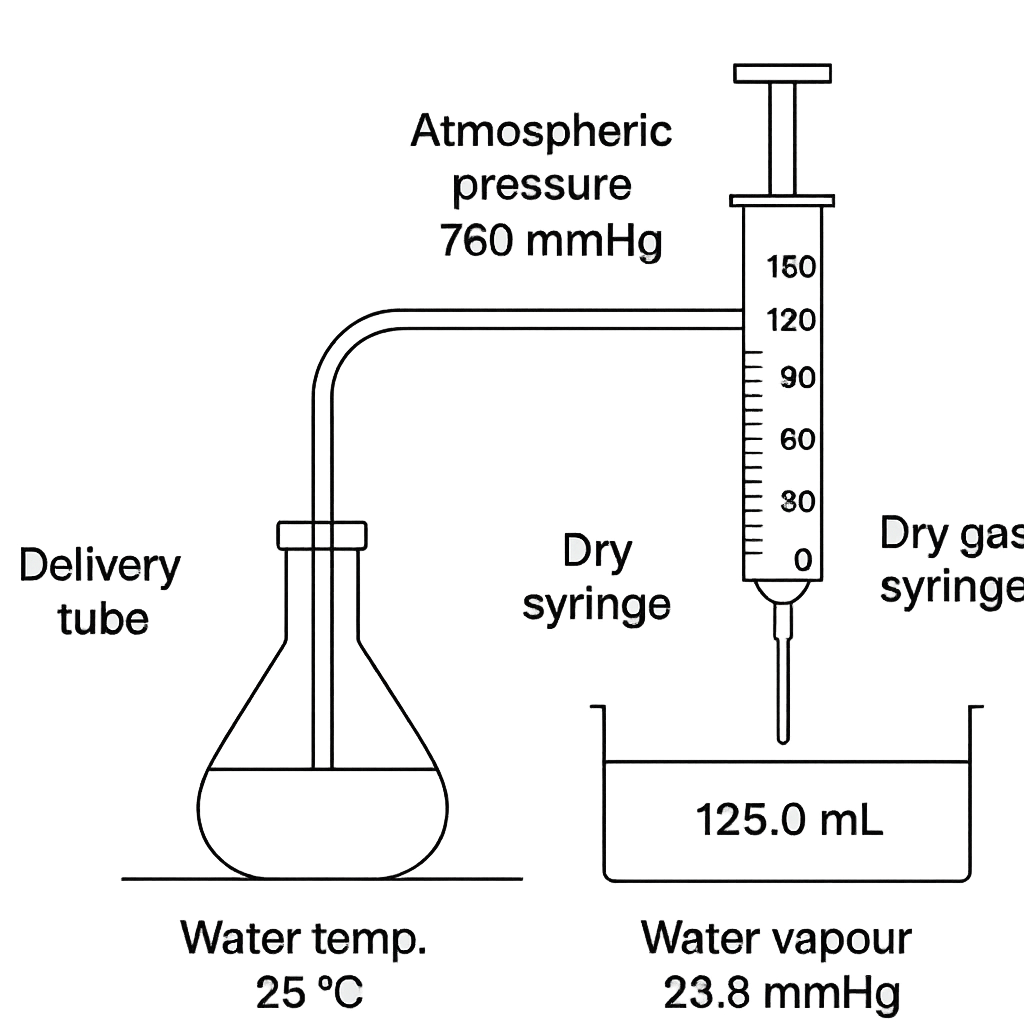
In the apparatus shown, hydrogen gas is collected over water at 25 °C. The dry gas syringe reads a volume of 125.0 mL. The atmospheric pressure is 760 mm Hg and the vapor pressure of water at 25 °C is 23.8 mm Hg. Calculate the number of moles of hydrogen collected.
A. 5.12×10⁻³ mol
Correct B. 4.96×10⁻³ mol
C. 5.00×10⁻³ mol
D. 4.20×10⁻³ mol

Correct Answer: B

Want to see the full step-by-step solution? Unlock AI Explanation & Analytics
Question 15 View Details
Four hydrogen halides have the following H-X bond dissociation energies: HF = 567 kJ mol⁻¹, HCl = 432 kJ mol⁻¹, HBr = 366 kJ mol⁻¹, HI = 299 kJ mol⁻¹. Their corresponding alkali‑metal halides have lattice energies: LiF = -1036 kJ mol⁻¹, LiCl = -828 kJ mol⁻¹, LiBr = -734 kJ mol⁻¹, LiI = -656 kJ mol⁻¹. Considering both the H-X bond strength and the polarity of the H-X bond (which increases with the electronegativity difference between H and X), which hydride would be the most suitable as a non‑aqueous acid in organic synthesis? Justify your choice.
A. HI
Correct B. HCl
C. HF
D. HBr

Correct Answer: B

Want to see the full step-by-step solution? Unlock AI Explanation & Analytics
Question 16 View Details
A 25.0 mL sample of an aqueous solution contains a mixture of Fe^{2+} and Fe^{3+} ions. When titrated with 0.0200 M KMnO_{4} in acidic medium, 18.5 mL of the permanganate solution is required to reduce all Fe^{2+} to Fe^{3+}. The total mass of iron (as elemental Fe) present in the 25.0 mL sample is 0.112 g. Determine the mass of Fe^{2+} present in the sample.
A. 0.080 g
B. 0.120 g
C. 0.095 g
Correct D. 0.103 g

Correct Answer: D

Want to see the full step-by-step solution? Unlock AI Explanation & Analytics
Question 17 View Details
A 10.0 g solid mixture of sodium carbonate (Na_{2}CO_{3}) and sodium bicarbonate (NaHCO_{3}) is heated strongly. After heating, the mass of the solid residue is 7.5 g. Assuming that only carbon dioxide and water are lost from the decomposition of NaHCO_{3}, calculate the mass percentage of NaHCO_{3} in the original mixture.
Correct A. 67.8 %
B. 72.5 %
C. 55.0 %
D. 61.3 %

Correct Answer: A

Want to see the full step-by-step solution? Unlock AI Explanation & Analytics
Question 18 View Details
A 2.00 g sample of an unknown hydrocarbon containing only carbon, hydrogen and oxygen is combusted completely. The combustion yields 5.50 g of carbon dioxide and 2.20 g of water. Determine the empirical formula of the compound.
A. C8H14O2
Correct B. C8H15O
C. C7H14O
D. C9H16O

Correct Answer: B

Want to see the full step-by-step solution? Unlock AI Explanation & Analytics
Question 19 View Details
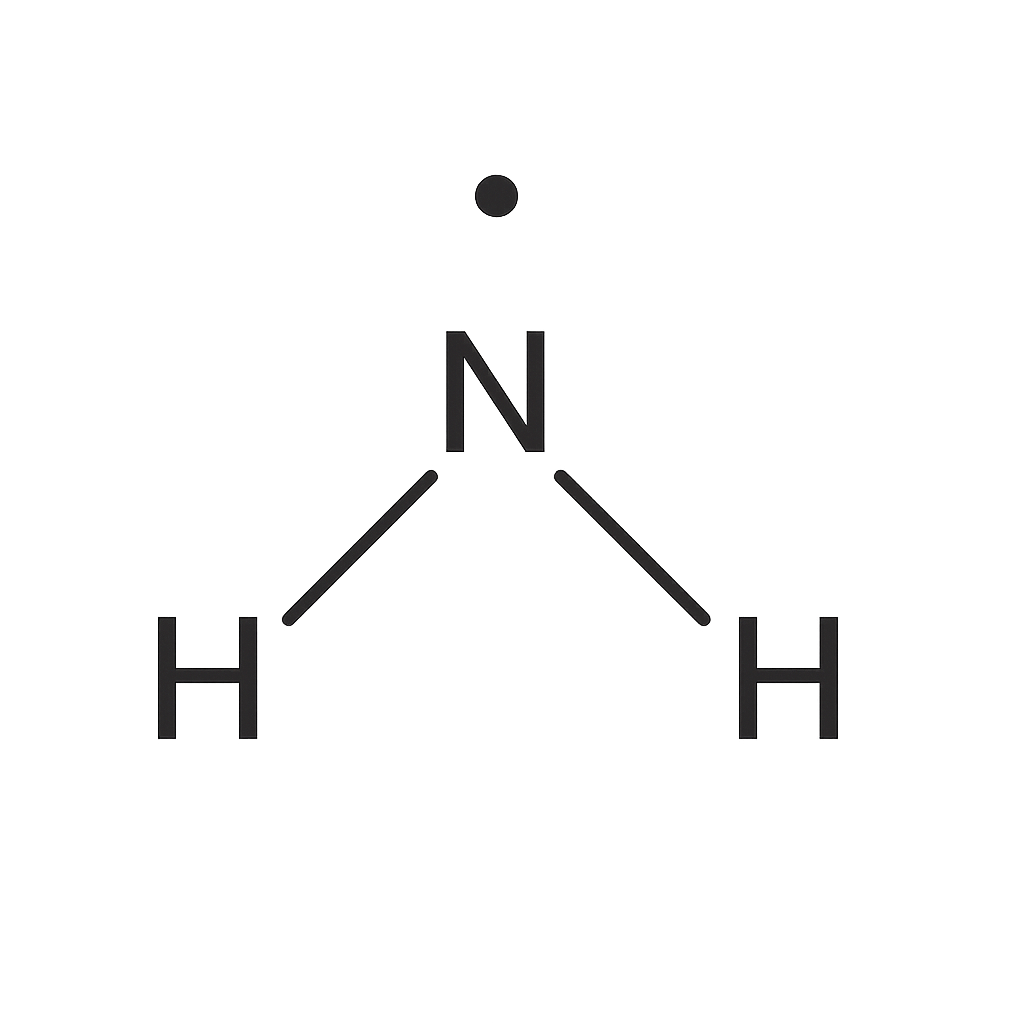
The diagram shows a molecule of ammonia (NH_{3}). Identify the hybridisation of the nitrogen atom and state the molecular geometry.
A. sp² hybridisation; trigonal planar geometry
Correct B. sp³ hybridisation; trigonal pyramidal geometry
C. sp³ hybridisation; tetrahedral geometry
D. sp hybridisation; linear geometry

Correct Answer: B

Want to see the full step-by-step solution? Unlock AI Explanation & Analytics
Question 20 View Details
When 5.00 g of iron reacts with excess chlorine gas according to the equation \(2 \text{Fe} + 3 \text{Cl}_{2} \rightarrow 2 \text{FeCl}_{3}\), the isolated product weighs 9.00 g. (i) Calculate the theoretical mass of FeCl_{3} that could be formed. (ii) Determine the percent yield of the reaction. (iii) Calculate the mass of chlorine gas that actually reacted.
A. 13.2 g; 55%; 6.80 g
B. 15.0 g; 60%; 5.40 g
Correct C. 14.5 g; 62%; 5.90 g
D. 14.0 g; 58%; 5.20 g

Correct Answer: C

Want to see the full step-by-step solution? Unlock AI Explanation & Analytics
Question 21 View Details
In a galvanic cell at 298 K the following half‑cells are used: \( \mathrm{Fe^{3+}}(0.20\ \text{M})/\mathrm{Fe^{2+}}(\text{unknown})/\mathrm{Fe(s)} \) and \( \mathrm{Cu^{2+}}(0.10\ \text{M})/\mathrm{Cu(s)} \). The standard reduction potentials are \( E^{\circ}(\mathrm{Fe^{3+}/Fe^{2+}}) = +0.77\ \text{V} \) and \( E^{\circ}(\mathrm{Cu^{2+}/Cu}) = +0.34\ \text{V} \). The measured cell potential is \( 0.40\ \text{V} \). Determine the concentration of \( \mathrm{Fe^{2+}} \) in the solution.
A. 3.45 M
B. 0.20 M
C. 0.77 M
Correct D. 2.03 M

Correct Answer: D

Want to see the full step-by-step solution? Unlock AI Explanation & Analytics
Question 22 View Details
A \(0.80\ \text{g}\) sample of an unknown hydrocarbon is combusted completely in excess \( \mathrm{O_2} \), producing \(1.76\ \text{g}\) of \( \mathrm{CO_2} \) and \(0.81\ \text{g}\) of \( \mathrm{H_2O} \). (a) Determine the empirical formula of the hydrocarbon. (b) Assuming the hydrocarbon is an alkane (\( \mathrm{C_nH_{2n+2}} \)), find its molecular formula and molar mass. (c) Write the balanced combustion equation and calculate the number of moles of \( \mathrm{O_2} \) consumed.
A. Empirical formula C3H8; molecular formula C6H14; molar mass 86.2 g mol⁻¹; O2 consumed 0.075 mol
B. Empirical formula C5H11; molecular formula C10H22; molar mass 142.3 g mol⁻¹; O2 consumed 0.095 mol
C. Empirical formula C2H5; molecular formula C4H10; molar mass 58.1 g mol⁻¹; O2 consumed 0.060 mol
Correct D. Empirical formula C4H9; molecular formula C8H18; molar mass 114.2 g mol⁻¹; O2 consumed 0.088 mol

Correct Answer: D

Want to see the full step-by-step solution? Unlock AI Explanation & Analytics
Question 23 View Details
A buffer solution is prepared by dissolving \(0.250\ \text{mol}\) of acetic acid (\( \mathrm{CH_3COOH} \)) and \(0.150\ \text{mol}\) of sodium acetate (\( \mathrm{CH_3COONa} \)) in \(1.00\ \text{L}\) of water. The acid dissociation constant of acetic acid is \( K_a = 1.8 \times 10^{-5} \). (a) Calculate the pH of the buffer. (b) If \(0.100\ \text{mol}\) of NaOH is added to the solution, what is the new pH?
A. 4.60, 5.02
B. 4.30, 4.78
Correct C. 4.52, 4.97
D. 4.45, 4.90

Correct Answer: C

Want to see the full step-by-step solution? Unlock AI Explanation & Analytics
Question 24 View Details
Chlorine has atomic number \(17\). Write its ground‑state electron configuration using noble‑gas notation and state the number of valence electrons.
Correct A. [Ne] 3s2 3p5; 7 valence electrons
B. [Ne] 3s2 3p4; 6 valence electrons
C. [He] 2s2 2p5; 7 valence electrons
D. [Ne] 3s2 3p6; 8 valence electrons

Correct Answer: A

Want to see the full step-by-step solution? Unlock AI Explanation & Analytics
Question 25 View Details
2‑Methylprop‑1‑ene (\( \mathrm{C_4H_8} \)) is hydrogenated with \( \mathrm{H_2} \) over a Pt catalyst to give 2‑methylpropane (\( \mathrm{C_4H_{10}} \)). If \(5.00\ \text{g}\) of the alkene are used and the reaction proceeds with \(95\%\) isolated yield, what mass of 2‑methylpropane is obtained?
A. 4.75 g
B. 5.00 g
Correct C. 4.92 g
D. 5.18 g

Correct Answer: C

Want to see the full step-by-step solution? Unlock AI Explanation & Analytics

Master the Exam!

You've seen a preview, but there are thousands more questions plus AI tutor to break down complex solutions.

Unlock Full Access Available for Android & Windows
Help others prepare! Share this practice hub:
Chat with Support