neco model questions vol1 2021 chemistry | Essay

Prepare for your exams with neco model questions vol1 questions? Reviewing past/model questions is one of the most effective ways to guarantee a high score. This practice hub features authentic 2021 chemistry (Essay) questions designed to simulate the real exam environment.

Practice these randomly selected questions to test your readiness.
Question 1 View Details
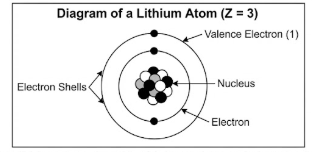
The diagram shows a lithium atom (Z = 3) with its nucleus and electron shells labelled as in the illustration.
Question Parts
(a)
State the number of protons, neutrons and electrons present in a neutral lithium atom.
(b)
Write the ground‑state electron configuration of lithium using (i) the full notation and (ii) the abbreviated noble‑gas notation.
(c)
Natural lithium consists of two isotopes: ⁶Li (7.5 % abundance, atomic mass 6.015 u) and ⁷Li (92.5 % abundance, atomic mass 7.016 u). Calculate the average atomic mass of lithium to three decimal places.
Detailed Essay Solution & Marking Scheme Available

Get the step-by-step mathematical proofs, key points required by examiners, and a comprehensive breakdown from our AI Tutor.
Question 2 View Details
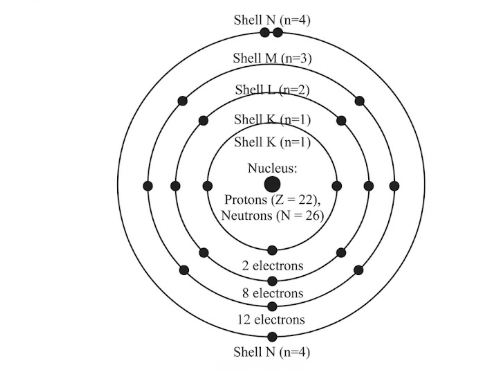
The diagram shows a Bohr model of a neutral atom of an element that belongs to the d‑block of the periodic table. The nucleus is labelled with the number of protons (Z) and neutrons (N). Four electron shells are shown and labelled K, L, M and N with the number of electrons on each shell indicated.
Question Parts
(a)
Identify the element shown in the diagram. State its name, chemical symbol and atomic number.
(b)
Write the ground‑state electron configuration of the element (i) in full notation and (ii) in abbreviated notation using the appropriate noble‑gas core.
(c)
The element commonly exhibits two oxidation states, +2 and +4. (i) Write the electron configuration of the ion in each oxidation state. (ii) Explain, with reference to the order of electron removal, why the configurations are as obtained.
() Write the electron configuration of Ti²⁺.
() Write the electron configuration of Ti⁴⁺.
() Explain why the electrons are removed in that order.
(d)
Aqueous solutions of Ti³⁺ ions are violet whereas Ti⁴⁺ ions are colourless. Explain this observation in terms of d‑electron transitions and crystal‑field theory.
Detailed Essay Solution & Marking Scheme Available

Get the step-by-step mathematical proofs, key points required by examiners, and a comprehensive breakdown from our AI Tutor.
Question 3 View Details
A binary compound MN₂ is formed between element M (group 15, electronegativity 2.1) and element N (group 16, electronegativity 3.5). The compound is a colourless solid with a melting point of 150 °C. For comparison, the ionic compound NaCl has a lattice energy of 787 kJ mol⁻¹ and a melting point of 801 °C.
Question Parts
(a)
Using the electronegativity values, state whether the M–N bond is ionic, polar covalent or non‑polar covalent. Justify your answer.
(b)
Predict the hybridisation and the molecular geometry around the central atom N in MN₂. Give a brief justification using VSEPR theory.
(c)
Explain why MN₂ has a much lower melting point than the ionic solid NaCl, even though both contain the same number of atoms per formula unit.
(d)
MN₂ is insoluble in water but dissolves readily in a non‑polar organic solvent such as benzene. Discuss the nature of the intermolecular forces that account for this solubility behaviour.
Detailed Essay Solution & Marking Scheme Available

Get the step-by-step mathematical proofs, key points required by examiners, and a comprehensive breakdown from our AI Tutor.
Question 4 View Details
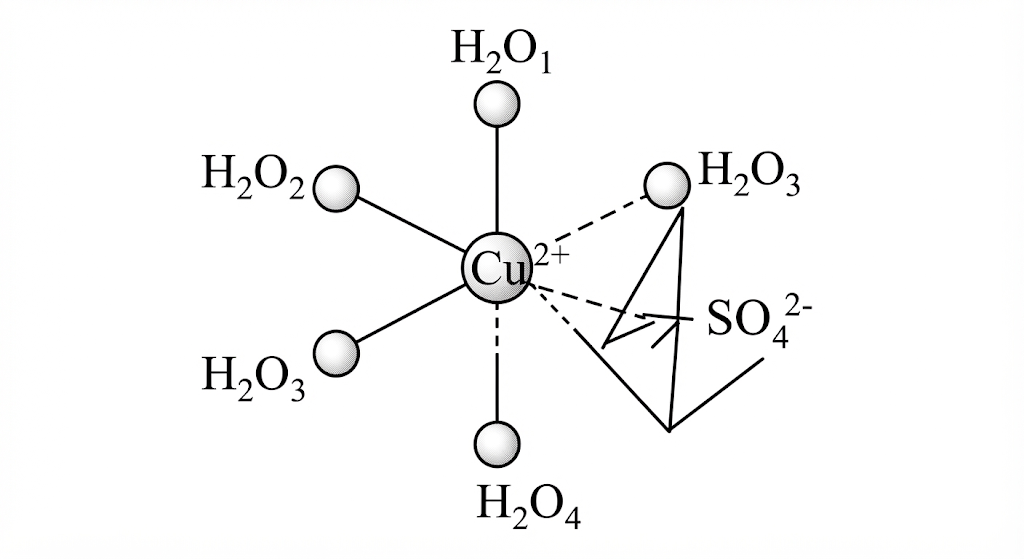
The diagram shows the crystal structure of copper(II) sulfate pentahydrate, CuSO₄·5H₂O. The Cu²⁺ ion is coordinated to a tetrahedral sulfate (SO₄²⁻) ion and five water molecules, each water molecule being labelled H₂O₁ to H₂O₅.
Question Parts
(a)
Calculate the molar mass of CuSO₄·5H₂O. Show all steps of your calculation.
(b)
A sample of CuSO₄·5H₂O weighing 12.5 g is heated until all water of crystallisation is removed, giving anhydrous CuSO₄. Calculate:
() The mass of water lost.
() The number of moles of water removed.
() The mass of the remaining anhydrous CuSO₄.
(c)
To prepare 250.0 mL of a 0.200 mol dm⁻³ CuSO₄ solution using the pentahydrate, calculate the mass of CuSO₄·5H₂O required. Show all steps.
() Moles of CuSO₄ required.
() Conversion to moles of the pentahydrate.
() Mass of CuSO₄·5H₂O to be weighed.
(d)
State two practical advantages of using CuSO₄·5H₂O rather than anhydrous CuSO₄ when preparing laboratory solutions.
Detailed Essay Solution & Marking Scheme Available

Get the step-by-step mathematical proofs, key points required by examiners, and a comprehensive breakdown from our AI Tutor.

Question 5 View Details
A laboratory experiment involves the reaction: 2 Al (s) + 3 CuSO₄ (aq) → Al₂(SO₄)₃ (aq) + 3 Cu (s) A student weighs 15.0 g of aluminium and 30.0 g of copper(II) sulphate (anhydrous) and carries out the reaction. After completion, the copper obtained is dried and weighed, giving an actual mass of 5.0 g. Answer the following:
Question Parts
(a)
Identify the limiting reagent and show the calculations used to reach the conclusion.
(b)
Calculate the theoretical mass of copper that could be produced from the quantities of reactants used.
(c)
Determine the percent yield of copper obtained and calculate the mass of aluminium that remains unreacted after the reaction is complete.
Detailed Essay Solution & Marking Scheme Available

Get the step-by-step mathematical proofs, key points required by examiners, and a comprehensive breakdown from our AI Tutor.

Question 6 View Details
A 2.00 g sample of an unknown substance is heated in a calorimeter. The substance has the following thermal data: • Specific heat capacity (solid) = 0.90 J g⁻¹ °C⁻¹\n• Specific heat capacity (liquid) = 1.20 J g⁻¹ °C⁻¹\n• Specific heat capacity (gas) = 0.60 J g⁻¹ °C⁻¹\n• Latent heat of fusion = 60 J g⁻¹\n• Latent heat of vaporisation = 220 J g⁻¹\n• Melting point = 0 °C\n• Boiling point = 100 °C\n The sample is initially at –20 °C and is heated until it reaches 120 °C.\n Answer the following:
Question Parts
(a)
Calculate the energy required for each of the following stages: i) Heating the solid from –20 °C to its melting point. ii) Melting the solid at 0 °C. iii) Heating the liquid from 0 °C to its boiling point. iv) Vaporising the liquid at 100 °C. v) Heating the gas from 100 °C to 120 °C.
(b)
Determine the total energy required to raise the temperature of the sample from –20 °C to 120 °C.
(c)
State which stage consumes the greatest amount of energy and give a brief explanation for this observation.
Detailed Essay Solution & Marking Scheme Available

Get the step-by-step mathematical proofs, key points required by examiners, and a comprehensive breakdown from our AI Tutor.

Question 7 View Details
A 0.250 mol sample of a monoprotic weak acid HA (Ka = 1.8 × 10⁻⁵) is dissolved in 1.00 L of water and then partially neutralised with NaOH to give a solution that is 40% neutralised.
Question Parts
(a)
Write the overall neutralisation reaction and state the amounts (in moles) of HA and its conjugate base A⁻ present in the resulting solution.
(b)
Calculate the pH of the solution obtained in part (a). Show all steps, including the determination of concentrations and the equilibrium expression you use.
(c)
The solution is then diluted to a total volume of 2.00 L. Explain qualitatively how the pH will be affected by this dilution and relate your answer to the concept of buffer capacity.
(d)
After dilution, 0.050 mol of HCl is added to the 2.00 L solution. Calculate the new pH, stating any assumptions you make.
Detailed Essay Solution & Marking Scheme Available

Get the step-by-step mathematical proofs, key points required by examiners, and a comprehensive breakdown from our AI Tutor.

Question 8 View Details
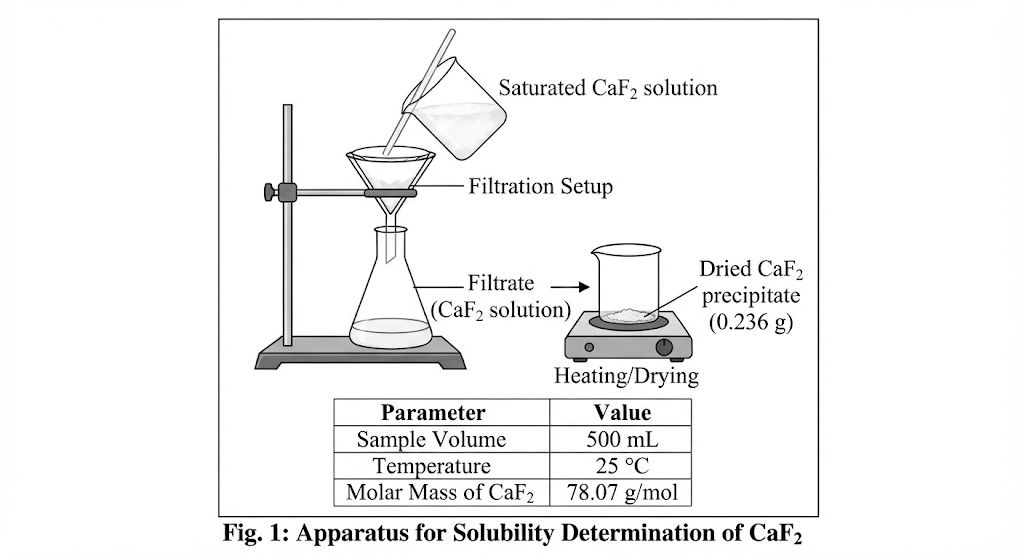
A student carried out an experiment to determine the solubility product constant (Ksp) of calcium fluoride, CaF₂, at 25 °C using the apparatus shown in the diagram. A 500 mL sample of the saturated solution was filtered, and the precipitate obtained was dried and weighed. The mass of the dried CaF₂ precipitate was 0.236 g. The molar mass of CaF₂ is 78.07 g mol⁻¹. Using this information, answer the following:
Question Parts
(a)
Calculate the molar solubility (s) of CaF₂ in the saturated solution at 25 °C (in mol L⁻¹).
(b)
From the molar solubility obtained in part (a), calculate the solubility product constant Ksp for CaF₂ at 25 °C.
(c)
If 0.10 M NaF is added to the saturated solution, predict the new molar solubility of CaF₂ and calculate its value (in mol L⁻¹). Assume the common‑ion effect and that the change in [F⁻] due to CaF₂ dissolution is negligible compared with 0.10 M.
(d)
Explain, with reference to Le Chatelier’s principle and the ionic equilibrium, why the addition of the common ion (F⁻) reduces the solubility of CaF₂.
Detailed Essay Solution & Marking Scheme Available

Get the step-by-step mathematical proofs, key points required by examiners, and a comprehensive breakdown from our AI Tutor.

Master the Exam!

You've seen a preview, but there are thousands more questions plus AI tutor to break down complex solutions.

Unlock Full Access Available for Android & Windows
Help others prepare! Share this practice hub:
Chat with Support