neco model questions vol1 2021 biology | Objective

Prepare for your exams with neco model questions vol1 questions? Reviewing past/model questions is one of the most effective ways to guarantee a high score. This practice hub features authentic 2021 biology (Objective) questions designed to simulate the real exam environment.

Practice these randomly selected questions to test your readiness.

Question 1 View Details
The renal plasma flow (RPF) in a healthy adult is 600 mL min(^{-1}). The filtration fraction (FF) is 20 %. A drug administered later reduces the filtration fraction by 25 % of its original value while RPF remains unchanged. What is the new glomerular filtration rate (GFR) in mL min(^{-1})?
A. 120
B. 75
C. 105
Correct D. 90

Correct Answer: D

Want to see the full step-by-step solution? Unlock AI Explanation & Analytics
Question 2 View Details
The leaf of a desert shrub differs from its ancestor in three ways: (i) leaf surface area is reduced by 30 %; (ii) stomatal density is reduced by 40 %; (iii) leaf thickness increases by 20 %, which reduces the diffusion of water vapour proportionally to the increase in thickness. If the ancestor loses water at a rate of 5 mg cm(^{-2}) h(^{-1}) under the same environmental conditions, estimate the water‑loss rate of the descendant leaf. State whether this rate is below the critical threshold of 2 mg cm(^{-2}) h(^{-1}) for survival.
Correct A. 1.75
B. 1.5
C. 2.0
D. 2.1

Correct Answer: A

Want to see the full step-by-step solution? Unlock AI Explanation & Analytics
Question 3 View Details
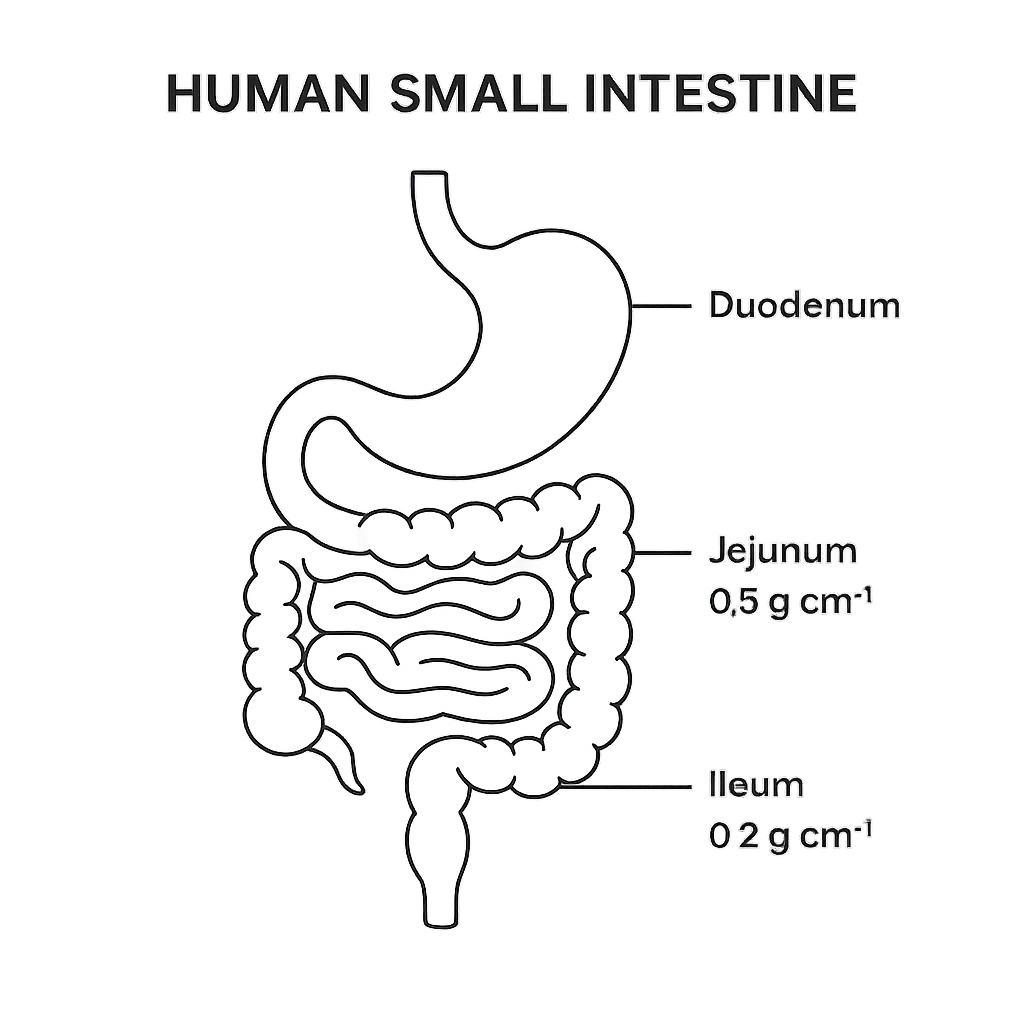
The diagram shows the small intestine of an adult human, whose total length is 600 cm. The intestine is divided into three segments: duodenum (25 % of the total length), jejunum (45 % of the total length) and ileum (30 % of the total length). Glucose is absorbed in the jejunum at a rate of 0.5 g per centimetre and in the ileum at a rate of 0.2 g per centimetre. No significant absorption occurs in the duodenum. If a person ingests 180 g of glucose, how many grams are absorbed in the jejunum, assuming absorption proceeds until the ingested amount is exhausted?
A. 150
Correct B. 135
C. 120
D. 100

Correct Answer: B

Want to see the full step-by-step solution? Unlock AI Explanation & Analytics
Question 4 View Details
A bacterial culture starts with \(1 \times 10^{3}\) cells. Under optimal conditions the generation time is 30 min. After 4 h the culture is exposed to an antibiotic that doubles the generation time while the culture continues to grow. How many cells are present after a total of 8 h?
Correct A. 4096000
B. 2048000
C. 1024000
D. 65536000

Correct Answer: A

Want to see the full step-by-step solution? Unlock AI Explanation & Analytics
Question 5 View Details
A high‑altitude plant experiences a 20 % reduction in atmospheric CO\(_2\) partial pressure relative to sea level. To compensate it (i) increases stomatal density by 25 %, (ii) enlarges its internal leaf surface area for gas exchange by 15 %, and (iii) develops a thicker cuticle that reduces water loss by 10 % but also lowers CO\(_2\) diffusion efficiency by 5 %. If the photosynthetic rate is directly proportional to the product of CO\(_2\) partial pressure, stomatal density and internal surface area, and is reduced proportionally by the cuticle's effect on CO\(_2\) diffusion, what is the overall multiplicative factor by which the photosynthetic rate changes compared with sea‑level conditions? Express your answer as a decimal rounded to two decimal places.
A. 1.15
B. 1.04
C. 0.27
Correct D. 1.09

Correct Answer: D

Want to see the full step-by-step solution? Unlock AI Explanation & Analytics
Question 6 View Details
A lake has a primary productivity of \(8000\) kcal m\(^{-2}\) yr\(^{-1}\) and covers an area of \(2\) km\(^2\). Energy transfer efficiency between successive trophic levels is \(10\%\). An herbivorous fish needs \(2000\) kcal per individual per year and a piscivorous bird needs \(5000\) kcal per individual per year. Assuming a steady‑state ecosystem with only three trophic levels (plants → fish → bird), what is the maximum number of birds that can be supported?
A. 40000
B. 24000
C. 16000
Correct D. 32000

Correct Answer: D

Want to see the full step-by-step solution? Unlock AI Explanation & Analytics
Question 7 View Details
A car travels three road sections: Section A is \(12\) km at a speed limit of \(60\) km h\(^{-1}\); Section B is \(8\) km where the speed limit is reduced to \(40\) km h\(^{-1}\) because of construction; Section C is \(5\) km with a speed limit of \(80\) km h\(^{-1}\) but there is a traffic signal that forces a stop of \(2\) minutes. The car's fuel consumption is \(8\) L per 100 km at \(60\) km h\(^{-1}\). For each km h\(^{-1}\) above \(60\) km h\(^{-1}\) the consumption increases by \(0.05\) L per 100 km, and for each km h\(^{-1}\) below \(60\) km h\(^{-1}\) it decreases by \(0.04\) L per 100 km. What total amount of fuel, in litres, is consumed for the whole journey? Give your answer rounded to two decimal places.
Correct A. 1.99
B. 1.85
C. 2.10
D. 2.05

Correct Answer: A

Want to see the full step-by-step solution? Unlock AI Explanation & Analytics
Question 8 View Details
In a plant two genes \(A\) and \(B\) are linked on the same chromosome with a recombination frequency of \(12\%\). The dominant alleles \(A\) and \(B\) give purple flowers and tall stature respectively, while the recessive alleles \(a\) and \(b\) give white flowers and dwarf stature. A heterozygous plant \(AaBb\) (in coupling phase) is crossed with a double‑recessive plant \(aabb\). What percentage of the progeny are expected to be tall with white flowers?
Correct A. 6
B. 12
C. 3
D. 9

Correct Answer: A

Want to see the full step-by-step solution? Unlock AI Explanation & Analytics
Question 9 View Details
A taxonomist studies five insect species (A, B, C, D, E) using two morphological characters: wing venation (present / absent) and antenna segmentation (≤10 segments / >10 segments). The observations are:\n\n- A: wing present, antenna >10\n- B: wing present, antenna ≤10\n- C: wing absent, antenna >10\n- D: wing absent, antenna ≤10\n- E: wing present, antenna >10\n\nThe taxonomist groups the species into genera such that each genus is monophyletic for both characters (all species in a genus share the same state for each character). Additionally, each family must contain at least two genera, and each family must contain at least one genus that includes more than one species. What is the maximum possible number of families that can be formed under these rules?
A. 3
Correct B. 1
C. 4
D. 2

Correct Answer: B

Want to see the full step-by-step solution? Unlock AI Explanation & Analytics
Question 10 View Details
A desert mammal weighs \(2.5\) kg. Its basal metabolic rate (BMR) follows Kleiber's law: \(\text{BMR (kcal day}^{-1}) = 70 \times (\text{mass in kg})^{0.75}\). Metabolic water production is \(0.6\) mL per kcal expended. Water lost through respiration and skin equals \(30\%\) of the metabolic water produced. The animal can raise its body temperature from \(37^{\circ}\)C to \(40^{\circ}\)C; each degree increase reduces evaporative water loss by \(15\%\) (the reduction is cumulative). The animal obtains water only from metabolic water. Are its physiological adaptations sufficient to meet its daily water requirement? Answer "Yes" or "No".
A. Affirmative
Correct B. No
C. True
D. Yes

Correct Answer: B

Want to see the full step-by-step solution? Unlock AI Explanation & Analytics
Question 11 View Details
Which organelle possesses a double membrane, contains ribosomes on its outer surface, and is the site of synthesis of secretory proteins?
A. Smooth Endoplasmic Reticulum
B. Golgi Apparatus
Correct C. Rough Endoplasmic Reticulum
D. Mitochondrion

Correct Answer: C

Want to see the full step-by-step solution? Unlock AI Explanation & Analytics
Question 12 View Details
A small non‑polar gas molecule and a large polar protein are placed on opposite sides of a phospholipid bilayer. Which of the two will most readily cross the membrane without the aid of transport proteins?
A. Both molecules cross equally
Correct B. The small non‑polar gas molecule
C. Neither molecule can cross without transport proteins
D. The large polar protein

Correct Answer: B

Want to see the full step-by-step solution? Unlock AI Explanation & Analytics
Question 13 View Details
A person consumes a snack containing 50 g of glucose. The pancreas secretes insulin at a rate of 0.5 units for each gram of glucose above a basal 5 g. Each insulin unit lowers blood glucose by 0.5 mg/dL per hour. If the initial blood glucose level is 90 mg/dL, what will be the blood glucose level after 2 hours, assuming no other glucose intake or loss?
A. 60 mg/dL
B. 82.5 mg/dL
C. 75 mg/dL
Correct D. 67.5 mg/dL

Correct Answer: D

Want to see the full step-by-step solution? Unlock AI Explanation & Analytics
Question 14 View Details
A 55‑kg adult presents with fatigue. Laboratory results show haemoglobin 8 g/dL, RBC count 2.5×10⁶/µL, and mean corpuscular volume (MCV) 70 fL. (i) Identify the type of anaemia. (ii) Calculate the total amount of elemental iron required for a therapeutic regimen of 3 mg elemental iron per kg body weight per day for 6 weeks.
A. Microcytic anaemia; 6.93 g
B. Iron‑deficiency anaemia; 5.5 g
C. Iron‑deficiency anaemia; 7.5 g
Correct D. Iron‑deficiency anaemia; 6.93 g

Correct Answer: D

Want to see the full step-by-step solution? Unlock AI Explanation & Analytics
Question 15 View Details
A plant cell membrane has a permeability coefficient for glucose of \(1.2 \times 10^{-5}\ \text{cm s}^{-1}\). The external glucose concentration is \(5\ \text{mM}\) and the internal concentration is \(0.5\ \text{mM}\). The membrane surface area is \(2000\ \mu\text{m}^2\). (i) Calculate the diffusive flux \(J\) of glucose (in \(\text{mol cm}^{-2}\text{s}^{-1}\)). (ii) Determine the amount of glucose (in \(\text{mol}\)) that enters the cell in one minute.
A. (i) 5.4 × 10⁻¹⁰ mol·cm⁻²·s⁻¹; (ii) 6.5 × 10⁻¹³ mol
Correct B. (i) 5.4 × 10⁻¹¹ mol·cm⁻²·s⁻¹; (ii) 6.5 × 10⁻¹⁴ mol
C. (i) 5.4 × 10⁻¹¹ mol·cm⁻²·s⁻¹; (ii) 6.5 × 10⁻¹³ mol
D. (i) 4.3 × 10⁻¹¹ mol·cm⁻²·s⁻¹; (ii) 5.2 × 10⁻¹⁴ mol

Correct Answer: B

Want to see the full step-by-step solution? Unlock AI Explanation & Analytics
Question 16 View Details
A 30‑year‑old female weighs 65 kg and is 160 cm tall. Using the Harris‑Benedict equation for females, her basal metabolic rate (BMR) is given by \( \text{BMR}=655+9.6W+1.8H-4.7A \) where \(W\) is weight in kg, \(H\) height in cm and \(A\) age in years. She is moderately active with an activity factor of 1.55, so her total energy expenditure (TEE) is \( \text{TEE}=\text{BMR}\times1.55 \). She wishes to lose weight by creating a daily deficit of 500 kcal. If she plans that 20 % of her target calories should come from protein and each gram of protein provides 4 kcal, how many grams of protein should she consume each day? Give your answer to the nearest gram.
A. 101
B. 78
Correct C. 86
D. 92

Correct Answer: C

Want to see the full step-by-step solution? Unlock AI Explanation & Analytics
Question 17 View Details
In a kidney, the renal plasma flow (RPF) is 600 mL min⁻¹ and the filtration fraction is 0.20. The plasma glucose concentration is 0.9 mg mL⁻¹, and 99 % of the filtered glucose is reabsorbed. How many milligrams of glucose are excreted per minute?
Correct A. 1.08 mg/min
B. 0.54 mg/min
C. 1.5 mg/min
D. 2.16 mg/min

Correct Answer: A

Want to see the full step-by-step solution? Unlock AI Explanation & Analytics
Question 18 View Details
A population of beetles has allele frequencies \(p=0.6\) for the dominant allele \(A\) and \(q=0.4\) for the recessive allele \(a\). The fitnesses of the genotypes are: \(w_{AA}=1.0\), \(w_{Aa}=0.8\), \(w_{aa}=0.6\). After one generation of selection, what is the new frequency of allele \(a\)? Give your answer to three decimal places.
Correct A. 0.343
B. 0.380
C. 0.300
D. 0.320

Correct Answer: A

Want to see the full step-by-step solution? Unlock AI Explanation & Analytics
Question 19 View Details
A woman with a regular 28‑day menstrual cycle measures her serum progesterone on two occasions: on day 20 the level is 2 ng mL⁻¹ and on day 22 it is 8 ng mL⁻¹. Ovulation is defined as the first day on which progesterone exceeds 5 ng mL⁻¹. Assuming progesterone rises linearly between the two measurements, on which calendar day of the cycle did ovulation most likely occur? Given that the luteal phase lasts 14 days, on which day would you expect her next menstrual period to start?
A. Ovulation on day 22; next period on day 36
Correct B. Ovulation on day 21; next period on day 35
C. Ovulation on day 20; next period on day 34
D. Ovulation on day 23; next period on day 37

Correct Answer: B

Want to see the full step-by-step solution? Unlock AI Explanation & Analytics
Question 20 View Details
In the class Mammalia, the order Carnivora is divided into three families: Felidae, Canidae and Ursidae. Felidae contains 8 genera, each with 4 species; Canidae contains 5 genera, each with 6 species; Ursidae contains 2 genera, each with 3 species. A newly discovered genus is added to Felidae and it contains 2 species.\n\n(a) How many total species are now recognized in the order Carnivora?\n(b) What fraction of the total species are in the family Canidae? Express the answer as a simplified fraction.\n(c) If a biologist randomly selects one species from Carnivora, what is the probability that it belongs to the newly discovered genus? Express the probability as a decimal to three significant figures.
A. Total species = 72; fraction in Canidae = 5/12; probability of new genus = 0.0278
Correct B. Total species = 70; fraction in Canidae = 3/7; probability of new genus = 0.0286
C. Total species = 68; fraction in Canidae = 15/34; probability of new genus = 0.0294
D. Total species = 70; fraction in Canidae = 3/10; probability of new genus = 0.0286

Correct Answer: B

Want to see the full step-by-step solution? Unlock AI Explanation & Analytics
Question 21 View Details
A newly emerging infectious disease has a basic reproduction number \(R_0 = 3.5\). A vaccine available for this disease is 80 % effective in preventing infection, and 10 % of the population is already immune due to prior exposure. What is the minimum proportion of the total population that must be vaccinated to achieve herd immunity (i.e., to make the effective reproduction number less than 1)? Express your answer as a percentage rounded to the nearest whole number.
A. 73%
Correct B. 77%
C. 80%
D. 71%

Correct Answer: B

Want to see the full step-by-step solution? Unlock AI Explanation & Analytics
Question 22 View Details
A cell has a volume of \(2.0 \times 10^{-12}\) L and contains glucose at a concentration of \(5\ \text{mM}\). How many moles of glucose are present in the cell? Give your answer in scientific notation.
A. 2.0 \times 10^{-14} mol
Correct B. 1.0 \times 10^{-14} mol
C. 1.0 \times 10^{-13} mol
D. 5.0 \times 10^{-15} mol

Correct Answer: B

Want to see the full step-by-step solution? Unlock AI Explanation & Analytics
Question 23 View Details
A lake covering \(2\ \text{km}^2\) has a primary productivity of \(800\ \text{g C m}^{-2}\text{ yr}^{-1}\). Ten percent of the primary production is transferred to herbivores, and fifteen percent of the herbivore production is transferred to carnivores. A pollutant reduces the primary productivity by 20 % and lowers the herbivore transfer efficiency by 5 % (absolute). What is the new annual amount of carbon (in kg) stored in carnivore biomass after the pollutant impact?
A. 7.5 \times 10^{3} kg
Correct B. 9.6 \times 10^{3} kg
C. 8.0 \times 10^{3} kg
D. 1.2 \times 10^{4} kg

Correct Answer: B

Want to see the full step-by-step solution? Unlock AI Explanation & Analytics
Question 24 View Details
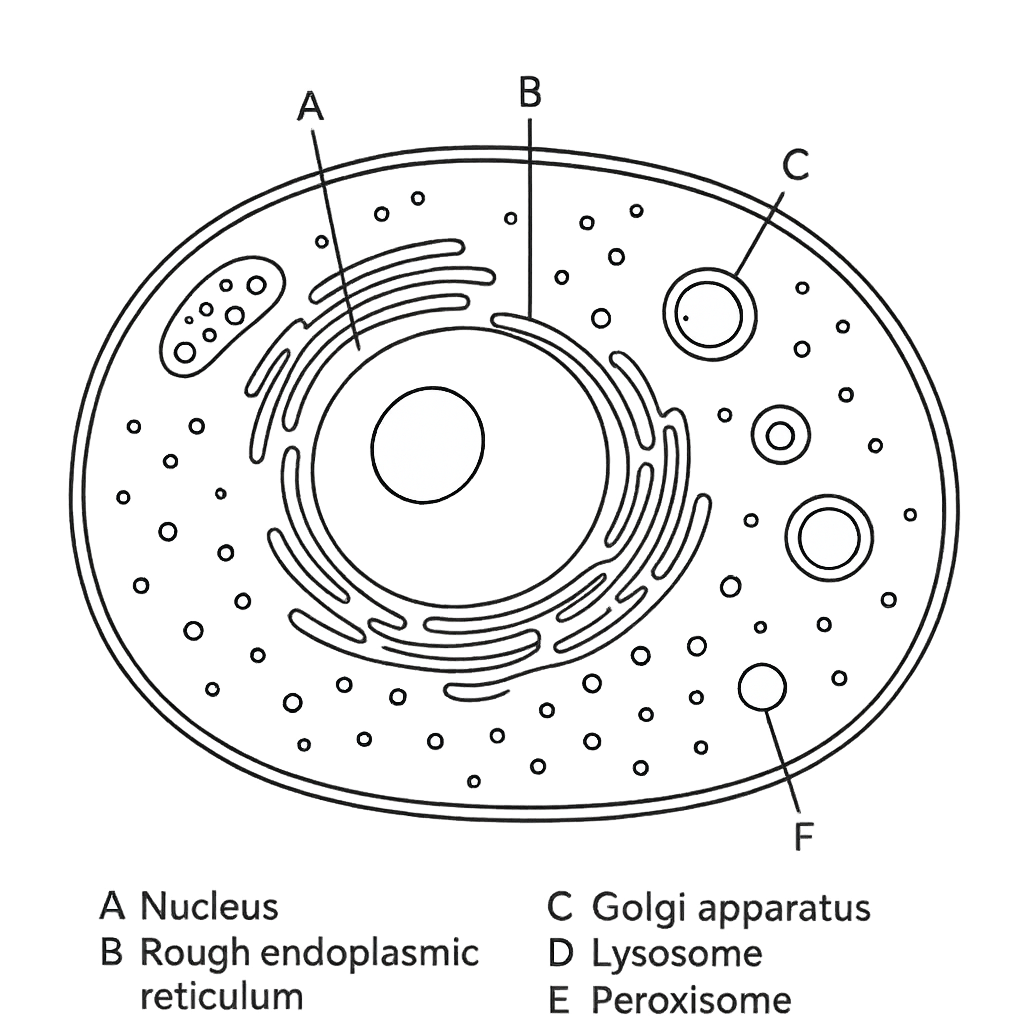
The diagram of an animal cell labels the following structures: A - Nucleus, B - Rough Endoplasmic Reticulum, C - Golgi apparatus, D - Lysosome, E - Peroxisome, F - Plasma membrane. A protein is synthesized on the ribosomes of the rough ER and is destined for secretion outside the cell. Using the labelled diagram, list in order the organelles through which this protein passes before it is released from the cell.
A. Rough Endoplasmic Reticulum → Plasma membrane → Golgi apparatus
B. Rough Endoplasmic Reticulum → Lysosome → Plasma membrane
Correct C. Rough Endoplasmic Reticulum → Golgi apparatus → Plasma membrane
D. Rough Endoplasmic Reticulum → Golgi apparatus → Nucleus

Correct Answer: C

Want to see the full step-by-step solution? Unlock AI Explanation & Analytics
Question 25 View Details
An organism shows these characteristics: (i) eukaryotic cells, (ii) cell walls composed of chitin, (iii) reproduction by basidiospores formed on club‑shaped structures, (iv) development of a macroscopic fruiting body with a cap and stalk. Based on standard biological classification, state the Kingdom, Phylum and Class to which this organism belongs.
A. Kingdom: Fungi; Phylum: Basidiomycota; Class: Ustilaginomycetes
B. Kingdom: Fungi; Phylum: Ascomycota; Class: Saccharomycetes
Correct C. Kingdom: Fungi; Phylum: Basidiomycota; Class: Agaricomycetes
D. Kingdom: Plantae; Phylum: Bryophyta; Class: Musci

Correct Answer: C

Want to see the full step-by-step solution? Unlock AI Explanation & Analytics

Master the Exam!

You've seen a preview, but there are thousands more questions plus AI tutor to break down complex solutions.

Unlock Full Access Available for Android & Windows
Help others prepare! Share this practice hub:
Chat with Support