neco model questions vol1 2021 agricultural_science | Essay

Prepare for your exams with neco model questions vol1 questions? Reviewing past/model questions is one of the most effective ways to guarantee a high score. This practice hub features authentic 2021 agricultural_science (Essay) questions designed to simulate the real exam environment.

Practice these randomly selected questions to test your readiness.

Question 1 View Details
Biodiversity plays a vital role in sustaining productive agricultural ecosystems.
Question Parts
(a)
Explain how biodiversity contributes to natural pest control in crop fields.
(b)
Describe the role of soil microorganisms in the cycling of nutrients essential for plant growth.
(c)
Evaluate two farm management practices that enhance biodiversity and discuss their likely impact on crop productivity.
Detailed Essay Solution & Marking Scheme Available

Get the step-by-step mathematical proofs, key points required by examiners, and a comprehensive breakdown from our AI Tutor.
Question 2 View Details
A student is required to determine the field capacity (FC) of a loamy soil sample using the gravimetric method. The experimental setup consists of a 500 mL beaker, a funnel, a pre‑weighed filter paper (mass = 10 g), a balance (accuracy 0.01 g), and a water source. The procedure is as follows: (i) 200 g of air‑dry soil is placed in the beaker, (ii) water is added slowly until the soil is saturated and excess water drains freely, (iii) the soil is allowed to stand for 30 min, (iv) the saturated soil together with the filter paper is weighed and the combined mass recorded as 260 g. The oven‑dry mass of the soil (after drying at 105 °C for 24 h) is 150 g.
Question Parts
(a)
Calculate the field capacity of the soil sample expressed as grams of water per gram of dry soil.
(b)
Explain why the 30 minute standing period is necessary before weighing the saturated soil.
(c)
Identify two possible sources of error in this gravimetric method and suggest how each can be minimised.
Detailed Essay Solution & Marking Scheme Available

Get the step-by-step mathematical proofs, key points required by examiners, and a comprehensive breakdown from our AI Tutor.

Question 3 View Details
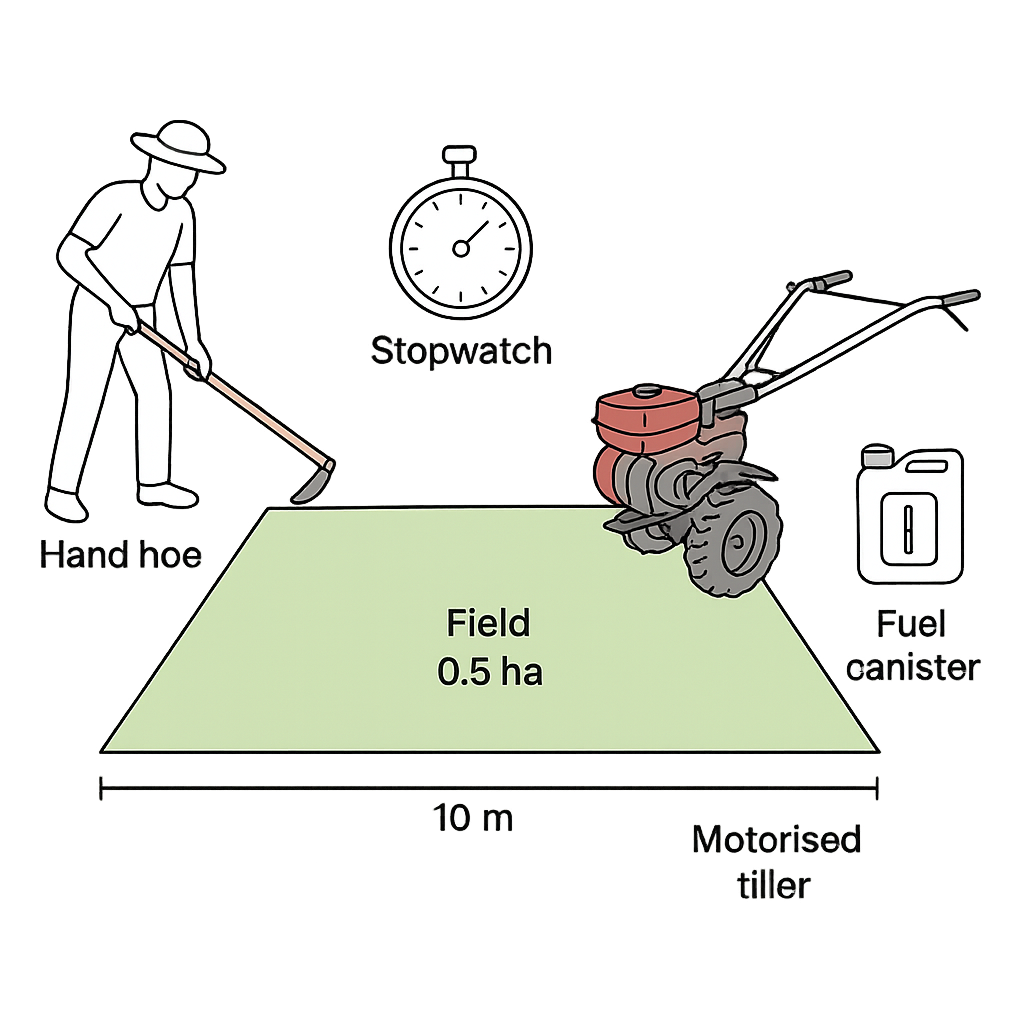
A smallholder farmer intends to prepare a 0.5 ha field for planting. Two tillage methods are available:
Question Parts
(a)
Using a hand hoe, the farmer records a tillage time of 2.5 hours for every 0.1 ha. Calculate the total person‑hours required to till the whole 0.5 ha field.
(b)
A motorised tiller consumes 0.8 L of diesel per hectare. Diesel costs ₦180 per litre. Calculate the fuel cost to till the 0.5 ha field with the tiller.
(c)
Labour is valued at ₦1,500 per person‑day (8 h). Compare the total cost of preparing the field by each method and state which method is more cost‑effective per hectare.
(d)
Discuss two advantages and two disadvantages of using a motorised tiller instead of a hand hoe for smallholder farms.
Detailed Essay Solution & Marking Scheme Available

Get the step-by-step mathematical proofs, key points required by examiners, and a comprehensive breakdown from our AI Tutor.

Question 4 View Details
A farmer plans to mechanise the planting of maize on a 2.5 ha farm. The following equipment options are available:
Question Parts
(a)
Option 1: A 30 kW tractor capable of pulling a 2‑row planter. The tractor consumes 5 L of diesel per hour and diesel costs ₦180 per litre. Option 2: A 15 kW motorised planter that can operate independently, consuming 3 L of diesel per hour. Assuming the field is to be planted at a speed of 5 km h⁻¹, calculate the total diesel cost for each option to plant the entire 2.5 ha.
(b)
Considering the power requirements and the calculated diesel costs, evaluate which option is more suitable for this farmer. In your answer, address:
() Ability of the equipment to meet the required field capacity.
() Long‑term economic implications, including fuel cost per hectare and capital investment considerations.
() Potential maintenance and durability issues.
Detailed Essay Solution & Marking Scheme Available

Get the step-by-step mathematical proofs, key points required by examiners, and a comprehensive breakdown from our AI Tutor.

Question 5 View Details
A farmer in the savanna zone intends to improve the productivity of a 5‑hectare field that has been continuously cultivated with maize for the past five years.
Question Parts
(a)
Explain how the inclusion of a leguminous crop in a rotation can enhance soil fertility and increase the yield of the subsequent maize crop.
(b)
If the farmer introduces a three‑year rotation of maize – cowpea – maize, and research shows that cowpea fixes 50 kg N ha⁻¹, while each additional kilogram of available nitrogen increases maize grain yield by 10 kg ha⁻¹, estimate the expected increase in maize yield (kg ha⁻¹) in the third year compared with continuous maize, assuming all fixed nitrogen becomes available to the following maize crop.
(c)
Design a detailed three‑year crop rotation plan for the 5‑ha field. Indicate the crop to be grown each year, the proportion of the area allocated to each crop, and justify how the plan meets soil‑fertility, pest‑disease management and market‑demand considerations.
Detailed Essay Solution & Marking Scheme Available

Get the step-by-step mathematical proofs, key points required by examiners, and a comprehensive breakdown from our AI Tutor.

Question 6 View Details
A smallholder dairy farmer keeps a herd of 20 lactating cows of the local Sokoto Gudali breed. The farmer is considering replacing 10 of these cows with improved Holstein‑Friesian cows.
Question Parts
(a)
Discuss two advantages and two disadvantages of adopting the improved Holstein‑Friesian breed in the context of the farmer’s resource base.
(b)
The average daily milk yield of a local cow is 8 L, while a Holstein‑Friesian yields 20 L. Each lactating cow requires 3 kg dry matter (DM) per day. The local forage available provides 2.5 kg DM per cow per day and costs ₦150 per kg for supplemental concentrate. Calculate the additional feed cost per day required to meet the nutritional needs of the herd after replacement, assuming the farmer will supplement the deficit with concentrate.
Detailed Essay Solution & Marking Scheme Available

Get the step-by-step mathematical proofs, key points required by examiners, and a comprehensive breakdown from our AI Tutor.

Question 7 View Details
A farmer in the savanna zone cultivates maize on a 5‑hectare field. The field is planted at a spacing of 0.75 m × 0.25 m, giving a plant population of about 53 000 plants per hectare. The crop has been experiencing severe damage from the stem borer (Busseola fusca).
Question Parts
(a)
Describe the life cycle of Busseola fusca and indicate which stage is most vulnerable to control measures.
(b)
Using integrated pest management (IPM), recommend a control programme that includes cultural, biological and chemical measures. For the chemical measure, the recommended insecticide is to be applied at a rate of 2.5 L ha⁻¹ of a formulation that contains 200 g of active ingredient per litre. Calculate the total amount of active ingredient required for the whole 5‑ha field.
(c)
The economic injury level (EIL) for stem borer is estimated at 5 % of plants damaged, each damaged plant causing a loss of 0.25 kg of grain. The market price of maize is ₦120 kg⁻¹ and the cost of the recommended insecticide application (including labour) is ₦15 000. Determine whether the farmer should apply the insecticide now, showing all calculations.
Detailed Essay Solution & Marking Scheme Available

Get the step-by-step mathematical proofs, key points required by examiners, and a comprehensive breakdown from our AI Tutor.

Question 8 View Details
A horticulturalist grows tomatoes in a greenhouse covering 2000 m². The plants are spaced 0.5 m × 0.5 m, giving a total of 800 plants. During a rainy season the crop suffered from a fungal disease caused by Phytophthora infestans (late blight).
Question Parts
(a)
Explain the disease triangle and illustrate how each component (host, pathogen, environment) contributes to the occurrence of late blight in the described greenhouse.
(b)
The horticulturalist recorded the number of infected plants each week for four weeks as follows: Week 1 – 30 plants, Week 2 – 78 plants, Week 3 – 150 plants, Week 4 – 210 plants. Calculate the disease incidence (%) for each week and identify the week when the disease reached epidemic proportion (incidence > 20 %).
Detailed Essay Solution & Marking Scheme Available

Get the step-by-step mathematical proofs, key points required by examiners, and a comprehensive breakdown from our AI Tutor.

Master the Exam!

You've seen a preview, but there are thousands more questions plus AI tutor to break down complex solutions.

Unlock Full Access Available for Android & Windows
Help others prepare! Share this practice hub:
Chat with Support