neco model questions vol1 2020 physics | Objective

Prepare for your exams with neco model questions vol1 questions? Reviewing past/model questions is one of the most effective ways to guarantee a high score. This practice hub features authentic 2020 physics (Objective) questions designed to simulate the real exam environment.

Practice these randomly selected questions to test your readiness.

Question 1 View Details
A metal block is heated to \(150^{\circ}\text{C}\) and placed in a well‑insulated container containing \(200\ \text{g}\) of water at \(20^{\circ}\text{C}\). After thermal equilibrium the temperature of the system is \(30^{\circ}\text{C}\). During the experiment the container loses a total of \(5\ \text{kJ}\) of heat to the surroundings. The specific heat capacities are \(c_{\text{metal}} = 0.45\ \text{kJ·kg}^{-1}\text{K}^{-1}\) and \(c_{\text{water}} = 4.18\ \text{kJ·kg}^{-1}\text{K}^{-1}\). Determine the mass of the metal block (in kilograms).
A. 0.300
B. 0.200
Correct C. 0.247
D. 0.150

Correct Answer: C

Want to see the full step-by-step solution? Unlock AI Explanation & Analytics
Question 2 View Details
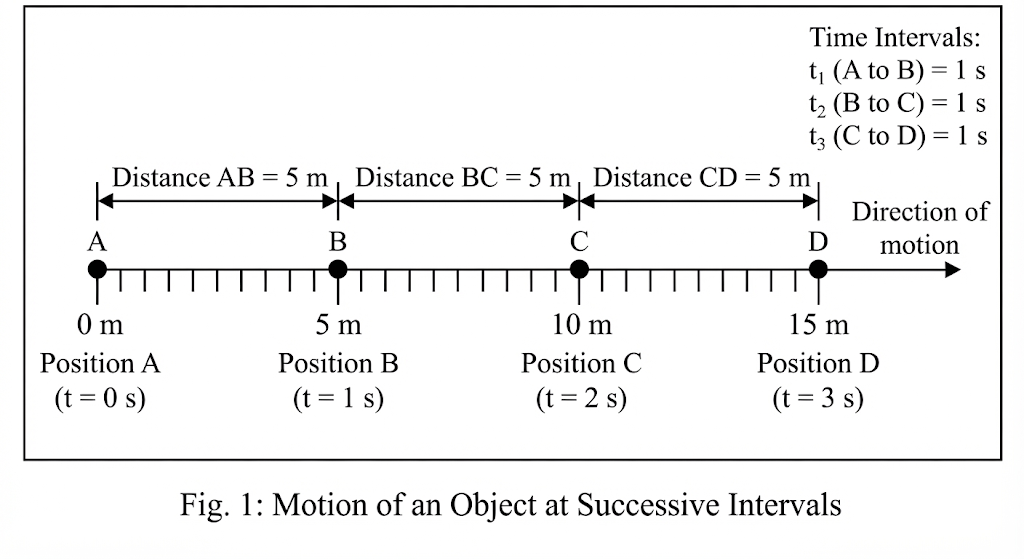
The motion diagram shows an object at four successive one‑second intervals (t = 0 s, 1 s, 2 s, 3 s). The positions are marked as points A, B, C and D respectively, and the distances AB, BC and CD are each \(5\ \text{m}\). Assuming the motion is uniform, determine the speed of the object in \(\text{m·s}^{-1}\).
A. 7
Correct B. 5
C. 4
D. 6

Correct Answer: B

Want to see the full step-by-step solution? Unlock AI Explanation & Analytics
Question 3 View Details
A car travels \(150\ \text{km}\) in \(2.5\ \text{h}\). Express its average speed in \(\text{m·s}^{-1}\).
A. 20.0
Correct B. 16.7
C. 15.0
D. 18.3

Correct Answer: B

Want to see the full step-by-step solution? Unlock AI Explanation & Analytics
Question 4 View Details
A sealed container holds \(2.0\ \text{mol}\) of an ideal gas at a pressure of \(1.0\ \text{atm}\) and a temperature of \(27^{\circ}\text{C}\). The gas is heated at constant volume until its pressure doubles. What is the final temperature of the gas in degrees Celsius?
A. 300
B. 400
C. 354
Correct D. 327

Correct Answer: D

Want to see the full step-by-step solution? Unlock AI Explanation & Analytics
Question 5 View Details
In a laboratory, a spring balance is known to read \(5\%\) higher than the true force. The balance records a reading of \(8.4\ \text{N}\) for an unknown object. Taking \(g = 9.8\ \text{m·s}^{-2}\), determine the actual mass of the object in kilograms (to two decimal places).
A. 0.80
Correct B. 0.82
C. 0.86
D. 0.78

Correct Answer: B

Want to see the full step-by-step solution? Unlock AI Explanation & Analytics
Question 6 View Details
A 5.0 kg block is pulled up a rough incline that is 8.0 m long and makes an angle of \(30^{\circ}\) with the horizontal. The coefficient of kinetic friction between the block and the incline is \(0.20\). The block starts from rest and reaches the top with a speed of \(4.0\) m s\(^{-1}\). Determine (a) the magnitude of the constant pulling force required, and (b) the average power delivered by this force during the motion. Use \(g = 9.8\) m s\(^{-2}\).
A. Pulling force \approx 30 N; average power \approx 60 W
Correct B. Pulling force \(\approx 38\) N; average power \(\approx 76\) W
C. Pulling force \approx 45 N; average power \approx 90 W
D. Pulling force \approx 50 N; average power \approx 100 W

Correct Answer: B

Want to see the full step-by-step solution? Unlock AI Explanation & Analytics
Question 7 View Details
A string fixed at both ends has length \(L = 0.5\) m and linear mass density \(\mu = 0.010\) kg m\(^{-1}\). When a tension \(T\) is applied, its fundamental frequency is \(120\) Hz. If the tension is increased by \(80\) N, what is the new fundamental frequency? Give your answer to the nearest hertz.
A. 140 Hz
B. 170 Hz
C. 130 Hz
Correct D. 150 Hz

Correct Answer: D

Want to see the full step-by-step solution? Unlock AI Explanation & Analytics
Question 8 View Details
A block‑and‑tackle system consists of three fixed pulleys and two movable pulleys. A load of \(500\) N is lifted at constant speed. The effort applied to the rope is \(150\) N. (a) Determine the ideal mechanical advantage (IMA) of the system. (b) Determine the actual mechanical advantage (AMA). (c) Calculate the efficiency of the system as a percentage. (d) If the rope is pulled with a speed of \(0.60\) m s\(^{-1}\), what is the speed of the load?
A. IMA = 3; AMA = 3.33; efficiency ≈ 83 %; load speed = 0.20 m s⁻¹
B. IMA = 5; AMA = 2.5; efficiency ≈ 50 %; load speed = 0.12 m s⁻¹
Correct C. IMA = 4; AMA = 3.33; efficiency ≈ 83 %; load speed = 0.15 m s⁻¹
D. IMA = 4; AMA = 2.78; efficiency ≈ 70 %; load speed = 0.18 m s⁻¹

Correct Answer: C

Want to see the full step-by-step solution? Unlock AI Explanation & Analytics
Question 9 View Details
A 2.0 kg block of copper (specific heat capacity unknown) at \(150^{\circ}\)C is placed into 1.0 kg of water (specific heat capacity \(4186\) J kg\(^{-1}\) K\(^{-1}\)) initially at \(20^{\circ}\)C in an insulated container. After the system reaches equilibrium at \(40^{\circ}\)C, it is found that \(5.0\) kJ of heat has been lost to the surroundings. Determine the specific heat capacity of the copper in J kg\(^{-1}\) K\(^{-1}\).
A. ≈ 350 J·kg⁻¹·K⁻¹
Correct B. ≈ 403 J·kg⁻¹·K⁻¹
C. ≈ 500 J·kg⁻¹·K⁻¹
D. ≈ 450 J·kg⁻¹·K⁻¹

Correct Answer: B

Want to see the full step-by-step solution? Unlock AI Explanation & Analytics
Question 10 View Details
A boat can travel at \(5.0\) m s\(^{-1}\) in still water. It must cross a river that is \(200\) m wide, whose current flows uniformly at \(3.0\) m s\(^{-1}\). (a) If the boat heads directly across the river (perpendicular to the banks), find the time taken to reach the opposite bank and the downstream displacement of the boat. (b) To land directly opposite its starting point, at what angle upstream from the perpendicular must the boat be aimed? Give the angle to the nearest degree.
A. (a) 45 s, 135 m downstream; (b) 40° upstream from the perpendicular
B. (a) 30 s, 90 m downstream; (b) 30° upstream from the perpendicular
C. (a) 50 s, 150 m downstream; (b) 45° upstream from the perpendicular
Correct D. (a) 40 s, 120 m downstream; (b) 37° upstream from the perpendicular

Correct Answer: D

Want to see the full step-by-step solution? Unlock AI Explanation & Analytics
Question 11 View Details
A metal rod of length \(2.00\,\text{m}\) at \(20\,^{\circ}\text{C}\) expands uniformly when heated. Its coefficient of linear expansion is \(1.2\times10^{-5}\,^{\circ}\text{C}^{-1}\). After heating, its length becomes \(2.048\,\text{m}\). Determine the final temperature of the rod in kelvin.
A. 2100 K
Correct B. 2293 K
C. 2400 K
D. 2250 K

Correct Answer: B

Want to see the full step-by-step solution? Unlock AI Explanation & Analytics
Question 12 View Details
A sealed gas occupies a cylinder of volume \(500\,\text{cm}^3\) at a temperature of \(27\,^{\circ}\text{C}\) and an unknown pressure \(P_{1}\). The gas is heated to \(127\,^{\circ}\text{C}\), causing the piston to move so that the volume increases by 20\% of its original volume. The final pressure is measured to be \(1.2\,\text{atm}\). Calculate the initial pressure \(P_{1}\) in atmospheres.
Correct A. 1.08 atm
B. 0.96 atm
C. 1.20 atm
D. 0.90 atm

Correct Answer: A

Want to see the full step-by-step solution? Unlock AI Explanation & Analytics
Question 13 View Details
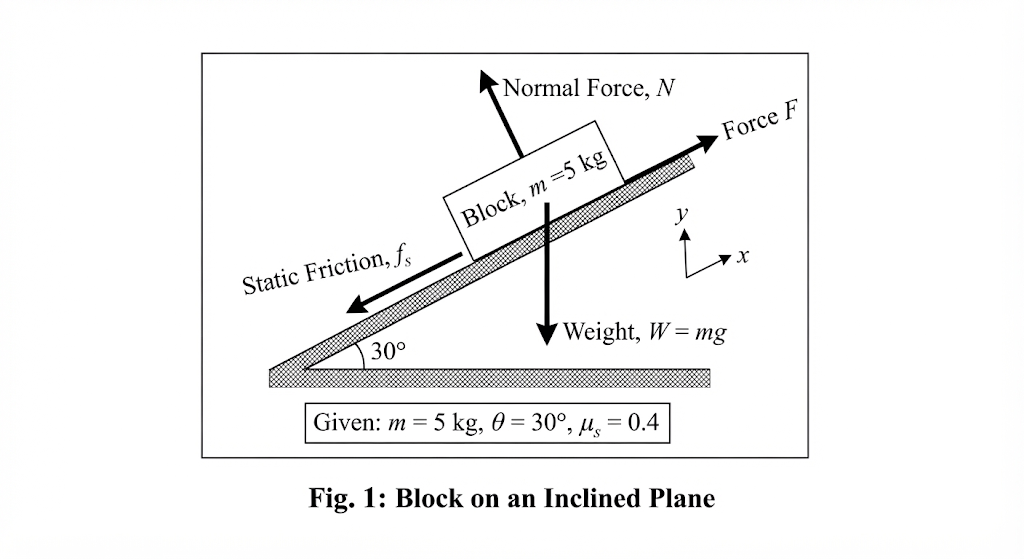
The diagram shows a \(5\,\text{kg}\) block resting on an incline that makes an angle of \(30^{\circ}\) with the horizontal. The coefficient of static friction between the block and the plane is \(\mu_{s}=0.4\). An external force \(F\) is applied parallel to the plane upward (up the incline) to keep the block at rest. Determine the minimum magnitude of \(F\) required (in newtons).
Correct A. 7.53 N
B. 5.20 N
C. 9.80 N
D. 12.00 N

Correct Answer: A

Want to see the full step-by-step solution? Unlock AI Explanation & Analytics
Question 14 View Details
A block‑and‑tackle system has an ideal mechanical advantage of 4. When it is used to lift a load of \(800\,\text{N}\), the required input force is measured to be \(250\,\text{N}\). (a) Determine the efficiency of the system (as a percentage). (b) Assuming the same efficiency, calculate the input force needed to lift a \(1200\,\text{N}\) load with the same system.
A. Efficiency = 70 %; Input force for 1200 N load = 450 N
B. Efficiency = 75 %; Input force for 1200 N load = 400 N
Correct C. Efficiency = 80 %; Input force for 1200 N load = 375 N
D. Efficiency = 85 %; Input force for 1200 N load = 360 N

Correct Answer: C

Want to see the full step-by-step solution? Unlock AI Explanation & Analytics
Question 15 View Details
A battery of emf \(E = 12\,\text{V}\) has an internal resistance \(r\). It is connected to an external circuit consisting of two resistors \(R_{1}=6\,\Omega\) and \(R_{2}=12\,\Omega\) connected in parallel. The terminal voltage across the external circuit is measured to be \(9\,\text{V}\). Determine (a) the internal resistance \(r\) of the battery (in ohms), (b) the total current supplied by the battery (in amperes), (c) the power dissipated in the internal resistance (in watts), and (d) the efficiency of the battery (percentage of the total power delivered to the external circuit).
Correct A. r = 4/3 Ω; total current = 2.25 A; internal power = 6.75 W; efficiency = 75 %
B. r = 2 Ω; total current = 2.0 A; internal power = 8.0 W; efficiency = 70 %
C. r = 1 Ω; total current = 2.5 A; internal power = 6.25 W; efficiency = 80 %
D. r = 3/2 Ω; total current = 2.0 A; internal power = 6.0 W; efficiency = 66 %

Correct Answer: A

Want to see the full step-by-step solution? Unlock AI Explanation & Analytics
Question 16 View Details
A convex lens of focal length \(+10\ \text{cm}\) is placed 5 cm to the left of a concave lens of focal length \(-20\ \text{cm}\). An object 30 cm in front of the convex lens (on its left) produces a final image after passing through both lenses. Determine the distance of the final image from the concave lens and state whether the image is real or virtual.
A. 10 cm to the right of the concave lens; the image is virtual.
B. 25 cm to the left of the concave lens; the image is real.
C. 15 cm to the right of the concave lens; the image is virtual.
Correct D. 20 cm to the right of the concave lens; the image is real.

Correct Answer: D

Want to see the full step-by-step solution? Unlock AI Explanation & Analytics
Question 17 View Details
A radioactive sample contains two isotopes, A and B, that both decay by beta emission. Isotope A has a half‑life of 5 min and an initial activity of 800 Bq. Isotope B has a half‑life of 20 min and an initial activity of 200 Bq. After a certain time the total activity of the sample is measured to be 500 Bq. Calculate the elapsed time (in minutes) to the nearest tenth.
A. 5.8 minutes (to the nearest tenth)
B. 4.9 minutes (to the nearest tenth)
Correct C. 6.2 minutes (to the nearest tenth)
D. 7.4 minutes (to the nearest tenth)

Correct Answer: C

Want to see the full step-by-step solution? Unlock AI Explanation & Analytics
Question 18 View Details
A 5 kg block rests on a rough inclined plane. The coefficient of static friction between the block and the plane is 0.30. A horizontal force of 20 N is applied to the block, pushing it up the plane. Find the smallest angle \(\theta\) (in degrees, to one decimal place) that the plane can make with the horizontal such that the block is on the verge of moving up the plane.
A. 6.1°
B. 7.3°
Correct C. 5.5°
D. 4.9°

Correct Answer: C

Want to see the full step-by-step solution? Unlock AI Explanation & Analytics
Question 19 View Details
A stationary source emits sound of frequency \(f = 500\ \text{Hz}\) in air where the speed of sound is \(v = 340\ \text{m s}^{-1}\). A second identical source moves directly towards a stationary observer with speed \(v_s\). The observer hears a beat frequency of \(5\ \text{Hz}\) between the two sounds. Determine the speed \(v_s\) of the moving source (in m s\(^{-1}\), to two decimal places).
A. 2.84 m s⁻¹
Correct B. 3.37 m s⁻¹
C. 4.15 m s⁻¹
D. 5.00 m s⁻¹

Correct Answer: B

Want to see the full step-by-step solution? Unlock AI Explanation & Analytics
Question 20 View Details
A hydrogen‑like ion emits a photon when an electron drops from the \(n = 5\) level to the \(n = 2\) level. The wavelength of this photon is measured to be \(109\ \text{nm}\). (a) Identify the atomic number \(Z\) of the ion. (b) Using this \(Z\), calculate the wavelength of the photon emitted when the electron subsequently drops from \(n = 2\) to \(n = 1\). (c) Find the total energy released in the two‑step transition in kilojoules per mole of ions. (d) Express this total energy as a percentage of the ion's ionisation energy from the ground state.
A. Z=2; λ(2→1)=32.1 nm; total energy≈5.30×10³ kJ mol⁻¹; ≈98 % of the ionisation energy.
B. Z=3; λ(2→1)=28.2 nm; total energy≈4.80×10³ kJ mol⁻¹; ≈90 % of the ionisation energy.
C. Z=1; λ(2→1)=121.6 nm; total energy≈2.18×10³ kJ mol⁻¹; ≈42 % of the ionisation energy.
Correct D. Z=2; λ(2→1)=30.4 nm; total energy≈5.05×10³ kJ mol⁻¹; ≈96 % of the ionisation energy.

Correct Answer: D

Want to see the full step-by-step solution? Unlock AI Explanation & Analytics
Question 21 View Details
A mixed radioactive sample contains isotopes A and B. Isotope A has a half‑life of 10 min and isotope B has a half‑life of 30 min. The total initial activity of the sample is \(6.0\times10^{5}\) decays min\(^{-1}\). After 20 min the measured total activity is \(2.0\times10^{5}\) decays min\(^{-1}\). Assuming both isotopes decay independently, determine the initial activity contributed by each isotope.
A. Isotope A: 4.00×10^5 decays min⁻¹; Isotope B: 2.00×10^5 decays min⁻¹
Correct B. Isotope A: 4.68×10^5 decays min⁻¹; Isotope B: 1.32×10^5 decays min⁻¹
C. Isotope A: 3.60×10^5 decays min⁻¹; Isotope B: 2.40×10^5 decays min⁻¹
D. Isotope A: 5.00×10^5 decays min⁻¹; Isotope B: 1.00×10^5 decays min⁻¹

Correct Answer: B

Want to see the full step-by-step solution? Unlock AI Explanation & Analytics
Question 22 View Details
A rectangular metal plate has length \(L = 15.0\ \text{cm}\) (±0.1 cm) and width \(W = 8.0\ \text{cm}\) (±0.1 cm). Calculate the area of the plate in square metres, expressing the result with its absolute uncertainty.
A. (0.0115 ± 0.00023) m^2
B. (0.0125 ± 0.00023) m^2
C. (0.0120 ± 0.00030) m^2
Correct D. (0.0120 ± 0.00023) m^2

Correct Answer: D

Want to see the full step-by-step solution? Unlock AI Explanation & Analytics
Question 23 View Details
Three point charges are placed at the vertices of a right‑angled triangle. Vertex A is at the origin, vertex B lies 0.20 m along the positive x‑axis, and vertex C lies 0.30 m along the positive y‑axis. The charges are: \(q_{A}=+2\ \mu\text{C}\) at A, \(q_{B}=-3\ \mu\text{C}\) at B, and \(q_{C}=+4\ \mu\text{C}\) at C. Determine the magnitude and direction of the net electric field at point A due to the charges at B and C.
A. 8.2×10^5 N/C, 31° above the +x axis
B. 7.9×10^5 N/C, 45° below the +x axis
Correct C. 7.9×10^5 N/C, 31° below the +x axis
D. 6.5×10^5 N/C, 31° below the +x axis

Correct Answer: C

Want to see the full step-by-step solution? Unlock AI Explanation & Analytics
Question 24 View Details
A particle moves 5.0 m east and then 12.0 m north. Find the magnitude of its displacement and state whether the total distance travelled is a scalar or a vector quantity.
A. Displacement 5 m; total distance is a scalar
Correct B. Displacement 13 m; total distance is a scalar
C. Displacement 17 m; total distance is a scalar
D. Displacement 13 m; total distance is a vector

Correct Answer: B

Want to see the full step-by-step solution? Unlock AI Explanation & Analytics
Question 25 View Details
In a uniform electric field, point A is taken as the reference. The potential difference between points A and B, which are 0.50 m apart along the positive x‑direction, is \(\Delta V_{AB}= -30\ \text{V}\). The potential difference between points A and C, which are 0.40 m apart along a direction that makes \(60^{\circ}\) with the positive x‑axis, is \(\Delta V_{AC}= -20\ \text{V}\). Determine the magnitude of the electric field (in V m\(^{-1}\)) and its direction measured counter‑clockwise from the positive x‑axis.
Correct A. 64 V/m, 21° above the +x axis
B. 48 V/m, 30° above the +x axis
C. 80 V/m, 15° above the +x axis
D. 64 V/m, 45° above the +x axis

Correct Answer: A

Want to see the full step-by-step solution? Unlock AI Explanation & Analytics

Master the Exam!

You've seen a preview, but there are thousands more questions plus AI tutor to break down complex solutions.

Unlock Full Access Available for Android & Windows
Help others prepare! Share this practice hub:
Chat with Support