neco model questions vol1 2020 chemistry | Objective

Prepare for your exams with neco model questions vol1 questions? Reviewing past/model questions is one of the most effective ways to guarantee a high score. This practice hub features authentic 2020 chemistry (Objective) questions designed to simulate the real exam environment.

Practice these randomly selected questions to test your readiness.

Question 1 View Details
A buffer solution is prepared by mixing a weak acid HA (Ka = 1.0 × 10⁻⁵) with its sodium salt NaA. The total concentration of acid plus conjugate base in the final solution is 0.200 M and the measured pH is 4.75. Initially the solution contained only HA at 0.200 M before any NaA was added. Determine (a) the ratio \([A^-]/[HA]\) in the buffer and (b) the concentration of NaA that must be added (in M) to obtain the required pH.
A. 0.600; 0.0720
B. 0.562; 0.0800
Correct C. 0.562; 0.0720
D. 0.500; 0.0600

Correct Answer: C

Want to see the full step-by-step solution? Unlock AI Explanation & Analytics
Question 2 View Details
A drinking‑water source contains pollutant A that decays during storage with a first‑order rate constant \(k = 0.02\ \text{day}^{-1}\). The water is stored for 3 days before consumption. After storage the water also contains a second pollutant B at a constant concentration of \(0.01\ \text{mg\,L}^{-1}\). An adult drinks 2 L of the water each day. The combined daily intake of A and B must not exceed the tolerable daily intake (TDI) of \(0.04\ \text{mg\,day}^{-1}\). Determine the maximum initial concentration \(C_0\) of pollutant A (in mg L\(^{-1}\)) that can be present in the source water so that the TDI is not exceeded.
A. 0.0120
B. 0.0112
Correct C. 0.0106
D. 0.0095

Correct Answer: C

Want to see the full step-by-step solution? Unlock AI Explanation & Analytics
Question 3 View Details
At 25 °C a saturated solution of calcium fluoride, \(\text{CaF}_2\), has a solubility \(s_1 = 1.5 \times 10^{-4}\ \text{mol\,L}^{-1}\). The dissolution is endothermic with \(\Delta H^\circ = +15\ \text{kJ\,mol}^{-1}\). A student adds \(0.001\ \text{mol}\) of sodium fluoride, NaF, to 1.0 L of this saturated solution at 25 °C. (a) State whether \(\text{CaF}_2\) will precipitate under these conditions. (b) Assuming the solution can be heated, calculate the temperature (in °C) to which it must be raised so that the added fluoride just remains in solution (i.e., the ion product equals the solubility product). Use the van't Hoff relation \(\ln(K_2/K_1) = -\Delta H^\circ/R\,(1/T_2 - 1/T_1)\) with \(R = 8.314\ \text{J\,mol}^{-1}\text{K}^{-1}\) and \(T_1 = 298\ \text{K}\).
Correct A. Precipitation occurs; 305 °C
B. No precipitation; 305 °C
C. Precipitation occurs; 295 °C
D. No precipitation; 295 °C

Correct Answer: A

Want to see the full step-by-step solution? Unlock AI Explanation & Analytics
Question 4 View Details
A factory discharges 5 000 L day\(^{-1}\) of effluent containing pollutant Y at a concentration of \(0.8\ \text{mg\,L}^{-1}\). The effluent passes through three treatment stages in series: * Stage 1 (adsorption) removes 40 % of the pollutant present. * Stage 2 (biological degradation) removes 30 % of the pollutant remaining after Stage 1, and during this stage the flow rate is reduced by 10 % (the water is recycled), after which the reduced flow proceeds to Stage 3. * Stage 3 (advanced oxidation) restores the original flow rate and removes 50 % of the pollutant remaining after Stage 2. Calculate (a) the final concentration of pollutant Y (in mg L\(^{-1}\)) after all stages, (b) the total mass of pollutant Y removed per day (in g), and (c) the overall percentage removal efficiency. Present your answer as the three values in the order asked, separated by semicolons.
A. 0.180; 3.60; 82.0
Correct B. 0.151; 3.24; 81.1
C. 0.120; 2.80; 78.5
D. 0.200; 4.00; 85.0

Correct Answer: B

Want to see the full step-by-step solution? Unlock AI Explanation & Analytics
Question 5 View Details
The element that lies in period 4 and group 13 of the periodic table has an atomic number of 13 and an approximate atomic mass of 27 u. What is the name of this element?
A. Indium
B. Gallium
Correct C. Aluminium
D. Boron

Correct Answer: C

Want to see the full step-by-step solution? Unlock AI Explanation & Analytics
Question 6 View Details
A 1.76 g sample of an unknown monohydric alcohol with molecular formula \(C_nH_{2n+2}O\) reacts with excess sodium metal, liberating \(0.224\) L of hydrogen gas at STP. When the same alcohol is oxidised with pyridinium chlorochromate (PCC), it yields a single ketone whose molar mass is \(86\ \text{g mol}^{-1}\). Determine the value of \(n\) and identify the structure of the alcohol (specify whether it is primary, secondary or tertiary).
A. n = 5; tertiary alcohol (2‑pentanol)
Correct B. n = 5; secondary alcohol (2‑pentanol)
C. n = 4; primary alcohol (1‑butanol)
D. n = 6; tertiary alcohol (2‑hexanol)

Correct Answer: B

Want to see the full step-by-step solution? Unlock AI Explanation & Analytics
Question 7 View Details
A 5.00 g sample of a solid mixture contains 60 % (by mass) calcium carbonate \(CaCO_3\) and the remainder sodium carbonate \(Na_2CO_3\). Upon strong heating, both carbonates decompose according to:\n\(CaCO_3 \rightarrow CaO + CO_2\)\n\(Na_2CO_3 \rightarrow Na_2O + CO_2\)\nCalculate (a) the total volume of carbon dioxide gas produced at \(25^{\circ}\text{C}\) and \(1\ \text{atm}\), and (b) the mass of calcium oxide obtained.
Correct A. (a) 1.20 L (b) 1.68 g
B. (a) 1.35 L (b) 1.55 g
C. (a) 1.05 L (b) 1.80 g
D. (a) 0.96 L (b) 2.00 g

Correct Answer: A

Want to see the full step-by-step solution? Unlock AI Explanation & Analytics
Question 8 View Details
Consider a galvanic cell constructed as follows: \(\text{Zn(s)}| \text{Zn}^{2+}(0.010\ \text{M}) || \text{Cu}^{2+}(0.10\ \text{M})| \text{Cu(s)}\). The standard reduction potentials are \(E^{\circ}_{\text{Zn}^{2+}/\text{Zn}} = -0.76\ \text{V}\) and \(E^{\circ}_{\text{Cu}^{2+}/\text{Cu}} = +0.34\ \text{V}\).\n(a) Calculate the cell emf at \(25^{\circ}\text{C}\).\n(b) What concentration of \(\text{Zn}^{2+}\) would be required to make the cell emf exactly \(1.05\ \text{V}\) at the same temperature?
A. (a) 1.20 V (b) ≈0.5 M
B. (a) 0.95 V (b) ≈10 M
C. (a) 1.05 V (b) ≈2.0 M
Correct D. (a) 1.13 V (b) ≈4.9 M

Correct Answer: D

Want to see the full step-by-step solution? Unlock AI Explanation & Analytics
Question 9 View Details
An element X is located in period 4 and group 16 of the periodic table and has an atomic number of 34. State the chemical symbol of element X and give its most common oxidation state in compounds.
A. S, -2
B. Te, -2
Correct C. Se, -2
D. Se, +4

Correct Answer: C

Want to see the full step-by-step solution? Unlock AI Explanation & Analytics
Question 10 View Details
A 100 g block of ice at \(-10^{\circ}\text{C}\) is placed in a well‑insulated container with 200 g of water at \(80^{\circ}\text{C}\). The specific heat capacities are \(c_{\text{ice}} = 2.1\ \text{J g}^{-1}\text{K}^{-1}\), \(c_{\text{water}} = 4.18\ \text{J g}^{-1}\text{K}^{-1}\), and the latent heat of fusion of ice is \(L_f = 334\ \text{J g}^{-1}\). Determine the final state of the system and the equilibrium temperature (to two significant figures).
A. Ice at -10 °C
B. Mixture of ice and water at 15 °C
C. Liquid water at 0 °C
Correct D. Liquid water at 25 °C

Correct Answer: D

Want to see the full step-by-step solution? Unlock AI Explanation & Analytics
Question 11 View Details
The solubility of AgCl in pure water at 25 °C is \(1.33\times10^{-5}\ \text{mol L}^{-1}\). At 35 °C the solubility in pure water increases by 20 %. In a solution that already contains 0.010 M NaCl, calculate the solubility of AgCl at 35 °C (in mol\,L\(^{-1}\)).
A. 1.0\times10^{-7}\ \text{mol L}^{-1}
B. 3.0\times10^{-8}\ \text{mol L}^{-1}
C. 2.0\times10^{-8}\ \text{mol L}^{-1}
Correct D. 2.5\times10^{-8}\ \text{mol L}^{-1}

Correct Answer: D

Want to see the full step-by-step solution? Unlock AI Explanation & Analytics
Question 12 View Details
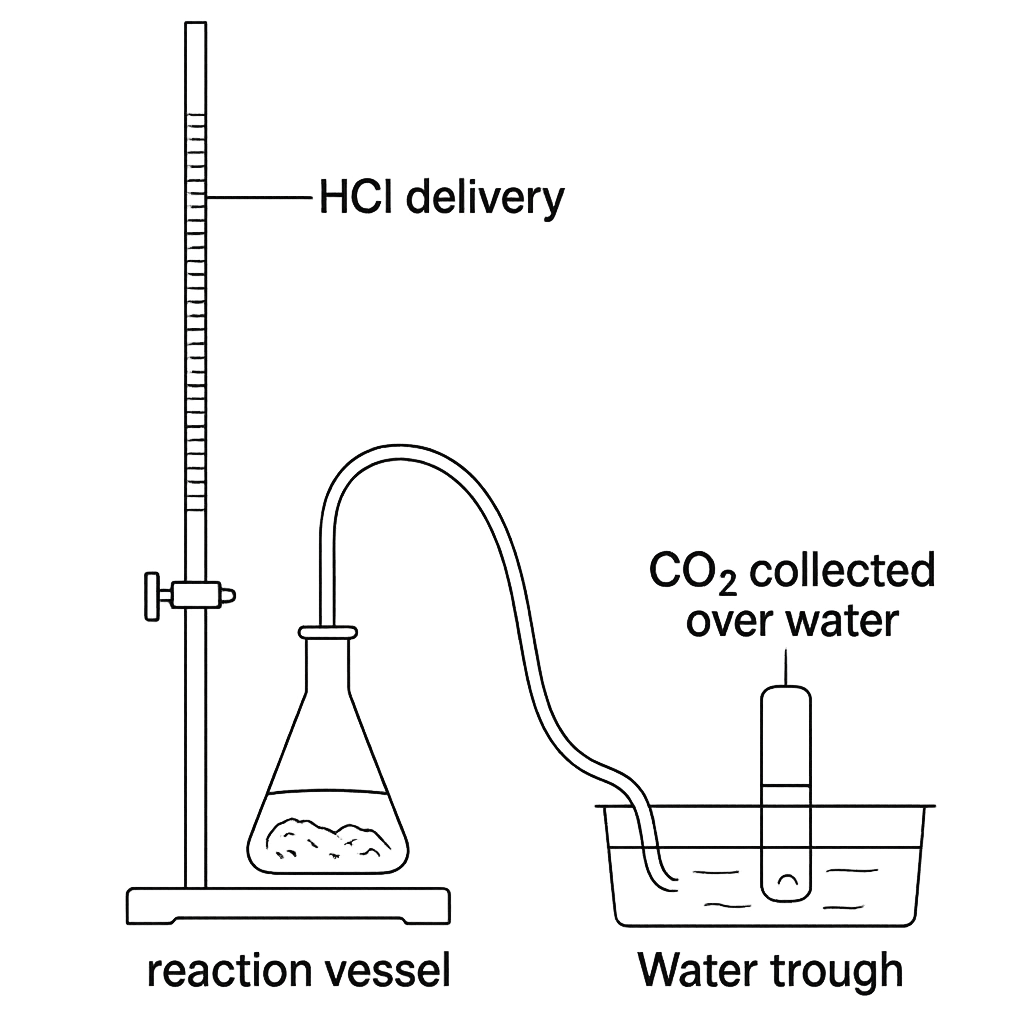
A student reacts 0.500 g of an unknown metal carbonate \(\text{MCO}_{3}\) with excess HCl. The CO\(_2\) gas produced is collected over water at 25 °C and a total pressure of 750 mmHg. The volume of gas collected is 0.350 L. The vapour pressure of water at 25 °C is 23.8 mmHg. Determine the molar mass of the metal M.
A. 45.2\ \text{g mol}^{-1}
Correct B. 36.6\ \text{g mol}^{-1}
C. 55.0\ \text{g mol}^{-1}
D. 28.0\ \text{g mol}^{-1}

Correct Answer: B

Want to see the full step-by-step solution? Unlock AI Explanation & Analytics
Question 13 View Details
A 2.00 g sample of ice at \(-10^{\circ}\text{C}\) is heated until it becomes steam at \(120^{\circ}\text{C}\). Specific heats: ice \(2.1\ \text{J g}^{-1}\text{K}^{-1}\), water \(4.18\ \text{J g}^{-1}\text{K}^{-1}\), steam \(2.0\ \text{J g}^{-1}\text{K}^{-1}\). Latent heats: fusion \(334\ \text{J g}^{-1}\), vaporisation \(2260\ \text{J g}^{-1}\). (a) Calculate the total heat required. (b) If a heater supplies \(500\ \text{J s}^{-1}\), how long will the process take?
A. 6.45\times10^{3}\ \text{J};\ 13.0\ \text{s}
B. 7.20\times10^{3}\ \text{J};\ 14.5\ \text{s}
C. 5.90\times10^{3}\ \text{J};\ 11.8\ \text{s}
Correct D. 6.15\times10^{3}\ \text{J};\ 12.3\ \text{s}

Correct Answer: D

Want to see the full step-by-step solution? Unlock AI Explanation & Analytics
Question 14 View Details
A 5.00 g sample of an unknown monobasic carboxylic acid with formula \(\text{C}_{n}\text{H}_{2n+1}\text{COOH}\) is dissolved in 50 mL water and titrated with 0.100 M NaOH. The equivalence point is reached after 42.5 mL of NaOH. The acid is then esterified with excess ethanol in the presence of H\(_2\)SO\(_4\) to give an ethyl ester. After purification, 0.520 g of the ester is obtained. (a) Determine the value of \(n\) and the molar mass of the acid. (b) Calculate the percent yield of the esterification.
A. n=5;\ M_{acid}\approx118\ \text{g mol}^{-1};\ %\,yield\approx60\%
B. n=4;\ M_{acid}\approx102\ \text{g mol}^{-1};\ %\,yield\approx70\%
Correct C. n=5;\ M_{acid}\approx118\ \text{g mol}^{-1};\ %\,yield\approx85\%
D. n=6;\ M_{acid}\approx134\ \text{g mol}^{-1};\ %\,yield\approx92\%

Correct Answer: C

Want to see the full step-by-step solution? Unlock AI Explanation & Analytics
Question 15 View Details
In the acid‑catalysed esterification of acetic acid with ethanol, the rate law is first order in \([\text{CH}_{3}\text{COOH}]\) and first order in \([\text{H}_{2}\text{SO}_{4}]\), zero order in ethanol. At 60 °C, with \([\text{CH}_{3}\text{COOH}]=0.20\ \text{M}\) and \([\text{H}_{2}\text{SO}_{4}]=0.050\ \text{M}\), the initial rate is \(2.5\times10^{-5}\ \text{M s}^{-1}\). Raising the temperature to 80 °C doubles the rate constant \(k\). Assuming the concentrations remain unchanged, calculate the time required for \([\text{CH}_{3}\text{COOH}]\) to decrease from 0.20 M to 0.10 M at 80 °C.
A. 5.6\times10^{3}\ \text{s}\ (≈93\ \text{min})
B. 1.4\times10^{3}\ \text{s}\ (≈23\ \text{min})
Correct C. 2.8\times10^{3}\ \text{s}\ (≈46\ \text{min})
D. 2.8\times10^{2}\ \text{s}\ (≈4.6\ \text{min})

Correct Answer: C

Want to see the full step-by-step solution? Unlock AI Explanation & Analytics
Question 16 View Details
A 1.650 g sample of a phosphorus oxide containing only phosphorus and oxygen is placed in a 2.0 L sealed vessel at 298 K. The initial pressure in the vessel is 750 mmHg. After the sample is heated until it completely decomposes, the pressure rises to 1020 mmHg. The pressure increase is due solely to the evolution of O₂ gas according to the decomposition reaction \( \text{P}_x\text{O}_y \rightarrow x\text{P} + \frac{y}{2}\text{O}_2 \). Determine the empirical formula of the oxide.
A. P₃O₇
B. P₂O₄
C. P₄O₁₀
Correct D. P₂O₅

Correct Answer: D

Want to see the full step-by-step solution? Unlock AI Explanation & Analytics
Question 17 View Details
A diatomic molecule AB has a measured bond length of 150 pm and a dipole moment of 2.5 D. The electronegativities of A and B are 2.1 and 3.5 respectively. (i) Calculate the fractional ionic character of the A-B bond using the relation \( \mu = \delta \; d\), where \( \mu\) is the dipole moment, \( d\) is the bond length expressed in meters, and \( \delta\) is the effective charge in coulombs. (ii) Estimate the percent ionic character from Pauling's equation \( \%\text{ionic}=\bigl(1-e^{-0.25(\Delta\chi)^2}\bigr)\times100\). (iii) Compare the two percentages and comment on the nature of the bond.
A. ≈28.9 % from dipole data; ≈40.1 % from Pauling's equation; the bond is moderately polar with mixed covalent‑ionic character.
B. ≈36.0 % from dipole data; ≈35.0 % from Pauling's equation; the bond is moderately polar with mixed covalent‑ionic character.
Correct C. ≈34.7 % from dipole data; ≈38.7 % from Pauling's equation; the bond is moderately polar with mixed covalent‑ionic character.
D. ≈30.2 % from dipole data; ≈42.5 % from Pauling's equation; the bond is moderately polar with mixed covalent‑ionic character.

Correct Answer: C

Want to see the full step-by-step solution? Unlock AI Explanation & Analytics
Question 18 View Details
A 1.00 g sample of impure white phosphorus (P₄) containing 90 % P₄ by mass is burnt completely in excess O₂. The calorimeter records a heat release of 2.90 kJ for the sample. (i) Determine the heat released per mole of pure P₄. (ii) Using the reaction \( \text{P}_4 + 5\text{O}_2 \rightarrow \text{P}_4\text{O}_{10} \), calculate the standard enthalpy of formation of \( \text{P}_4\text{O}_{10}(s) \). (iii) State whether the formation of \( \text{P}_4\text{O}_{10} \) is exothermic or endothermic.
A. -450 kJ·mol⁻¹ (exothermic)
Correct B. -399 kJ·mol⁻¹ (exothermic)
C. -350 kJ·mol⁻¹ (exothermic)
D. -399 kJ·mol⁻¹ (endothermic)

Correct Answer: B

Want to see the full step-by-step solution? Unlock AI Explanation & Analytics
Question 19 View Details
A buffer solution is prepared by dissolving 0.250 mol of acetic acid (CH₃COOH, \(K_a = 1.8\times10^{-5}\)) and 0.150 mol of sodium acetate (CH₃COONa) in 1.00 L of water. (i) Calculate the pH of the solution. (ii) The solution is then diluted to a total volume of 2.00 L; calculate the new pH. (iii) How many millilitres of 0.100 M NaOH must be added to the original (1.00 L) buffer to raise its pH by exactly 0.50 units?
A. 1500 mL
B. 200 mL
C. 850 mL
Correct D. 1120 mL

Correct Answer: D

Want to see the full step-by-step solution? Unlock AI Explanation & Analytics
Question 20 View Details
In acidic solution the redox reaction between permanganate ion and oxalic acid is balanced as follows: \( \text{MnO}_4^- + \text{C}_2\text{O}_4^{2-} + H^+ \rightarrow \text{Mn}^{2+} + CO_2 + H_2O \). (i) Balance the overall redox equation, showing the stoichiometric coefficients. (ii) If 0.0250 mol of KMnO₄ reacts completely with excess oxalic acid, calculate the volume of 0.500 M H₂SO₄ required to supply the necessary H⁺ ions.
A. 250 mL
B. 150 mL
C. 100 mL
Correct D. 200 mL

Correct Answer: D

Want to see the full step-by-step solution? Unlock AI Explanation & Analytics
Question 21 View Details
A 6.0 g mixture of ethane \(\mathrm{C_{2}H_{6}}\) and propene \(\mathrm{C_{3}H_{6}}\) is burnt in excess oxygen. The combustion produces \(18.0\) g of \(\mathrm{CO_{2}}\) and \(9.8\) g of \(\mathrm{H_{2}O}\). Determine the mass percent of each hydrocarbon in the original mixture.
A. Ethane 50.0 % (≈3.0 g), Propene 50.0 % (≈3.0 g)
B. Ethane 60.0 % (≈3.6 g), Propene 40.0 % (≈2.4 g)
C. Ethane 75.0 % (≈4.5 g), Propene 25.0 % (≈1.5 g)
Correct D. Ethane 66.7 % (≈4.0 g), Propene 33.3 % (≈2.0 g)

Correct Answer: D

Want to see the full step-by-step solution? Unlock AI Explanation & Analytics
Question 22 View Details
A 10.0 g mixture of potassium chlorate \(\mathrm{KClO_{3}}\) and potassium nitrate \(\mathrm{KNO_{3}}\) is heated in a closed vessel. Only the chlorate decomposes according to \(\mathrm{KClO_{3} \rightarrow KCl + \tfrac{3}{2} O_{2}}\). The volume of oxygen collected at 298 K and 1 atm is 2.0 L. Determine the mass percent of \(\mathrm{KClO_{3}}\) in the original mixture.
A. 75.0 % (≈7.5 g \(\mathrm{KClO_{3}}\))
Correct B. 66.8 % (≈6.68 g \(\mathrm{KClO_{3}}\))
C. 50.0 % (≈5.0 g \(\mathrm{KClO_{3}}\))
D. 60.0 % (≈6.0 g \(\mathrm{KClO_{3}}\))

Correct Answer: B

Want to see the full step-by-step solution? Unlock AI Explanation & Analytics
Question 23 View Details
A galvanic cell is constructed as \(\mathrm{Zn|Zn^{2+}(unknown)}\) || \(\mathrm{Cu^{2+}(0.010\,M)|Cu}\). At 25 °C the measured emf is \(1.05\) V. Standard electrode potentials are \(E^{\circ}(\mathrm{Zn^{2+}/Zn}) = -0.76\) V and \(E^{\circ}(\mathrm{Cu^{2+}/Cu}) = +0.34\) V. Calculate the concentration of \(\mathrm{Zn^{2+}}\) in the cell.
A. 1.2 M (approximately)
B. 0.12 M (approximately)
C. 0.78 M (approximately)
Correct D. 0.49 M (approximately)

Correct Answer: D

Want to see the full step-by-step solution? Unlock AI Explanation & Analytics
Question 24 View Details
The oxidation of a primary alcohol \(\mathrm{RCH_{2}OH}\) to the corresponding aldehyde \(\mathrm{RCHO}\) by \(\mathrm{Na_{2}Cr_{2}O_{7}}\) in acidic medium follows first‑order kinetics. At 298 K the rate constant is \(k_{1}=2.5\times10^{-4}\ \text{s}^{-1}\). When the temperature is raised to 308 K the observed half‑life is 5.0 min. Determine the activation energy \(E_{a}\) in kJ·mol\(^{-1}\). (R = 8.314 J·mol\(^{-1}\)·K\(^{-1}\))
Correct A. 170 kJ·mol⁻¹ (approximately)
B. 120 kJ·mol⁻¹ (approximately)
C. 210 kJ·mol⁻¹ (approximately)
D. 95 kJ·mol⁻¹ (approximately)

Correct Answer: A

Want to see the full step-by-step solution? Unlock AI Explanation & Analytics
Question 25 View Details
A 2.00 g sample of an unknown compound containing carbon, hydrogen, oxygen and 0.10 g of nitrogen is combusted completely. The combustion yields 5.53 g of \(\mathrm{CO_{2}}\) and 2.24 g of \(\mathrm{H_{2}O}\). Determine the empirical formula of the organic portion (C, H, O) of the compound.
Correct A. C₁₄H₂₈O
B. C₁₅H₃₀O
C. C₁₄H₂₆O
D. C₁₃H₂₆O

Correct Answer: A

Want to see the full step-by-step solution? Unlock AI Explanation & Analytics

Master the Exam!

You've seen a preview, but there are thousands more questions plus AI tutor to break down complex solutions.

Unlock Full Access Available for Android & Windows
Help others prepare! Share this practice hub:
Chat with Support