neco model questions vol1 2020 biology | Objective

Prepare for your exams with neco model questions vol1 questions? Reviewing past/model questions is one of the most effective ways to guarantee a high score. This practice hub features authentic 2020 biology (Objective) questions designed to simulate the real exam environment.

Practice these randomly selected questions to test your readiness.

Question 1 View Details
In a certain kingdom there are three phyla. The first phylum has twice as many classes as the second, and the third phylum has \(6\) classes. The total number of classes in the kingdom is \(21\). Each class in the first phylum contains \(5\) orders, each class in the second phylum contains \(3\) orders, and each class in the third phylum contains \(4\) orders. The total number of orders in the kingdom is \(89\). If each order in the first phylum contains \(2\) families, each order in the second phylum contains \(3\) families, and each order in the third phylum contains \(4\) families, how many families are there in total in the kingdom?
A. 231
B. 251
C. 261
Correct D. 241

Correct Answer: D

Want to see the full step-by-step solution? Unlock AI Explanation & Analytics
Question 2 View Details
An outbreak of a disease occurs in a community of \(10{,}000\) people. The first week there are \(5\) confirmed cases. Each infected person infects, on average, \(R_{0}\) new persons per week. After three weeks the cumulative number of cases is \(150\). Assuming discrete weekly generations and a constant \(R_{0}\), determine the approximate value of \(R_{0}\). A vaccination programme is then introduced that reduces the effective reproduction number by \(40\%\). Starting from the end of week three, estimate the total number of cases that will have occurred by the end of week five (i.e., after two more weeks) under the reduced reproduction number. Round the final number of cases to the nearest whole person.
A. 621
B. 581
C. 511
Correct D. 551

Correct Answer: D

Want to see the full step-by-step solution? Unlock AI Explanation & Analytics
Question 3 View Details
In a plant two genes are linked on the same chromosome: gene \(A\) (tall \(A\) dominant, dwarf \(a\) recessive) and gene \(B\) (green \(B\) dominant, yellow \(b\) recessive). The recombination frequency between them is \(10\%\). A heterozygous plant \(AaBb\) is crossed with a homozygous recessive plant \(aabb\). Assuming the parental gametes \(AB\) and \(ab\) each constitute \(45\%\) of the heterozygote's gametes and the recombinant gametes \(Ab\) and \(aB\) each constitute \(5\%\), what percentage of the offspring are tall (regardless of colour)?
A. 55
Correct B. 50
C. 60
D. 45

Correct Answer: B

Want to see the full step-by-step solution? Unlock AI Explanation & Analytics
Question 4 View Details
A daily diet plan consists of three meals. Meal 1 provides \(30\) g protein, \(40\) g carbohydrate and \(20\) g fat. Meal 2 provides \(25\) g protein, \(60\) g carbohydrate and \(15\) g fat. Meal 3 provides \(20\) g protein, \(50\) g carbohydrate and \(25\) g fat. The recommended daily intake (RDI) for an adult is \(56\) g protein, \(310\) g carbohydrate and \(70\) g fat. Calculate the percentage of the RDI met for each macronutrient after the three meals, round each percentage to the nearest whole percent, and state which macronutrient is the most limiting (i.e., has the lowest percentage of its RDI) together with that percentage.
Correct A. carbohydrate, 48%
B. carbohydrate, 55%
C. protein, 55%
D. fat, 40%

Correct Answer: A

Want to see the full step-by-step solution? Unlock AI Explanation & Analytics
Question 5 View Details
State the correct sequential order of the phases of mitosis.
Correct A. prophase, metaphase, anaphase, telophase
B. prophase, anaphase, metaphase, telophase
C. prophase, metaphase, telophase, anaphase
D. metaphase, prophase, anaphase, telophase

Correct Answer: A

Want to see the full step-by-step solution? Unlock AI Explanation & Analytics
Question 6 View Details
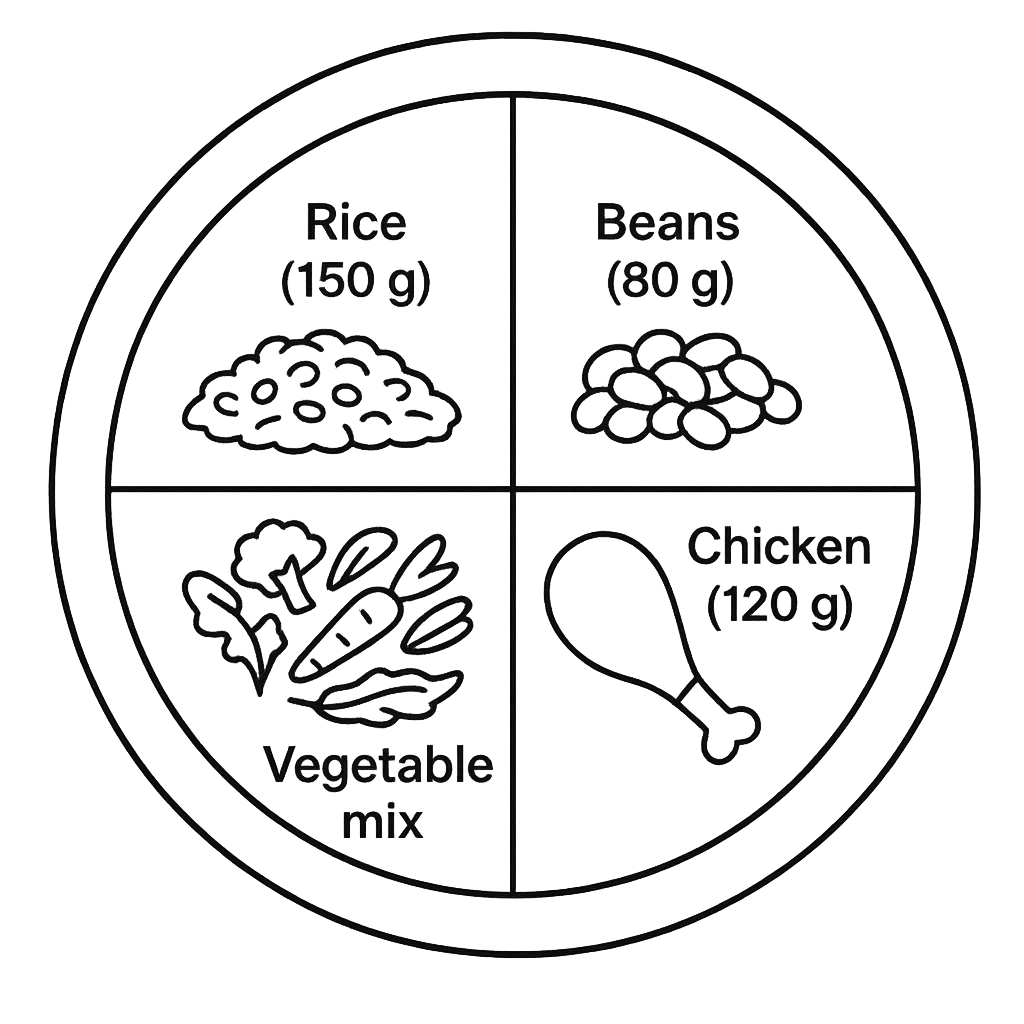
The diagram shows a plate divided into four food portions with their masses: Rice ((150\) g), Beans ((80\) g), Chicken ((120\) g) and Vegetable mix ((100\) g). The macronutrient composition of each food is: Rice - (80\)% carbohydrate, (2\)% protein, (0\)% fat; Beans - (20\)% carbohydrate, (20\)% protein, (1\)% fat; Chicken - (0\)% carbohydrate, (30\)% protein, (10\)% fat; Vegetables - (5\)% carbohydrate, (2\)% protein, (0\)% fat. Using the energy values (4\) kcal g(^{-1}\) for carbohydrate and protein and (9\) kcal g(^{-1}\) for fat, calculate the total caloric content of the meal shown in the diagram. Round your answer to the nearest kilocalorie.
A. 1023
Correct B. 907
C. 960
D. 845

Correct Answer: B

Want to see the full step-by-step solution? Unlock AI Explanation & Analytics
Question 7 View Details
A person at sea level (barometric pressure \(P_b = 760\) mmHg) breathes with a tidal volume of \(500\) mL and a respiratory rate of \(15\) breaths min\(^{-1}\). Anatomical dead space is \(150\) mL. The fraction of inspired oxygen is \(F_{IO_2}=0.21\). Water vapour pressure in the airways is \(P_{H_2O}=47\) mmHg, arterial \(P_{CO_2}=40\) mmHg and the respiratory quotient is \(R=0.8\). (a) Calculate the alveolar ventilation per minute. (b) Using the alveolar gas equation, determine the alveolar partial pressure of oxygen (\(P_{A O_2}\)). Round your answer to the nearest whole mmHg.
A. 5200; 105
Correct B. 5250; 100
C. 5150; 90
D. 5300; 95

Correct Answer: B

Want to see the full step-by-step solution? Unlock AI Explanation & Analytics
Question 8 View Details
In a certain model, the length of the follicular phase (\(L_f\), in days) is inversely proportional to the average daily estrogen concentration (\(E\), in pg mL\(^{-1}\)) during that phase, expressed as \(L_f = \dfrac{k}{E}\) where the constant \(k = 140\) day·pg mL\(^{-1}\). A woman has a 28‑day menstrual cycle and her measured average estrogen concentration during the follicular phase is \(35\) pg mL\(^{-1}\). (a) Determine the length of her follicular phase. (b) On which day of the cycle does ovulation occur, assuming ovulation marks the end of the follicular phase? (c) What average estrogen concentration would be required to extend the follicular phase to \(10\) days?
A. 6 days; day 6; 10 pg/mL
Correct B. 4 days; day 4; 14 pg/mL
C. 5 days; day 5; 12 pg/mL
D. 3 days; day 3; 16 pg/mL

Correct Answer: B

Want to see the full step-by-step solution? Unlock AI Explanation & Analytics
Question 9 View Details
The cytoplasm of a cell has a total volume of \(1500\) µm³. It contains \(2000\) mitochondria, each with an average volume of \(0.5\) µm³. Assuming the mitochondria are the only large organelles occupying volume, calculate the percentage of the cytoplasmic volume that is occupied by mitochondria. Give your answer to one decimal place.
A. 75.0
B. 66.6
C. 60.0
Correct D. 66.7

Correct Answer: D

Want to see the full step-by-step solution? Unlock AI Explanation & Analytics
Question 10 View Details
Two genes, A and B, are located on the same chromosome and are 20 % recombination apart. A plant heterozygous for both genes in the cis configuration (genotype AB/ab) is crossed with a plant homozygous recessive (ab/ab). (a) List the possible gametes produced by the heterozygous parent and their respective frequencies. (b) What is the probability (as a percentage) that an offspring will be both tall (dominant allele A) and have purple flowers (dominant allele B)?
A. 20
B. 50
Correct C. 40
D. 30

Correct Answer: C

Want to see the full step-by-step solution? Unlock AI Explanation & Analytics
Question 11 View Details
A person's blood glucose concentration is initially 5.0 mmol L⁻¹. After a meal, insulin rises to 12 µU mL⁻¹ and each µU mL⁻¹ of insulin causes glucose uptake of 0.04 mmol L⁻¹ per 10 min. At the same time glucagon falls to 4 µU mL⁻¹ and each µU mL⁻¹ of glucagon causes glucose release of 0.02 mmol L⁻¹ per 10 min. Assuming the rates remain constant for 30 min, what is the blood glucose concentration after this period?
Correct A. 3.8 mmol L⁻¹
B. 4.2 mmol L⁻¹
C. 3.6 mmol L⁻¹
D. 3.3 mmol L⁻¹

Correct Answer: A

Want to see the full step-by-step solution? Unlock AI Explanation & Analytics
Question 12 View Details
Two freshwater ecosystems, A and B, each have a primary‑producer biomass of 5 000 kg. In ecosystem A the energy‑transfer efficiencies are: producer → primary consumer 10 %, primary → secondary 15 %, secondary → top predator 5 %. The observed top‑predator biomass in A is 30 kg.\nIn ecosystem B the efficiencies are: producer → primary consumer 12 %, primary → secondary 10 %, secondary → top predator 4 %. The observed top‑predator biomass in B is 20 kg.\n(a) Calculate the biomass of the primary‑consumer level in ecosystem B.\n(b) Which ecosystem has the greater secondary‑consumer biomass?
A. 500 kg; Ecosystem A
Correct B. 5 000 kg; Ecosystem A
C. 700 kg; Ecosystem B
D. 600 kg; Ecosystem B

Correct Answer: B

Want to see the full step-by-step solution? Unlock AI Explanation & Analytics
Question 13 View Details
A subject has a plasma urea concentration of 7 mmol L⁻¹ and a glomerular filtration rate (GFR) of 125 mL min⁻¹. Urea is filtered completely and 50 % of the filtered load is reabsorbed. If the urine flow rate is 1.2 mL min⁻¹, (a) how many millimoles of urea are excreted per minute? (b) what is the urea concentration in the urine (mmol L⁻¹)?
A. 0.52 mmol min⁻¹; 433 mmol L⁻¹
Correct B. 0.44 mmol min⁻¹; 365 mmol L⁻¹
C. 0.35 mmol min⁻¹; 292 mmol L⁻¹
D. 0.44 mmol min⁻¹; 300 mmol L⁻¹

Correct Answer: B

Want to see the full step-by-step solution? Unlock AI Explanation & Analytics
Question 14 View Details
During which phase of mitosis do sister chromatids separate and move toward opposite poles of the cell?
Correct A. Anaphase
B. Metaphase
C. Telophase
D. Prophase

Correct Answer: A

Want to see the full step-by-step solution? Unlock AI Explanation & Analytics
Question 15 View Details
At rest a person produces metabolic heat at a rate of 100 W. In a hot environment the body loses heat by radiation (30 W) and convection (20 W). To avoid a rise in core temperature, excess heat must be lost by sweating. The latent heat of vaporisation of water is 2.43 kJ g⁻¹. Assuming steady‑state conditions, what is the minimum sweat rate (g min⁻¹) required to maintain thermal balance?
A. 1.5 g min⁻¹
Correct B. 1.2 g min⁻¹
C. 0.8 g min⁻¹
D. 2.0 g min⁻¹

Correct Answer: B

Want to see the full step-by-step solution? Unlock AI Explanation & Analytics
Question 16 View Details
Two populations of a species show a (2\%\) difference in their mitochondrial DNA sequences. If the neutral mutation rate is (0.5\%\) per million years per lineage, estimate the time (in million years) since the populations diverged. A fossil belonging to one population is dated at (1.2\) million years old. Assuming the divergence time applies to both populations, estimate the age (in million years) of the earliest possible fossil from the other population.
A. 1.0
B. 0.6
Correct C. 0.8
D. 0.4

Correct Answer: C

Want to see the full step-by-step solution? Unlock AI Explanation & Analytics
Question 17 View Details
In a community, an infectious disease shows case numbers doubling every 5 days. The average infectious period is 7 days. Assuming a simple SIR model, estimate the basic reproduction number \(R_0\) using the approximation \(R_0 = 1 + \frac{D\ln 2}{T_d}\), where \(D\) is the infectious period and \(T_d\) the doubling time. Then determine the herd‑immunity threshold \(H = 1 - \frac{1}{R_0}\). If a vaccine has an efficacy of 85\%, what proportion of the total population must be vaccinated to achieve herd immunity?
Correct A. 0.58
B. 0.62
C. 0.70
D. 0.45

Correct Answer: A

Want to see the full step-by-step solution? Unlock AI Explanation & Analytics
Question 18 View Details
A bus must travel a 240 km route. For the first 150 km it travels at 60 km h\(^{-1}\) and consumes fuel at 0.4 L km\(^{-1}\). For the remaining distance it travels at 40 km h\(^{-1}\) and consumes fuel at 0.5 L km\(^{-1}\). Fuel costs are ₦150 per litre at the starting depot and ₦130 per litre at a fuel station located exactly at the 150 km mark. The bus's fuel tank capacity is 120 L. Determine the fueling strategy that minimises total fuel cost while ensuring the bus can complete the route, and state the minimum total cost.
A. 14700
B. 14950
Correct C. 14850
D. 15000

Correct Answer: C

Want to see the full step-by-step solution? Unlock AI Explanation & Analytics
Question 19 View Details
A genus *Xanthus* originally contained 12 species. Recent molecular studies reclassify these species as follows: *Xanthus* retains 7 species, a newly erected genus *Aureus* receives 5 species, and 2 species are transferred to the existing genus *Viridis*. (a) What is the percentage decrease in the number of species in *Xanthus*? (b) What fraction of the original 12 species are now placed in *Aureus*? Express the fraction in lowest terms.
A. -33.3%; 5/12
B. -45.0%; 5/12
C. -41.7%; 1/4
Correct D. -41.7%; 5/12

Correct Answer: D

Want to see the full step-by-step solution? Unlock AI Explanation & Analytics
Question 20 View Details
A diploid somatic cell with chromosome number \(2n = 8\) undergoes meiosis. How many haploid gametes are produced and what is the chromosome number in each gamete?
Correct A. 4 gametes, each with 4 chromosomes
B. 4 gametes, each with 2 chromosomes
C. 2 gametes, each with 4 chromosomes
D. 8 gametes, each with 4 chromosomes

Correct Answer: A

Want to see the full step-by-step solution? Unlock AI Explanation & Analytics
Question 21 View Details
In an island bird population, the initial frequency of allele A is \(0.30\). Each generation, \(10\%\) of the individuals are migrants from the mainland where the frequency of allele A is \(0.60\). After migration, individuals with allele A have a \(20\%\) fitness advantage over those with allele a (selection coefficient \(s = 0.20\)). Assuming random mating and a large population, what is the frequency of allele A after one generation? Give your answer to three decimal places.
A. 0.408
Correct B. 0.372
C. 0.336
D. 0.300

Correct Answer: B

Want to see the full step-by-step solution? Unlock AI Explanation & Analytics
Question 22 View Details
During a neurological examination, a patient shows the following findings: (i) the patellar tendon tap elicits no knee‑jerk reflex, (ii) the patient reports normal sensation over the anterior thigh, (iii) when asked to voluntarily extend the leg, the patient can do so normally, and (iv) the ankle‑jerk reflex is present and normal. Based on these observations, which component of the patellar reflex arc is most likely impaired? Provide the specific part (e.g., afferent neuron, integration centre, efferent neuron, etc.).
A. the afferent neuron (sensory fiber) of the patellar reflex
Correct B. the integration centre (synapse in the spinal cord) of the patellar reflex
C. the efferent neuron (motor fiber) of the patellar reflex
D. the muscle spindle (receptor) of the patellar reflex

Correct Answer: B

Want to see the full step-by-step solution? Unlock AI Explanation & Analytics
Question 23 View Details
In a lake, a fish population follows the logistic growth model \(\frac{dN}{dt}=rN\left(1-\frac{N}{K}\right)\) with intrinsic growth rate \(r = 0.5\ \text{year}^{-1}\) and carrying capacity \(K = 20\,000\) fish. The population is initially \(N_0 = 5\,000\) fish. After two years, a constant harvest of \(H\) fish per year is introduced. (a) Determine the maximum sustainable harvest rate \(H_{\max}\) (in fish per year) that will allow the population to persist without extinction. (b) Under this maximum harvest, what is the equilibrium population size? Give your answers as whole numbers.
A. 2,800 fish per year; equilibrium population 9,000 fish
Correct B. 2,500 fish per year; equilibrium population 10,000 fish
C. 3,000 fish per year; equilibrium population 8,000 fish
D. 2,000 fish per year; equilibrium population 12,000 fish

Correct Answer: B

Want to see the full step-by-step solution? Unlock AI Explanation & Analytics
Question 24 View Details
A person has a glomerular filtration rate (GFR) of \(120\ \text{mL min}^{-1}\). Of the filtrate, \(99\%\) of the water is reabsorbed in the proximal tubule, \(85\%\) of the remaining water is reabsorbed in the loop of Henle, and \(95\%\) of the remaining water is reabsorbed in the distal tubule and collecting duct. Assuming no other losses, calculate the total volume of urine produced in one day (in millilitres). Round your answer to the nearest whole number.
A. 15
B. 10
Correct C. 13
D. 12

Correct Answer: C

Want to see the full step-by-step solution? Unlock AI Explanation & Analytics
Question 25 View Details
In Drosophila, two genes A and B are located on the same chromosome with a recombination frequency of \(12\%\). The dominant alleles are \(A\) and \(B\); recessive alleles are \(a\) and \(b\). A homozygous dominant individual (genotype \(AA\ BB\)) is crossed with a homozygous recessive individual (\(aa\ bb\)). The F\(_1\) generation is test‑crossed with a homozygous recessive (\(aa\ bb\)). (a) What is the map distance between genes A and B in centimorgans? (b) Out of 500 progeny from the test cross, how many are expected to show recombinant phenotypes? Provide the number of recombinant offspring.
A. 10 cM; 50 recombinant offspring
B. 15 cM; 75 recombinant offspring
C. 12 cM; 30 recombinant offspring
Correct D. 12 cM; 60 recombinant offspring

Correct Answer: D

Want to see the full step-by-step solution? Unlock AI Explanation & Analytics

Master the Exam!

You've seen a preview, but there are thousands more questions plus AI tutor to break down complex solutions.

Unlock Full Access Available for Android & Windows
Help others prepare! Share this practice hub:
Chat with Support