neco model questions vol1 2020 biology | Essay

Prepare for your exams with neco model questions vol1 questions? Reviewing past/model questions is one of the most effective ways to guarantee a high score. This practice hub features authentic 2020 biology (Essay) questions designed to simulate the real exam environment.

Practice these randomly selected questions to test your readiness.
Question 1 View Details
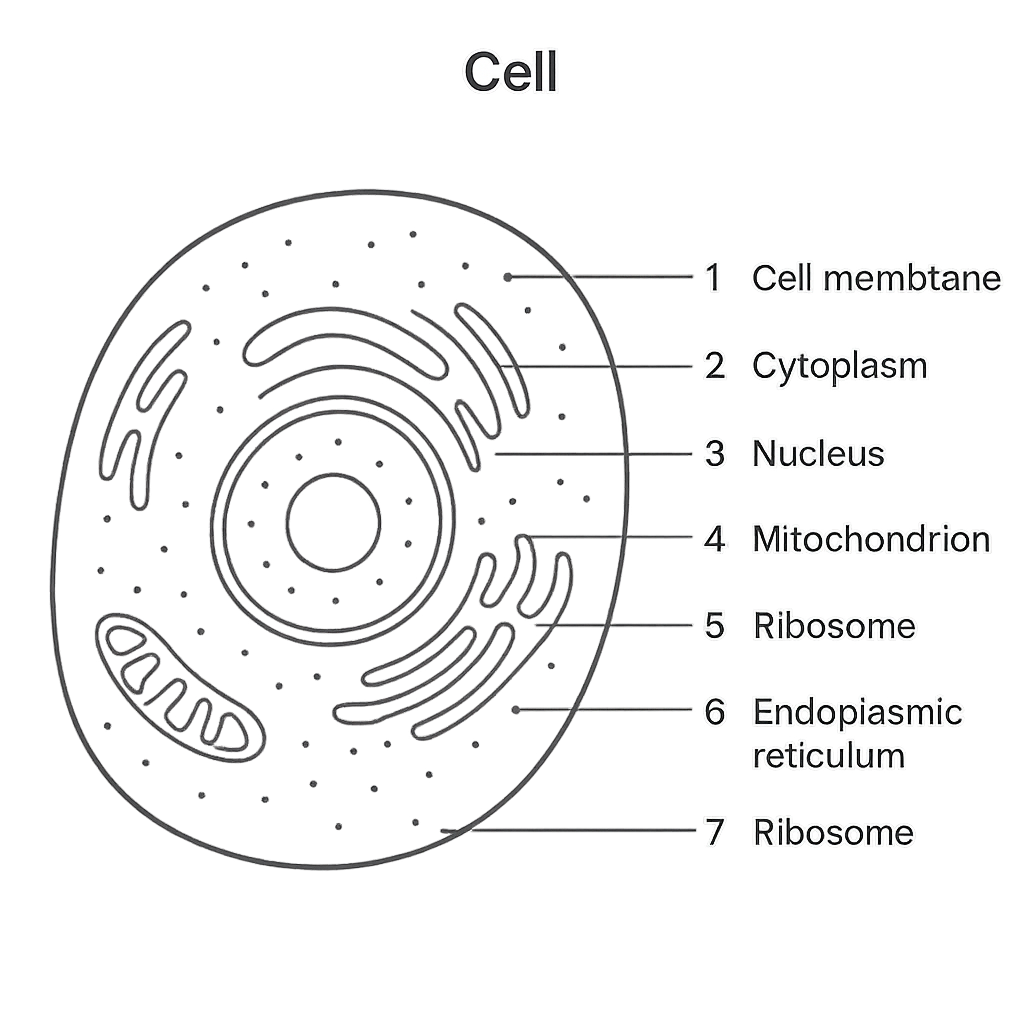
The labelled diagram shows a typical animal cell.
Question Parts
(a)
Identify the cell structures labelled 1 to 7 in the diagram.
(b)
State the main function of each of the structures identified in part (a).
(c)
Compare one major difference between animal and plant cells that can be inferred from the diagram.
Detailed Essay Solution & Marking Scheme Available

Get the step-by-step mathematical proofs, key points required by examiners, and a comprehensive breakdown from our AI Tutor.
Question 2 View Details
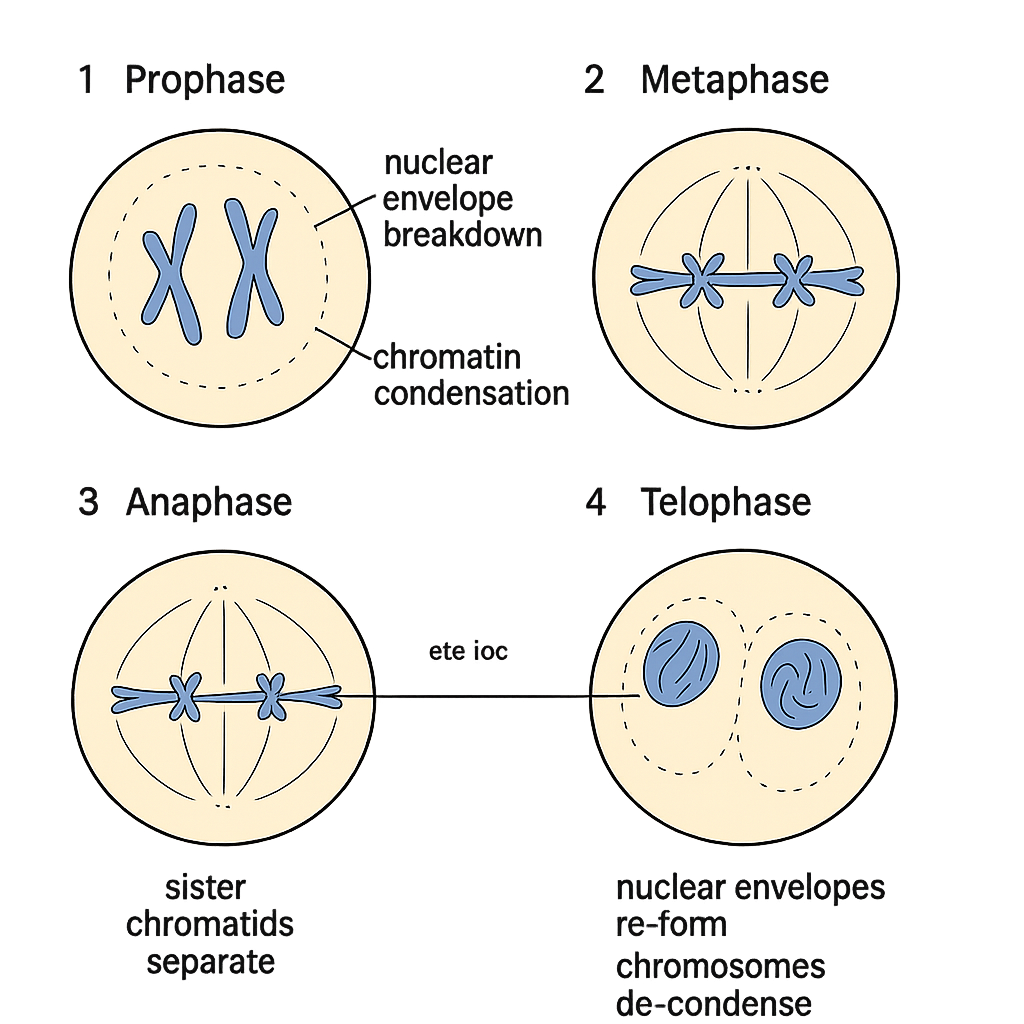
The labelled diagram depicts the stages of mitosis in a eukaryotic cell.
Question Parts
(a)
List the stages of mitosis in their correct chronological order, using the labels shown in the diagram.
(b)
For each stage identified in part (a), describe one key cellular event that characterises that stage.
(c)
Explain the significance of cytokinesis following telophase in animal cells.
Detailed Essay Solution & Marking Scheme Available

Get the step-by-step mathematical proofs, key points required by examiners, and a comprehensive breakdown from our AI Tutor.
Question 3 View Details
A 30‑year‑old female weighing 60 kg follows a 3‑day diet that provides a total of 2 500 kcal per day. The macronutrient composition of the diet is 300 g carbohydrate, 80 g protein and 70 g fat.
Question Parts
(a)
Calculate the percentage of the total daily energy that is supplied by each macronutrient (carbohydrate, protein and fat). Show all steps.
(b)
Explain two physiological consequences that may arise from a chronic protein deficiency in this individual.
(c)
The Recommended Dietary Allowance (RDA) for protein for a moderately active adult is 0.8 g kg⁻¹ day⁻¹. Suggest two practical dietary modifications that would enable her to meet the RDA, and justify each suggestion.
Detailed Essay Solution & Marking Scheme Available

Get the step-by-step mathematical proofs, key points required by examiners, and a comprehensive breakdown from our AI Tutor.
Question 4 View Details
At sea level the atmospheric pressure is 760 mm Hg and the fractional concentration of inspired oxygen (FIO₂) is 0.21. The alveolar gas equation is PAO₂ = (Patm – PH₂O) × FIO₂ – (PaCO₂ / R), where PH₂O = 47 mm Hg and the respiratory quotient (R) is 0.8. An adult at rest has an arterial PCO₂ of 40 mm Hg.
Question Parts
(a)
Using the alveolar gas equation, calculate the alveolar partial pressure of oxygen (PAO₂) at sea level and at an altitude of 3 000 m where the atmospheric pressure falls to 523 mm Hg, assuming all other variables remain unchanged.
(b)
Explain how the reduction in PAO₂ at high altitude affects the overall oxygen transport from the lungs to the tissues.
(c)
During vigorous exercise at sea level, the Bohr effect causes a right‑shift of the haemoglobin‑oxygen dissociation curve. Describe this effect and discuss why it is advantageous during exercise.
Detailed Essay Solution & Marking Scheme Available

Get the step-by-step mathematical proofs, key points required by examiners, and a comprehensive breakdown from our AI Tutor.

Question 5 View Details
The human circulatory system transports gases, nutrients, hormones and waste products between the external environment and body cells.
Question Parts
(a)
Explain how the structure of capillaries facilitates exchange of nutrients and waste between blood and surrounding tissues.
(b)
The average adult cardiac output is 5 L min⁻¹. Blood contains 0.2 % dissolved oxygen by volume. Calculate the volume of oxygen (as a gas at STP) delivered to the tissues each minute.
(c)
During intense exercise cardiac output rises to 20 L min⁻¹ and muscle oxygen extraction increases from 25 % to 40 % of the oxygen delivered. Calculate the increase in the amount of oxygen extracted per minute compared with rest.
(d)
Discuss two physiological adaptations that improve the efficiency of transport during prolonged physical activity.
Detailed Essay Solution & Marking Scheme Available

Get the step-by-step mathematical proofs, key points required by examiners, and a comprehensive breakdown from our AI Tutor.

Question 6 View Details
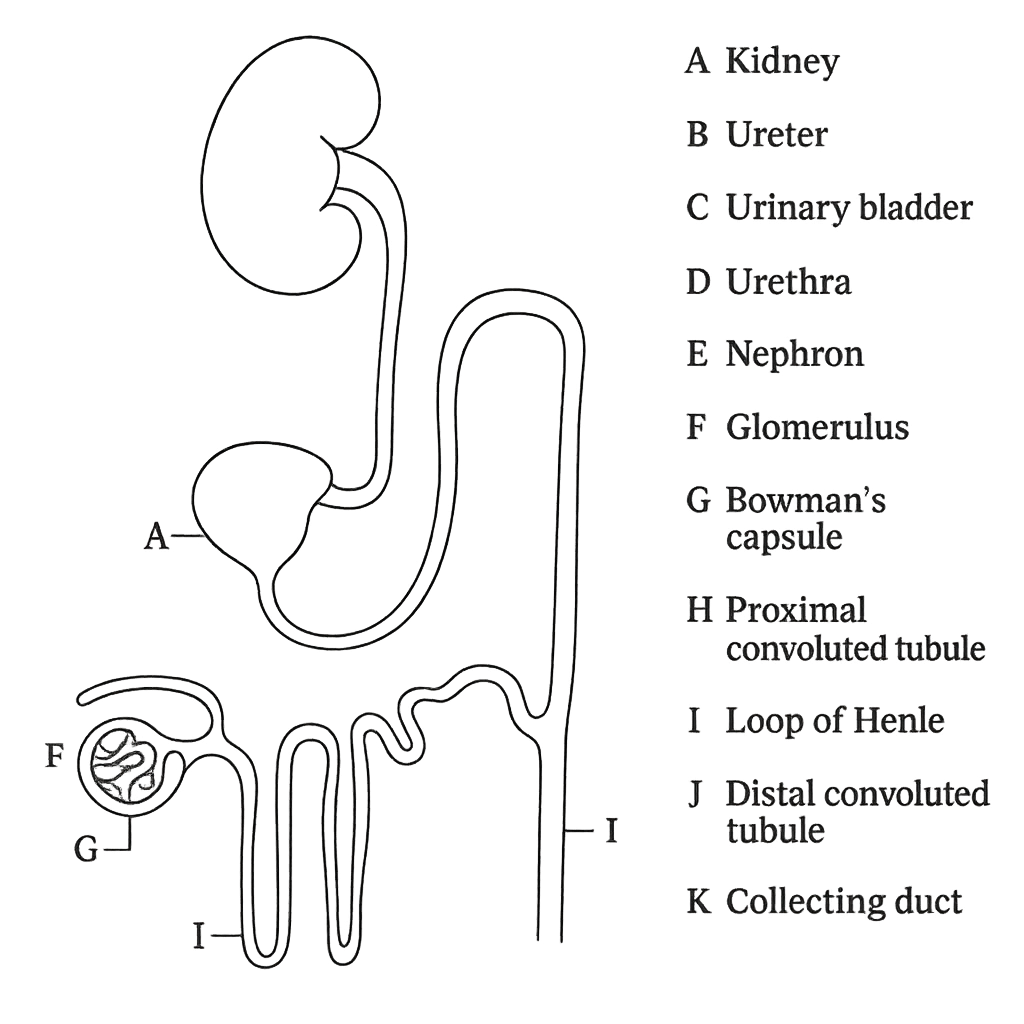
The diagram shows the human excretory system. The kidney is illustrated in detail with a labelled nephron. Labels A–K correspond to the structures listed in the diagram specification.
Question Parts
(a)
Identify the structures labelled A–K in the diagram.
(b)
Describe the sequence of events that lead to the formation of urine, linking each step to the appropriate labelled part of the diagram.
(c)
The filtrate entering Bowman's capsule contains 180 mM NaCl. After passage through the loop of Henle its NaCl concentration is 120 mM. Calculate the percentage reduction in NaCl concentration and discuss the physiological importance of this change.
(d)
A defect reduces water reabsorption in the collecting duct (K) by 30 %. Predict the likely effect on (i) urine volume and (ii) urine osmolarity, giving a brief explanation based on the diagram.
Detailed Essay Solution & Marking Scheme Available

Get the step-by-step mathematical proofs, key points required by examiners, and a comprehensive breakdown from our AI Tutor.

Question 7 View Details
Explain how the human body maintains internal stability when exposed to external temperature changes.
Question Parts
(a)
Describe the role of the hypothalamus in thermoregulation, stating the type of feedback involved.
(b)
Outline the physiological responses that occur when a person is suddenly exposed to a cold environment, indicating the organs or tissues involved and the direction of change (e.g., vasoconstriction, shivering).
(c)
Compare the mechanisms of heat loss in humans with those of a mammal that relies primarily on evaporative cooling (e.g., a dog). Discuss one advantage and one limitation of each mechanism.
(d)
A patient with a lesion in the sympathetic spinal cord (T1–T3) cannot sweat on the chest and upper abdomen. Predict how this defect would affect the individual's ability to regulate body temperature in a hot environment and suggest two management strategies.
Detailed Essay Solution & Marking Scheme Available

Get the step-by-step mathematical proofs, key points required by examiners, and a comprehensive breakdown from our AI Tutor.

Question 8 View Details
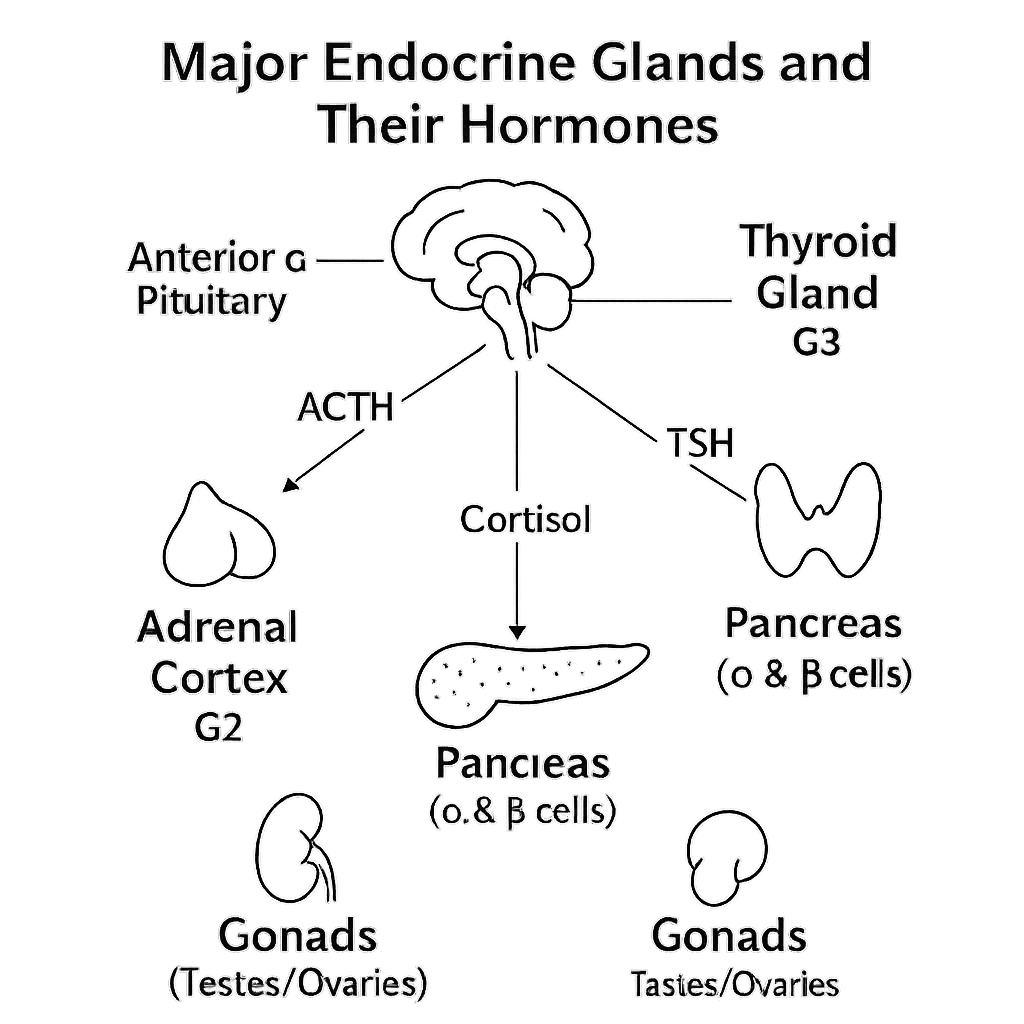
The diagram shows the major endocrine glands of the human body and the principal hormones they secrete. Each gland is labelled G1, G2, G3, G4 and G5.
Question Parts
(a)
Identify the gland labelled G1 and list two hormones it secretes. For each hormone, state one physiological effect.
() Identify the gland labelled G1.
() List two hormones secreted by this gland.
() State one physiological effect of each hormone listed.
(b)
The hormone cortisol is secreted by the gland labelled G2. Explain how cortisol helps the body respond to prolonged stress, addressing both metabolic and immune aspects.
(c)
Describe the negative feedback loop that controls the secretion of thyroid hormones. In your answer, name the hypothalamic releasing factor, the pituitary hormone, the thyroid hormone, and the target organ. Then discuss the likely clinical manifestations if this feedback is disrupted resulting in hyperthyroidism.
Detailed Essay Solution & Marking Scheme Available

Get the step-by-step mathematical proofs, key points required by examiners, and a comprehensive breakdown from our AI Tutor.

Master the Exam!

You've seen a preview, but there are thousands more questions plus AI tutor to break down complex solutions.

Unlock Full Access Available for Android & Windows
Help others prepare! Share this practice hub:
Chat with Support