neco model questions vol1 2020 agricultural_science | Essay

Prepare for your exams with neco model questions vol1 questions? Reviewing past/model questions is one of the most effective ways to guarantee a high score. This practice hub features authentic 2020 agricultural_science (Essay) questions designed to simulate the real exam environment.

Practice these randomly selected questions to test your readiness.

Question 1 View Details
A farmer wishes to improve the sustainability of his 5‑hectare mixed‑crop farm located in the Sudan savanna zone of Nigeria. The farm currently practices continuous cultivation of maize with occasional fallow periods of two months. The farmer is considering adopting an integrated crop‑livestock system that incorporates legumes, trees and controlled grazing.
Question Parts
(a)
Explain how rotating maize with a leguminous crop such as cowpea can enhance soil fertility. Include the biological processes involved.
(b)
Discuss two ecological advantages of planting nitrogen‑fixing trees on the farm margins.
(c)
Identify three potential pest‑management benefits that arise from integrating livestock grazing into the cropping system.
Detailed Essay Solution & Marking Scheme Available

Get the step-by-step mathematical proofs, key points required by examiners, and a comprehensive breakdown from our AI Tutor.
Question 2 View Details
A soil laboratory is set up to determine the bulk density and porosity of a field soil sample using the displacement method. The arrangement shown in the illustration consists of a 500 ml graduated cylinder placed on a bench. First, 250 ml of distilled water is poured into the cylinder. A 100 g oven‑dry soil sample is then added and the mixture is shaken vigorously for 2 minutes before being allowed to settle for 2 hours. After settlement, the water level rises to 320 ml on the cylinder scale and a hydrometer inserted into the liquid reads 1.025 g cm⁻³ at that level.
Question Parts
(a)
Describe the procedural steps shown in the set‑up that are required to obtain a reliable bulk‑density measurement.
(b)
Using the data provided, calculate: (i) the bulk density of the soil in g cm⁻³; (ii) the porosity of the soil as a percentage (assume a particle density of 2.65 g cm⁻³). Show all intermediate steps.
Detailed Essay Solution & Marking Scheme Available

Get the step-by-step mathematical proofs, key points required by examiners, and a comprehensive breakdown from our AI Tutor.

Question 3 View Details
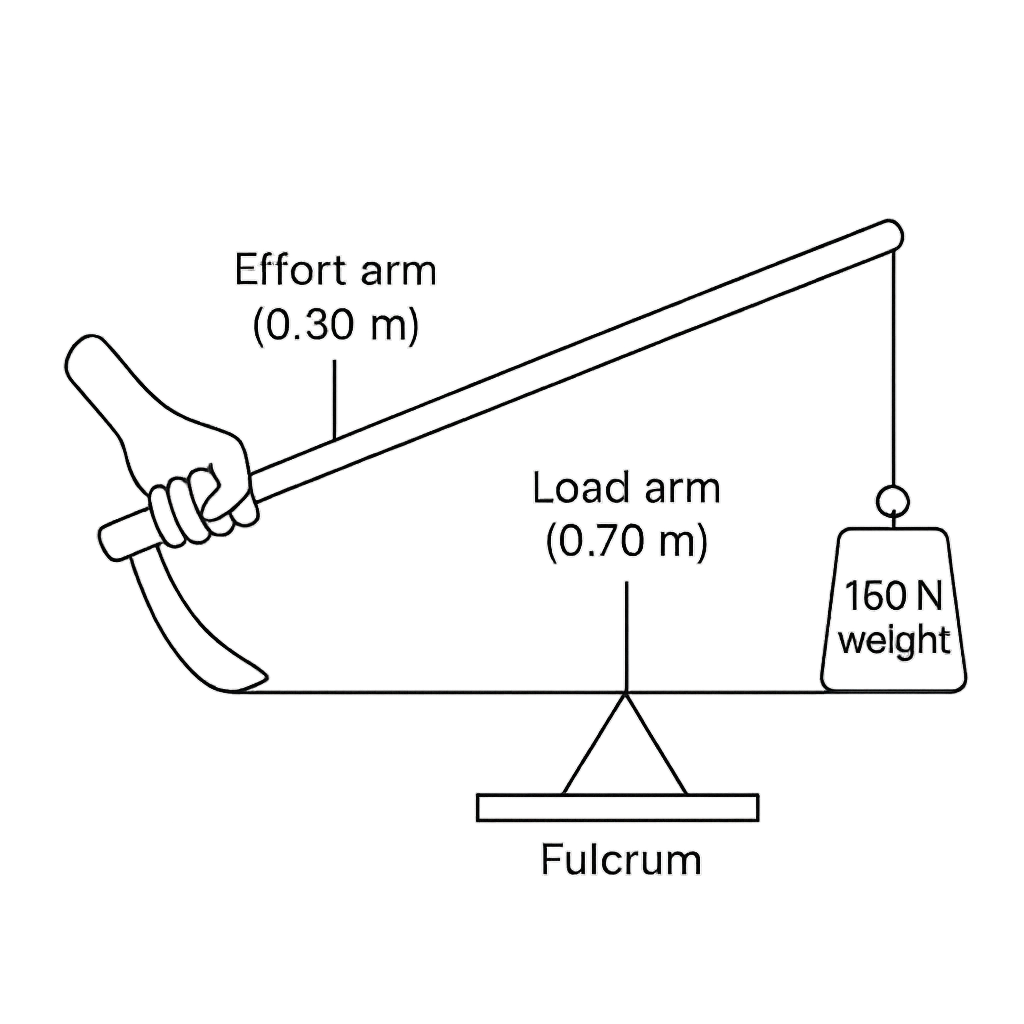
The diagram shows a simple lever arrangement used to test the mechanical advantage of a hand hoe. The fulcrum is positioned 0.30 m from the point where the farmer applies the effort (the cutting edge of the hoe) and 0.70 m from the point where a load is attached. A weight of 150 N is suspended from the load arm.
Question Parts
(a)
Calculate the mechanical advantage (MA) of the lever.
(b)
Determine the magnitude of the effort force that the farmer must apply to lift the 150 N load.
(c)
If the farmer can apply a maximum effort of 80 N, will the lever lift the load? Justify your answer.
(d)
Discuss two advantages of using a lever‑type hand hoe over a straight‑hand hoe in terms of labour efficiency.
Detailed Essay Solution & Marking Scheme Available

Get the step-by-step mathematical proofs, key points required by examiners, and a comprehensive breakdown from our AI Tutor.

Question 4 View Details
A farmer intends to cultivate a 5‑hectare field using a tractor fitted with a 2‑bottom disc plough. Each disc bottom has a working width of 0.45 m. The farmer allows a 5 % overlap between successive passes to ensure complete coverage. The tractor can maintain a forward speed of 5 km h⁻¹ and the overall field efficiency (including turning, overlapping and delays) is estimated at 80 %.
Question Parts
(a)
Calculate the effective working width of the plough after accounting for the overlap.
(b)
Determine the theoretical field capacity (ha h⁻¹) of the tractor‑plough combination before applying field efficiency.
(c)
Adjust the capacity for the given field efficiency and compute the actual time required to cultivate the entire 5‑ha field.
(d)
Briefly discuss two factors that could cause the actual field capacity to differ from the calculated value.
Detailed Essay Solution & Marking Scheme Available

Get the step-by-step mathematical proofs, key points required by examiners, and a comprehensive breakdown from our AI Tutor.

Question 5 View Details
A farmer intends to establish a cash crop on a 2.5‑hectare field in the middle belt of Nigeria. The soil test shows pH 6.2, organic matter 1.8%, and the field receives an average annual rainfall of 1 200 mm, with a distinct dry season of three months. Market surveys indicate that both maize and soybean are in demand, with current farm‑gate prices of ₦45 000 per tonne for maize and ₦70 000 per tonne for soybean. The recommended seeding rates are 25 kg ha⁻¹ for maize and 10 kg ha⁻¹ for soybean. Expected yields under good management are 4 t ha⁻¹ for maize and 2.5 t ha⁻¹ for soybean.
Question Parts
(a)
Based on the soil and climatic information, recommend which crop (maize or soybean) is more suitable for the farmer and give two agronomic reasons for your choice.
(b)
Calculate the total quantity of seed required for the recommended crop to plant the whole 2.5 ha field.
(c)
Assuming the expected yield is realised, estimate the gross income that the farmer can obtain from the harvest of the recommended crop.
(d)
Suggest two cultural or management practices that could further increase the yield of the chosen crop.
Detailed Essay Solution & Marking Scheme Available

Get the step-by-step mathematical proofs, key points required by examiners, and a comprehensive breakdown from our AI Tutor.

Question 6 View Details
A smallholder dairy farmer keeps 20 lactating cows. Each cow produces on average 12 litres of milk per day. The cows are fed a concentrate mixture containing 20 % crude protein at a rate of 2 kg per cow per day, and a roughage (grass) containing 8 % crude protein at a rate of 5 kg per cow per day. The cost of the concentrate is ₦150 per kg and the cost of the roughage is ₦30 per kg. Milk is sold at ₦120 per litre.
Question Parts
(a)
Calculate the total daily milk production of the herd.
(b)
Determine the total daily amount (in kilograms) of concentrate and roughage required for the whole herd.
(c)
Compute the total daily feed cost for the herd.
Detailed Essay Solution & Marking Scheme Available

Get the step-by-step mathematical proofs, key points required by examiners, and a comprehensive breakdown from our AI Tutor.

Question 7 View Details
A farmer cultivates maize on 5 hectares. The average yield is 3 tonnes per hectare and the market price of maize is ₦150 per kilogram. During a scouting visit the farmer observes the stem borer (Busseola fusca) and estimates that each larva causes a loss of 0.5 kg of grain. The recommended chemical control is an insecticide costing ₦120 per litre, applied at 2 L ha⁻¹. Labour for spraying is ₦500 per hectare.
Question Parts
(a)
Calculate the Economic Injury Level (EIL) in number of larvae per hectare, i.e. the number of larvae at which the cost of control equals the loss caused.
(b)
If the scouting count shows 8 larvae per hectare, should the farmer apply the insecticide? Justify your answer.
(c)
Outline an Integrated Pest Management (IPM) programme for the stem borer that could reduce reliance on chemical control.
Detailed Essay Solution & Marking Scheme Available

Get the step-by-step mathematical proofs, key points required by examiners, and a comprehensive breakdown from our AI Tutor.

Question 8 View Details
A farmer cultivates tomatoes on 2 hectares at a planting density of 25 000 plants per hectare. The market price of tomatoes is ₦150 per kilogram. During a disease survey, 30 % of the plants show typical leaf‑spot symptoms and laboratory analysis confirms the causal agent to be the fungus Alternaria solani. Each infected plant is estimated to lose 0.8 kg of marketable fruit. The recommended fungicide costs ₦150 per litre and is applied at 1.5 L ha⁻¹. Labour for spraying is ₦400 per hectare.
Question Parts
(a)
Calculate the total monetary loss per hectare caused by the disease.
(b)
Determine the cost of applying the fungicide per hectare.
(c)
Based on the figures above, advise whether the fungicide should be applied. Show the economic reasoning.
(d)
Outline an Integrated Disease Management (IDM) strategy for Alternaria leaf‑spot on tomatoes, covering cultural, biological, chemical and monitoring components.
Detailed Essay Solution & Marking Scheme Available

Get the step-by-step mathematical proofs, key points required by examiners, and a comprehensive breakdown from our AI Tutor.

Master the Exam!

You've seen a preview, but there are thousands more questions plus AI tutor to break down complex solutions.

Unlock Full Access Available for Android & Windows
Help others prepare! Share this practice hub:
Chat with Support