neco model questions vol1 2019 physics | Objective

Prepare for your exams with neco model questions vol1 questions? Reviewing past/model questions is one of the most effective ways to guarantee a high score. This practice hub features authentic 2019 physics (Objective) questions designed to simulate the real exam environment.

Practice these randomly selected questions to test your readiness.

Question 1 View Details
An atom is placed in a uniform magnetic field and the spectral line corresponding to the transition from the n = 3 to n = 2 level (unperturbed wavelength \(\lambda_{0} = 656.3\,\text{nm}\)) shows a normal Zeeman splitting into three components. The measured separation between adjacent components is \(\Delta\lambda = 0.02\,\text{nm}\). Given \(\mu_{B} = 9.274\times10^{-24}\,\text{J·T}^{-1}\), \(h = 6.626\times10^{-34}\,\text{J·s}\) and \(c = 3.00\times10^{8}\,\text{m·s}^{-1}\), (a) determine the magnetic field strength \(B\), and (b) calculate the energy of the photon for the unperturbed transition in electron‑volts.
A. B \approx 1.5\,\text{T}; photon energy \approx 1.80\,\text{eV}
B. B \approx 0.5\,\text{T}; photon energy \approx 1.95\,\text{eV}
Correct C. B \approx 1.0\,\text{T}; photon energy \approx 1.89\,\text{eV}
D. B \approx 2.0\,\text{T}; photon energy \approx 2.10\,\text{eV}

Correct Answer: C

Want to see the full step-by-step solution? Unlock AI Explanation & Analytics
Question 2 View Details
A mixed radioactive sample contains two beta‑emitting isotopes, A and B. Isotope A has a half‑life of 5 min and an initial activity of 8000 Bq. Isotope B has an unknown half‑life \(T_{B}\) and an initial activity of 2000 Bq. After 15 min the total measured activity is 2500 Bq. (a) Find the half‑life \(T_{B}\) of isotope B (in minutes, to two decimal places). (b) How many beta particles are emitted by isotope B during the first 30 min? Give your answer in scientific notation to three significant figures.
A. T_B = 30.00 min; emitted particles \approx 3.10×10⁶
B. T_B = 25.75 min; emitted particles \approx 4.00×10⁶
C. T_B = 45.20 min; emitted particles \approx 2.50×10⁶
Correct D. T_B = 36.15 min; emitted particles ≈ 2.73×10⁶

Correct Answer: D

Want to see the full step-by-step solution? Unlock AI Explanation & Analytics
Question 3 View Details
A machine consists of two meshing gears. Gear A (the driver) has 20 teeth and rotates at 1500 rpm. It drives gear B (the driven) which has 50 teeth and is fixed to a pulley of radius 0.10 m. The belt from this pulley drives a second pulley of radius 0.20 m that is attached to a drum lifting a 500‑kg mass at constant speed. The overall mechanical efficiency of the gear‑belt system is 70 %. (a) Determine the useful power delivered to the drum in kilowatts. (b) Find the tension difference (tight side minus slack side) in the belt in newtons.
A. Power ≈ 25.0 kW; tension difference ≈ 3.2×10³ N
Correct B. Power ≈ 30.8 kW; tension difference ≈ 4.9×10³ N
C. Power ≈ 28.9 kW; tension difference ≈ 5.5×10³ N
D. Power ≈ 35.6 kW; tension difference ≈ 6.1×10³ N

Correct Answer: B

Want to see the full step-by-step solution? Unlock AI Explanation & Analytics
Question 4 View Details
A 5.0 kg block is released from rest at the top of a 30° incline that is 8.0 m long. The coefficient of kinetic friction between the block and the incline is 0.15. After reaching the bottom, the block moves onto a horizontal surface (same \(\mu\)) and compresses a spring of constant \(k = 1200\,\text{N·m}^{-1}\) until it momentarily stops. (a) Calculate the maximum compression of the spring (in metres, to three significant figures). (b) Determine the average power delivered by the spring during the compression phase (in kilowatts, to two decimal places).
A. Maximum compression ≈ 0.610 m; average power ≈ 1.45 kW
B. Maximum compression ≈ 0.420 m; average power ≈ 0.98 kW
C. Maximum compression ≈ 0.352 m; average power ≈ 0.85 kW
Correct D. Maximum compression ≈ 0.486 m; average power ≈ 1.11 kW

Correct Answer: D

Want to see the full step-by-step solution? Unlock AI Explanation & Analytics
Question 5 View Details
Convert a speed of 72 km h⁻¹ to metres per second and then to centimetres per second. Give your answers with the appropriate number of significant figures.
A. 20.0 m s⁻¹; 20000 cm s⁻¹
B. 20.0 m s⁻¹; 200 cm s⁻¹
Correct C. 20.0 m s⁻¹; 2000 cm s⁻¹
D. 18.0 m s⁻¹; 1800 cm s⁻¹

Correct Answer: C

Want to see the full step-by-step solution? Unlock AI Explanation & Analytics
Question 6 View Details
A uniform rigid lever AB of total length 2.0 m is used as a first‑class lever. A load of 300 N is attached at end B. An effort force is applied at end A. The fulcrum C is placed somewhere between A and B such that when the lever is raised, the effort end moves twice the vertical distance moved by the load end. Determine (a) the magnitude of the effort force (in newtons), and (b) the distances \(AC\) and \(CB\) (in metres).
A. Effort = 180 N; AC = 1.00 m, CB = 1.00 m
B. Effort = 120 N; AC = 1.50 m, CB = 0.50 m
Correct C. Effort = 150 N; AC = 1.33 m, CB = 0.67 m
D. Effort = 200 N; AC = 1.20 m, CB = 0.80 m

Correct Answer: C

Want to see the full step-by-step solution? Unlock AI Explanation & Analytics
Question 7 View Details
A cyclist travels at a constant speed of 5.6 km h\(^{-1}\). How far, in metres, will the cyclist travel in 2 min 30 s? Give your answer to the nearest metre.
A. 240 m
B. 236 m
C. 225 m
Correct D. 233 m

Correct Answer: D

Want to see the full step-by-step solution? Unlock AI Explanation & Analytics
Question 8 View Details
The free‑body diagram shown represents a block of weight \(W = 200\) N resting on a smooth inclined plane that makes an angle of \(30^{\circ}\) with the horizontal. A horizontal push of magnitude \(P = 50\) N is applied to the block as indicated. The coefficient of kinetic friction between the block and the plane is \(\mu_k = 0.20\). Assuming the block moves down the plane, calculate its acceleration (in m s\(^{-2}\)).
Correct A. 0.84 m s⁻²
B. 1.23 m s⁻²
C. 0.42 m s⁻²
D. -0.84 m s⁻²

Correct Answer: A

Want to see the full step-by-step solution? Unlock AI Explanation & Analytics
Question 9 View Details
A converging lens L\(_1\) has focal length \(f_1 = 12\) cm. An object is placed 30 cm to the left of L\(_1\). A second converging lens L\(_2\) with focal length \(f_2 = 10\) cm is placed to the right of L\(_1\). The final image formed by L\(_2\) is located 8 cm to the right of L\(_2\). Determine (a) the distance between the two lenses, and (b) the overall linear magnification of the system (ratio of image height to object height).
A. Distance between lenses ≈ 48.6 cm; overall magnification = 0.057
B. Distance between lenses ≈ 42.0 cm; overall magnification = -0.045
Correct C. Distance between lenses ≈ 48.6 cm; overall magnification = -0.057
D. Distance between lenses ≈ 55.2 cm; overall magnification = -0.062

Correct Answer: C

Want to see the full step-by-step solution? Unlock AI Explanation & Analytics
Question 10 View Details
A rectangular coil of 50 turns, each side 0.20 m by 0.10 m, rotates at a constant angular speed \(\omega\) in a uniform magnetic field \(B = 0.5\) T. The axis of rotation is perpendicular to the field and passes through the centre of the coil. The coil is connected to a resistor of \(R = 10\) Ω. (a) At the instant when the plane of the coil makes an angle of \(30^{\circ}\) with the magnetic field, determine the magnitude of the induced emf, (b) the instantaneous current, and (c) the rate at which electrical energy is being dissipated in the resistor. (d) If the maximum induced emf is 5 V, find the angular speed \(\omega\).
A. ω = 10 rad s⁻¹; emf = 2.0 V; I = 0.20 A; power = 0.40 W
B. ω = 9 rad s⁻¹; emf = 2.25 V; I = 0.225 A; power = 0.506 W
Correct C. ω = 10 rad s⁻¹; emf = 2.5 V; I = 0.25 A; power = 0.625 W
D. ω = 11 rad s⁻¹; emf = 2.75 V; I = 0.275 A; power = 0.756 W

Correct Answer: C

Want to see the full step-by-step solution? Unlock AI Explanation & Analytics
Question 11 View Details
A block and tackle system consists of one fixed pulley and one movable pulley, giving a mechanical advantage of 2. The system operates with an overall efficiency of 80 %. A load of 500 N is lifted at constant speed. (i) Calculate the magnitude of the input force required to lift the load. (ii) If a second block and tackle arrangement with a mechanical advantage of 3 and the same efficiency is used to lift the same load, by what percentage is the required input force reduced compared with the first arrangement? Give your answer to one decimal place.
A. 50.0
B. 40.0
Correct C. 33.3
D. 25.0

Correct Answer: C

Want to see the full step-by-step solution? Unlock AI Explanation & Analytics
Question 12 View Details
A string under tension vibrates in its fundamental mode with a frequency of 120 Hz. When the tension is increased, the frequency of the third harmonic becomes 540 Hz. Assuming the string's linear mass density remains unchanged, determine the percentage increase in the tension required to produce this change. Give your answer as a whole‑number percentage.
A. 150
B. 100
Correct C. 125
D. 75

Correct Answer: C

Want to see the full step-by-step solution? Unlock AI Explanation & Analytics
Question 13 View Details
Two point charges are placed on the vertical y‑axis. A charge \(q_1 = +8\;\mu\text{C}\) is at the origin and a charge \(q_2 = -2\;\mu\text{C}\) is at \(y = 0.12\;\text{m}\). (i) Find the position on the y‑axis where the net electric field is zero. (ii) Calculate the electric potential at that point relative to infinity. Use \(k = 9\times10^{9}\;\text{N·m}^2\!\!/\text{C}^2\) and give the potential in volts to two significant figures.
A. y = 0.36 m; V = 1.2×10^5 V
B. y = 0.24 m; V = 2.5×10^5 V
Correct C. y = 0.24 m; V = 1.5×10^5 V
D. y = 0.08 m; V = 2.0×10^5 V

Correct Answer: C

Want to see the full step-by-step solution? Unlock AI Explanation & Analytics
Question 14 View Details
A 5 kg block rests on a rough inclined plane that makes an angle \(\theta\) with the horizontal. The coefficient of static friction between the block and the plane is \(\mu_s = 0.3\). The block is prevented from sliding down by a horizontal force \(P\) applied to the block. If the magnitude of the required horizontal force is found to be 20 N, determine the angle \(\theta\) of the incline (in degrees, to one decimal place). Take \(g = 10\;\text{m\,s}^{-2}\).
Correct A. 38.5
B. 42.0
C. 30.2
D. 35.0

Correct Answer: A

Want to see the full step-by-step solution? Unlock AI Explanation & Analytics
Question 15 View Details
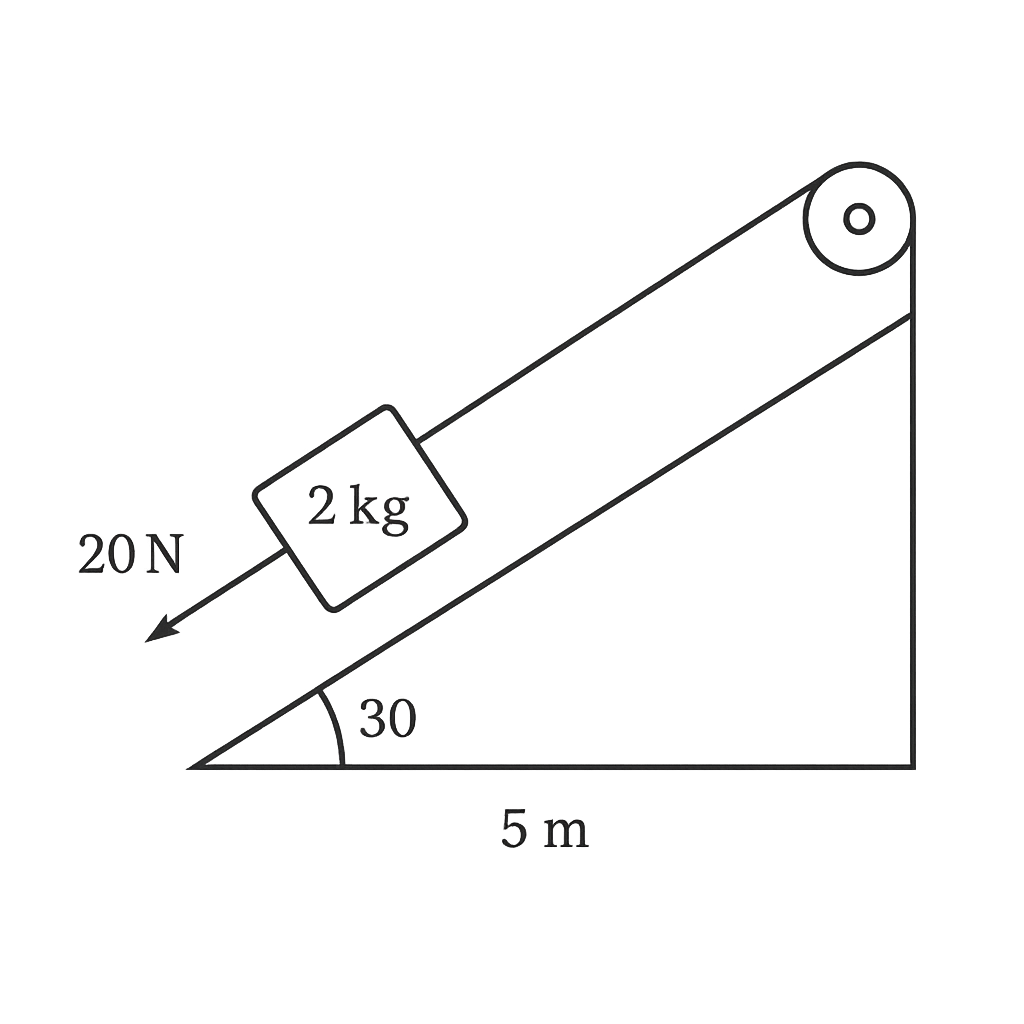
The diagram shows a smooth incline of length 5 m making an angle of \(30^{\circ}\) with the horizontal. A block of mass 2 kg is attached to a light inextensible string that passes over a frictionless pulley at the top of the incline. A constant horizontal force of 20 N is applied to the block (direction shown horizontally to the right). The coefficient of kinetic friction between the block and the incline is 0.2. The block starts from rest at the bottom of the incline and slides up the incline. Using the work‑energy principle, determine the speed of the block when it reaches the top of the incline. Give your answer in \(\text{m\,s}^{-1}\) to two significant figures.
A. 2.5
Correct B. 3.0
C. 4.2
D. 5.0

Correct Answer: B

Want to see the full step-by-step solution? Unlock AI Explanation & Analytics
Question 16 View Details
An ideal rectangular coil of \(N = 200\) turns and area \(A = 0.020\,\text{m}^2\) rotates uniformly in a uniform magnetic field of magnitude \(B = 0.50\,\text{T}\). The coil rotates at a frequency of \(f = 50\,\text{Hz}\) and its terminals are connected across a resistor of resistance \(R = 10\,\Omega\).\n\n(a) Determine the maximum induced emf in the coil.\n(b) Find the average electrical power dissipated in the resistor.\n(c) Assuming the mechanical power supplied to keep the coil rotating equals the electrical power dissipated, calculate the torque that must be applied to the coil shaft.
A. 5.0×10^1 N·m
Correct B. 6.3×10^1 N·m
C. 6.3×10^2 N·m
D. 7.8×10^1 N·m

Correct Answer: B

Want to see the full step-by-step solution? Unlock AI Explanation & Analytics
Question 17 View Details
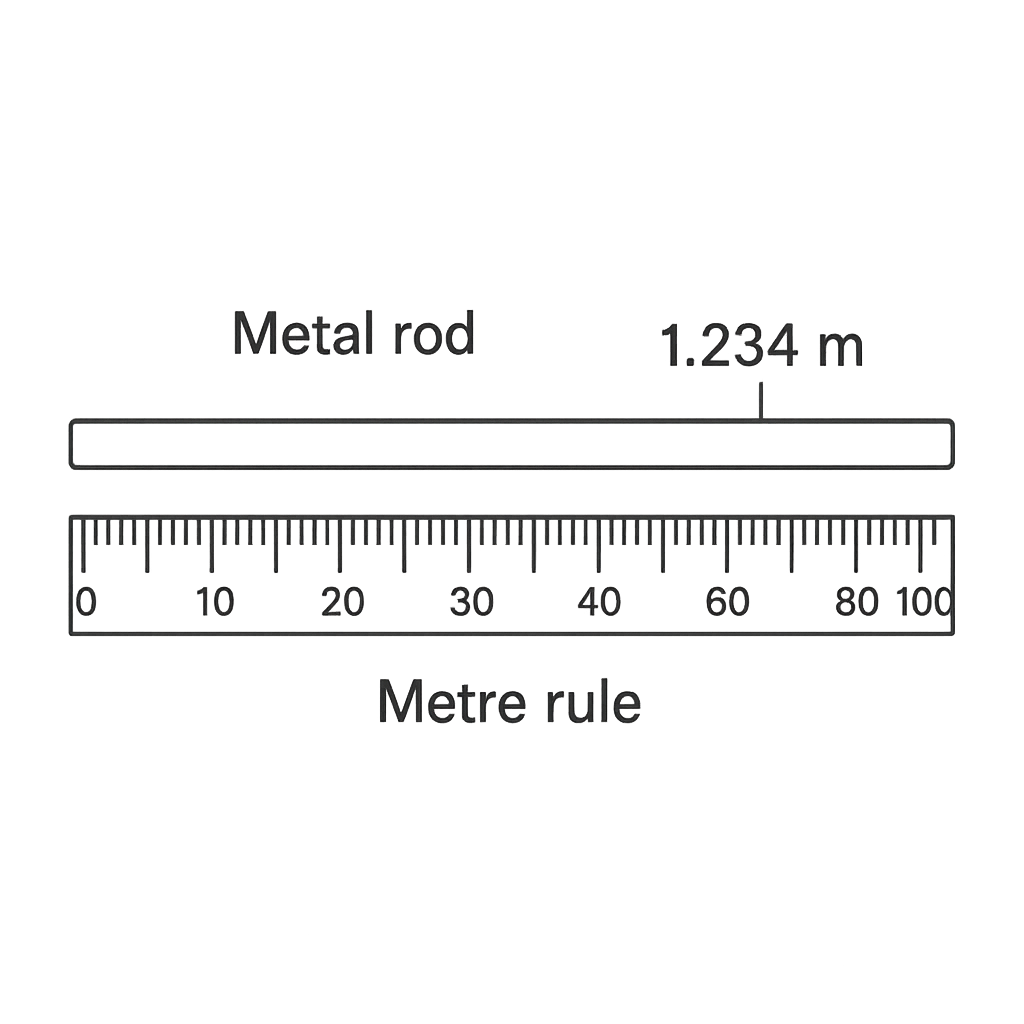
A practical setup consists of a metal rod whose length is to be measured using a metre rule. The metre rule has a systematic error of +0.5 % (it reads 0.5 % larger than the true length) and a random error of \(\pm0.2\) mm. When the rod is aligned with the rule, the reading obtained is \(1.234\) m.\n\nDetermine the best estimate of the true length of the rod and state the absolute uncertainty.
Correct A. 1.228 m (±0.0002 m)
B. 1.220 m (±0.0002 m)
C. 1.228 m (±0.0003 m)
D. 1.235 m (±0.0002 m)

Correct Answer: A

Want to see the full step-by-step solution? Unlock AI Explanation & Analytics
Question 18 View Details
A boat moves northward at a speed of \(5.0\) m s\(^{-1}\) relative to the water. The river flows eastward at \(3.0\) m s\(^{-1}\).\n\n(i) Find the speed and direction of the boat relative to the ground.\n(ii) Determine the component of the boat's ground‑velocity along the northeast direction (i.e., at \(45^{\circ}\) to the north).
A. 6.40 m s⁻¹ at 45° east of north; component along NE = 6.40 m s⁻¹
B. 4.90 m s⁻¹ at 31° east of north; component along NE = 4.90 m s⁻¹
Correct C. 5.83 m s⁻¹ at 31° east of north; component along NE = 5.66 m s⁻¹
D. 5.83 m s⁻¹ at 20° east of north; component along NE = 5.20 m s⁻¹

Correct Answer: C

Want to see the full step-by-step solution? Unlock AI Explanation & Analytics
Question 19 View Details
A sealed container holds an ideal gas at a pressure of \(2.0\) atm and temperature \(300\) K, occupying a volume of \(5.0\) L. The gas is heated at constant external pressure of \(2.0\) atm until its temperature reaches \(450\) K, allowing the piston to move.\n\n(a) Calculate the final volume of the gas.\n(b) Determine the work done by the gas during this isobaric expansion. (Give your answer in joules, using \(1\;\text{atm}=1.01325\times10^{5}\;\text{Pa}\).)
Correct A. V_f = 7.5 L; W = 5.1×10^2 J
B. V_f = 8.0 L; W = 5.1×10^2 J
C. V_f = 7.5 L; W = 6.0×10^2 J
D. V_f = 6.0 L; W = 4.0×10^2 J

Correct Answer: A

Want to see the full step-by-step solution? Unlock AI Explanation & Analytics
Question 20 View Details
A rectangular loop of wire has width \(w = 0.10\) m and length \(l = 0.30\) m. A current of \(I = 5.0\) A flows clockwise when the loop is viewed from above. The loop is placed in a magnetic field that varies with the horizontal coordinate \(x\) (measured from the left side of the loop) as\n\n\[\nB(x) = B_{0}\bigl(1 + \alpha x\bigr),\n\]\n\nwhere \(B_{0}=0.20\) T and \(\alpha = 0.5\;\text{m}^{-1}\). The plane of the loop is perpendicular to the direction of the field, and the side of length \(w\) is parallel to the \(x\)-axis.\n\nCalculate the net magnetic force on the loop, giving its magnitude and direction.
A. 0.015 N directed toward increasing field (left‑to‑right)
B. 0.010 N directed toward decreasing field (right‑to‑left)
Correct C. 0.015 N directed toward decreasing field (right‑to‑left)
D. 0.030 N directed toward decreasing field (right‑to‑left)

Correct Answer: C

Want to see the full step-by-step solution? Unlock AI Explanation & Analytics
Question 21 View Details
A sealed container holds an ideal gas at \(27^{\circ}\text{C}\) and a volume of \(2.0\ \text{L}\). The gas is heated so that its pressure increases by \(25\%\) while the volume expands to \(2.5\ \text{L}\). What is the final temperature of the gas in \(^{\circ}\text{C}\)?
A. 176
B. 236
Correct C. 196
D. 216

Correct Answer: C

Want to see the full step-by-step solution? Unlock AI Explanation & Analytics
Question 22 View Details
A battery of emf \(E\) volts and internal resistance \(r\) \(\Omega\) is connected to an external circuit consisting of a 10 \(\Omega\) resistor in parallel with a variable resistor \(R\). When \(R = \frac{20}{3}\,\Omega\), the total current drawn from the battery is 3.0 A and the voltage across the 10 \(\Omega\) resistor is 12.0 V. When the variable resistor is changed to \(4\ \Omega\), the total current becomes 4.0 A. Determine the emf \(E\) of the battery (in volts).
A. 96/5
B. 108/7
C. 84/7
Correct D. 96/7

Correct Answer: D

Want to see the full step-by-step solution? Unlock AI Explanation & Analytics
Question 23 View Details
An athlete starts from rest and runs with a constant acceleration for the first 4 s, covering a distance of 32 m. He then continues for a further 6 s with a different constant acceleration, and the total distance covered in the 10 s is 100 m. Determine the acceleration during the second interval (in \(\text{m s}^{-2}\)).
A. -15/9
Correct B. -14/9
C. -14/8
D. -13/9

Correct Answer: B

Want to see the full step-by-step solution? Unlock AI Explanation & Analytics
Question 24 View Details
A 150 g sample of an unknown metal at \(120^{\circ}\text{C}\) is placed in 250 g of water at \(25^{\circ}\text{C}\) in an insulated container. The final equilibrium temperature is \(30^{\circ}\text{C}\). Given the specific heat capacity of water is \(4.18\ \text{J g}^{-1}\text{°C}^{-1}\), determine the specific heat capacity of the metal (in \(\text{J g}^{-1}\text{°C}^{-1}\)).
A. 0.300
B. 0.350
C. 0.420
Correct D. 0.387

Correct Answer: D

Want to see the full step-by-step solution? Unlock AI Explanation & Analytics
Question 25 View Details
In a hydrogen atom an electron drops from an unknown higher energy level \(n_i\) to the \(n=2\) level, emitting a photon with wavelength \(410\ \text{nm}\). (a) Determine the initial principal quantum number \(n_i\). (b) Calculate the energy of the emitted photon in electron volts (eV). (Use \(R = 1.097\times10^{7}\ \text{m}^{-1}\), \(h = 6.626\times10^{-34}\ \text{J s}\), \(c = 3.00\times10^{8}\ \text{m s}^{-1}\), and \(1\ \text{eV}=1.602\times10^{-19}\ \text{J}\).)
A. n_i = 5; E ≈ 2.86 eV
Correct B. n_i = 6; E ≈ 3.03 eV
C. n_i = 4; E ≈ 2.55 eV
D. n_i = 7; E ≈ 3.20 eV

Correct Answer: B

Want to see the full step-by-step solution? Unlock AI Explanation & Analytics

Master the Exam!

You've seen a preview, but there are thousands more questions plus AI tutor to break down complex solutions.

Unlock Full Access Available for Android & Windows
Help others prepare! Share this practice hub:
Chat with Support