neco model questions vol1 2019 physics | Essay

Prepare for your exams with neco model questions vol1 questions? Reviewing past/model questions is one of the most effective ways to guarantee a high score. This practice hub features authentic 2019 physics (Essay) questions designed to simulate the real exam environment.

Practice these randomly selected questions to test your readiness.
Question 1 View Details
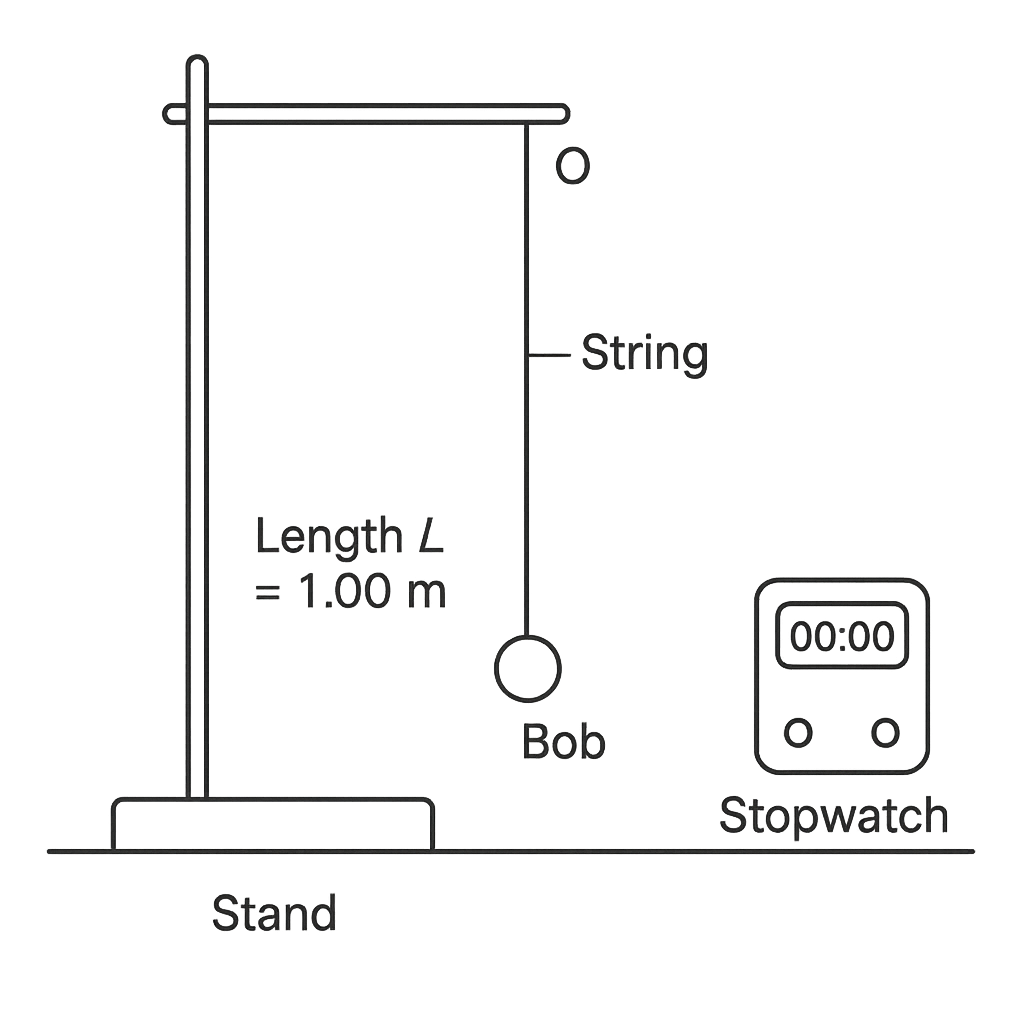
A simple pendulum experiment is set up to determine the acceleration due to gravity (g). The length of the string from the point of suspension to the centre of the bob is measured as 1.00 m (±0.01 m). The bob is a small dense sphere. Using a digital stopwatch, a student records the time for 20 complete oscillations as 40.2 s (±0.2 s). The experiment is performed on a level table in a quiet laboratory.
Question Parts
(a)
Calculate the period of the pendulum and use it to determine the experimental value of g. Show all steps and state the final value of g with its appropriate number of significant figures.
(b)
Identify two possible systematic errors in this experiment and explain qualitatively how each would affect the calculated value of g (whether it would be higher or lower than the true value).
(c)
Suggest two practical modifications that could be made to improve the accuracy of the measurement of g.
Detailed Essay Solution & Marking Scheme Available

Get the step-by-step mathematical proofs, key points required by examiners, and a comprehensive breakdown from our AI Tutor.
Question 2 View Details
A car travels on a straight road as follows: it moves northward for 150 km in 2.00 h, then makes a right‑angle turn and moves eastward for 120 km in 1.50 h. During the eastward leg a steady wind blows from the west at 20 km h⁻¹. The engine exerts a constant force of 5.0 × 10³ N in the direction of the car’s motion during the eastward leg.
Question Parts
(a)
Calculate the average speed of the car for the whole journey.
(b)
Determine the magnitude and direction (bearing measured clockwise from north) of the average velocity vector for the whole journey.
(c)
During the eastward leg, find the resultant velocity of the car relative to the ground, taking the wind into account. State its magnitude and direction (angle measured north of east).
(d)
Calculate the work done by the engine during the eastward leg of the journey.
Detailed Essay Solution & Marking Scheme Available

Get the step-by-step mathematical proofs, key points required by examiners, and a comprehensive breakdown from our AI Tutor.
Question 3 View Details
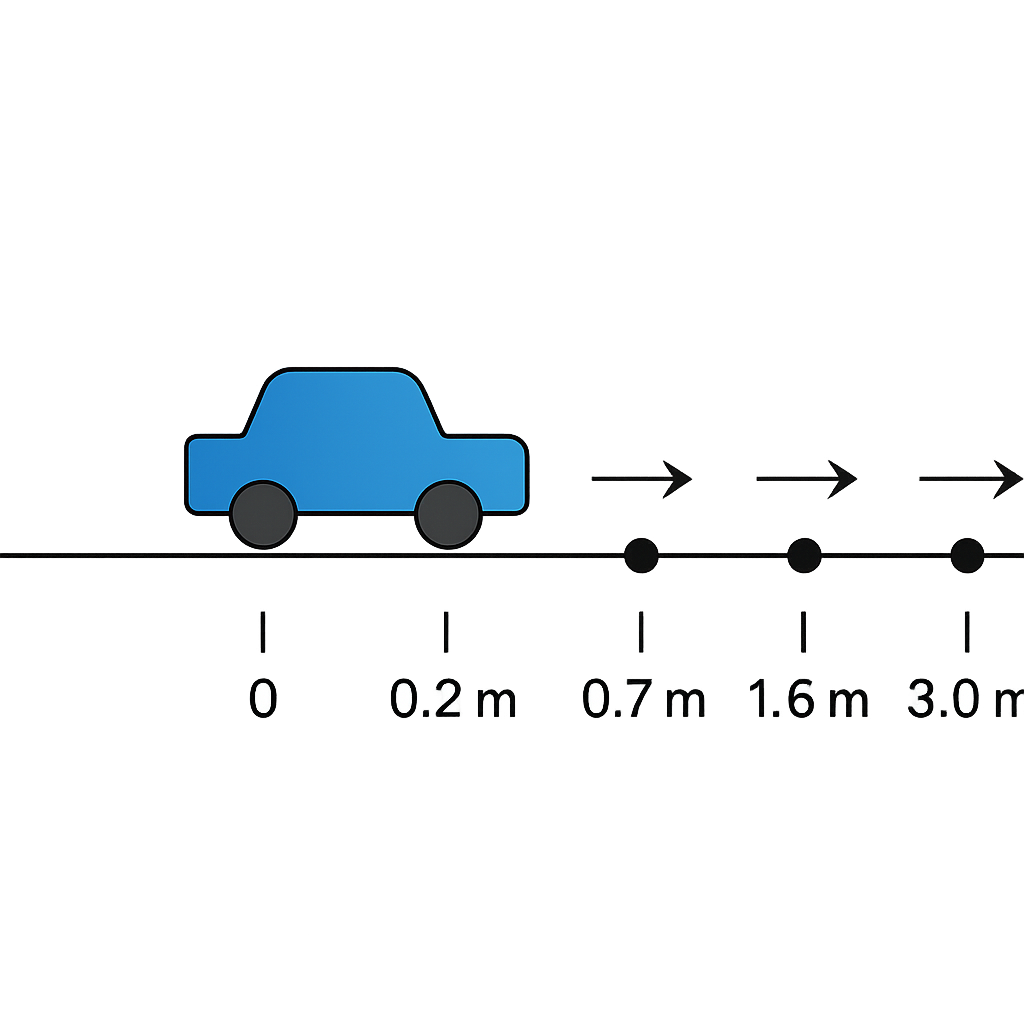
A motion diagram of a toy car moving in a straight horizontal line is shown. The diagram marks the position of the car at successive 0.5 s intervals. The spacings between the marks are: - 0.2 m between the start point and the first mark, - 0.5 m between the first and second marks, - 0.9 m between the second and third marks, - 1.4 m between the third and fourth marks. The car starts from rest and moves to the right as indicated by arrows on the diagram.
Question Parts
(a)
Calculate the instantaneous speed of the car at the end of each 0.5 s interval.
(b)
Assuming the acceleration is uniform during each interval, determine the magnitude of the acceleration for each interval.
(c)
From the values obtained, comment on the nature of the car’s acceleration over the observed period.
Detailed Essay Solution & Marking Scheme Available

Get the step-by-step mathematical proofs, key points required by examiners, and a comprehensive breakdown from our AI Tutor.

Question 4 View Details
A uniform rigid beam AB is 4.0 m long and has a mass of 20 kg. The beam is hinged at point A to a vertical wall. A cable AC is attached to the free end B and makes an angle of 30° above the horizontal, supporting the beam. A hanging load of 50 N is attached to the beam at a point D that is 1.5 m from the hinge A. The beam is in static equilibrium.
Question Parts
(a)
Calculate the tension in the supporting cable AC.
(b)
Determine the horizontal and vertical components of the reaction force at the hinge A.
(c)
State the condition(s) that must be satisfied for the beam to remain in static equilibrium.
Detailed Essay Solution & Marking Scheme Available

Get the step-by-step mathematical proofs, key points required by examiners, and a comprehensive breakdown from our AI Tutor.

Question 5 View Details
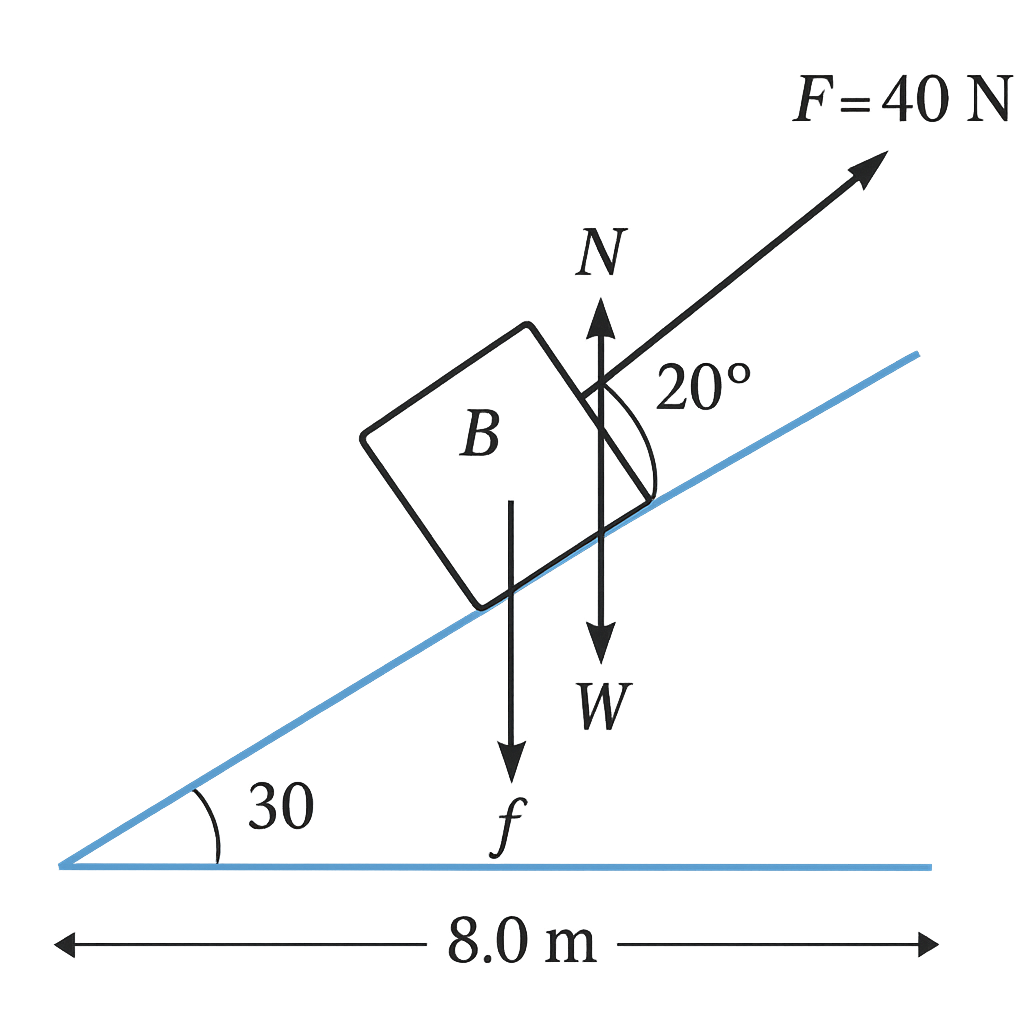
A 5.0 kg block is placed at the bottom of a smooth inclined plane that makes an angle of 30° with the horizontal. The length of the plane is 8.0 m. A rope pulls the block up the plane. The rope exerts a constant tension of 40 N directed 20° above the horizontal. The coefficient of kinetic friction between the block and the plane is 0.20. The block starts from rest at the bottom of the plane. Using the information given and the diagram supplied, answer the following:
Question Parts
(a)
Determine the magnitude of the component of the 40 N pulling force that acts parallel to the surface of the inclined plane.
(b)
Calculate the work done on the block by each of the following forces as it moves the full 8.0 m up the plane: (i) the pulling force, (ii) the weight of the block, (iii) the frictional force.
(c)
Find the net work done on the block and determine its speed when it reaches the top of the plane.
(d)
Now suppose the pulling force is not constant but increases uniformly from 0 N at the bottom to 40 N at the top of the plane (the direction of the force remains 20° above the horizontal). (i) Calculate the work done by this varying force over the 8.0 m displacement. (ii) Based on this work, discuss whether the block can still reach the top of the plane. If it can, give its speed; if it cannot, state the reason.
Detailed Essay Solution & Marking Scheme Available

Get the step-by-step mathematical proofs, key points required by examiners, and a comprehensive breakdown from our AI Tutor.

Question 6 View Details
A compound machine is shown in the diagram. It consists of a lever AB pivoted at O (the fulcrum). The effort arm OA is 1.2 m long and the load arm OB is 0.3 m long. A downward effort force is applied at A. From point A a rope passes over a fixed pulley P, then under a movable pulley M that is attached to the same load of weight 150 N hanging at B. The free end of the rope is pulled upward by a hand at C. The hand pulls the rope through a distance of 6.0 m, causing the load to rise vertically by 0.75 m. Answer the following questions:
Question Parts
(a)
The lever and the pulley system each contribute to the overall mechanical advantage. (i) Calculate the mechanical advantage of the lever alone. (ii) Calculate the mechanical advantage of the pulley arrangement alone (ignore friction). (iii) Determine the overall ideal mechanical advantage of the compound machine. (iv) Using the overall ideal mechanical advantage, find the ideal effort force that must be applied by the hand at C to raise the 150 N load.
(b)
In practice the hand must exert a force of 22 N while pulling the rope through 6.0 m to raise the load by 0.75 m. Calculate the efficiency of the compound machine expressed as a percentage.
Detailed Essay Solution & Marking Scheme Available

Get the step-by-step mathematical proofs, key points required by examiners, and a comprehensive breakdown from our AI Tutor.

Question 7 View Details
A vertical cylindrical piston of cross‑sectional area 0.020 m² contains 1.5 mol of an ideal gas at 300 K and a pressure of 1.0×10⁵ Pa. The piston is frictionless and initially in equilibrium with the surrounding atmospheric pressure of 1.0×10⁵ Pa. The gas is heated so that the volume of the gas increases by 0.015 m³ while the piston moves freely. After this expansion the piston is locked in its new position and the gas is heated further to a temperature of 500 K. Answer the following:
Question Parts
(a)
The piston moves freely during the heating that causes the volume increase. (i) Determine the final temperature of the gas after the volume has increased by 0.015 m³. (ii) Calculate the work done by the gas during this expansion.
(b)
After the piston is locked, the gas is heated further until its temperature reaches 500 K. Determine the new pressure of the gas.
(c)
Explain qualitatively how the pressure reading on a manometer would change if the whole experiment were carried out at a high altitude where the atmospheric pressure is 0.8×10⁵ Pa, assuming the piston is initially balanced with the local atmospheric pressure.
Detailed Essay Solution & Marking Scheme Available

Get the step-by-step mathematical proofs, key points required by examiners, and a comprehensive breakdown from our AI Tutor.

Question 8 View Details
A composite rod consists of a 0.50 m long copper section (thermal conductivity k₁ = 400 W m⁻¹ K⁻¹) joined end‑to‑end with a 0.50 m long steel section (k₂ = 50 W m⁻¹ K⁻¹). Both sections have the same uniform cross‑sectional area A = 1.0×10⁻⁴ m². The left end of the copper is maintained at 100 °C and the right end of the steel at 20 °C. Answer the following: (a) Determine the temperature at the copper–steel junction. (b) Calculate the steady‑state rate of heat transfer through the whole rod. (c) A thin flat layer of insulation (k₃ = 0.04 W m⁻¹ K⁻¹, thickness 0.001 m) is applied around the steel section, covering the same cross‑sectional area. Assuming the end temperatures remain unchanged, estimate the new rate of heat transfer. (d) Discuss qualitatively how increasing the length of the steel section would affect the temperature distribution and the overall heat transfer rate.
Question Parts
(a)
Determine the temperature at the copper–steel junction.
(b)
Calculate the steady‑state rate of heat transfer through the rod.
(c)
With the insulation layer added to the steel section, estimate the new heat‑transfer rate, keeping the end temperatures unchanged.
Detailed Essay Solution & Marking Scheme Available

Get the step-by-step mathematical proofs, key points required by examiners, and a comprehensive breakdown from our AI Tutor.

Master the Exam!

You've seen a preview, but there are thousands more questions plus AI tutor to break down complex solutions.

Unlock Full Access Available for Android & Windows
Help others prepare! Share this practice hub:
Chat with Support