neco model questions vol1 2019 chemistry | Objective

Prepare for your exams with neco model questions vol1 questions? Reviewing past/model questions is one of the most effective ways to guarantee a high score. This practice hub features authentic 2019 chemistry (Objective) questions designed to simulate the real exam environment.

Practice these randomly selected questions to test your readiness.

Question 1 View Details
A galvanic cell is constructed as follows: Zn(s) | Zn^{2+} (0.010 M) || Cu^{2+} (0.50 M) | Cu(s) at 25 °C. The standard reduction potentials are \(E^{\circ}_{\text{Zn}^{2+}/\text{Zn}} = -0.76\ \text{V}\) and \(E^{\circ}_{\text{Cu}^{2+}/\text{Cu}} = +0.34\ \text{V}\). (a) Calculate the cell potential under the given conditions using the Nernst equation. (b) If a charge of 0.250 C passes through the cell, how many grams of copper are deposited on the copper electrode? Provide your answer as "Ecell = ... V; mass Cu = ... g".
A. Ecell = 1.15 V; mass Cu = 2.10×10^{-4} g
B. Ecell = 0.95 V; mass Cu = 2.10×10^{-4} g
Correct C. Ecell = 1.15 V; mass Cu = 1.65×10^{-4} g
D. Ecell = 0.85 V; mass Cu = 1.65×10^{-4} g

Correct Answer: C

Want to see the full step-by-step solution? Unlock AI Explanation & Analytics
Question 2 View Details
A student carries out the following sequence of reactions starting from 5.00 g of cyclohexanol (M = 100.16 g mol^{-1}). First, cyclohexanol is oxidised to cyclohexanone (M = 98.15 g mol^{-1}) with Na_{2}Cr_{2}O_{7}/H_{2}SO_{4}. Second, the cyclohexanone reacts with phenylhydrazine (M = 108.14 g mol^{-1}) to give the corresponding phenylhydrazone. The overall yield for these two steps is 80 %. Third, the phenylhydrazone undergoes a Fischer indole synthesis with excess ethyl acetoacetate under acidic conditions to give a single indole derivative of formula C_{14}H_{12}N_{2}O (M = 224.25 g mol^{-1}) with a yield of 70 %. Calculate the mass of the final indole product obtained.
A. 4.98 g
Correct B. 6.28 g
C. 5.12 g
D. 7.45 g

Correct Answer: B

Want to see the full step-by-step solution? Unlock AI Explanation & Analytics
Question 3 View Details
A sealed container of volume 5.00 L contains a mixture of gases at 298 K and 1.00 atm: 2.00 L of H_{2}(g) and 3.00 L of O_{2}(g). The mixture is ignited and the reaction 2 H_{2} + O_{2} → 2 H_{2}O(l) proceeds to completion, with water condensing completely. Assuming the remaining gases behave ideally, calculate the final pressure in the container after the reaction.
A. 0.80 atm
B. 1.00 atm
C. 0.20 atm
Correct D. 0.40 atm

Correct Answer: D

Want to see the full step-by-step solution? Unlock AI Explanation & Analytics
Question 4 View Details
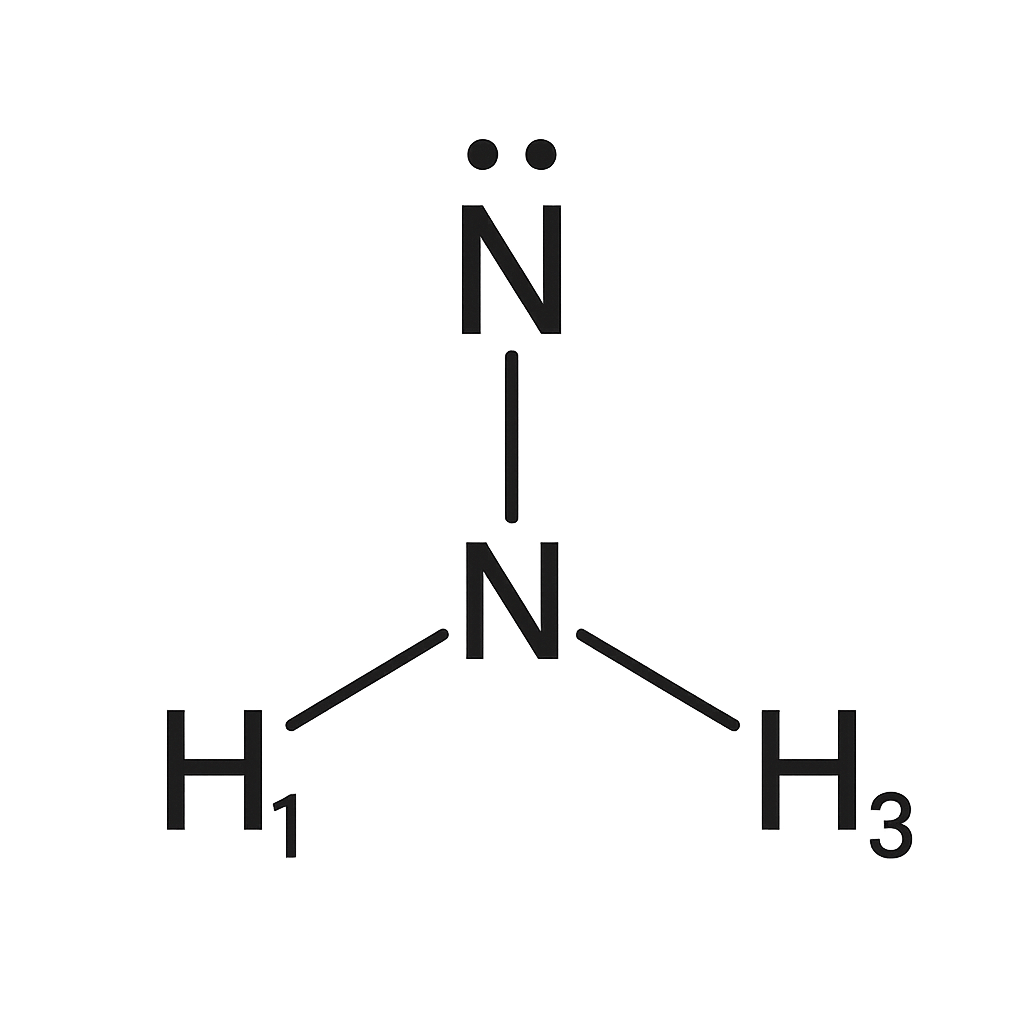
The diagram shows an ammonia molecule (NH_{3}) with the nitrogen atom at the centre, three single bonds to hydrogen atoms and one lone pair on nitrogen. Based on this structure, what is the hybridisation of the nitrogen atom?
Correct A. sp³
B. sp
C. sp³d
D. sp²

Correct Answer: A

Want to see the full step-by-step solution? Unlock AI Explanation & Analytics
Question 5 View Details
A 0.250 M solution of benzoic acid (pK_{a}=4.20) is prepared. 25.0 mL of this acid solution is mixed with 25.0 mL of 0.250 M sodium benzoate solution to form a buffer. (a) Calculate the pH of the buffer. (b) Then 10.0 mL of 0.250 M HCl is added to the buffer (volumes are additive). What is the new pH after the addition?
Correct A. 3.83
B. 3.20
C. 4.12
D. 3.55

Correct Answer: A

Want to see the full step-by-step solution? Unlock AI Explanation & Analytics
Question 6 View Details
A river has a flow of \(200\,000\) L day\(^{-1}\) and already carries a BOD load of \(0.10\) kg day\(^{-1}\). Two factories discharge into the river. Factory B releases \(10\,000\) L day\(^{-1}\) with a BOD concentration of \(80\) mg L\(^{-1}\). Factory A will discharge \(20\,000\) L day\(^{-1}\) of wastewater whose untreated BOD concentration is \(300\) mg L\(^{-1}\). The permissible BOD concentration in the river after mixing is \(5\) mg L\(^{-1}\).\n\n(a) What is the maximum BOD concentration (in mg L\(^{-1}\)) that Factory A may have in its effluent after treatment so that the river limit is not exceeded?\n\n(b) What percentage reduction in BOD must Factory A achieve relative to its untreated concentration of \(300\) mg L\(^{-1}\)?
Correct A. (a) 12.5 mg L⁻¹; (b) 95.8 % reduction
B. (a) 15.0 mg L⁻¹; (b) 85.0 % reduction
C. (a) 10.0 mg L⁻¹; (b) 90.0 % reduction
D. (a) 8.3 mg L⁻¹; (b) 97.2 % reduction

Correct Answer: A

Want to see the full step-by-step solution? Unlock AI Explanation & Analytics
Question 7 View Details
An industrial plant emits sulfur dioxide (SO₂) from a stack 50 m high. At a down‑wind distance of 2 km, the ground‑level concentration is given by the simplified Gaussian plume formula \[ C = \frac{Q}{\pi u \sigma_y \sigma_z}\,\exp\!\left(-\frac{H^{2}}{2\sigma_z^{2}}\right) \] where \(Q\) is the emission rate (g s⁻¹), \(u = 3\) m s⁻¹ is the wind speed, \(\sigma_y = 0.08x\) and \(\sigma_z = 0.10x\) with \(x = 2000\) m, and \(H = 50\) m. The ambient air‑quality standard for SO₂ is \(0.05\) ppm; the background concentration is \(0.01\) ppm. (At 25 °C, 1 ppm SO₂ = \( \dfrac{64}{24.45}\) mg m⁻³.)\n\n(a) What is the maximum permissible emission rate \(Q_{\max}\) (in g s⁻¹) from the plant?\n\n(b) If the plant currently emits \(50\) g s⁻¹, what percentage reduction in emissions is required to meet the standard?
A. (a) ≈ 28 g s⁻¹; (b) ≈ 44 % reduction
Correct B. (a) ≈ 33 g s⁻¹; (b) ≈ 35 % reduction
C. (a) ≈ 40 g s⁻¹; (b) ≈ 25 % reduction
D. (a) ≈ 50 g s⁻¹; (b) ≈ 0 % reduction

Correct Answer: B

Want to see the full step-by-step solution? Unlock AI Explanation & Analytics
Question 8 View Details
The nitrate ion, \(\mathrm{NO_3^-}\), is known to exhibit resonance. \n\n(a) How many sigma (\(\sigma\)) bonds are present in \(\mathrm{NO_3^-}\)?\n\n(b) How many pi (\(\pi\)) bonds are effectively present when resonance is taken into account?\n\n(c) What is the overall bond order for each N-O bond in the ion?
A. (a) 4 sigma bonds; (b) 1 delocalised pi bond; (c) bond order = 3/2
Correct B. (a) 3 sigma bonds; (b) 1 delocalised pi bond; (c) bond order = 4/3
C. (a) 2 sigma bonds; (b) 1 delocalised pi bond; (c) bond order = 5/3
D. (a) 3 sigma bonds; (b) 2 pi bonds; (c) bond order = 5/3

Correct Answer: B

Want to see the full step-by-step solution? Unlock AI Explanation & Analytics
Question 9 View Details
For a certain substance the liquid‑vapour equilibrium pressures are measured as follows:\n\n\[\begin{array}{c|c}\text{Temperature (K)} & \text{Pressure (atm)}\\ \hline 350 & 0.80\\ 370 & 1.20\end{array}\]\n\nAssuming the vapour behaves as an ideal gas, use the Clausius-Clapeyron equation \n\[\ln\!\left(\frac{P_2}{P_1}\right)= -\frac{\Delta H_{\text{vap}}}{R}\left(\frac{1}{T_2}-\frac{1}{T_1}\right)\]\n\nto calculate the enthalpy of vaporisation \(\Delta H_{\text{vap}}\) in kJ mol\(^{-1}\). (Take \(R = 8.314\) J mol\(^{-1}\) K\(^{-1}\).)
A. ≈ 18 kJ mol⁻¹
B. ≈ 30 kJ mol⁻¹
Correct C. ≈ 22 kJ mol⁻¹
D. ≈ 25 kJ mol⁻¹

Correct Answer: C

Want to see the full step-by-step solution? Unlock AI Explanation & Analytics
Question 10 View Details
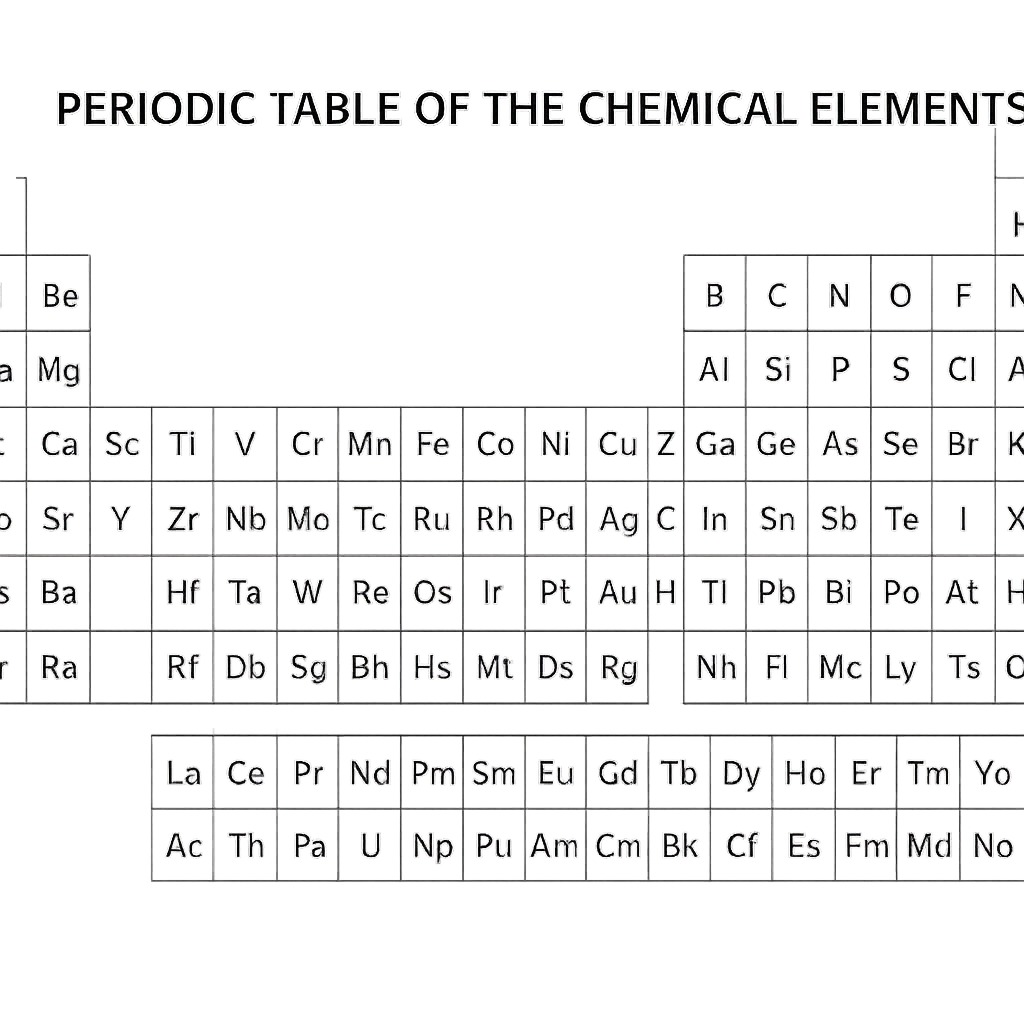
The diagram shows a standard periodic table in which the element located in period 4 and group 10 is highlighted. Identify the element (provide its chemical symbol).
A. Co
B. Zn
C. Cu
Correct D. Ni

Correct Answer: D

Want to see the full step-by-step solution? Unlock AI Explanation & Analytics
Question 11 View Details
An unknown monohydric alcohol with the general formula \(C_nH_{2n+2}O\) is weighed (2.00 g) and completely combusted. The combustion produces 2.20 g of \(CO_2\) and 0.60 g of \(H_2O\). The oxidation of the same alcohol with excess \(K_2Cr_2O_7\) in acidic medium gives a carboxylic acid that is isolated and weighed (0.55 g).\n\n(a) Determine the molecular formula of the alcohol and state whether it is primary, secondary or tertiary.\n(b) Calculate the theoretical mass of the carboxylic acid expected from the oxidation and the percent yield based on the observed 0.55 g.
A. C3H6O, primary; theoretical acid mass 0.58 g, percent yield ≈ 95 %
B. C4H10O, tertiary; theoretical acid mass 0.70 g, percent yield ≈ 79 %
C. C2H6O, secondary; theoretical acid mass 0.55 g, percent yield ≈ 100 %
Correct D. C3H8O, primary; theoretical acid mass 0.62 g, percent yield ≈ 89 %

Correct Answer: D

Want to see the full step-by-step solution? Unlock AI Explanation & Analytics
Question 12 View Details
The diagram shows the Bohr model of a neutral atom of element X. The nucleus contains 35 nucleons. The electron shells are drawn with 2 electrons in the first shell, 8 electrons in the second shell and 7 electrons in the third shell.\n\n(i) Write the atomic number (Z) of element X.\n(ii) State the number of neutrons in the nucleus.\n(iii) Give the full nuclear symbol of the element.
Correct A. ^35_17Cl
B. ^35_18Ar
C. ^36_17Cl
D. ^35_16S

Correct Answer: A

Want to see the full step-by-step solution? Unlock AI Explanation & Analytics
Question 13 View Details
A 0.70 g sample of an unknown hydrocarbon containing only carbon and hydrogen is combusted completely. The combustion yields 2.20 g of \(CO_2\) and 0.90 g of \(H_2O\).\n\n(a) Determine the empirical formula of the hydrocarbon.\n(b) If the molar mass of the hydrocarbon is known to be 56 g mol\(^{-1}\), give its molecular formula and classify it as an alkane, alkene or alkyne.
A. C3H6, alkene
B. C5H10, alkane
C. C4H8, alkyne
Correct D. C4H8, alkene

Correct Answer: D

Want to see the full step-by-step solution? Unlock AI Explanation & Analytics
Question 14 View Details
A 10.0 g mixture of cyclohexane (\(C_6H_{12}\)) and hexane (\(C_6H_{14}\)) is subjected to catalytic cracking. The only products obtained are ethene (\(C_2H_4\)) and butane (\(C_4H_{10}\)). The mass of ethene collected is 4.20 g.\n\nAssuming the cracking reactions are:\n\[C_6H_{12} \rightarrow 3\,C_2H_4\]\n\[C_6H_{14} \rightarrow C_2H_4 + C_4H_{10}\]\n\ncalculate the mass of cyclohexane present in the original mixture.
Correct A. 1.40
B. 3.50
C. 0.70
D. 2.10

Correct Answer: A

Want to see the full step-by-step solution? Unlock AI Explanation & Analytics
Question 15 View Details
Write the electron configuration of a neutral chlorine atom (atomic number 17) using the notation up to the 3p subshell.
A. 1s^2 2s^2 2p^6 3s^2 3p^6
B. 1s^2 2s^2 2p^6 3s^2 3p^4
Correct C. 1s^2 2s^2 2p^6 3s^2 3p^5
D. 1s^2 2s^2 2p^5 3s^2 3p^5

Correct Answer: C

Want to see the full step-by-step solution? Unlock AI Explanation & Analytics
Question 16 View Details
A sample of water of unknown mass is heated from 25 °C to 120 °C at 1 atm pressure. The water is first heated as liquid to its boiling point, then completely vaporised, and the resulting steam is further heated to 120 °C. The specific heat capacity of liquid water is \(4.18\ \text{J g}^{-1}\text{K}^{-1}\), the latent heat of vaporisation is \(2260\ \text{J g}^{-1}\), and the specific heat capacity of steam is \(2.01\ \text{J g}^{-1}\text{K}^{-1}\). If the total heat supplied is \(1.20\times10^{6}\ \text{J}\), determine the mass of water originally present (in grams).
A. 380 g
B. 500 g
Correct C. 459 g
D. 420 g

Correct Answer: C

Want to see the full step-by-step solution? Unlock AI Explanation & Analytics
Question 17 View Details
A 2.00 L rigid container at 27 °C contains a mixture of nitrogen and hydrogen gases at a total pressure of 1.20 atm. The mixture is allowed to react completely according to \(\mathrm{N_2 + 3H_2 \rightarrow 2NH_3}\). After the reaction, the pressure of the remaining unreacted gases (still at 27 °C) is measured to be 0.48 atm. Assuming ideal‑gas behaviour, calculate the mass of ammonia formed (in grams).
A. 0.600 g
B. 0.450 g
C. 0.350 g
Correct D. 0.498 g

Correct Answer: D

Want to see the full step-by-step solution? Unlock AI Explanation & Analytics
Question 18 View Details
A piece of impure copper weighing 5.00 g is dissolved in excess 0.50 M nitric acid to give a solution of \(\mathrm{Cu^{2+}}\). The solution is then electrolysed using a constant current of 0.25 A for 30 min. The current efficiency for copper deposition is 90 %. For the cathodic reaction \(\mathrm{Cu^{2+} + 2e^- \rightarrow Cu}\), calculate the mass of copper deposited on the cathode (in grams). (Molar mass Cu = 63.55 g mol\(^{-1}\), Faraday constant = 96500 C mol\(^{-1}\)).
A. 0.100 g
Correct B. 0.133 g
C. 0.150 g
D. 0.120 g

Correct Answer: B

Want to see the full step-by-step solution? Unlock AI Explanation & Analytics
Question 19 View Details
A 2.84 g sample of an unknown non‑metal oxide has the empirical formula \(\mathrm{X_2O_5}\). When the oxide is reduced by heating with excess carbon, the liberated oxygen gas is collected over water and found to have a dry mass of 1.60 g. Determine the atomic mass of element X and identify the element (choose from P, S, As).
A. 32 g mol⁻¹, sulfur (S)
Correct B. 31 g mol⁻¹, phosphorus (P)
C. 30 g mol⁻¹, arsenic (As)
D. 28 g mol⁻¹, phosphorus (P)

Correct Answer: B

Want to see the full step-by-step solution? Unlock AI Explanation & Analytics
Question 20 View Details
The element with atomic number 26 is a transition metal. Write its ground‑state electron configuration using the Aufbau principle, and state its period and group number in the modern IUPAC numbering.
Correct A. [Ar] 3d⁶ 4s²; period 4; group 8
B. [Ar] 3d⁶ 4s²; period 5; group 8
C. [Ar] 3d⁵ 4s²; period 4; group 8
D. [Ar] 3d⁶ 4s²; period 4; group 7

Correct Answer: A

Want to see the full step-by-step solution? Unlock AI Explanation & Analytics
Question 21 View Details
An ore sample weighing 100.0 g contains 34.5% copper by mass. The ore is first roasted to convert the copper sulfide to copper(I) oxide (Cu₂O), which is then reduced with carbon according to \(\mathrm{Cu_2O + C \rightarrow 2\,Cu + CO}\). Only 85% of the Cu₂O present is actually reduced. Calculate (a) the mass of copper metal obtained and (b) the overall percent yield based on the copper originally present in the ore.
A. 27.5 g; 80.0%
B. 31.0 g; 90.0%
C. 28.0 g; 82.5%
Correct D. 29.3 g; 85.0%

Correct Answer: D

Want to see the full step-by-step solution? Unlock AI Explanation & Analytics
Question 22 View Details
0.250 mol of acetic acid (\(\mathrm{CH_3COOH}\)) and 0.150 mol of sodium acetate (\(\mathrm{CH_3COONa}\)) are dissolved in 1.00 L of water to form a buffer. The \(pK_a\) of acetic acid is 4.76. After adding 0.050 mol of hydrochloric acid (\(\mathrm{HCl}\)) to the buffer, what is the new pH of the solution? Give your answer to two decimal places.
Correct A. 4.28
B. 4.12
C. 3.95
D. 4.45

Correct Answer: A

Want to see the full step-by-step solution? Unlock AI Explanation & Analytics
Question 23 View Details
An isotope of the element with atomic number 27 has a mass number of 59. How many neutrons are present in one atom of this isotope?
Correct A. 32
B. 34
C. 30
D. 26

Correct Answer: A

Want to see the full step-by-step solution? Unlock AI Explanation & Analytics
Question 24 View Details
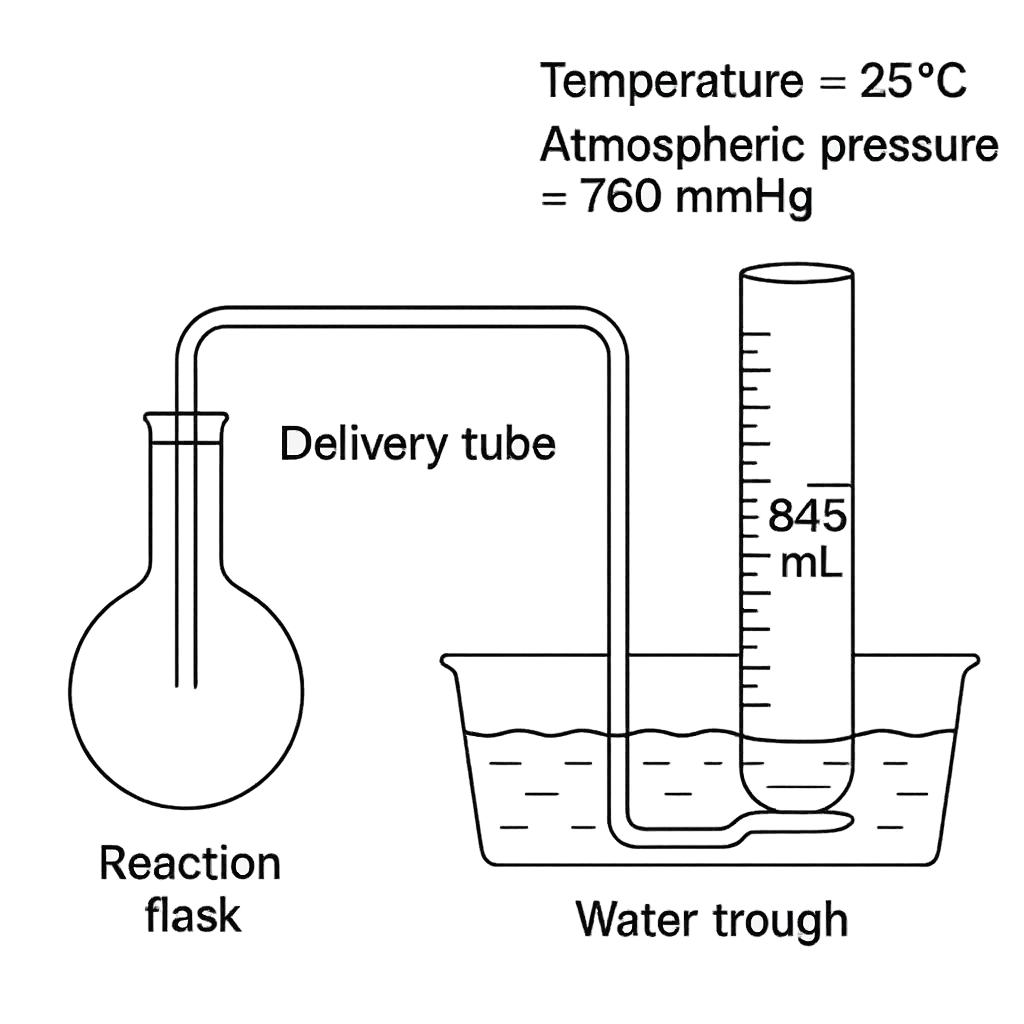
The apparatus shown is a gas‑collection‑over‑water setup. Hydrogen gas is generated and collected in the inverted graduated cylinder. The volume of gas collected is 845 mL at 25 °C. The atmospheric pressure is 760 mm Hg and the vapor pressure of water at 25 °C is 23.8 mm Hg. Calculate the number of moles of hydrogen gas collected. Use \(R = 0.0821\; \text{L·atm·mol}^{-1}\text{·K}^{-1}\).
A. 0.0250 mol
B. 0.0300 mol
C. 0.0360 mol
Correct D. 0.0335 mol

Correct Answer: D

Want to see the full step-by-step solution? Unlock AI Explanation & Analytics
Question 25 View Details
0.0500 mol of potassium permanganate (\(\mathrm{KMnO_4}\)) is added to 250 mL of an acidic solution containing ferrous ions (\(\mathrm{Fe^{2+}}\)). After the reaction, the excess permanganate is titrated with 0.1000 M sodium oxalate (\(\mathrm{Na_2C_2O_4}\)) according to \(\mathrm{2\,MnO_4^- + 5\,C_2O_4^{2-} + 16\,H^+ \rightarrow 2\,Mn^{2+} + 10\,CO_2 + 8\,H_2O}\). The titration required 12.5 mL of the oxalate solution. Determine the original concentration of \(\mathrm{Fe^{2+}}\) in the solution (mol L⁻¹).
A. 1.20 M
Correct B. 0.99 M
C. 0.80 M
D. 0.55 M

Correct Answer: B

Want to see the full step-by-step solution? Unlock AI Explanation & Analytics

Master the Exam!

You've seen a preview, but there are thousands more questions plus AI tutor to break down complex solutions.

Unlock Full Access Available for Android & Windows
Help others prepare! Share this practice hub:
Chat with Support