neco model questions vol1 2019 agricultural_science | Objective

Prepare for your exams with neco model questions vol1 questions? Reviewing past/model questions is one of the most effective ways to guarantee a high score. This practice hub features authentic 2019 agricultural_science (Objective) questions designed to simulate the real exam environment.

Practice these randomly selected questions to test your readiness.

Question 1 View Details
A farmer has 5 ha of land. He will grow maize on \(x\) ha and beans on the remaining \((5-x)\) ha. Maize requires 120 kg N ha\(^{-1}\); beans fix 25 kg N ha\(^{-1}\) and need no fertilizer. Fertilizer is sold in 50‑kg bags at ₦600 each. The market price is ₦2100 per tonne of maize (yield 4 t ha\(^{-1}\)) and ₦1500 per tonne of beans (yield 2.5 t ha\(^{-1}\)). The farmer can spend at most ₦6000 on fertilizer. What value of \(x\) (to one decimal place) will give the maximum net profit? State the profit at that \(x\).
A. x = 3.8 ha, profit = ₦28,500
Correct B. x = 4.3 ha, profit = ₦32,745
C. x = 4.6 ha, profit = ₦30,200
D. x = 4.0 ha, profit = ₦31,100

Correct Answer: B

Want to see the full step-by-step solution? Unlock AI Explanation & Analytics
Question 2 View Details
A tractor has an engine power of 45 kW at 1500 rpm. It drives the wheels through a transmission with a gear ratio of 4:1 (engine : driveshaft) and a final‑drive ratio of 3:1. The wheel radius is 0.5 m and the overall drivetrain efficiency is 85 %. Determine (a) the tractive force at the wheels (in kN) and (b) the maximum speed of the tractor in this gear (in km h\(^{-1}\)).
A. 6.10 kN, 25.3 km\/h
B. 5.20 kN, 20.1 km\/h
C. 4.85 kN, 22.0 km\/h
Correct D. 5.84 kN, 23.6 km/h

Correct Answer: D

Want to see the full step-by-step solution? Unlock AI Explanation & Analytics
Question 3 View Details
Name the soil process by which atmospheric nitrogen is converted into ammonia by certain bacteria.
A. Nitrification
B. Ammonification
C. Denitrification
Correct D. Nitrogen fixation

Correct Answer: D

Want to see the full step-by-step solution? Unlock AI Explanation & Analytics
Question 4 View Details
A hydraulic lift pump delivers 80 L min\(^{-1}\) at 210 bar. The lift cylinder has a piston area of 0.025 m\(^2\). (a) Calculate the theoretical lifting speed of the cylinder in m min\(^{-1}\). (b) If the system efficiency is 78 %, what is the actual lifting speed? (c) What is the hydraulic power required by the pump in kW (ignore losses)?
Correct A. 3.2 m/min, 2.5 m/min, 28 kW
B. 4.0 m/min, 3.1 m/min, 32 kW
C. 2.9 m/min, 2.0 m/min, 24 kW
D. 3.5 m/min, 2.7 m/min, 30 kW

Correct Answer: A

Want to see the full step-by-step solution? Unlock AI Explanation & Analytics
Question 5 View Details
A farmer wants to sow a 3‑ha field with a crop that requires a row spacing of 30 cm and a plant spacing within a row of 20 cm. The seed germination rate is 85 % and each seed weighs 0.025 g. How many kilograms of seed should be purchased? (Round up to the nearest kilogram.)
A. 12 kg
B. 18 kg
Correct C. 15 kg
D. 13 kg

Correct Answer: C

Want to see the full step-by-step solution? Unlock AI Explanation & Analytics
Question 6 View Details
A farmer raises 50 rabbits for market. Each rabbit gains an average of 45 g per day over a 60‑day growth period. Rabbits eat 150 g of feed per day each and 10 % of the feed is wasted. Feed costs ₦120 per kg. If each rabbit is sold for ₦2,500, what is the total profit earned?
A. 75500
B. 125000
Correct C. 65600
D. 71000

Correct Answer: C

Want to see the full step-by-step solution? Unlock AI Explanation & Analytics
Question 7 View Details
To prepare a 2.5 ha field, a farmer can use either a hand hoe or a motorised tiller. The hand hoe prepares 0.2 ha per hour and labour costs ₦150 per hour. The tiller prepares 0.8 ha per hour, uses fuel costing ₦250 per hour and must be rented at ₦500 per day (8 h). Which option gives the lower total cost?
A. Both options cost the same
Correct B. Motorised tiller
C. Hire a tractor
D. Hand hoe

Correct Answer: B

Want to see the full step-by-step solution? Unlock AI Explanation & Analytics
Question 8 View Details
A plough has a cutting width of 45 cm. To avoid missing strips, each successive pass overlaps the previous one by 10 % of the width. For a rectangular field 120 m long and 80 m wide, with passes run along the 120 m length, what is the minimum number of passes required to cover the field?
A. 210
B. 225
C. 180
Correct D. 198

Correct Answer: D

Want to see the full step-by-step solution? Unlock AI Explanation & Analytics
Question 9 View Details
Which of the following sequences correctly represents the main processes of the nitrogen cycle? (a) Nitrification, (b) Nitrogen fixation, (c) Denitrification, (d) Ammonification.
A. a, b, d, c
Correct B. b, a, d, c
C. b, d, a, c
D. b, a, c, d

Correct Answer: B

Want to see the full step-by-step solution? Unlock AI Explanation & Analytics
Question 10 View Details
Which factor does NOT directly increase soil erosion? (a) steep slope, (b) high vegetation cover, (c) heavy rainfall, (d) bare soil.
Correct A. b
B. a
C. d
D. c

Correct Answer: A

Want to see the full step-by-step solution? Unlock AI Explanation & Analytics
Question 11 View Details
A soil analysis shows that the soil contains 2% nitrogen (N) by weight. To meet the recommended nitrogen application rate of 120 kg N per hectare, a farmer decides to apply only this soil as a top‑dressing. Assuming no other nitrogen sources, how many kilograms of soil must be applied per hectare?
Correct A. 6000
B. 12000
C. 5000
D. 600

Correct Answer: A

Want to see the full step-by-step solution? Unlock AI Explanation & Analytics
Question 12 View Details
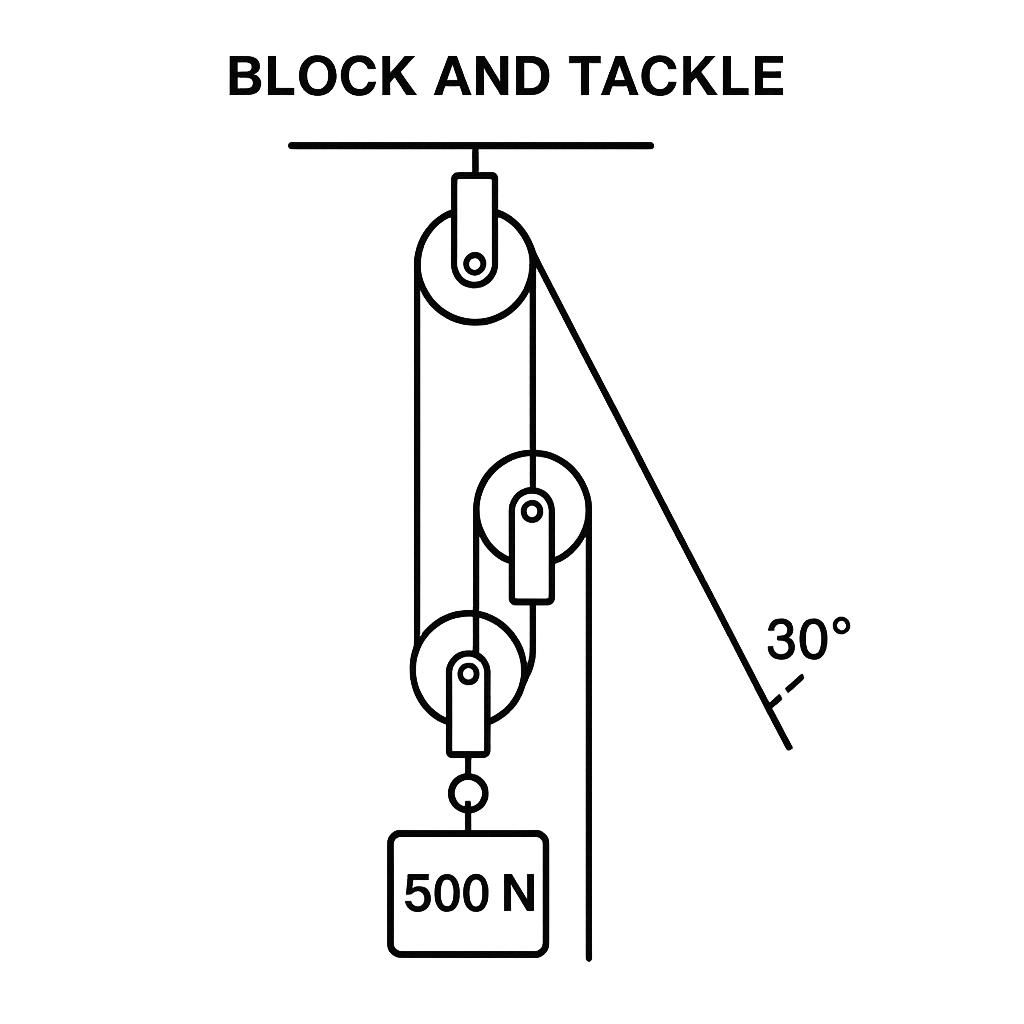
A block and tackle system is used to lift a load of 500 N. The arrangement provides four supporting rope segments (mechanical advantage = 4). The effort rope is pulled at an angle of 30° to the vertical. What is the magnitude of the effort force required to hold the load steady?
Correct A. 144
B. 173
C. 100
D. 125

Correct Answer: A

Want to see the full step-by-step solution? Unlock AI Explanation & Analytics
Question 13 View Details
A 10‑hectare field of a cash crop is expected to yield 2,500 kg per hectare under normal conditions, and the market price is ₦200 per kilogram. If a fungal disease reduces the yield by 15% and no control is applied, calculate the revenue loss. A fungicide applied at 2 L per hectare costs ₦30 per litre and reduces the disease loss to 10% of the original loss. Should the farmer apply the fungicide? Show the net profit difference between the two options.
A. Yes, applying the fungicide increases profit by ₦800,000.
Correct B. Yes, applying the fungicide increases profit by ₦674,400.
C. No, applying the fungicide would reduce profit by ₦50,000.
D. Yes, applying the fungicide increases profit by ₦600,000.

Correct Answer: B

Want to see the full step-by-step solution? Unlock AI Explanation & Analytics
Question 14 View Details
A farmer intends to keep 200 laying hens. Each hen costs ₦5,000 to purchase. Feed costs ₦0.30 per bird per day. Eggs sell for ₦25 each and each bird lays an average of 5 eggs per week. Other variable costs amount to ₦1,500 per month, and fixed costs (housing, equipment) are ₦150,000 per year. Assuming the operation runs continuously, how many weeks are required to recover the initial investment (purchase cost of the birds plus the annual fixed costs)?
A. 45
B. 52
C. 60
Correct D. 48

Correct Answer: D

Want to see the full step-by-step solution? Unlock AI Explanation & Analytics
Question 15 View Details
A forest of 100 ha is planted with a fast‑growing species whose growth follows the logistic model \(\Delta S = r S\left(1-\frac{S}{K}\right)\) where \(S\) is the standing stock (m³/ha), \(r = 0.1\) yr⁻¹ and the carrying capacity \(K = 200\) m³/ha. The initial standing stock is 120 m³/ha. The manager wants to harvest a constant volume \(H\) each year while keeping the stock from falling below the initial level. Determine the maximum sustainable annual harvest \(H_{max}\) (in m³/ha·yr). If timber sells for ₦2,500 per m³ and the cost of harvesting is ₦300 per m³, calculate the net annual revenue per hectare from this sustainable harvest.
A. Maximum sustainable harvest = 8 m³\/ha per year; net annual revenue = ₦14,000 per ha.
B. Maximum sustainable harvest = 3 m³\/ha per year; net annual revenue = ₦5,400 per ha.
C. Maximum sustainable harvest = 6 m³\/ha per year; net annual revenue = ₦8,200 per ha.
Correct D. Maximum sustainable harvest = 5 m³/ha per year; net annual revenue = ₦11,000 per ha.

Correct Answer: D

Want to see the full step-by-step solution? Unlock AI Explanation & Analytics
Question 16 View Details
A farmer produces maize. Fixed costs are N500,000 and variable cost is N150,000 per ton. The market price per ton depends on the quantity produced and is given by \(P(Q) = 600,000 - 20,000 Q\) where \(Q\) is the quantity in tons. Determine the quantity \(Q\) that maximizes the farmer's profit and state the maximum profit.
Correct A. Q = 11.25 tons; Maximum profit = N2,031,250
B. Q = 9.75 tons; Maximum profit = N1,800,000
C. Q = 10.5 tons; Maximum profit = N1,950,000
D. Q = 12.5 tons; Maximum profit = N2,050,000

Correct Answer: A

Want to see the full step-by-step solution? Unlock AI Explanation & Analytics
Question 17 View Details
An extension officer plans a 4‑year training programme for cattle farmers. The programme incurs a fixed cost of N300,000 and a variable cost of N8,000 per participant (paid at the start). Each trained farmer is expected to increase his annual maize yield by 0.3 tons. The market price of maize is N80,000 per ton. Only 50 % of the participants are expected to adopt the new practice. The discount rate is 12 % per year. (i) Determine the smallest whole number of participants required for the programme to have a positive net present value (NPV). (ii) Calculate the NPV when this minimum number of participants is enrolled.
A. Minimum participants = 13; NPV ≈ N20,000
B. Minimum participants = 12; NPV ≈ N5,000
C. Minimum participants = 10; NPV ≈ N-2,500
Correct D. Minimum participants = 11; NPV ≈ N12,805

Correct Answer: D

Want to see the full step-by-step solution? Unlock AI Explanation & Analytics
Question 18 View Details
In a herd of 200 cattle, a contagious disease has an annual incidence of 12 % and a mortality rate of 25 % among the infected animals. A vaccine costing N5,000 per animal reduces the incidence by 70 % and the mortality among infected animals by 50 %. If the entire herd is vaccinated, (i) how many deaths are averted compared with no vaccination? (ii) what is the cost per death averted?
A. Deaths averted ≈ 5.1; Cost per death averted ≈ N250,000
B. Deaths averted ≈ 6.0; Cost per death averted ≈ N210,000
Correct C. Deaths averted ≈ 5.1; Cost per death averted ≈ N196,078
D. Deaths averted ≈ 4.2; Cost per death averted ≈ N150,000

Correct Answer: C

Want to see the full step-by-step solution? Unlock AI Explanation & Analytics
Question 19 View Details
An agricultural extension campaign targets 10,000 farmers using three communication channels: radio, television and farmer field days. Radio reaches 60 % of the farmers, television reaches 45 %, and field days reach 30 %. Overlaps are as follows: 20 % are reached by both radio and television, 15 % by radio and field days, 10 % by television and field days, and 5 % are reached by all three channels. (i) How many distinct farmers are reached by at least one channel? (ii) How many farmers remain unreached?
A. Farmers reached = 9,600; Unreached = 400
B. Farmers reached = 9,350; Unreached = 650
C. Farmers reached = 9,200; Unreached = 800
Correct D. Farmers reached = 9,500; Unreached = 500

Correct Answer: D

Want to see the full step-by-step solution? Unlock AI Explanation & Analytics
Question 20 View Details
A pine forest stand contains an initial timber volume of 5,000 m³. The stand grows naturally at 8 % of its current volume each year. A manager wishes to harvest a constant amount each year for five consecutive years, subject to two conditions: (a) the annual harvest may not exceed the net growth in that year, and (b) after the fifth harvest the remaining volume must be at least 3,000 m³. (i) What is the greatest constant annual harvest volume (in m³) that satisfies both conditions? (ii) Assuming the market price of timber is N150 per m³ and the discount rate is 10 % per year, compute the net present value (NPV) of the harvests over the five‑year period.
A. Maximum constant harvest = 380 m³ per year; NPV ≈ N219,123
B. Maximum constant harvest = 450 m³ per year; NPV ≈ N256,310
Correct C. Maximum constant harvest = 400 m³ per year; NPV ≈ N227,442
D. Maximum constant harvest = 350 m³ per year; NPV ≈ N198,765

Correct Answer: C

Want to see the full step-by-step solution? Unlock AI Explanation & Analytics
Question 21 View Details
A farmer grows maize. His total cost (in Naira) for producing \(q\) tonnes is given by \(C(q)=0.1q^{2}+300\). The market price per tonne depends on the total market supply \(S\) (in tonnes) according to \(P = 1500 - 0.5S\). Other farmers together supply 2000 tonnes. Assuming the farmer sells all his output, determine the quantity \(q\) (in tonnes) that maximizes his profit. State the optimal \(q\) as an exact fraction.
Correct A. \frac{1250}{3}
B. \frac{1150}{3}
C. \frac{1250}{2}
D. \frac{1300}{3}

Correct Answer: A

Want to see the full step-by-step solution? Unlock AI Explanation & Analytics
Question 22 View Details
A fish population in a lake follows the logistic growth model \(\frac{dN}{dt}=rN\left(1-\frac{N}{K}\right)\) with intrinsic growth rate \(r=0.6\) per year and carrying capacity \(K=25\,000\) tonnes. The fishery harvests a constant amount \(H\) (tonnes per year). The government wishes to increase the harvest to a new constant \(H_{2}\) but requires that the equilibrium population under the new harvest be at least \(12\,000\) tonnes. Determine the maximum allowable harvest \(H_{2}\) (in tonnes per year) that satisfies this condition, and give the corresponding equilibrium population.
A. 3000
B. 4000
Correct C. 3750
D. 3500

Correct Answer: C

Want to see the full step-by-step solution? Unlock AI Explanation & Analytics
Question 23 View Details
A batch of 500 kg fresh cassava roots contains 70 % moisture (wet basis). The drying process follows \(M(t)=M_{e}+(M_{0}-M_{e})e^{-kt}\), where \(M(t)\) is the moisture ratio (kg water per kg dry matter) at time \(t\) (hours), \(M_{e}=0.2\), and \(M_{0}\) corresponds to the initial moisture. The target moisture is 20 % (wet basis) after 8 hours. (a) Determine the drying constant \(k\) (h\(^{-1}\)). (b) Calculate the total weight of the cassava after drying.
A. k \approx 0.60 h^{-1}; final weight = 180 kg
Correct B. k \approx 0.47 h^{-1}; final weight = 187.5 kg
C. k \approx 0.35 h^{-1}; final weight = 200 kg
D. k \approx 0.80 h^{-1}; final weight = 175 kg

Correct Answer: B

Want to see the full step-by-step solution? Unlock AI Explanation & Analytics
Question 24 View Details
A tilapia farm aims to produce 10 000 kg of fish. The overall feed conversion ratio (FCR) is 1.5, so total feed required is 15 000 kg. Two feeds are available: Feed A costs ₦150 kg⁻¹ and contains 30 % protein; Feed B costs ₦200 kg⁻¹ and contains 40 % protein. The diet must supply an average of 35 % protein. Determine the kilograms of each feed that minimize the total feed cost while meeting the protein requirement, and state the minimum total cost.
Correct A. 7,500 kg of Feed A and 7,500 kg of Feed B; total cost = 2,625,000 Naira
B. 5,000 kg of Feed A and 10,000 kg of Feed B; total cost = 2,750,000 Naira
C. 6,000 kg of Feed A and 9,000 kg of Feed B; total cost = 2,700,000 Naira
D. 8,000 kg of Feed A and 7,000 kg of Feed B; total cost = 2,650,000 Naira

Correct Answer: A

Want to see the full step-by-step solution? Unlock AI Explanation & Analytics
Question 25 View Details
A farmer has 5 L of an insecticide formulation that contains 250 g L⁻¹ of active ingredient. The recommended application rate is 0.75 L per hectare. (a) What is the maximum area (in hectares) that can be treated with the available formulation? (b) How many kilograms of active ingredient will be applied to that area? (c) What area of the farmer's 12.5‑ha field will remain untreated?
Correct A. Maximum area = 20/3 ha (≈6.67 ha); active ingredient = 1.25 kg; untreated area = 17.5/3 ha (≈5.83 ha)
B. Maximum area = 5 ha (≈5.00 ha); active ingredient = 1.00 kg; untreated area = 15\/2 ha (≈7.50 ha)
C. Maximum area = 25\/3 ha (≈8.33 ha); active ingredient = 1.25 kg; untreated area = 12.5\/3 ha (≈4.17 ha)
D. Maximum area = 20\/3 ha (≈6.67 ha); active ingredient = 1.50 kg; untreated area = 17.5\/3 ha (≈5.83 ha)

Correct Answer: A

Want to see the full step-by-step solution? Unlock AI Explanation & Analytics

Master the Exam!

You've seen a preview, but there are thousands more questions plus AI tutor to break down complex solutions.

Unlock Full Access Available for Android & Windows
Help others prepare! Share this practice hub:
Chat with Support