neco model questions vol1 2019 agricultural_science | Essay

Prepare for your exams with neco model questions vol1 questions? Reviewing past/model questions is one of the most effective ways to guarantee a high score. This practice hub features authentic 2019 agricultural_science (Essay) questions designed to simulate the real exam environment.

Practice these randomly selected questions to test your readiness.

Question 1 View Details
A farmer intends to establish a mixed‑farming system on a 5‑hectare farm located in the Sudan savanna zone.
Question Parts
(a)
Explain how a crop‑rotation sequence that alternates cereals (e.g., maize) with legumes (e.g., cowpea) can improve soil fertility and break pest cycles.
(b)
The farmer will grow maize on 3 ha and cowpea on 2 ha. Cowpea fixes an average of 25 kg N ha⁻¹, while maize requires 150 kg N ha⁻¹. Calculate the net nitrogen balance (in kg) for the whole farm. Show all steps.
(c)
Discuss two ecological advantages of integrating a small ruminant herd (e.g., goats) into this mixed‑farming system, focusing on nutrient cycling and biodiversity.
Detailed Essay Solution & Marking Scheme Available

Get the step-by-step mathematical proofs, key points required by examiners, and a comprehensive breakdown from our AI Tutor.
Question 2 View Details
A soil scientist conducts a field experiment to determine the infiltration rate of a sandy loam using a double‑ring infiltrometer. The set‑up is shown in the illustration.
Question Parts
(a)
Explain why the double‑ring design reduces lateral water flow and therefore provides a more accurate measurement of vertical infiltration.
(b)
The inner ring has a diameter of 30 cm and the outer ring 60 cm. Water is added to the inner ring until the water level rises 5 cm above the soil surface. The time taken for the water level to fall from 5 cm to 3 cm is recorded as 12 minutes. Assuming steady infiltration, calculate the infiltration rate in mm hour⁻¹. Show your calculation.
(c)
If the measured infiltration rate must be corrected for a soil temperature of 25 °C using the temperature correction factor K = 1 + 0.02(T – 20), where T is temperature in °C, compute the corrected infiltration rate. Give the final value to one decimal place.
Detailed Essay Solution & Marking Scheme Available

Get the step-by-step mathematical proofs, key points required by examiners, and a comprehensive breakdown from our AI Tutor.

Question 3 View Details
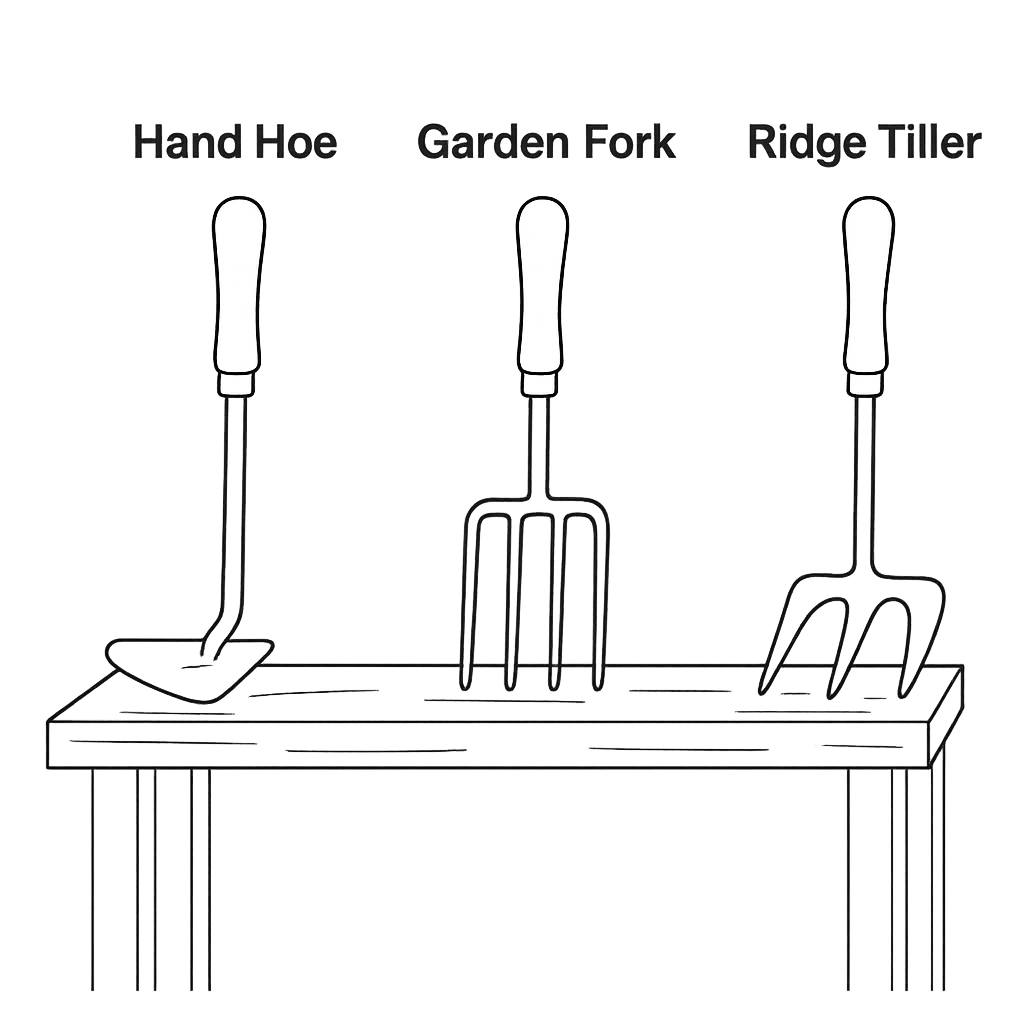
A farmer is preparing a small vegetable garden of 0.5 ha and intends to use hand tools for land preparation.
Question Parts
(a)
Identify three hand tools shown in the diagram that are suitable for preparing the soil, and state one specific function of each.
(b)
The farmer plans to use the hoe to break up clods after ploughing. If the hoe can break 12 clods per minute and the field contains an estimated 720 clods, calculate the total time required in hours and minutes.
(c)
Discuss two advantages and two disadvantages of using hand tools compared with mechanised implements for small‑scale vegetable production.
Detailed Essay Solution & Marking Scheme Available

Get the step-by-step mathematical proofs, key points required by examiners, and a comprehensive breakdown from our AI Tutor.

Question 4 View Details
A farmer owns a 5‑hectare maize farm and is considering the purchase of a mechanised tractor‑driven power tiller.
Question Parts
(a)
The power tiller has a rated power of 25 kW and a fuel consumption rate of 5 L per hour at full load. If the farmer expects to operate the tiller for 6 hours per day during land preparation, calculate the total fuel required for the entire operation.
(b)
The tractor that can pull the tiller has a pulling capacity of 15 kN. If the average soil resistance during tillage is 8 kN, determine whether the tractor is adequate. Show the reasoning.
(c)
Explain two environmental impacts (positive or negative) associated with the use of mechanised tillage on the farm.
Detailed Essay Solution & Marking Scheme Available

Get the step-by-step mathematical proofs, key points required by examiners, and a comprehensive breakdown from our AI Tutor.

Question 5 View Details
A farmer has 2.0 ha of land that he intends to use for a maize‑soybean mixed cropping system. He will plant maize on 1.2 ha and soybean on 0.8 ha.
Question Parts
(a)
Determine the amount of seed (in kg) required for each crop if the recommended seed rates are 25 kg ha⁻¹ for maize and 4 kg ha⁻¹ for soybean.
(b)
The expected yields are 4.5 t ha⁻¹ for maize and 2.8 t ha⁻¹ for soybean. Calculate (i) the total expected production (in tonnes) from the whole farm and (ii) the gross income if the market prices are ₦120,000 per tonne for maize and ₦180,000 per tonne for soybean.
(c)
Discuss at least three agronomic or economic advantages of practising a maize‑soybean rotation on this farm.
Detailed Essay Solution & Marking Scheme Available

Get the step-by-step mathematical proofs, key points required by examiners, and a comprehensive breakdown from our AI Tutor.

Question 6 View Details
A smallholder dairy farm keeps 20 lactating Friesian cows. Each cow has an average body weight of 450 kg and produces 22 litres of milk per day. The farm feeds the cows a concentrate mixture containing 20 % crude protein (CP) and a roughage (maize silage) containing 8 % CP. The recommended daily dry‑matter (DM) intake is 3 % of body weight, and the cows require 3.2 g of CP per litre of milk produced.
Question Parts
(a)
Calculate the total dry‑matter intake (in kg) required per cow per day.
(b)
Determine the amount of concentrate (kg) and roughage (kg) each cow should receive daily to meet both the DM and CP requirements. Assume the two feeds together supply the total DM intake.
(c)
If the concentrate costs ₦45,000 per tonne and the roughage costs ₦12,000 per tonne, compute the daily feed cost for the whole herd using the ration derived in part (b).
(d)
Suggest two management interventions that could improve the feed efficiency and milk yield of the herd, explaining the rationale behind each.
Detailed Essay Solution & Marking Scheme Available

Get the step-by-step mathematical proofs, key points required by examiners, and a comprehensive breakdown from our AI Tutor.

Question 7 View Details
A farmer in the Sudan savanna region of Nigeria cultivates maize on a 5‑hectare field. The farmer reports severe damage caused by an insect pest that has a rapid life cycle and attacks the whorl and young leaves. Recent surveys indicate that the pest is the Fall armyworm (Spodoptera frugiperda).
Question Parts
(a)
List three major insect pests of maize in Nigeria and, for each, briefly describe its life cycle stages that are responsible for crop damage.
(b)
For the Fall armyworm, develop an Integrated Pest Management (IPM) strategy that includes (i) cultural control, (ii) biological control, and (iii) chemical control. Justify the choice of any pesticide, considering its toxicity class and the risk of resistance development.
(c)
Using the data below, calculate the Economic Injury Level (EIL) for Fall armyworm on this maize farm and state the threshold number of larvae per hectare at which control should be applied. - Average grain loss caused by one larva = 0.20 kg ha⁻¹ - Market price of maize grain = ₦150 per kg - Cost of control (pesticide + application) = ₦500 per ha - Proportion of damage prevented by the chosen pesticide (K) = 0.90
Detailed Essay Solution & Marking Scheme Available

Get the step-by-step mathematical proofs, key points required by examiners, and a comprehensive breakdown from our AI Tutor.

Question 8 View Details
A smallholder in the rainforest zone of Nigeria cultivates tomatoes. After a rainy spell, the farmer notices circular brown lesions with concentric rings on the lower leaves of several plants.
Question Parts
(a)
From a survey of 200 tomato plants, 45 plants show typical symptoms. Out of a total of 1 200 leaves examined, 180 leaves are diseased. Calculate (i) the disease incidence (%) and (ii) the disease severity index (%).
(b)
Identify the most probable disease causing the described symptoms and name its causal organism.
(c)
Propose an integrated disease management plan for this disease, covering (i) cultural, (ii) resistant varieties, and (iii) chemical control. Explain why rotating with a non‑host crop helps reduce inoculum levels.
Detailed Essay Solution & Marking Scheme Available

Get the step-by-step mathematical proofs, key points required by examiners, and a comprehensive breakdown from our AI Tutor.

Master the Exam!

You've seen a preview, but there are thousands more questions plus AI tutor to break down complex solutions.

Unlock Full Access Available for Android & Windows
Help others prepare! Share this practice hub:
Chat with Support