neco model questions vol1 2018 physics | Objective

Prepare for your exams with neco model questions vol1 questions? Reviewing past/model questions is one of the most effective ways to guarantee a high score. This practice hub features authentic 2018 physics (Objective) questions designed to simulate the real exam environment.

Practice these randomly selected questions to test your readiness.

Question 1 View Details
A 0.5 kg copper block (specific heat capacity \(c_{Cu}=385\ \text{J kg}^{-1}\text{K}^{-1}\)) at \(200^{\circ}\text{C}\) is placed into an insulated container that holds water initially at \(20^{\circ}\text{C}\). After thermal equilibrium the temperature of the system is \(30^{\circ}\text{C}\). If the specific heat capacity of water is \(c_{w}=4186\ \text{J kg}^{-1}\text{K}^{-1}\), determine the mass of water in the container.
A. 0.88 kg
B. 0.68 kg
C. 0.98 kg
Correct D. 0.78 kg

Correct Answer: D

Want to see the full step-by-step solution? Unlock AI Explanation & Analytics
Question 2 View Details
Two forces act on a point: a 30 N force directed due east and a 40 N force directed due north. Find the magnitude of the resultant force in newtons.
Correct A. 50 N
B. 30 N
C. 40 N
D. 70 N

Correct Answer: A

Want to see the full step-by-step solution? Unlock AI Explanation & Analytics
Question 3 View Details
On the x‑axis, a point charge \(q_{1}=+8\ \mu\text{C}\) is placed at the origin and a charge \(q_{2}=-2\ \mu\text{C}\) at \(x=0.12\ \text{m}\). Determine the position on the x‑axis where the net electric field is zero. Give your answer as a distance in metres measured from the origin, indicating the direction (positive or negative).
A. 0.36 m
Correct B. 0.24 m
C. 0.08 m
D. -0.24 m

Correct Answer: B

Want to see the full step-by-step solution? Unlock AI Explanation & Analytics
Question 4 View Details
A sphere of radius \(R = 0.10\ \text{m}\) contains a volume charge density that varies with distance from the centre as \(\rho(r)=\rho_{0}\frac{r}{R}\) where \(\rho_{0}=6.0\times10^{-6}\ \text{C m}^{-3}\). Using Gauss's law, find the electric flux through a spherical surface of radius \(r = 0.08\ \text{m}\) centred at the same point.
Correct A. 8.7×10^2 N·m^2·C^{-1}
B. 9.2×10^2 N·m^2·C^{-1}
C. 8.7×10^3 N·m^2·C^{-1}
D. 7.5×10^2 N·m^2·C^{-1}

Correct Answer: A

Want to see the full step-by-step solution? Unlock AI Explanation & Analytics
Question 5 View Details
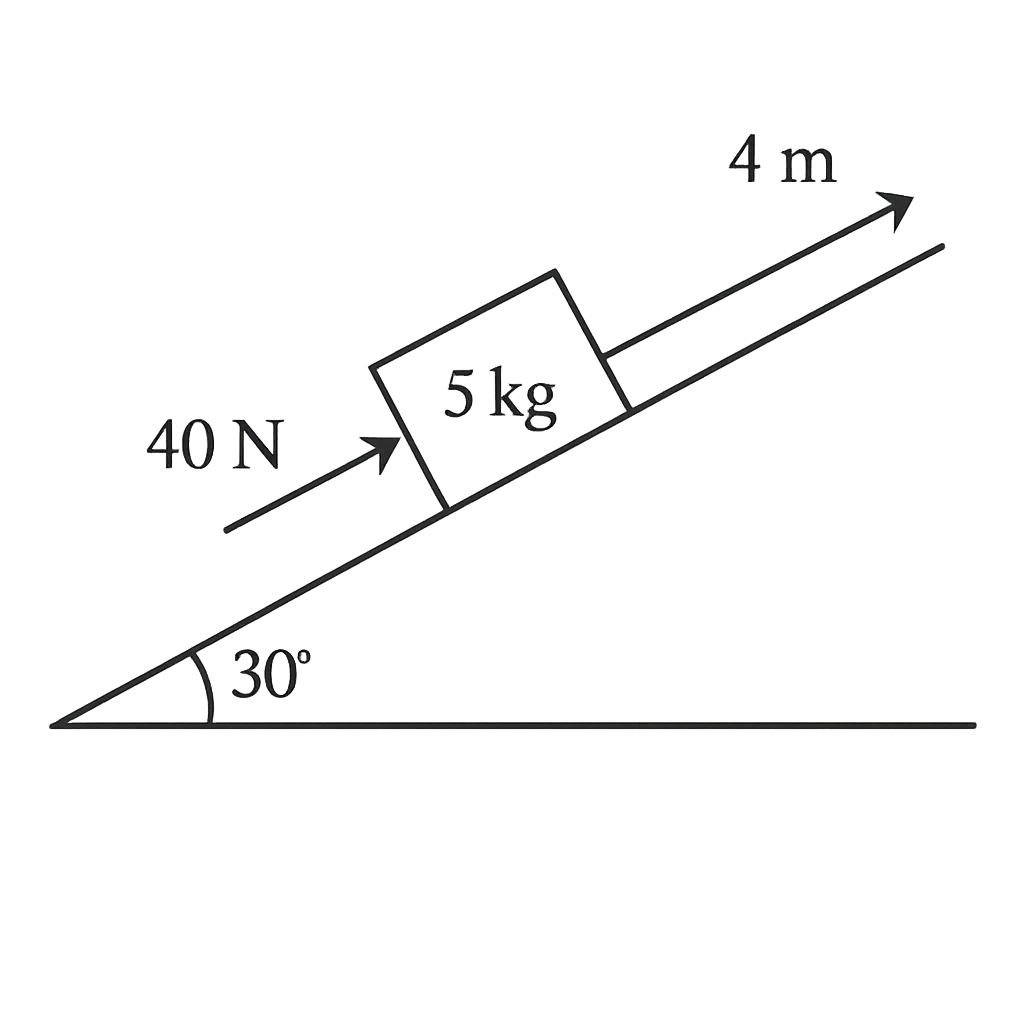
A 5 kg block rests on a smooth inclined plane that makes an angle of \(30^{\circ}\) with the horizontal. A horizontal force of 40 N pulls the block up the slope. The coefficient of kinetic friction between the block and the plane is \(\mu_k = 0.20\). The block moves 4.0 m up the incline. Calculate the net work done on the block during this displacement.
A. -14.1 J
B. -4.2 J
Correct C. -9.4 J
D. 9.4 J

Correct Answer: C

Want to see the full step-by-step solution? Unlock AI Explanation & Analytics
Question 6 View Details
A block of mass 5 kg slides down an inclined plane that makes an angle of \(30^{\circ}\) with the horizontal. The plane is rough, and the coefficient of kinetic friction is unknown. The block starts from rest at the top of the plane and reaches the bottom, which is 10 m down the slope, in 4.0 s. Assuming constant acceleration, determine the coefficient of kinetic friction \(\mu_{k}\). Give your answer to two decimal places.
A. 0.51
B. 0.38
C. 0.62
Correct D. 0.43

Correct Answer: D

Want to see the full step-by-step solution? Unlock AI Explanation & Analytics
Question 7 View Details
A compound pulley system consists of two identical movable pulleys and one fixed pulley. The rope is pulled vertically upward with a force \(F\). Each movable pulley reduces the tension in the rope segment that leaves it to 90 % of the tension that enters it (i.e., \(T_{out}=0.9\,T_{in}\)). A load of mass \(50\ \text{kg}\) is attached to the rope. Determine the minimum pulling force \(F\) required to lift the load at constant speed. Take \(g=9.8\ \text{m s}^{-2}\).
A. 6.80×10^2 N
B. 5.20×10^2 N
Correct C. 6.05×10^2 N
D. 7.10×10^2 N

Correct Answer: C

Want to see the full step-by-step solution? Unlock AI Explanation & Analytics
Question 8 View Details
A converging lens of focal length \(+12\ \text{cm}\) is placed \(8\ \text{cm}\) to the left of a plane mirror. An object is located \(30\ \text{cm}\) to the left of the lens. Light from the object passes through the lens, reflects from the mirror, and passes back through the lens to form the final image. Determine the position of the final image relative to the lens, stating the distance and on which side of the lens it is formed. Give your answer in centimeters to one decimal place.
A. 25.0 cm right of the lens
B. 19.5 cm right of the lens
C. 12.0 cm left of the lens
Correct D. 19.5 cm left of the lens

Correct Answer: D

Want to see the full step-by-step solution? Unlock AI Explanation & Analytics
Question 9 View Details
A battery of emf \(E\) volts and internal resistance \(r\) ohms is connected to a circuit as shown: a resistor \(R_1 = 5\ \Omega\) is in series with the parallel combination of \(R_2 = 3\ \Omega\) and \(R_3 = 9\ \Omega\). The total current drawn from the battery is \(4.0\ \text{A}\). The power dissipated in resistor \(R_2\) is measured to be \(27\ \text{W}\). The battery supplies a total power of \(120\ \text{W}\). Determine the emf \(E\) of the battery and its internal resistance \(r\).
A. E = 32 V, r = 0.20 Ω
B. E = 30 V, r = 0.35 Ω
C. E = 28 V, r = 0.30 Ω
Correct D. E = 30 V, r = 0.25 Ω

Correct Answer: D

Want to see the full step-by-step solution? Unlock AI Explanation & Analytics
Question 10 View Details
A source emits sound of frequency \(f_s = 500\ \text{Hz}\) in air where the speed of sound is \(v = 340\ \text{m s}^{-1}\). The source moves directly towards a stationary observer with a speed of \(20\ \text{m s}^{-1}\). At the same time, a second identical source, fixed at a point 30 m from the observer, emits the same frequency \(500\ \text{Hz}\). The observer hears the superposition of the two sounds. Calculate the beat frequency heard by the observer. Give your answer in hertz to one decimal place.
A. 27.8 Hz
Correct B. 31.3 Hz
C. 29.4 Hz
D. 31.0 Hz

Correct Answer: B

Want to see the full step-by-step solution? Unlock AI Explanation & Analytics
Question 11 View Details
A rectangular coil of \(N = 200\) turns and area \(A = 0.020\,\text{m}^2\) rotates at a constant angular speed of \(\omega = 120\pi\,\text{rad\,s}^{-1}\) in a uniform magnetic field of magnitude \(B = 0.50\,\text{T}\). The coil is connected in series with an external resistor of resistance \(R = 10\,\Omega\) and the coil's internal resistance \(r = 2\,\Omega\). Determine the average power dissipated in the external resistor.
A. 1.85×10⁴ W
B. 2.10×10⁴ W
Correct C. 1.97×10⁴ W
D. 2.05×10⁴ W

Correct Answer: C

Want to see the full step-by-step solution? Unlock AI Explanation & Analytics
Question 12 View Details
Two point charges are placed on a vertical line. Charge \(q_{1}=+6\,\mu\text{C}\) is at the origin \(O\), and charge \(q_{2}=-3\,\mu\text{C}\) is at point \(P\) which is \(0.12\,\text{m}\) above \(O\). (a) Find the distance \(x\) from \(O\) along \(OP\) where the net electric field is zero. (b) Calculate the electric potential at that point relative to infinity.
A. x = 0.045 m; V = 1.80×10⁵ V
B. x = 0.090 m; V = 2.70×10⁵ V
C. x = 0.060 m; V = 2.10×10⁵ V
Correct D. x = 0.070 m; V = 2.25×10⁵ V

Correct Answer: D

Want to see the full step-by-step solution? Unlock AI Explanation & Analytics
Question 13 View Details
A car starts from rest and accelerates with a time‑dependent acceleration \(a(t)=2t\,\text{m\,s}^{-2}\) for the first \(5\,\text{s}\). Immediately after, the driver applies a constant deceleration of \(4\,\text{m\,s}^{-2}\) until the car comes to rest. Find the total distance travelled by the car.
A. 1.00×10² m
Correct B. 1.20×10² m
C. 9.0×10¹ m
D. 1.40×10² m

Correct Answer: B

Want to see the full step-by-step solution? Unlock AI Explanation & Analytics
Question 14 View Details
A \(150\,\text{g}\) piece of aluminium (specific heat \(c_{1}=0.900\,\text{J\,g}^{-1}\,\text{°C}^{-1}\)) initially at \(80\,\text{°C}\) is placed into \(200\,\text{g}\) of water (\(c_{2}=4.18\,\text{J\,g}^{-1}\,\text{°C}^{-1}\)) at \(20\,\text{°C}\) in an insulated container. Determine (a) the final equilibrium temperature of the system and (b) the amount of heat transferred from the aluminium to the water.
A. T_f = 30.2 °C; Q = 6.5 kJ
Correct B. T_f = 28.4 °C; Q = 7.0 kJ
C. T_f = 25.0 °C; Q = 8.2 kJ
D. T_f = 27.0 °C; Q = 7.5 kJ

Correct Answer: B

Want to see the full step-by-step solution? Unlock AI Explanation & Analytics
Question 15 View Details
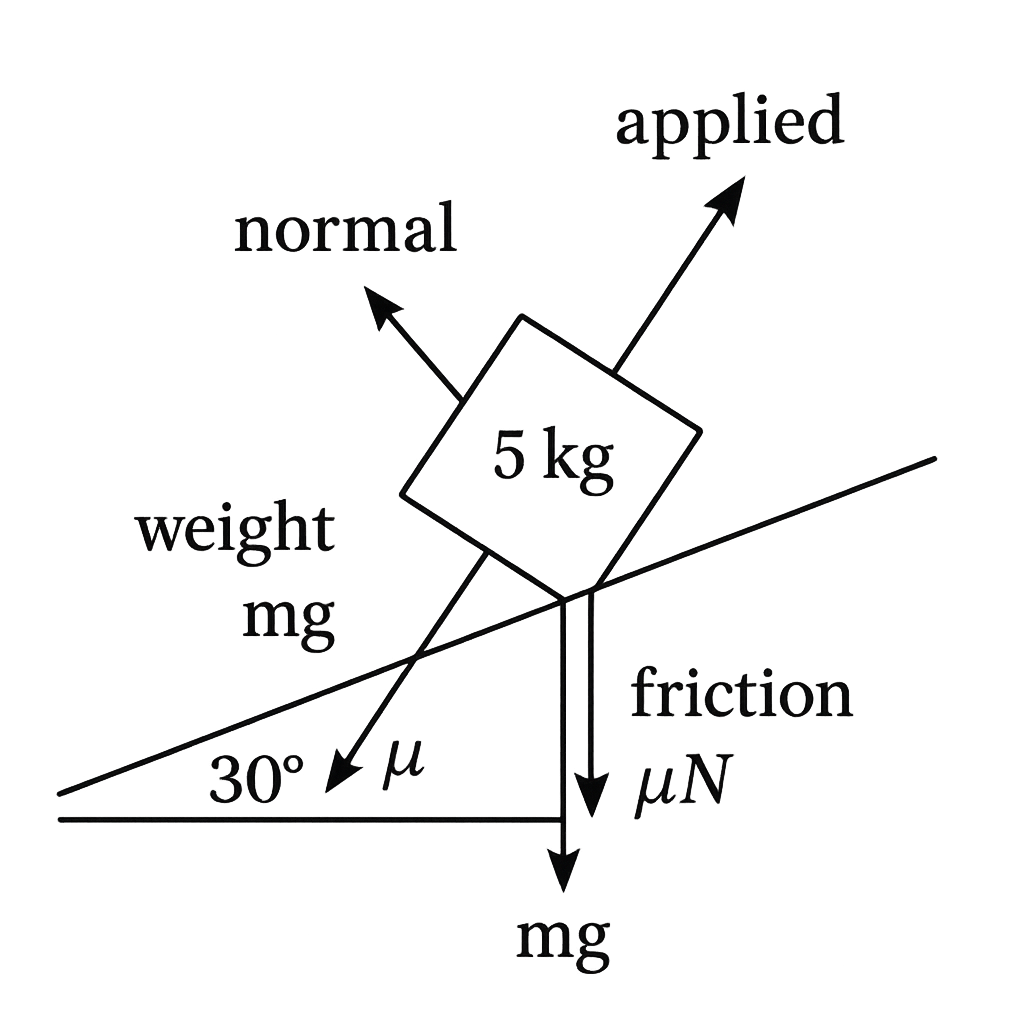
A \(5\,\text{kg}\) block rests on an inclined plane that makes an angle of \(30^{\circ}\) with the horizontal. The coefficient of kinetic friction between the block and the plane is \(\mu_{k}=0.20\). An external force \(F\) is applied parallel to the plane upward, causing the block to move up the plane at constant speed. Using the force diagram, calculate the magnitude of \(F\).
A. 30 N
B. 40 N
C. 35 N
Correct D. 33 N

Correct Answer: D

Want to see the full step-by-step solution? Unlock AI Explanation & Analytics
Question 16 View Details
A string 0.90 m long is fixed at both ends. The distance between two consecutive nodes observed on the string is 0.15 m. The string has a linear mass density of 0.005 kg m⁻¹ and is under a tension of 50 N. Determine the frequency of the vibration of the string.
Correct A. 333.3 Hz
B. 300 Hz
C. 400 Hz
D. 350 Hz

Correct Answer: A

Want to see the full step-by-step solution? Unlock AI Explanation & Analytics
Question 17 View Details
A long solenoid 0.50 m in length has 800 turns and carries a current of 2.0 A.\n(a) Find the magnetic field inside the solenoid.\n(b) A rectangular conducting loop of width 0.10 m and height 0.20 m is placed with one side flush against the end of the solenoid, the plane of the loop parallel to the solenoid axis. The loop is pulled completely out of the solenoid at a constant speed of 0.05 m s⁻¹. Determine the average induced emf in the loop during the extraction.\n(c) If the loop has a resistance of 4 Ω, calculate the total thermal energy generated in the loop during the extraction.
A. 2.0×10⁻⁹ J
B. 1.0×10⁻⁹ J
C. 5.0×10⁻¹⁰ J
Correct D. 4.0×10⁻¹⁰ J

Correct Answer: D

Want to see the full step-by-step solution? Unlock AI Explanation & Analytics
Question 18 View Details
A source of sound of frequency 800 Hz moves towards a stationary observer at 30 m s⁻¹ in air where the speed of sound is 340 m s⁻¹. At the same time the observer moves away from a second stationary source of frequency 750 Hz at 20 m s⁻¹. Determine the beat frequency heard by the observer.
A. 200 Hz
Correct B. 172 Hz
C. 190 Hz
D. 150 Hz

Correct Answer: B

Want to see the full step-by-step solution? Unlock AI Explanation & Analytics
Question 19 View Details
A car starts from rest and accelerates uniformly at 2.5 m s⁻² for 8 s. It then continues at the attained constant speed for a further 12 s. Find the total distance travelled by the car.
A. 400 m
B. 240 m
Correct C. 320 m
D. 280 m

Correct Answer: C

Want to see the full step-by-step solution? Unlock AI Explanation & Analytics
Question 20 View Details
A pulley system is used to lift a load of 200 N. The effort applied vertically downward is 80 N and the system operates with an efficiency of 85 %. Determine (a) the ideal mechanical advantage (IMA), (b) the actual mechanical advantage (AMA), and (c) the speed ratio (SR) of the system.
Correct A. IMA = 2.5, AMA = 2.125, SR ≈ 1.18
B. IMA = 3.0, AMA = 2.55, SR ≈ 1.18
C. IMA = 2.5, AMA = 2.0, SR ≈ 1.25
D. IMA = 2.0, AMA = 1.7, SR ≈ 1.18

Correct Answer: A

Want to see the full step-by-step solution? Unlock AI Explanation & Analytics
Question 21 View Details
A 150 g sample of water at \(20^{\circ}\text{C}\) is placed in a calorimeter whose heat capacity is \(50\ \text{J/}^{\circ}\text{C}\). An aluminum rod of unknown mass \(m\) (specific heat \(c_{\text{Al}} = 0.900\ \text{J g}^{-1}\!^{\circ}\text{C}^{-1}\)) is heated to \(200^{\circ}\text{C}\) and then quickly transferred into the water. Assuming no heat loss to the surroundings, the final equilibrium temperature of the system is \(30^{\circ}\text{C}\). Determine the mass \(m\) of the aluminum rod in grams (to two decimal places).
Correct A. 44.25 g
B. 38.40 g
C. 52.10 g
D. 30.75 g

Correct Answer: A

Want to see the full step-by-step solution? Unlock AI Explanation & Analytics
Question 22 View Details
A \(5.0\ \text{kg}\) block is released from rest at the top of a frictionless incline that is \(10\ \text{m}\) high and makes an angle of \(30^{\circ}\) with the horizontal. At the bottom of the incline the block reaches a horizontal rough surface with coefficient of kinetic friction \(\mu_{k}=0.20\) and then compresses a spring of force constant \(k=800\ \text{N m}^{-1}\) until it momentarily comes to rest. (i) Find the maximum compression \(x\) of the spring (in metres, to two decimal places). (ii) Assuming the block decelerates uniformly while compressing the spring, calculate the average power delivered by the block during the compression phase (in kilowatts, to two decimal places).
Correct A. x = 1.09 m; P = 3.13 kW
B. x = 0.95 m; P = 2.80 kW
C. x = 0.80 m; P = 4.00 kW
D. x = 1.25 m; P = 3.50 kW

Correct Answer: A

Want to see the full step-by-step solution? Unlock AI Explanation & Analytics
Question 23 View Details
A sealed rigid container of volume \(2.0\ \text{L}\) contains a mixture of oxygen and nitrogen at \(27^{\circ}\text{C}\) and a total pressure of \(750\ \text{mmHg}\). The partial pressure of oxygen is twice that of nitrogen. The container is then heated to \(127^{\circ}\text{C}\) while remaining sealed. (i) Determine the initial partial pressures of oxygen and nitrogen (in mmHg). (ii) Find the total pressure of the gas mixture after heating, expressed in kilopascals (kPa) to one decimal place.
Correct A. p_N2 = 250 mmHg, p_O2 = 500 mmHg; total pressure = 133.3 kPa
B. p_N2 = 300 mmHg, p_O2 = 600 mmHg; total pressure = 150.0 kPa
C. p_N2 = 200 mmHg, p_O2 = 400 mmHg; total pressure = 120.0 kPa
D. p_N2 = 250 mmHg, p_O2 = 500 mmHg; total pressure = 120.0 kPa

Correct Answer: A

Want to see the full step-by-step solution? Unlock AI Explanation & Analytics
Question 24 View Details
A solid metal sphere of mass \(0.50\ \text{kg}\) and specific heat capacity \(c = 0.45\ \text{J g}^{-1}\!^{\circ}\text{C}^{-1}\) is initially at \(200^{\circ}\text{C}\) and is placed in a room where the ambient temperature is \(25^{\circ}\text{C}\). The sphere cools according to Newton's law of cooling, \(\displaystyle \frac{dT}{dt} = -k\,(T - T_{\text{room}})\). After \(5\) minutes its temperature has fallen to \(120^{\circ}\text{C}\). (i) Determine the cooling constant \(k\) (in \(\text{min}^{-1}\), to two decimal places). (ii) Predict the temperature of the sphere after \(15\) minutes (in \(^\circ\text{C}\), to the nearest degree).
A. k = 0.15 min^{-1}; T(15 min) ≈ 40 °C
B. k = 0.12 min^{-1}; T(15 min) ≈ 65 °C
Correct C. k = 0.12 min^{-1}; T(15 min) ≈ 53 °C
D. k = 0.08 min^{-1}; T(15 min) ≈ 70 °C

Correct Answer: C

Want to see the full step-by-step solution? Unlock AI Explanation & Analytics
Question 25 View Details
Two thin converging lenses \(L_1\) and \(L_2\) are placed coaxially \(70\ \text{cm}\) apart. Lens \(L_1\) has a focal length of \(f_1 = 15\ \text{cm}\). An object is positioned \(30\ \text{cm}\) to the left of \(L_1\). The final image formed by \(L_2\) is real, inverted, and located \(40\ \text{cm}\) to the right of \(L_2\). Determine the focal length \(f_2\) of lens \(L_2\) (in centimetres, to the nearest centimetre).
A. 90 cm
B. 105 cm
Correct C. 120 cm
D. 150 cm

Correct Answer: C

Want to see the full step-by-step solution? Unlock AI Explanation & Analytics

Master the Exam!

You've seen a preview, but there are thousands more questions plus AI tutor to break down complex solutions.

Unlock Full Access Available for Android & Windows
Help others prepare! Share this practice hub:
Chat with Support