neco model questions vol1 2018 geography | Objective

Prepare for your exams with neco model questions vol1 questions? Reviewing past/model questions is one of the most effective ways to guarantee a high score. This practice hub features authentic 2018 geography (Objective) questions designed to simulate the real exam environment.

Practice these randomly selected questions to test your readiness.

Question 1 View Details
Town A is located at \(6^{\circ}00' \text{N}, 7^{\circ}00' \text{E}\) and Town B at \(5^{\circ}30' \text{N}, 8^{\circ}30' \text{E}\). The straight‑line distance between the two towns is approximately \(175\) km. Assuming \(1^{\circ}\) of latitude equals \(111\) km and \(1^{\circ}\) of longitude equals \(111\cos\bar{\phi}\) km, where \(\bar{\phi}\) is the mean latitude of the two towns, find the latitude of a point C that lies on the line AB and is \(120\) km from Town A. Give your answer in degrees and minutes north.
A. 5°30' N
B. 5°45' N
C. 6°00' N
Correct D. 5°39' N

Correct Answer: D

Want to see the full step-by-step solution? Unlock AI Explanation & Analytics
Question 2 View Details
A farmer cultivates maize on \(2\) ha. Under normal rainfall the expected yield is \(3.5\) t ha\(^{-1}\). The market price is ₦\(2{,}500\) per tonne and the base fertilizer cost is ₦\(5{,}000\) per ha. For each additional \(0.1\) t ha\(^{-1}\) of yield, the market price rises by ₦\(150\) per tonne and the fertilizer cost rises by ₦\(200\) per ha. Fixed costs (land, labour) amount to ₦\(5{,}000\). The farmer can install an irrigation system that guarantees an extra \(0.3\) t ha\(^{-1}\) yield at a total cost of ₦\(12{,}000\). Should the farmer adopt the irrigation system? Calculate the difference in profit (in naira) between adopting and not adopting the system.
A. No; profit would be lower by ₦7,500
Correct B. No; profit would be lower by ₦8,280
C. Yes; profit would increase by ₦2,150
D. No; profit would be lower by ₦9,600

Correct Answer: B

Want to see the full step-by-step solution? Unlock AI Explanation & Analytics
Question 3 View Details
A 5‑ha field has a uniform slope of 0.001. A storm delivers \(80\) mm of rain uniformly over \(6\) h. The soil infiltration capacity is \(5\) mm h\(^{-1}\). (a) Assuming runoff occurs uniformly during the storm, calculate the minimum discharge (in m³ s\(^{-1}\)) that a drainage ditch must convey to avoid water‑logging. (b) If the ditch is rectangular, \(1.2\) m wide, has Manning's roughness coefficient \(n = 0.025\) and the same slope as the field, determine the minimum depth of flow required to convey the discharge found in part (a). Give the depth to two decimal places (m).
A. 0.10 m³/s and 0.22 m depth
B. 0.08 m³/s and 0.18 m depth
C. 0.15 m³/s and 0.30 m depth
Correct D. 0.12 m³/s and 0.25 m depth

Correct Answer: D

Want to see the full step-by-step solution? Unlock AI Explanation & Analytics
Question 4 View Details
Three possible sites for a new settlement are being evaluated. The sites are scored (out of 10) for five criteria as follows: | Criterion | Weight | Town A | Town B | Town C | |-----------|--------|--------|--------|--------| | Water availability | 0.25 | 8 | 6 | 9 | | Soil fertility | 0.20 | 7 | 9 | 6 | | Transport access | 0.20 | 6 | 8 | 5 | | Flood risk (lower is better) | 0.15 | 4 | 7 | 5 | | Proximity to market | 0.20 | 9 | 6 | 8 | For flood risk, the score is used directly (higher score = lower risk). Compute the weighted suitability score for each town and state which town is most suitable for the new settlement.
A. None of the above
B. Town A
Correct C. Town B
D. Town C

Correct Answer: C

Want to see the full step-by-step solution? Unlock AI Explanation & Analytics
Question 5 View Details
The following table gives the average monthly temperature (\(^\circ\)C) and total rainfall (mm) for a location. | Month | Temp (°C) | Rainfall (mm) | |-------|----------|---------------| | Jan | 28 | 20 | | Feb | 30 | 30 | | Mar | 32 | 80 | | Apr | 33 | 150 | | May | 31 | 200 | | Jun | 27 | 250 | | Jul | 24 | 300 | | Aug | 23 | 280 | | Sep | 25 | 180 | | Oct | 27 | 100 | | Nov | 28 | 50 | | Dec | 29 | 30 | (a) Using the Köppen climate classification, determine the climate type (e.g., Aw, Am, etc.) for this location. (b) Estimate the annual potential evapotranspiration (PET) in mm using the Thornthwaite method, where \[\nI = \sum_{i=1}^{12}\left(\frac{T_i}{5}\right)^{1.514},\n\qquad\n a = 6.75\times10^{-7}I^{3} - 7.71\times10^{-5}I^{2} + 1.792\times10^{-2}I + 0.49239,\n\]\n\[\n\text{PET}_i = 16\left(\frac{10T_i}{I}\right)^{a}\;(\text{mm}).\n\]\nGive the climate type and the annual PET rounded to the nearest ten millimetres.
A. Af, 2200 mm
B. Am, 2100 mm
Correct C. Aw, 2140 mm
D. Aw, 2000 mm

Correct Answer: C

Want to see the full step-by-step solution? Unlock AI Explanation & Analytics
Question 6 View Details
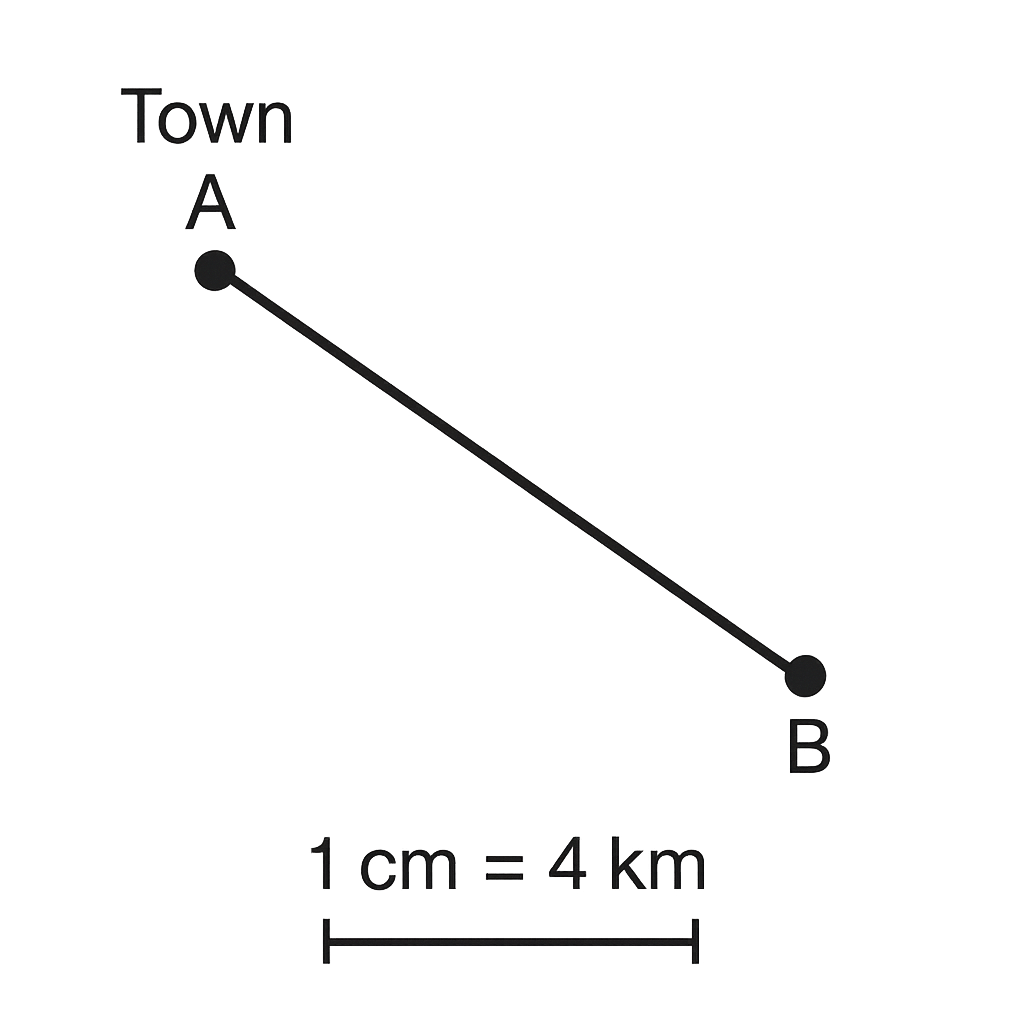
On the map, the straight road between Town A and Town B measures \(3.2\) cm. The map scale is \(1\text{ cm}=4\text{ km}\). What is the actual distance in kilometres between the two towns? If a vehicle travels at \(60\text{ km h}^{-1}\), how many minutes will the journey take?
Correct A. 13 minutes
B. 15 minutes
C. 14 minutes
D. 12 minutes

Correct Answer: A

Want to see the full step-by-step solution? Unlock AI Explanation & Analytics
Question 7 View Details
A district had a population of 1,200,000 in 2015. The crude birth rate was \(28\) per 1,000, the crude death rate \(12\) per 1,000 and the net migration rate \(-4\) per 1,000 (out‑migration). Assuming these rates remain constant, estimate the population in 2020. Give your answer rounded to the nearest thousand.
Correct A. 1274000
B. 1273000
C. 1320000
D. 1272000

Correct Answer: A

Want to see the full step-by-step solution? Unlock AI Explanation & Analytics
Question 8 View Details
A region has a uniform population density of 150 persons per km\(^2\). A secondary school requires a threshold population of 22,500 within its service range, and the maximum distance people are willing to travel is 15 km. (a) What is the minimum radius of the catchment area needed to meet the threshold? (b) Can a settlement with a population of 12,000 provide this service? Answer "Yes" or "No".
A. Undetermined
B. Maybe
Correct C. No
D. Yes

Correct Answer: C

Want to see the full step-by-step solution? Unlock AI Explanation & Analytics
Question 9 View Details
Two alternative routes connect City X to City Y.\n\nRoute A: 120 km highway at \(80\text{ km h}^{-1}\) followed by 40 km mountain road at \(40\text{ km h}^{-1}\). A mandatory rest stop of 30 minutes is required after the highway segment.\n\nRoute B: Direct 150 km road travelled at \(60\text{ km h}^{-1}\) for the first 60 km and \(70\text{ km h}^{-1}\) for the remaining 90 km, with no rest stop.\n\nThe vehicle's fuel consumption is 8 L per 100 km on highways (speed > 70 km h\(^{-1}\)), 12 L per 100 km on mountain roads, and 10 L per 100 km on all other roads. Fuel costs \(\text{₦}200\) per litre. The driver values time at \(\text{₦}500\) per hour.\n\nCalculate the total cost (fuel cost + time cost) for each route and state which route is cheaper. Give the answer as "Route A" or "Route B".
A. Route C
B. Route A
Correct C. Route B
D. Both routes cost the same

Correct Answer: C

Want to see the full step-by-step solution? Unlock AI Explanation & Analytics
Question 10 View Details
The table below gives the annual probability (as a percentage), estimated damage cost (in million Naira) and vulnerability factor (scale 1-5) for three environmental hazards in a region.\n\n| Hazard | Probability (%) | Damage (million N) | Vulnerability |\n|----------|----------------|--------------------|---------------|\n| Flood | 4 | 120 | 4 |\n| Drought | 6 | 80 | 3 |\n| Landslide| 2 | 150 | 5 |\n\nThe risk index for a hazard is calculated as\n\( \text{Risk Index}= (\text{Probability}/100) \times \text{Damage} \times \text{Vulnerability}. \)\n\nCompute the risk index for each hazard and indicate which hazard should be given top priority for mitigation. Provide the name of the hazard.
A. Landslide
B. Earthquake
Correct C. Flood
D. Drought

Correct Answer: C

Want to see the full step-by-step solution? Unlock AI Explanation & Analytics
Question 11 View Details
A town had a population of 150,000 in 2010. From 2010 to 2015 the annual growth rate was \(2.5\%\). From 2015 to 2020 the annual growth rate changed to \(1.8\%\). Assuming compound growth, what was the population in 2020 (rounded to the nearest whole number)?
A. 184000
B. 186500
C. 190000
Correct D. 185545

Correct Answer: D

Want to see the full step-by-step solution? Unlock AI Explanation & Analytics
Question 12 View Details
During a 7‑day week the sum of the daily average temperatures (average of the high and low) is \(179^{\circ}\text{C}\). The average temperatures for six days are \(22^{\circ}\text{C}, 24^{\circ}\text{C}, 23^{\circ}\text{C}, 21^{\circ}\text{C}, 25^{\circ}\text{C}\) and \(26^{\circ}\text{C}\). On the missing day the low temperature was \(16^{\circ}\text{C}\) and the temperature range (high minus low) was \(6^{\circ}\text{C}\) greater than the average temperature of that day. What was the high temperature on the missing day (in \(^{\circ}\text{C}\))?
Correct A. 60
B. 58
C. 55
D. 62

Correct Answer: A

Want to see the full step-by-step solution? Unlock AI Explanation & Analytics
Question 13 View Details
A bus travels a total distance of \(240\) km. It covers the first \(150\) km at an average speed of \(60\) km/h. For the remaining \(90\) km the speed \(v\) (km/h) can vary, but the total travel time must not exceed \(5\) hours. The bus consumes fuel at \(0.4\) L per km for the first segment and at a rate of \((0.3 + 0.005v)\) L per km for the second segment. Fuel costs \(\ ₦200\) per litre and the total fuel cost must not exceed \(\ ₦30{,}000\). What is the maximum possible speed \(v\) (km/h) for the second segment that satisfies both constraints?
A. 130
B. 150
C. 120
Correct D. 140

Correct Answer: D

Want to see the full step-by-step solution? Unlock AI Explanation & Analytics
Question 14 View Details
A river is \(150\) m wide. The riverbank on one side erodes at a rate of \(0.12\) m per year, while sediment is deposited on the opposite bank at a rate of \(0.08\) m per year. Assuming both processes act simultaneously to reduce the river's width, after how many years will the river's width be reduced by \(10\%\)?
Correct A. 75
B. 45
C. 60
D. 90

Correct Answer: A

Want to see the full step-by-step solution? Unlock AI Explanation & Analytics
Question 15 View Details
A map has a scale of \(1\) cm : \(5\) km. The straight‑line distance between Town A and Town B on the map measures \(7.4\) cm. What is the actual distance between the towns in kilometres?
A. 40
Correct B. 37
C. 42
D. 35

Correct Answer: B

Want to see the full step-by-step solution? Unlock AI Explanation & Analytics
Question 16 View Details
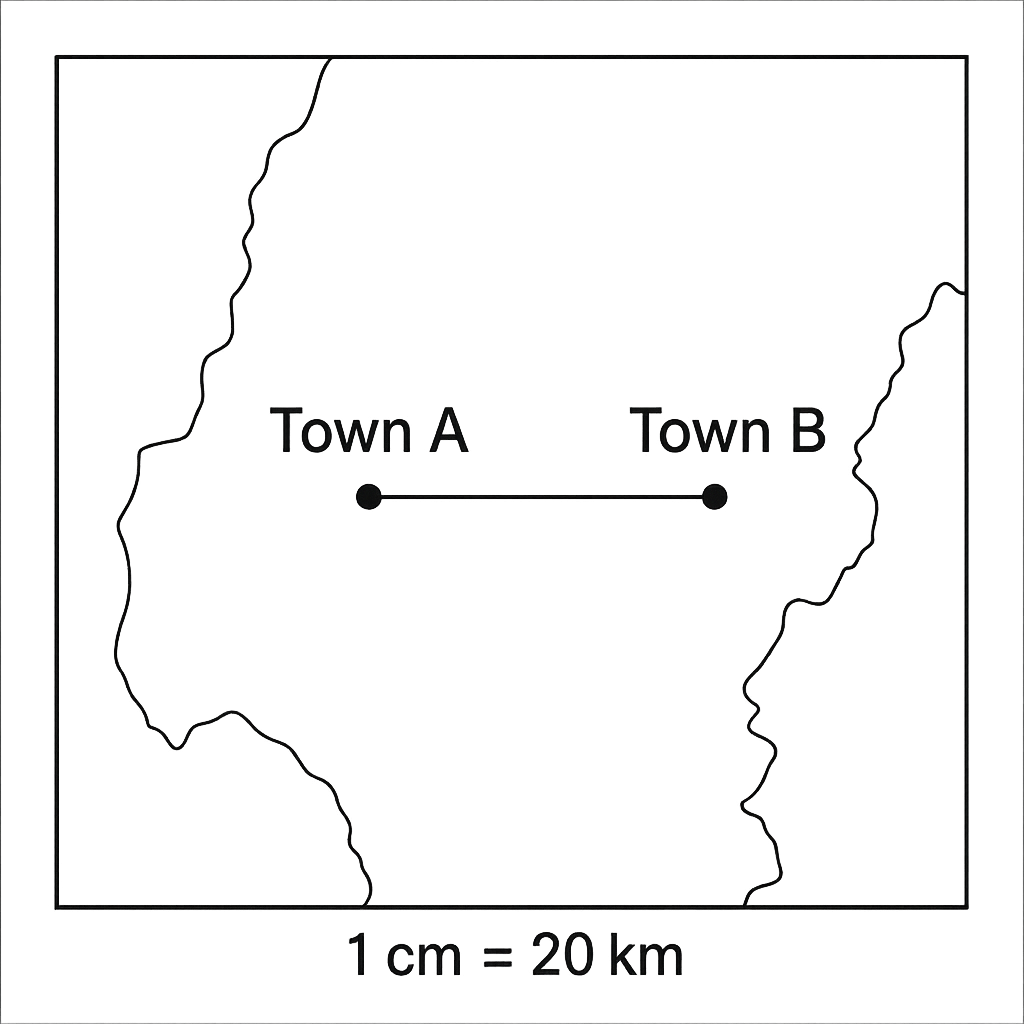
A map shows Town A and Town B 5 cm apart. The map scale is 1 cm = 20 km. Find the real distance between the towns in kilometres.
A. 80
Correct B. 100
C. 25
D. 120

Correct Answer: B

Want to see the full step-by-step solution? Unlock AI Explanation & Analytics
Question 17 View Details
In a river basin the drainage area is 250 km\(^2\) and the average slope is 12\%. Using the empirical relation \(I = 0.02\,A^{0.5}\,S^{1.2}\) (where \(I\) is the incision rate in mm/yr, \(A\) in km\(^2\) and \(S\) as a decimal), calculate \(I\) to three significant figures and state which type of landform is most likely to develop after long‑term erosion.
A. Incision rate ≈ 0.015 mm/yr; likely a steep canyon (incised valley)
B. Incision rate ≈ 0.040 mm/yr; likely a narrow gorge (rocky trench)
C. Incision rate ≈ 0.030 mm/yr; likely a mountainous ridge (uplifted plateau)
Correct D. Incision rate ≈ 0.025 mm/yr; likely a broad valley (fluvial plain)

Correct Answer: D

Want to see the full step-by-step solution? Unlock AI Explanation & Analytics
Question 18 View Details
A shale is subjected to a temperature of 500\(^\circ\)C and a pressure of 5 kbar during metamorphism. (i) Convert the pressure to pascals. (ii) Identify the most probable metamorphic rock formed. (iii) Name one mineral that commonly occurs in this rock.
Correct A. 5 × 10⁸ Pa; schist; mica
B. 5 × 10⁸ Pa; phyllite; biotite
C. 4 × 10⁸ Pa; gneiss; quartz
D. 5 × 10⁹ Pa; schist; garnet

Correct Answer: A

Want to see the full step-by-step solution? Unlock AI Explanation & Analytics
Question 19 View Details
A map has a scale of 1:50,000. The distance between two points on the map measures 3.2 cm. Determine the actual ground distance in kilometres, correct to one decimal place.
A. 3.2
Correct B. 1.6
C. 2.0
D. 0.8

Correct Answer: B

Want to see the full step-by-step solution? Unlock AI Explanation & Analytics
Question 20 View Details
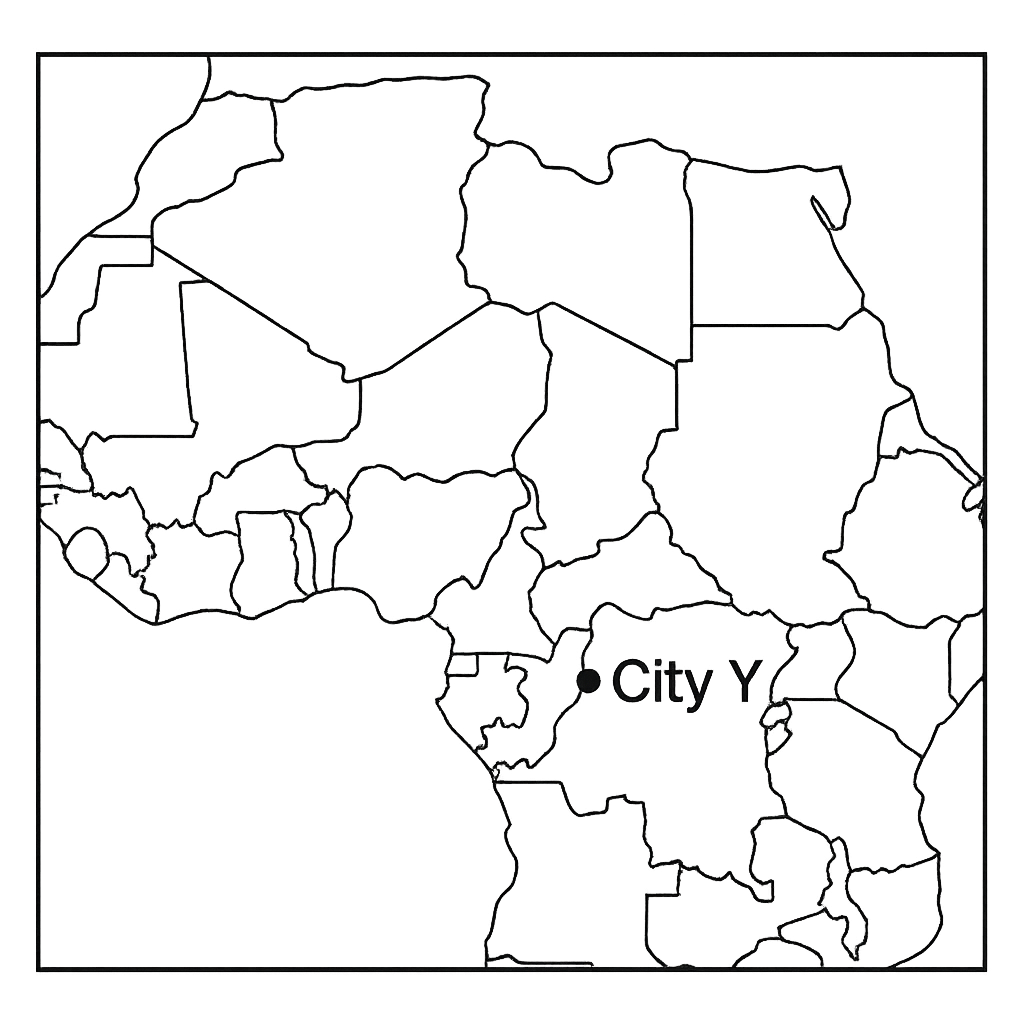
The diagram shows two cities, City X at 5°N latitude and City Y at 7°N latitude. Which city is situated farther north?
A. Both cities are at the same latitude
B. City X
Correct C. City Y
D. Neither city is north of the other

Correct Answer: C

Want to see the full step-by-step solution? Unlock AI Explanation & Analytics
Question 21 View Details
A cargo of goods must be transported 240 km from point A to point B. Two possible routes are available:\n\nRoute 1: Fully paved road. Average speed = \(60\) km/h. Toll = \(\text{₦}1,500\) per 100 km. Fuel consumption = \(8\) L per 100 km.\n\nRoute 2: Mixed road - 150 km paved and 90 km unpaved. On paved sections speed = \(55\) km/h and fuel consumption = \(7\) L per 100 km; on unpaved sections speed = \(35\) km/h and fuel consumption = \(9\) L per 100 km. No tolls. Fuel price = \(\text{₦}165\) per litre.\n\nThe cargo must be delivered within \(5\) hours and the company wants the minimum total cost (toll + fuel). Which route should be chosen and what is the total cost (in naira) of the chosen route? State the answer as "Route X, total cost = \(\text{₦}Y\)".
A. Route 2, total cost = \(\text{₦}6,500\)
B. Route 2, total cost = \(\text{₦}6,768\)
C. Route 1, total cost = \(\text{₦}7,200\)
Correct D. Route 1, total cost = \(\text{₦}6,768\)

Correct Answer: D

Want to see the full step-by-step solution? Unlock AI Explanation & Analytics
Question 22 View Details
The average monthly rainfall (in mm) for a location is: Jan 140, Feb 120, Mar 100, Apr 80, May 60, Jun 40, Jul 30, Aug 30, Sep 50, Oct 70, Nov 110, Dec 130. The potential evapotranspiration (PET) for the year is \(1800\) mm. Calculate the aridity index \(AI = \frac{P}{PET}\) (where \(P\) is the total annual precipitation) and state the climate zone using the following classification: \(AI<0.2\) - arid, \(0.2\le AI<0.5\) - semi‑arid, \(0.5\le AI<0.65\) - sub‑humid, \(AI\ge0.65\) - humid.
A. AI = 0.53, climate zone = Humid
Correct B. AI = 0.53, climate zone = Sub‑humid
C. AI = 0.61, climate zone = Sub‑humid
D. AI = 0.48, climate zone = Semi‑arid

Correct Answer: B

Want to see the full step-by-step solution? Unlock AI Explanation & Analytics
Question 23 View Details
A soil sample has a bulk density of \(1.4\) g cm\(^{-3}\) and a particle density of \(2.65\) g cm\(^{-3}\). The air‑filled porosity is \(0.25\) (i.e., 25 %). Calculate the field capacity, expressed as the percentage of the soil volume that is water‑filled at field capacity.
A. 27.8 %
B. 24.5 %
C. 20.0 %
Correct D. 22.2 %

Correct Answer: D

Want to see the full step-by-step solution? Unlock AI Explanation & Analytics
Question 24 View Details
Sea‑level temperature is \(30^{\circ}\)C and the environmental lapse rate is \(0.6^{\circ}\)C per 100 m. Three sites have the following data:\n\nSite A: altitude \(200\) m, annual rainfall \(900\) mm.\nSite B: altitude \(800\) m, annual rainfall \(1500\) mm.\nSite C: altitude \(1600\) m, annual rainfall \(2000\) mm.\n\nFor each site, calculate the temperature at the site, then compute the moisture index \(MI = \frac{\text{rainfall (mm)}}{\text{temperature (°C)}}\). Which site has the highest moisture index and is therefore expected to support the most forested vegetation?
A. Site A
Correct B. Site C
C. Site D
D. Site B

Correct Answer: B

Want to see the full step-by-step solution? Unlock AI Explanation & Analytics
Question 25 View Details
A map has a scale of 1 cm : 250 m. The distance between Town X and Town Y on the map measures \(6.4\) cm. What is the actual ground distance between the two towns in kilometres?
A. 1.8 km
B. 2.0 km
Correct C. 1.6 km
D. 0.64 km

Correct Answer: C

Want to see the full step-by-step solution? Unlock AI Explanation & Analytics

Master the Exam!

You've seen a preview, but there are thousands more questions plus AI tutor to break down complex solutions.

Unlock Full Access Available for Android & Windows
Help others prepare! Share this practice hub:
Chat with Support