neco model questions vol1 2018 chemistry | Objective

Prepare for your exams with neco model questions vol1 questions? Reviewing past/model questions is one of the most effective ways to guarantee a high score. This practice hub features authentic 2018 chemistry (Objective) questions designed to simulate the real exam environment.

Practice these randomly selected questions to test your readiness.

Question 1 View Details
A colourless liquid with molecular formula \(C_{5}H_{10}O\) is reduced by LiAlH\(_4\) to give a single alcohol which on dehydration yields a single alkene that is a symmetrical internal alkene. Identify the functional group present in the original compound and give its IUPAC name.
Correct A. pentan-2-one
B. pentan-2-ol
C. pentan-3-one
D. pentan-1-one

Correct Answer: A

Want to see the full step-by-step solution? Unlock AI Explanation & Analytics
Question 2 View Details
A saturated solution of Na\(_2\)CO\(_3\) at 20°C contains 215 g of Na\(_2\)CO\(_3\) per 1000 g of water. 300 g of this solution is prepared and then 50.0 g of K\(_2\)CO\(_3\) (solubility 112 g per 1000 g water at 20°C, 140 g per 1000 g water at 80°C) is added. The mixture is heated to 80°C, where the solubility of Na\(_2\)CO\(_3\) is 90 g per 1000 g water. Assuming no change in water mass on mixing, how many grams of Na\(_2\)CO\(_3\) will precipitate on heating?
A. 33.2 g
B. 25.0 g
Correct C. 30.9 g
D. 28.4 g

Correct Answer: C

Want to see the full step-by-step solution? Unlock AI Explanation & Analytics
Question 3 View Details
A molecule AB\(_3\) is colourless, has a trigonal planar geometry and an average A-B bond length of 1.28 Å. Spectroscopic data indicate that each A-B bond has a bond order of 1.33. Another molecule AB\(_4\) is colourless, has a tetrahedral geometry and an A-B bond length of 1.48 Å. Assuming that element A belongs to the second period and element B is a halogen, determine (i) the oxidation state of A in AB\(_4\), (ii) the hybridisation of A in AB\(_3\), and (iii) the number of resonance structures that give the observed bond order in AB\(_3\).
Correct A. Oxidation state of A: +4; Hybridisation of A in AB3: sp2; Number of resonance structures: 3
B. Oxidation state of A: +3; Hybridisation of A in AB3: sp2; Number of resonance structures: 1
C. Oxidation state of A: +5; Hybridisation of A in AB3: sp; Number of resonance structures: 4
D. Oxidation state of A: +2; Hybridisation of A in AB3: sp3; Number of resonance structures: 2

Correct Answer: A

Want to see the full step-by-step solution? Unlock AI Explanation & Analytics
Question 4 View Details
The vapour pressure of a liquid X follows the relation \(\log_{10} P = A - \frac{B}{T}\) where \(P\) is in kPa and \(T\) in K. Experimental data give \(P = 12.0\) kPa at \(350\) K and \(P = 45.0\) kPa at \(380\) K. Using the Clausius-Clapeyron equation, estimate the enthalpy of vapourisation \(\Delta H_{vap}\) of X in kJ mol\(^{-1}\).
A. 35.2 kJ mol^{-1}
B. 62.8 kJ mol^{-1}
Correct C. 48.7 kJ mol^{-1}
D. 55.1 kJ mol^{-1}

Correct Answer: C

Want to see the full step-by-step solution? Unlock AI Explanation & Analytics
Question 5 View Details
A mixture of two isomeric alcohols, each with molecular formula \(C_{3}H_{8}O\), is oxidised with acidic dichromate (K\(_2\)Cr\(_2\)O\(_7\)/H\(_2\)SO\(_4\)). Alcohol A gives a single aldehyde which on further oxidation yields a carboxylic acid that boils at 141 °C. Alcohol B gives a single ketone that does not undergo further oxidation under the same conditions. After oxidation, the mixture is treated with NaOH and heated, resulting in the evolution of CO\(_2\) gas. Identify the structures of A and B, and calculate the moles of CO\(_2\) evolved when 0.050 mol of the original mixture (containing equal moles of A and B) is fully oxidised as described.
A. A: 1-propanol; B: 2-propanol; CO2 evolved: 0.0125 mol
B. A: 2-propanol; B: 1-propanol; CO2 evolved: 0.025 mol
C. A: 1-propanol; B: 2-propanol; CO2 evolved: 0.050 mol
Correct D. A: 1-propanol; B: 2-propanol; CO2 evolved: 0.025 mol

Correct Answer: D

Want to see the full step-by-step solution? Unlock AI Explanation & Analytics
Question 6 View Details
Benzaldehyde \(\mathrm{C_6H_5CHO}\) is first reduced with NaBH\(_4\) to give benzyl alcohol \(\mathrm{C_6H_5CH_2OH}\). The benzyl alcohol is then oxidised with Jones reagent (CrO\(_3\)/H\(_2\)SO\(_4\)) to form benzoic acid \(\mathrm{C_6H_5COOH}\). Determine the overall change in oxidation number of the carbon atom that was the carbonyl carbon in benzaldehyde.
A. +1
B. 0
C. +3
Correct D. +2

Correct Answer: D

Want to see the full step-by-step solution? Unlock AI Explanation & Analytics
Question 7 View Details
The solubility of potassium nitrate (KNO\(_3\)) in water is 31.6 g per 100 g water at 20 °C and 45.8 g per 100 g water at 40 °C. Assuming the enthalpy of solution is constant over this temperature range, estimate the solubility at 60 °C (in g per 100 g water). Use the van't Hoff equation \(\ln\frac{c_2}{c_1}= -\frac{\Delta H}{R}\left(\frac{1}{T_2}-\frac{1}{T_1}\right)\) with \(R = 8.314\ \text{J mol}^{-1}\text{K}^{-1}\).
A. 55.0 g per 100 g water
B. 70.1 g per 100 g water
C. 58.2 g per 100 g water
Correct D. 63.5 g per 100 g water

Correct Answer: D

Want to see the full step-by-step solution? Unlock AI Explanation & Analytics
Question 8 View Details
A river with a flow rate of 200 m³ s\(^{-1}\) (phenol concentration negligible) receives a wastewater discharge of 5 m³ s\(^{-1}\) containing phenol at 500 mg L\(^{-1}\). After complete mixing, the phenol undergoes first‑order degradation with rate constant \(k = 0.1\ \text{day}^{-1}\). Calculate the phenol concentration (in µg L\(^{-1}\)) after the water has travelled for 2 days downstream, and state whether it complies with the WHO guideline limit of 10 µg L\(^{-1}\).
A. ≈5 000 µg L⁻¹; does not meet the WHO limit
B. ≈10 000 µg L⁻¹; meets the WHO limit
Correct C. ≈10 000 µg L⁻¹; does not meet the WHO limit
D. ≈20 000 µg L⁻¹; does not meet the WHO limit

Correct Answer: C

Want to see the full step-by-step solution? Unlock AI Explanation & Analytics
Question 9 View Details
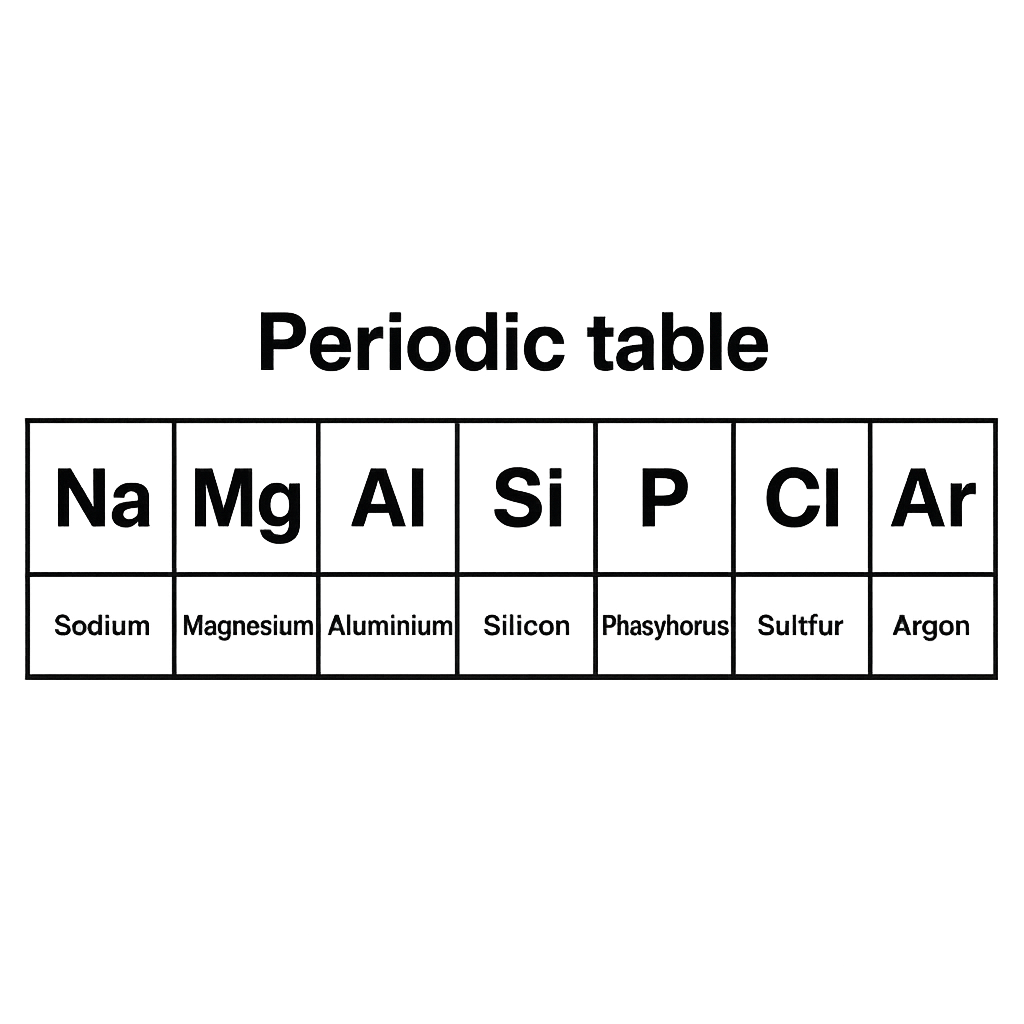
The diagram shows the elements of period 3 of the periodic table. Which element is located in group 17, period 3?
A. F
B. Br
Correct C. Cl
D. I

Correct Answer: C

Want to see the full step-by-step solution? Unlock AI Explanation & Analytics
Question 10 View Details
When 5.0 g of calcium carbonate (\(\mathrm{CaCO_3}\)) reacts with excess hydrochloric acid according to \(\mathrm{CaCO_3 + 2\,HCl \rightarrow CaCl_2 + CO_2 + H_2O}\), what mass of calcium chloride (\(\mathrm{CaCl_2}\)) is obtained if the reaction yield is 78 %?
Correct A. 4.33 g
B. 5.55 g
C. 3.89 g
D. 4.44 g

Correct Answer: A

Want to see the full step-by-step solution? Unlock AI Explanation & Analytics
Question 11 View Details
A 10.0 g mixture of CaCO₃ and Na₂CO₃ is heated, producing 5.0 g of CaO. The CaO is then reacted with excess HCl according to \( \text{CaO} + 2\text{HCl} \rightarrow \text{CaCl}_2 + \text{H}_2\text{O} \). Calculate the mass of \( \text{CaCl}_2 \) formed.
A. 8.85 g
B. 7.20 g
C. 10.5 g
Correct D. 9.90 g

Correct Answer: D

Want to see the full step-by-step solution? Unlock AI Explanation & Analytics
Question 12 View Details
In acidic solution, potassium permanganate reacts with oxalic acid according to the redox reaction. If \(0.025\) mol of \( \text{KMnO}_4 \) reacts with excess oxalic acid, determine the volume of \( \text{CO}_2 \) gas produced at STP.
A. 2.00 L
B. 1.40 L
Correct C. 2.80 L
D. 3.50 L

Correct Answer: C

Want to see the full step-by-step solution? Unlock AI Explanation & Analytics
Question 13 View Details
A 10.0 g ore sample contains 60 % by mass of \( \text{ZnS} \) and 40 % of \( \text{Fe}_2\text{O}_3 \). The ore is reduced with excess carbon at 1000 °C via \( \text{ZnS} + \text{C} \rightarrow \text{Zn} + \text{CS}_2 \) and \( \text{Fe}_2\text{O}_3 + 3\text{C} \rightarrow 2\text{Fe} + 3\text{CO} \). Calculate the total mass of metal (Zn + Fe) obtained.
A. 7.21 g
Correct B. 6.83 g
C. 8.34 g
D. 5.97 g

Correct Answer: B

Want to see the full step-by-step solution? Unlock AI Explanation & Analytics
Question 14 View Details
Acetic acid reacts with ethanol to form ethyl acetate and water: \( \text{CH}_3\text{COOH} + \text{C}_2\text{H}_5\text{OH} \rightleftharpoons \text{CH}_3\text{COOC}_2\text{H}_5 + \text{H}_2\text{O} \). At 25 °C the equilibrium constant \( K_c = 4.0 \). If 0.50 mol of acetic acid is mixed with 0.30 mol of ethanol in a 1.0 L container, find the equilibrium concentration of ethyl acetate and the percent conversion of acetic acid.
A. 0.20 M, 40.0 %
B. 0.30 M, 60.0 %
Correct C. 0.24 M, 48.6 %
D. 0.15 M, 30.0 %

Correct Answer: C

Want to see the full step-by-step solution? Unlock AI Explanation & Analytics
Question 15 View Details
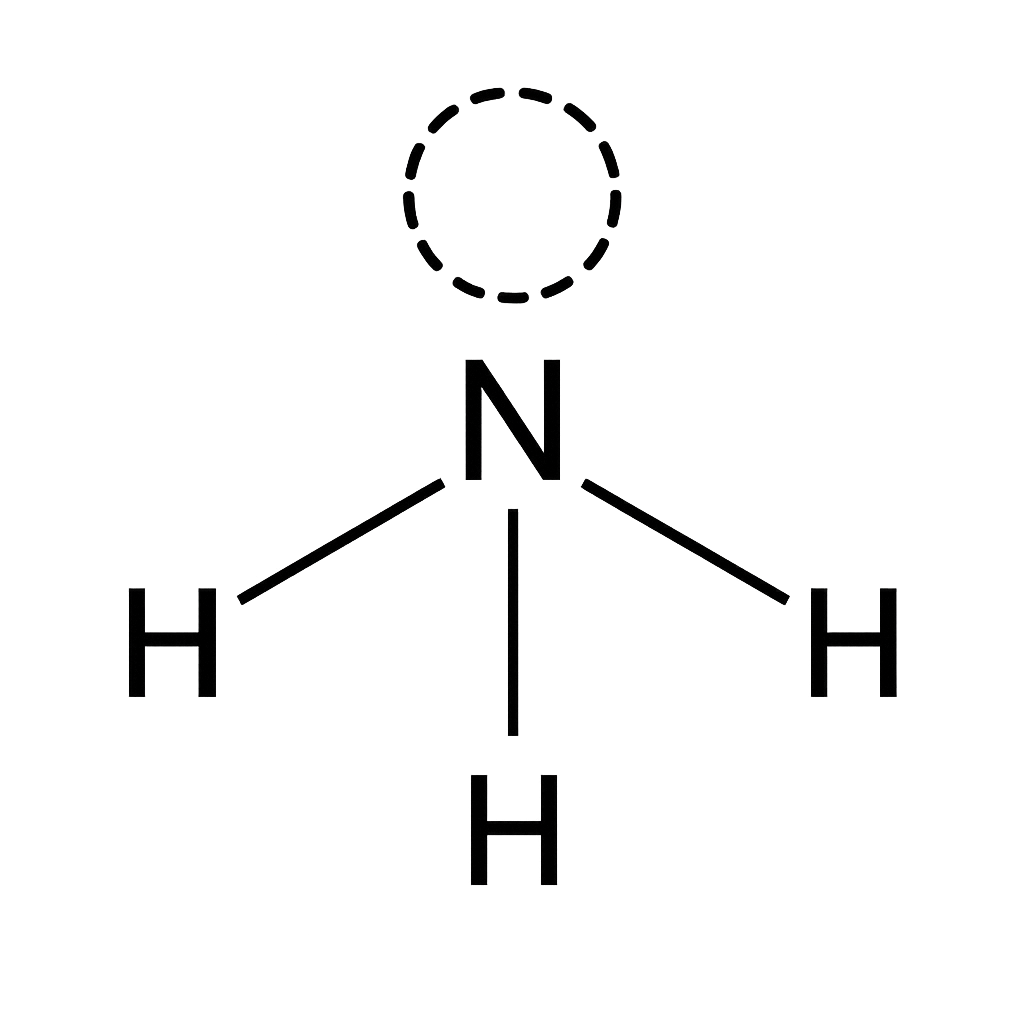
The diagram shows an ammonia molecule. Based on the VSEPR theory, state the hybridisation of the nitrogen atom and the molecular geometry.
A. sp² hybridisation, trigonal planar
Correct B. sp³ hybridisation, trigonal pyramidal
C. sp hybridisation, linear
D. sp³ hybridisation, tetrahedral

Correct Answer: B

Want to see the full step-by-step solution? Unlock AI Explanation & Analytics
Question 16 View Details
The electron configuration of an element is \(1s^{2}\,2s^{2}\,2p^{6}\,3s^{2}\,3p^{5}\). Determine the group number of the element in the periodic table and state its most common oxidation state.
A. Group 18; oxidation state 0
Correct B. Group 17; oxidation state -1
C. Group 16; oxidation state -2
D. Group 15; oxidation state -3

Correct Answer: B

Want to see the full step-by-step solution? Unlock AI Explanation & Analytics
Question 17 View Details
In a two‑step process, aluminium reacts with copper(II) sulfate according to \[2\,\text{Al} + 3\,\text{CuSO}_{4} \rightarrow \text{Al}_{2}(\text{SO}_{4})_{3} + 3\,\text{Cu}\] . The copper produced then reacts with excess sulphuric acid: \[\text{Cu} + 2\,\text{H}_{2}\text{SO}_{4} \rightarrow \text{CuSO}_{4} + \text{SO}_{2} + 2\,\text{H}_{2}\text{O}\] . If 5.0 g of Al and 10.0 g of CuSO\(_4\) are mixed, what mass of \(\text{SO}_{2}\) is obtained after the second reaction is complete? (Molar masses: Al = 27.0 g mol\(^{-1}\), CuSO\(_4\) = 159.6 g mol\(^{-1}\), SO\(_2\) = 64.1 g mol\(^{-1}\)).
A. 4.5 g of SO₂ (to three significant figures)
B. 3.2 g of SO₂ (to three significant figures)
C. 5.1 g of SO₂ (to three significant figures)
Correct D. 4.0 g of SO₂ (to three significant figures)

Correct Answer: D

Want to see the full step-by-step solution? Unlock AI Explanation & Analytics
Question 18 View Details
A condensation polymer is formed from monomer A \((\mathrm{C}_{4}\mathrm{H}_{6}\mathrm{O}_{2})\) and monomer B \((\mathrm{C}_{2}\mathrm{H}_{4}\mathrm{O})\). Each repeat unit results from the combination of one A and one B with the loss of one molecule of water. A polymer chain contains 30 repeat units and is terminated by an -OH group from monomer A at one end and an -H group from monomer B at the other end. (a) Write the molecular formula of the polymer. (b) State its degree of polymerisation. (c) Calculate the percentage by mass of carbon in the polymer (atomic masses: C = 12.01 g mol\(^{-1}\), H = 1.008 g mol\(^{-1}\), O = 16.00 g mol\(^{-1}\)).
A. Molecular formula C₁₈₀H₂₄₀O₆₁; degree of polymerisation = 30; %C ≈ 63.5 %
Correct B. Molecular formula C₁₈₀H₂₄₂O₆₁; degree of polymerisation = 30; %C ≈ 63.9 %
C. Molecular formula C₁₇₈H₂₄₂O₆₁; degree of polymerisation = 30; %C ≈ 63.2 %
D. Molecular formula C₁₈₀H₂₄₂O₆₀; degree of polymerisation = 30; %C ≈ 64.1 %

Correct Answer: B

Want to see the full step-by-step solution? Unlock AI Explanation & Analytics
Question 19 View Details
When 2.00 g of an unknown alkane with molecular formula \(\mathrm{C}_{n}\mathrm{H}_{2n+2}\) is combusted completely in excess oxygen, 5.60 g of \(\mathrm{CO}_{2}\) and 2.40 g of \(\mathrm{H}_{2}\mathrm{O}\) are produced. Determine the value of \(n\) and give the empirical formula of the alkane.
A. n = 20; empirical formula CH₂
B. n = 21; empirical formula C₂H₅
C. n = 22; empirical formula CH₃
Correct D. n = 21; empirical formula CH₂

Correct Answer: D

Want to see the full step-by-step solution? Unlock AI Explanation & Analytics
Question 20 View Details
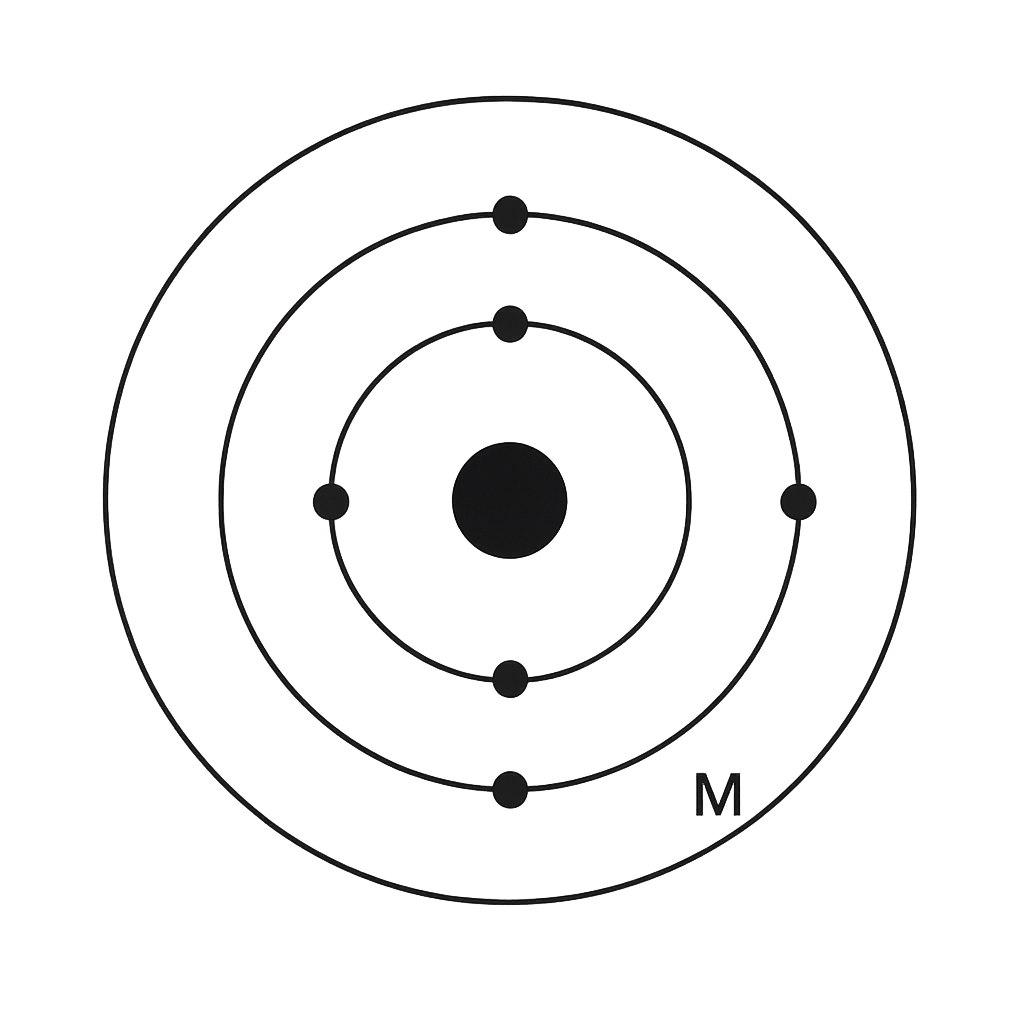
The diagram shows an atom with three electron shells: the K shell contains 2 electrons, the L shell contains 8 electrons, and the M shell contains 5 electrons. Identify the element and write its ground‑state electron configuration.
A. Element: sulfur (S); electron configuration: \(1s^{2} 2s^{2} 2p^{6} 3s^{2} 3p^{4}\)
B. Element: silicon (Si); electron configuration: \(1s^{2} 2s^{2} 2p^{6} 3s^{2} 3p^{2}\)
Correct C. Element: phosphorus (P); electron configuration: \(1s^{2} 2s^{2} 2p^{6} 3s^{2} 3p^{3}\)
D. Element: chlorine (Cl); electron configuration: \(1s^{2} 2s^{2} 2p^{6} 3s^{2} 3p^{5}\)

Correct Answer: C

Want to see the full step-by-step solution? Unlock AI Explanation & Analytics
Question 21 View Details
Using the bond dissociation energies given below, calculate the enthalpy change (ΔH) for the reactions \(\mathrm{F_2 + H_2 \rightarrow 2HF}\) and \(\mathrm{Cl_2 + H_2 \rightarrow 2HCl}\). The bond energies are: H-F = 565 kJ·mol⁻¹, H-Cl = 432 kJ·mol⁻¹, F-F = 158 kJ·mol⁻¹, Cl-Cl = 243 kJ·mol⁻¹, H-H = 436 kJ·mol⁻¹. Which reaction is more exothermic and, based on the data, why is HF a stronger acid than HCl in aqueous solution?
A. ΔH(F₂+H₂→2HF) = -536 kJ·mol⁻¹; ΔH(Cl₂+H₂→2HCl) = -185 kJ·mol⁻¹. Both reactions have equal exothermicity, and HF is a stronger acid due to its higher electronegativity alone.
Correct B. ΔH(F₂+H₂→2HF) = -536 kJ·mol⁻¹; ΔH(Cl₂+H₂→2HCl) = -185 kJ·mol⁻¹. The fluorine reaction is more exothermic, and HF is a stronger acid because the H-F bond is highly polar and the small F⁻ ion is strongly stabilised in water.
C. ΔH(F₂+H₂→2HF) = -450 kJ·mol⁻¹; ΔH(Cl₂+H₂→2HCl) = -200 kJ·mol⁻¹. The chlorine reaction is more exothermic, and HCl is a stronger acid because the H-Cl bond is less polar and the larger Cl⁻ ion is better stabilized in water.
D. ΔH(F₂+H₂→2HF) = -600 kJ·mol⁻¹; ΔH(Cl₂+H₂→2HCl) = -150 kJ·mol⁻¹. The fluorine reaction is more exothermic, and HF is a stronger acid because the H-F bond is weaker than H-Cl.

Correct Answer: B

Want to see the full step-by-step solution? Unlock AI Explanation & Analytics
Question 22 View Details
Ethyl acetate is prepared by the esterification of acetic acid with ethanol: \(\mathrm{CH_3COOH + C_2H_5OH \rightleftharpoons CH_3COOC_2H_5 + H_2O}\). At 25 °C the equilibrium constant \(K_c\) is 4.0. Initially, 0.10 mol of acetic acid and 0.15 mol of ethanol are placed in a 1.00 L flask; no products are present.\n(a) Calculate the equilibrium concentrations of all species and the percentage yield of ethyl acetate based on the initial amount of acetic acid.\n(b) If the equilibrium mixture is then diluted to a total volume of 2.00 L (no additional reagents added), determine the new equilibrium concentration of ethyl acetate and the percentage yield (based on the original 0.10 mol of acetic acid).
A. At 1 L: [EA]=0.0900 M, [HA]=0.0100 M, [EtOH]=0.0600 M, [H₂O]=0.0900 M; % yield = 90.0 %. After dilution to 2 L the equilibrium [EA]≈0.0450 M (0.0900 mol) and the % yield based on the original 0.10 mol remains 90.0 %.
B. At 1 L: [EA]=0.0600 M, [HA]=0.0400 M, [EtOH]=0.0900 M, [H₂O]=0.0600 M; % yield = 60.0 %. After dilution to 2 L the equilibrium [EA]≈0.0300 M (0.0600 mol) and the % yield remains 60.0 %.
Correct C. At 1 L: [EA]=0.0785 M, [HA]=0.0215 M, [EtOH]=0.0715 M, [H₂O]=0.0785 M; % yield = 78.5 %. After dilution to 2 L the equilibrium [EA]≈0.0393 M (0.0785 mol) and the % yield based on the original 0.10 mol remains 78.5 %.
D. At 1 L: [EA]=0.0785 M, [HA]=0.0215 M, [EtOH]=0.0715 M, [H₂O]=0.0785 M; % yield = 78.5 %. After dilution to 2 L the equilibrium [EA]≈0.0785 M (0.157 mol) and the % yield increases to 157 %.

Correct Answer: C

Want to see the full step-by-step solution? Unlock AI Explanation & Analytics
Question 23 View Details
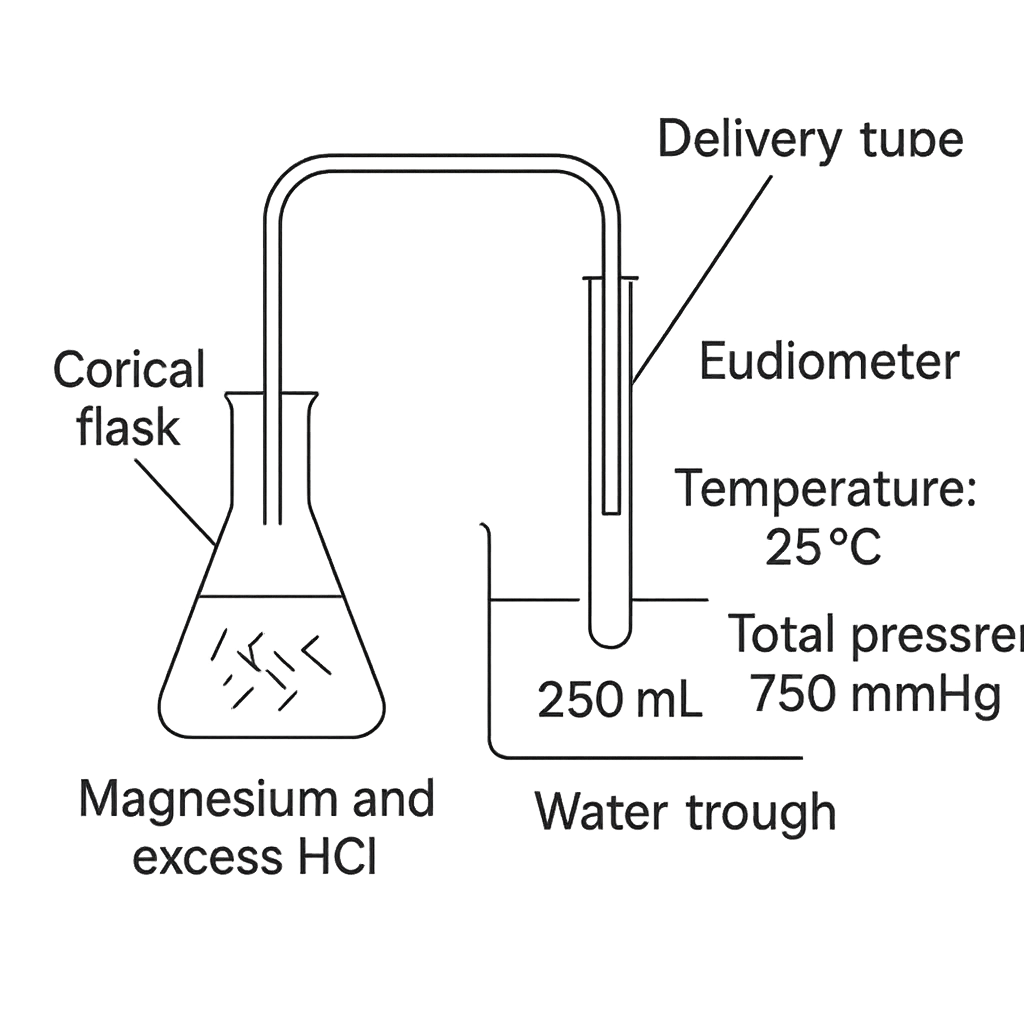
A laboratory apparatus for collecting a gas over water is shown in the diagram. A piece of magnesium (0.500 g) is placed in excess hydrochloric acid. The hydrogen gas produced is collected over water, giving a measured volume of 250 mL at 25 °C and a total pressure of 750 mmHg. The vapour pressure of water at 25 °C is 23.8 mmHg. Using the diagram, calculate (a) the number of moles of hydrogen gas actually collected and (b) the percentage yield of hydrogen based on the stoichiometric amount expected from the magnesium sample.
A. (a) 0.0125 mol of H₂ collected. (b) Percentage yield ≈ 60.5 % (≈61 %).
Correct B. (a) 0.0098 mol of H₂ collected. (b) Percentage yield ≈ 47.6 % (≈48 %).
C. (a) 0.0083 mol of H₂ collected. (b) Percentage yield ≈ 40.2 % (≈40 %).
D. (a) 0.0102 mol of H₂ collected. (b) Percentage yield ≈ 49.5 % (≈50 %).

Correct Answer: B

Want to see the full step-by-step solution? Unlock AI Explanation & Analytics
Question 24 View Details
An element has atomic number 15. Write its ground‑state electron configuration and give two common oxidation states exhibited by this element.
A. Chlorine; electron configuration \(1s^2 2s^2 2p^6 3s^2 3p^5\); common oxidation states +1 and -1.
Correct B. Phosphorus; electron configuration \(1s^2 2s^2 2p^6 3s^2 3p^3\); common oxidation states +3 and -3.
C. Sulfur; electron configuration \(1s^2 2s^2 2p^6 3s^2 3p^4\); common oxidation states +2 and -2.
D. Silicon; electron configuration \(1s^2 2s^2 2p^6 3s^2 3p^2\); common oxidation states +4 and -4.

Correct Answer: B

Want to see the full step-by-step solution? Unlock AI Explanation & Analytics
Question 25 View Details
A buffer solution is prepared by dissolving 0.250 mol of acetic acid (\(K_a = 1.8\times10^{-5}\)) and 0.150 mol of sodium acetate in 1.00 L of water.\n(a) Calculate the pH of the buffer.\n(b) After the buffer is prepared, 0.050 mol of HCl is added (volume remains 1.00 L). Calculate the new pH of the solution.
Correct A. (a) pH ≈ 4.52. (b) After adding 0.050 mol HCl, pH ≈ 4.27.
B. (a) pH ≈ 4.35. (b) After adding 0.050 mol HCl, pH ≈ 4.05.
C. (a) pH ≈ 4.45. (b) After adding 0.050 mol HCl, pH ≈ 4.20.
D. (a) pH ≈ 4.60. (b) After adding 0.050 mol HCl, pH ≈ 4.12.

Correct Answer: A

Want to see the full step-by-step solution? Unlock AI Explanation & Analytics

Master the Exam!

You've seen a preview, but there are thousands more questions plus AI tutor to break down complex solutions.

Unlock Full Access Available for Android & Windows
Help others prepare! Share this practice hub:
Chat with Support